

Singapore in 1858 was debating how it should be governed while reorganising the practical life of a growing port. A new Government Gazette gave official notices a dedicated home, familiar streets acquired different names, and an unfinished Town Hall forced its trustees and the municipality to confront the cost of civic ambition.
In London, speakers disputed currency policy, defence costs and convict transportation. In Singapore, engineers used convict labour for fortifications while petitioners objected to new arrivals. November brought a public reading of the proclamation announcing Crown government of India, a change that must be distinguished from the Straits Settlements’ later transfer to the Colonial Office.
The eleven chapters below follow the evidence through original print, parliamentary proceedings and contemporary documents reproduced in Buckley’s history. They show what people advertised, proposed, estimated and decided, with reading routes and worked exercises for exploring the year at different levels.
Choose your reading route
- The town on paper: start with the Gazette, visit the family warehouse and follow the renamed streets.
- How government worked: read about offices and recruitment, the April petition debate and the November proclamation.
- Build a Town Hall: follow the funding history, designs and builders, and the proposed municipal solution.
- Labour and imperial costs: compare the parliamentary dispute with petitions and fortification work.
- A short lesson: use the timeline, try the source exercises and choose a learner route.
Contents
A. Print, trade and the town’s addresses
- January: government gives its notices a dedicated home
- February: a family warehouse at Commercial Square
- 8 March: making the town’s addresses less confusing
B. Officials and the parliamentary argument
- Public offices and the search for trained officials
- 13 April: Singapore’s complaints reach the Commons
- Who paid for defence and convict labour?
C. The Town Hall’s unfinished business
- May: an unfinished Town Hall brings its history to the municipality
- Designs, estimates and the builders behind the Town Hall
- A proposed loan and the commissioners’ conditions
D. Labour, government and public ceremony
January: government gives its notices a dedicated home
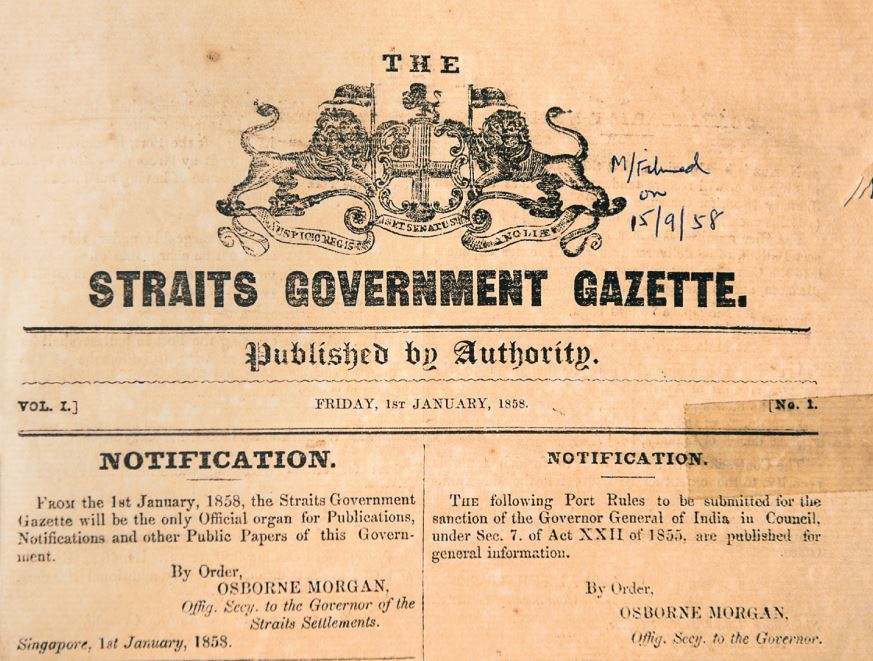
The first issue of the Straits Government Gazette was dated Friday, 1 January 1858. Its surviving first-page reproduction identifies it as volume one, number one. Beneath the masthead, a notification signed by Osborne Morgan, officiating secretary to the governor, announced that the Gazette would serve from that date as the government’s official channel for publications, notifications and other public papers. The announcement was itself dated at Singapore on the first day of the year.
This was a change in the organisation of official information. A person looking for an authorised notice now had a named publication to consult. The government could place different sorts of business within a recurring printed sequence, distinguished by issue dates and numbers. Those identifying features helped readers connect an instruction with the occasion on which it appeared, and helped officials refer back to the same printed document.
The next notification on the page shows that publication did not always mean a completed decision. It introduced proposed port rules that were to be submitted for the sanction of the Governor General of India in Council under section seven of Act XXII of 1855. They were being published for general information. The visible wording therefore records both a local act of communication and a further approval still required within the Indian administration.
This distinction mattered in a maritime town. A proposed rule could affect the expectations of people using the harbour before the process of authorisation was complete. The first page does not provide the whole body of those regulations, so it cannot establish their detailed requirements or their eventual commencement. What it does establish is the administrative sequence being announced to readers: publication for information, submission and requested sanction.
The government’s description of its own official organ should also be read precisely. It did not announce the disappearance of private newspapers, or the beginning of printing in Singapore. Indeed, advertisements and newspaper reports remain important evidence for other events in this same year. The Gazette added a clearly identified governmental channel to a town already exchanging information through commercial and public print.
Seen beside the constitutional arguments later in 1858, the page is especially revealing. Singapore had a local place of publication, a named local official and business concerning its port, yet the wording still directed the proposed rules towards an authority in India. The relationship that petitioners wished to change was visible in the ordinary documents through which the settlement was administered.
Sources: Straits Government Gazette, volume I, no. 1, 1 January 1858: original first-page reproduction.
February: a family warehouse at Commercial Square
In February, Spicer & Robinson advertised a new family warehouse at numbers nine and ten Commercial Square. The original advertisement, reproduced from the Singapore Free Press and Mercantile Advertiser of 25 February 1858, invites private families, hotel proprietors and the wider public to consider the establishment’s stock. The National Library’s accompanying history dates the opening to 1 February. The contemporary advertisement gives a particularly direct view of what the business wanted prospective customers to notice.
Its stock combined everyday provisions with imported specialities. Tea, coffee, rice, sugar and oatmeal appeared alongside biscuits, crackers, hams and cheese. Preserved meat, soups, sardines, salmon, bottled fruit and jams offered foods that could be stored and sold away from their places of production. The list is evidence of what the firm advertised, rather than a surviving inventory showing the quantity or origin of every item actually on its shelves.
Drinks occupied a substantial part of the advertisement. Wines were offered in bottles and in wood, while the named categories included port, sherry, claret and Madeira. Brandy, gin, porter and beer followed. Distinguishing bottles from wood and pints from quarts helped describe the forms in which goods could be purchased. The warehouse addressed household consumption and the requirements of hotels within the same commercial message.
Candles, tobacco and cigars widened the range beyond food and drink. This was not yet a description of all the departments associated with Robinsons in later generations. The 1858 evidence presents a particular shop at a particular address with a particular advertised selection. Its significance comes from that concrete starting point, before later growth makes the early business appear larger or more specialised than the document shows.
The advertisement promised prices intended to attract substantial public support while still remunerating the sellers. That is a sales claim, not proof that its prices were the lowest in Singapore. Nor does an invitation to the public establish who actually purchased there. Nevertheless, the explicit reference to hotel proprietors shows the firm seeking business customers as well as families, linking retail supply to the port’s accommodation and hospitality needs.
The address itself was about to acquire another official name. In March, the Municipal Commissioners renamed Commercial Square as Raffles Place. Reading the advertisement beside those minutes connects commercial print to the town’s changing map. It also preserves the original partnership name, Spicer & Robinson, without assigning later changes in partners, ownership or departments to the opening month.
Sources: Original Spicer & Robinson advertisement, Singapore Free Press and Mercantile Advertiser, 25 February 1858, p. 3, reproduced by the National Library; Buckley, volume II, p. 672: early partnership in retrospective account.

8 March: making the town’s addresses less confusing
The Municipal Minutes of 8 March 1858 explained a practical reason for changing street names: several roads had the same name, sometimes in two or three places, while canals lacked names. Buckley reproduces the resolution and its geographical descriptions. The commissioners were trying to make different places easier to distinguish, an important task in a town whose roads, markets, police stations and river crossings had to be located through written or spoken directions.
Commercial Square became Raffles Place, and Tavern Street became Bonham Street. These were changes to existing locations, not announcements that a new square and a new street had been constructed that day. A reader comparing an earlier advertisement or map with a later one therefore needs to follow both the physical place and its changing label. The February warehouse advertisement offers a useful example of exactly this problem.
On the north side of the Singapore River, the resolution explicitly addressed names duplicated on the south side. Church Street was to become Waterloo Street, Flint Street Prinsep Street and Market Street Crawfurd Street. The spelling in the reproduced historical text varies from modern usage. The underlying administrative act was to distinguish northern roads from other streets bearing the same names, rather than erase every occurrence of the older label across the whole town.
Other descriptions defined a road by its endpoints or neighbouring features. The route from Rochore Bridge to Serangoon Road became Lavender Street. A road between Selegie Street and Waterloo Street received the name Albert Street. Such descriptions remind us that the name was attached to a specified stretch. They should not be used as if a modern road’s entire length and alignment necessarily existed in precisely the same form in 1858.
South of the river, the resolution named Dalhousie Canal and described the sections to be called Havelock Road, Neil Road and Outram Road. The wording refers to the Sepoy Lines, a stone bridge, the road to New Harbour, a police station and the sheriff’s jail. This was an administrative map expressed in prose. The landmarks made the proposed boundaries intelligible to officials and readers familiar with the town.
The choices also placed British commemorative names into everyday use. Practical disambiguation and colonial commemoration could operate together in one resolution. The minutes provide the commissioners’ action and stated problem, but do not preserve the reactions of everyone who lived or worked along the roads. Their strongest annual evidence is the dated reorganisation of official names and the resulting need to translate between older and newer addresses.
Sources: Municipal Minutes of 8 March 1858 reproduced in Buckley, volume II, p. 667.

Public offices and the search for trained officials
In January, the Grand Jury suggested moving the Post Office and Marine Magistrate’s offices to Fort Fullerton. It also proposed placing a courthouse on the Post Office’s existing site. Buckley records these ideas as recommendations and says the move to Fort Fullerton happened much later. For 1858, the episode shows people considering how the town’s official functions should be arranged, rather than a completed relocation of those services.
Buildings were only one part of the problem of administration. Before leaving for Europe in February, Thomas Braddell, then Assistant Resident and Magistrate, published a pamphlet about Singapore and the Straits Settlements. Buckley connects it with the agitation for a transfer of government and reproduces Braddell’s discussion of recruitment. The proposal sought a government and an official service distinct from those of India.
Braddell recognised a tension between opening appointments to suitable outsiders and maintaining a supply of trained people. In his argument, capable candidates could not always be found at the moment a vacancy arose. Appointing an inexperienced person directly to the head of an important office would leave that person without the preparation available through earlier assistant work. A system therefore needed to develop experience as well as identify talent.
He suggested a mixed arrangement. Ordinary duties would be served by people qualified through education and training, while people outside the service who demonstrated a particular aptitude for public business could also be employed. Competition from such entrants, he thought, could encourage those already serving to exert themselves. He also envisaged recruiting young men either from Britain or locally, within the assumptions about gender and officeholding embodied in his proposal.
These were arguments about how a future service might work. Buckley’s favourable assessment of the pamphlet is the later historian’s judgement, and the reproduced passage is not a list of appointments actually made in 1858. Its value lies in identifying practical questions behind a constitutional demand: who would fill the offices, how would they learn the work, and how could a service avoid becoming closed to useful ability?
In May, the Municipal Commissioners decided to appoint a Town Engineer, Surveyor and Architect, and J. W. Reeve became the first Municipal Engineer. That local appointment gives the discussion a concrete counterpart. The same year’s Town Hall papers required professional assessment of plans, expenditure and unfinished construction. An official title mattered because particular technical decisions needed someone equipped to examine them, as the commissioners’ subsequent response to the trustees would make clear.
Sources: Buckley, volume II, pp. 666–668: Grand Jury suggestions, Braddell extract and municipal appointment; Continuation of Braddell extract and municipal context; May appointment and Town Hall papers.


13 April: Singapore’s complaints reach the Commons
On 13 April, Viscount Bury asked the House of Commons to consider the position of Penang, Singapore and Malacca while Parliament debated the future government of the East India Company’s territories. He wanted the Straits Settlements excepted from the proposed Indian arrangement and placed under the Secretary of State for the Colonies. He also moved for correspondence between the British government and the Company concerning the settlements.
Bury presented Singapore as a commercial port whose interests differed from those of the Indian administration. He connected its prosperity with the movement of shipping and goods between regions, arguing that its importance was imperial rather than narrowly Indian. This was a case for changing the place from which the settlements were governed. His speech should be read as an advocate’s selection of grievances, not as a neutral description accepted by every participant.
Currency supplied one example. Bury said the introduction of the rupee and smaller Indian coins had disrupted a trading environment accustomed to dollars. The difficulty, in his account, was not simply that a different coin had appeared, but that the denominations did not fit conveniently with existing transactions. An administrative preference for uniformity across territories could therefore conflict with a port’s established commercial practices.
He also recalled attempts to impose tonnage dues and argued that freedom from such charges had helped attract shipping. In his telling, energetic appeals to Britain had protected the free-port position. The same history could support another interpretation, however. Mr Baillie replied that the grievances over both duties and currency had been redressed, and therefore disputed the conclusion that the settlement’s interests were invariably ignored.
The disagreement exposes two standards for judging a government. Bury emphasised the damage and uncertainty created when an unsuitable measure was attempted. Baillie stressed the correction that followed objections. Both discussed an administrative process involving local complaints and higher authority, but they disagreed about whether its outcome demonstrated failure or responsiveness. A historian can preserve that disagreement without pretending the debate settled every underlying economic question.
Bury further complained about decisions made through official reports and the limited means by which inhabitants could convey their views. He saw the Grand Jury as a possible starting point for a more constitutional system. His idea did not establish representative government in Singapore that year. The concrete parliamentary result was narrower: the motion for copies of correspondence was agreed to. Obtaining papers opened material for scrutiny; it did not carry out the requested transfer of administration.
Sources: House of Commons, 13 April 1858, volume 149, columns 986–996: speeches and agreed motion.
Who paid for defence and convict labour?
The April Commons discussion turned repeatedly to the expense of Singapore’s defence and its role as a penal settlement. Bury claimed that the settlements bore burdens associated with prisoners transported from India and with the troops guarding them. Other speakers challenged both the financial account and the explanation of why military forces were needed. The debate is valuable because those disagreements are preserved rather than resolved into a single confident statement.
Baillie acknowledged that the penal role merited consideration, but argued that convict labour had also helped build the port’s prosperity through work on docks and public projects. His response made labour part of the constitutional question: separating Singapore from Indian administration raised questions about the people and resources that had supported its infrastructure. That argument discussed prisoners chiefly in terms of their usefulness to the settlement, leaving their own experiences outside the speech.
Defence expenditure was another obstacle in Baillie’s account. He estimated that maintaining the required force could cost Britain nearly three hundred thousand pounds annually if the settlement became a Crown colony. He contrasted that prospective expense with the limited contribution he believed the settlement could make. This was an argument about a possible future British charge, not an audited statement that Singapore spent that sum in calendar 1858.
Mr Mangles offered figures for the three settlements in the financial year 1855–56. He gave gross revenue as £97,904 and local civil expenditure as £74,753, leaving £23,151. He argued that the remaining resources could not have borne all the military, naval and convict charges attributed to the local population, and said those costs fell on India and the sending presidencies. His figures concern a grouped territory and an earlier accounting period; they cannot be relabelled Singapore’s annual budget for 1858.
Speakers also differed over the causes of insecurity. Some focused on transported prisoners, while others directed suspicion towards racialised descriptions of the wider population. Those descriptions reveal the speakers’ colonial assumptions and should not be adopted as evidence that an ethnic community was inherently dangerous. Even within the debate, the explanations competed with one another and served arguments about who should govern and pay.
The discussion therefore connected apparently separate questions: commercial freedom, the distribution of revenue, the cost of armed forces and access to coerced labour. A demand to move the settlements into another department was also a demand to rearrange responsibilities. The agreed request for correspondence was important precisely because speeches contained conflicting claims that documents might help examine. For this year, the exchange establishes the terms of a dispute, not a final settlement of all its accounts.
May: an unfinished Town Hall brings its history to the municipality
On 27 May, the Municipal Commissioners received a letter from H. T. Marshall, Charles Spottiswoode and T. O. Crane about the Town Hall. The trustees wanted the municipality to take over the building in its unfinished state, raise the money needed and complete the approved design. Their letter explained how a project intended for public use had reached this point, bringing several years of earlier decisions into the record of 1858.
The account began with the old Assembly Rooms, erected by subscription roughly ten years earlier at a cost of about six thousand dollars. According to the trustees, poor materials and defective construction had made them unsatisfactory. A tiled roof had been replaced with attap, and a professional builder later judged the structure unsafe and unsuitable for repair. These were the trustees’ stated reasons for abandoning repair in favour of a new building.
They also criticised the old location. An arrangement with the government exchanged the earlier site and building for a more suitable site, on the understanding that the completed Town Hall would be transferred to the Municipal Commissioners for community use. The trustees anticipated better access for the commercial public when a contemplated river crossing at Whampoa’s was provided. That part of their explanation looked towards an improved connection, rather than documenting an already completed bridge.
The financing combined public subscriptions with official contributions. The letter recalled a subscription campaign in 1855, followed by three thousand dollars from the government and the same amount from municipal funds. Money was placed with the Oriental Bank at interest. The account gave the amount eventually standing to the Town Hall’s credit, including interest, as $13,207.62. This was a funding history presented to explain the project’s current difficulty.
The original printed account contains an arithmetic inconsistency in its earlier deposit total. Its stated subscriptions and two official contributions do not add to the deposit figure that follows. Rather than inventing an unrecorded contribution, the discrepancy should remain visible when the accounts are studied. The later total, expenditure and remaining balance do reconcile, making it possible to follow the trustees’ immediate financial position without silently correcting the earlier record.
The letter thus placed a claim on the municipality within a history of shared responsibility. Private subscribers had helped start a building that officials were eventually expected to receive and the community was meant to use. By 1858, the difficulty was how to complete that promise after the available money had nearly run out. The trustees’ narrative made the unfinished building both a financial problem and an argument for continued public support.
Sources: Town Hall trustees’ letter in Municipal Minutes of 27 May, reproduced in Buckley, volume II, pp. 668–669; Funding and Assembly Rooms account.

Designs, estimates and the builders behind the Town Hall
The Town Hall trustees had sought designs beyond Singapore as well as locally. Their 1858 account says that no plan arrived from Calcutta, while three were submitted in Singapore. M. F. Davidson was also asked to obtain architectural advice in England with W. Spottiswoode. When a London design eventually arrived, the trustees considered it sufficiently similar to Bennett’s selected plan to justify keeping the local choice.
The comparison mattered to their account of ambition. They wanted a durable building suitable for a growing town, shaped in part by the disappointment of the Assembly Rooms. Their praise for the chosen design and their refusal to settle for a short-lived replacement explain the standard they said they were pursuing. They do not prove that every eventual cost was unavoidable, but they identify the aims against which estimates and construction decisions were being defended.
At the subscribers’ meeting of 13 November 1855, recalled in the letter, Captain Macpherson had offered a rough estimate of $12,565.50. Iron girders and a slate roof would raise it to $15,315.50. Bennett later estimated $16,926.96 when contracts were being attempted. These are figures for differing specifications and stages of planning, not three final bills for identical completed work. Keeping the sequence intact is necessary before judging the growth in expected expense.
Clunis junior was selected to supervise construction and materials, drawing on his experience at New Harbour with the P. & O. Company. The agreed supervision payment was eight hundred dollars in instalments. The trustees could not find someone willing to contract for the entire building, so they divided responsibility between materials and labour. That arrangement required them to coordinate several commitments rather than rely on one contractor for the whole result.
Their first timber contractor reportedly disappeared after receiving a small advance. A subsequent carpenter agreed to labour for three thousand dollars and timber at specified rates, and the trustees reported that he had fulfilled his obligations. For bricklaying, financial guarantees created another difficulty. The trustees eventually selected Goh Khoy, whom they described as highly skilled, although he could not provide security. They relied instead on their knowledge of his work and Clunis’s supervision.
Goh Khoy’s labour agreement was for four thousand dollars. The report said he had received about half that sum while the building was approximately half finished. This makes a named Chinese builder visible within a civic project often remembered through officials and donors. It also shows that skill and access to financial guarantees were different qualifications. The trustees’ decision placed practical knowledge of workmanship alongside formal security in choosing how to proceed.
Sources: Town Hall design search and financing, Buckley, volume II, p. 669; Original estimates, divided contracts, Clunis and Goh Khoy, p. 670.

A proposed loan and the commissioners’ conditions
By the time of their May approach, the Town Hall trustees reported expenditure of $13,129.62 and just seventy-eight dollars remaining. Those two amounts total the $13,207.62 balance they said had become available with interest. Clunis estimated that another $12,371.93 would be required at prevailing prices for materials and labour. The trustees believed his figure might err on the cautious side after earlier underestimation, but still expected at least twelve thousand dollars more to be needed.
The proposed solution was to transfer the unfinished building to the Municipal Commissioners. The trustees asked them to fulfil the existing contracts and finish the approved design from municipal resources. They suggested a loan specifically for the purpose, while leaving room for another method the commissioners might choose. Their request therefore concerned ownership or control, contractual obligations and funding together, rather than a simple donation to an otherwise completed project.
The loan suggestion included an argument about time. The trustees said a future generation would benefit from the building despite not having subscribed to its construction, and could therefore contribute through repayment. That reasoning treated the Town Hall as an asset expected to serve beyond its original donors. Borrowing would distribute some of the cost into the period when later users enjoyed the facilities, although the letter did not itself fix a loan rate, repayment term or lender.
The commissioners responded favourably but conditionally. Their chairman was to consult the governor about raising the money under section thirty-five of Act XXV of 1856. If that preliminary question was satisfactorily arranged, the plans and estimates would go to the municipal architect. He would examine the work already performed and what remained before the commissioners decided their answer to the deputation.
This sequence is more informative than simply saying that the municipality rescued the Town Hall in May. The surviving response describes consultation, technical inspection and a later decision. It does not demonstrate that a loan was received or that the handover was completed at that meeting. The new municipal architectural role was relevant because an independent assessment could test the trustees’ account before public resources were committed.
Buckley also records a notice that municipal meetings were open to the public at two o’clock on the seventh and twenty-seventh of each month, moving to Monday when the date fell on Sunday. Public attendance offered a way to observe business such as this, though it should not be confused with universal voting or equal influence. The Town Hall episode shows municipal government handling a public claim through money, law, expertise and a stated order of proceedings.
Sources: Town Hall balance and further estimate, Buckley, volume II, p. 670; Trustees’ loan proposal, conditional municipal response and public meeting notice, p. 671.

Prisoners, petitions and the labour of fortification
In May, 190 prisoners arrived whom the authorities described as too dangerous to remain in Alipore Jail. A public meeting on 19 May considered recent convict shipments and appointed a committee to petition the British government against further transportation to Singapore. The committee was also to approach the governor about removing the particular prisoners linked in the record with the Indian rebellion. Buckley says they were subsequently sent to the Andamans.
The description of danger belongs to the authorities and the reporting of the episode. It does not establish the individual conduct of every transported person, or prove that a local rebellion had been planned. The petition meeting is firmer evidence of the concerns and political activity of its organisers. It translated anxiety into a committee, a petition and an approach to an official who could act within the imperial administrative network.
Buckley also records a September memorial from London merchants to the Board of Control protesting Singapore’s use as a convict station. The local meeting and London memorial show objections travelling along commercial and governmental connections. They help explain why penal administration repeatedly appeared in parliamentary discussion, although the different documents cannot be treated as proof that all residents shared one view or that transportation had immediately ended.
At the same time, government construction relied on convict labour. Captain Collyer of the Madras Engineers arrived in January to report on proposed fortifications. He assumed the office of Chief Engineer on 1 August, with both skilled and ordinary convict labour placed at his disposal. Buckley’s account records work beginning on a battery on Government Hill and on extending and widening the battery at Fort Fullerton.
The juxtaposition is central to the year’s history. Prisoners were portrayed in one set of arguments as a danger or an unwanted burden, while another part of the colonial administration used their labour for works it considered necessary. The physical construction of defence depended partly on people who did not control the conditions under which they had been transported and assigned work. The available account tells us much more about official purposes than about their individual voices.
These were works in progress within a larger fortification scheme. They should not be presented as proof that every planned battery, barracks or magazine was completed in 1858. Buckley’s later praise of workmanship and criticism of military usefulness are retrospective judgements. The annual evidence is the engineer’s arrival, assumption of office and deployment of labour to identified sites, alongside organised objections to further convict arrivals.
Sources: Collyer’s arrival, 1 August assumption and convict work, Buckley, volume II, pp. 665–666; 19 May meeting, prisoner arrivals and London memorial, p. 668.

From parliamentary proposals to the November proclamation
The future of the Straits remained entangled with the wider reorganisation of Indian government. During consideration of the Government of India Bill on 6 July, Mr Gregson proposed a clause naming Penang, Singapore, Malacca, Labuan and Sarawak and placing them under the President and Council of India. His wording brought several territories into one proposal, but did not establish that all already had the same constitutional position.
Mr Fitzroy objected to the form of the clause. The Speaker agreed that it expressed an opinion without giving the necessary enacting powers and therefore could not stand as a clause in the bill. Gregson withdrew it with the House’s permission. The procedural ending matters: the presence of a proposal in a parliamentary record is evidence that it was advanced, while the following lines establish that it was not adopted.
The broader change in 1858 transferred government of the East India Company’s Indian territories to the Crown. For Singapore, that must be distinguished from the later transfer of the Straits Settlements to the Colonial Office. The demand Bury voiced in April was not accomplished simply because Company government ended. A change in the ultimate authority over India and a separation of the Straits from Indian administration were different constitutional developments.
Buckley describes the local reading of Queen Victoria’s proclamation on the Esplanade at seven in the morning on 19 November. A temporary platform with an attap covering accommodated the governor and assembled officials, consuls and naval and military officers. Troops, the Singapore Volunteer Rifle Corps, and personnel from HMS Amethyst took part. The ceremony placed the imperial announcement within a recognisable public setting in Singapore.
The governor read the proclamation in English, followed by a Malay version. Artillery salutes, military firing and cheers accompanied the occasion. The day was observed as a holiday, but heavy rain from early in the forenoon continued into the night. Decorated boats had been arranged off the Esplanade, while the rain disrupted plans for illumination. Buckley records Government House remaining dark and only a limited number of displays elsewhere.
There is a date error in Buckley’s introduction to the ceremony: his printed text calls the proclamation one of 1 September. The original-record catalogue of the British Library dates it at Allahabad on 1 November 1858. The local ceremony can therefore be described using Buckley’s account while correcting the document date rather than repeating it. Read with the April and July proceedings, November closes a year in which the basis of imperial government changed while Singapore’s requested administrative separation remained a distinct issue.
Sources: Commons, 6 July 1858, volume 151, column 1039: Gregson clause withdrawn; Buckley, volume II, p. 665: local proclamation ceremony and printed date error; British Library, Mss Eur D 620: proclamation dated 1 November 1858.
1858 in sequence
- 1 January: the first Straits Government Gazette identifies itself as the government’s official publication channel.
- January: Collyer arrives to report on fortification proposals; the Grand Jury recommends changes to the locations of public offices.
- February: Spicer & Robinson opens at Commercial Square and advertises its stock; Braddell publishes his argument about Straits administration before leaving for Europe.
- 8 March: municipal minutes rename Commercial Square as Raffles Place and resolve several duplicated street names.
- 13 April: the Commons debates Straits government and orders copies of correspondence; it does not enact the requested transfer.
- 19 May: a public meeting appoints a committee to petition against further convict transportation and seek removal of recent arrivals.
- 27 May: the Town Hall trustees’ request appears in the municipal minutes; commissioners propose consultation and architectural examination before a final response.
- 6 July: Gregson’s proposed clause concerning the settlements is withdrawn during consideration of the Government of India Bill.
- 1 August: Collyer assumes the Chief Engineer’s office.
- September: London merchants submit a memorial against Singapore’s penal role.
- 1 November: Queen Victoria’s proclamation is dated at Allahabad.
- 19 November: the proclamation is read publicly on Singapore’s Esplanade, followed by military ceremony and a rain-disrupted holiday.
The Town Hall letter looks back to 1855 and still earlier Assembly Rooms. Those earlier decisions explain the problem presented in May 1858; they are not new events of this year. The parliamentary figures likewise refer to the accounting period stated by each speaker.
Worked source-reading examples
1. Check what the first Gazette actually announces
Look at the inspected first-page reproduction. Identify the issue number, the date and the official who signs the opening notification. Then read the adjacent wording about port rules. A sound answer distinguishes the Gazette’s newly announced official role from rules still awaiting the Governor General’s sanction. The page supports both statements because it uses different language for each action.
2. Reconcile the Town Hall figures without repairing the source
The reproduced account gives subscriptions of $5,923.75 and two contributions of $3,000. Their sum is $11,923.75, but the next printed deposit figure is $11,999.75, a difference of $76. State the discrepancy rather than inventing a missing donation. Then add the later expenditure of $13,129.62 to the $78 remaining: this equals the stated balance with interest of $13,207.62.
The exercise has two different outcomes. One set of printed figures is inconsistent; another reconciles. Neither finding by itself identifies who made an error or proves that money was misused. A ledger, bank statement or another version of the trustees’ report would be needed to investigate the first difference further.
3. Follow an advertised address through a municipal resolution
The February warehouse advertisement places Spicer & Robinson at numbers nine and ten Commercial Square. The minutes of 8 March rename Commercial Square as Raffles Place. Explain how two documents can use different names for the same place without showing that the shop moved. Then identify what neither document supplies: evidence of a move, a modern street-number equivalence, or a complete history of the later business.
4. Read the last line of a parliamentary proposal
Compare the April request for correspondence with Gregson’s July clause. The April motion was agreed to and copies were ordered. The July wording was challenged because it lacked enacting powers and was withdrawn. An answer that stops at what a speaker proposed misses the outcome recorded immediately afterwards. The exercise tests the difference between a political aim, a procedural decision and an implemented constitutional change.
Sources: first Gazette page; Town Hall funding account and expenditure statement; original warehouse advertisement; street resolution; April Commons debate and July proceedings.
Three learner routes
Primary readers: connect a shop and a street
Choose three kinds of goods from the advertisement and explain why a family or a hotel might buy them. Draw an address label using Commercial Square, then another using the name adopted in March. Tell the story of the change without moving the shop or adding products that the advertisement does not show.
Secondary readers: explain an unfinished public project
Follow the three Town Hall chapters. Identify the original purpose, the financial problem, two contracting difficulties and the proposed municipal response. Write a paragraph explaining why the trustees’ request was more complicated than asking for another donation. Use the architects’ role and the outstanding contracts as evidence.
Families: compare two views of the same arrangement
Discuss the parliamentary argument about currency. One speaker emphasised the disruption caused by an attempted change; another pointed out that the complaint was later corrected. Explain what each person counted as evidence of good or poor government. Return to the record to see that reporting both views does not require deciding that either speech contains every relevant fact.
Frequently asked questions
Did Singapore become a separate Crown colony in 1858?
The year brought Crown government in place of East India Company government of India. The separate transfer of the Straits Settlements to the Colonial Office came later; the April Commons discussion did not enact it.
Was the first Gazette the first newspaper printed in Singapore?
No. Its opening notice established a government publication channel. Private newspapers already existed and supplied the advertisement used in this article.
Did Commercial Square become a new physical square in March?
The resolution renamed the existing Commercial Square as Raffles Place. A change of name is different from construction of a new place.
Were all the Town Hall estimates for identical specifications?
No. The earlier estimate explicitly changed when iron girders and a slate roof were included, and a later estimate came at the contracting stage. They require comparison by date and scope.
Did the municipality complete the Town Hall takeover at the May meeting?
The reproduced response was conditional. It called for consultation about money and an architect’s report before a later decision.
Does the warehouse advertisement prove who shopped there?
It identifies intended customers and advertised stock. It is not a sales ledger or a record of the customers who actually purchased goods.
Why is the proclamation dated November when Buckley prints September?
The original-record catalogue dates the proclamation at Allahabad on 1 November 1858. Buckley’s local ceremony account is retained, but its erroneous document date is corrected.
What makes 1858 distinct?
The year joined a major imperial transition to the everyday organisation of Singapore. The Gazette formalised a channel for government notices. Street names made the town easier to describe while carrying colonial commemorations. A warehouse advertisement reveals the particular goods and customers of an early retail enterprise, and the Town Hall papers expose the decisions, skill and money required to create a civic building.
The arguments about government were equally practical. Speakers disputed how currency should fit trade, which accounts should pay for defence, and how convict labour related to the port’s development. Braddell considered how officials might be trained and recruited; municipal commissioners asked for architectural advice before answering the trustees. These documents reveal administration through concrete choices rather than only through a change of rulers.
November’s proclamation ceremony gave the change in Indian government a public form on the Esplanade. Yet the year’s petitions, withdrawn clause and conditional municipal response also show how much remained unsettled. Reading those outcomes accurately preserves a Singapore whose future was being argued and financed, with different people bearing very different shares of its work and authority.
Continue exploring Singapore
- Learning Tanjong Pagar: connect historical routes towards New Harbour with a present-day neighbourhood learning journey.
- Singapore Atlas: place 1858’s buildings, port connections and constitutional debates within Singapore’s longer history.
- Return to the contents or begin the full 1858 route.
Continue backward: History of Singapore | 1857