
Singapore in 1928 combined new public construction with uncertainty over trade. The year's history also reaches into schools, work, religious institutions, public health and cultural life, where less monumental changes shaped the town.
A town being planned, regulated and extended
Singapore's future shape was already a subject of public argument in January. On 25 January, the Malaya Tribune advocated separate residential, industrial and commercial zones, while expressing concern about administration in the nearby rural districts. The editorial treated the town and its outskirts as connected planning problems: decisions about where people lived could not be separated from the location of business and industry. [S01]
By October, a specific eastern district appeared in municipal deliberations. A committee meeting on 12 October generally approved proposals for zoning, drainage and roads in the Siglap area that was about to enter the municipal boundary. The wording describes preparations for an administrative change, not a claim that every proposed road or drain was already built. [S02]
The municipal machinery also worked at the scale of individual estates. A November committee record approved notices to property owners concerning drains within Grove Estate. Improvement here involved formal demands on owners, connecting the handling of rainwater with responsibilities attached to particular properties. [S03]
Accountability for municipal purchasing was itself disputed. In July, President R. J. Farrer responded to a call for a report on the buying system by challenging the press's understanding of the facts. The exchange shows that the organisation of expenditure could become public controversy, rather than remaining a matter confined to municipal offices. [S04]
At the end of June, Municipal Commissioner See Tiong Wah was preparing questions about itinerant hawker licences for a commission meeting. The number of licences issued was a matter for public questioning, placing the administration of street trading on the municipal agenda. [S05]
In December, a municipal committee confirmed an estimate and provisional apportionment for making up and draining part of Ann Siang Road. The proposal specified the stretch beginning at Erskine Road. Street improvement required a defined location and financial arrangements before it could become a completed work. [S06]
The Municipal Commissioners also asked the government to appoint an inspector of lifts. The request followed a commission resolution and consultation with legal advisers. Machinery inside the town's buildings was creating questions about who should inspect it and under what authority. [S07]
A motorcyclist travelling towards Singapore from the direction of West Coast Road died after a collision with a Rural Board truck at the end of December. He was taken to the General Hospital. The report records a road death within the same growing system of motor transport that public authorities were trying to regulate. [S08]
Fullerton, the river crossing and everyday connections
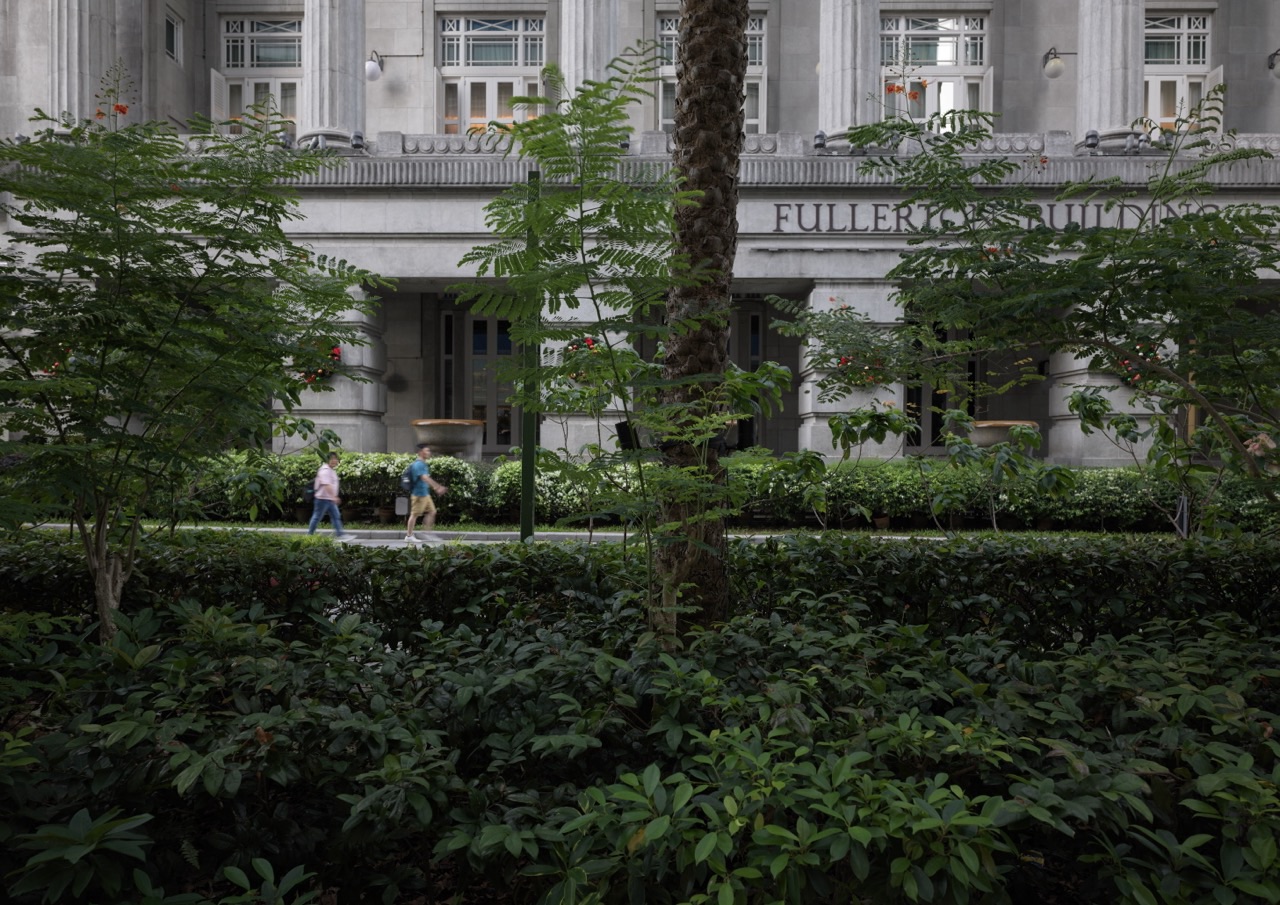
The Fullerton Building opened on 27 June 1928. Its occupants included the General Post Office, government offices, the Chamber of Commerce and the Singapore Club. These were different uses within one prominent waterfront structure: a person sending a letter, a commercial representative and a club member encountered the building through different kinds of access. [S09]
A late-August postal notice illustrated what concentrating services at Fullerton meant for customers. It announced that public telegraph business on Sundays would be restricted to the office in the Fullerton Building. The new premises were thus becoming an operating centre with rules about when and where a service could be obtained. [S10]
Postal facilities were also developing beyond the waterfront. On 22 September, the Free Press reported that telegraph facilities had been established at the Serangoon Road Sub-Post Office. This was a neighbourhood-level addition to the communications network, recorded in a short administrative notice rather than a grand opening report. [S11]
On 30 October, the steel superstructure of the new Elgin Bridge was placed across the Singapore River. The Straits Times reported the operation that morning and identified municipal bridge engineer T. C. Hood as its supervisor. The bridge was intended to connect North Bridge Road and South Bridge Road, restoring an important physical link through the town.
This was an engineering stage, not the opening of a finished road crossing. The frame spanned the river while further work remained, so 1928 belongs to the bridge's construction history rather than its opening to traffic. [S12]
Utility administration involved changes that were less visible than bridge steel. In January, a municipal committee approved a revised schedule for water supplied by meter, intended to take effect on 1 April. The decision concerned the terms on which measured water would be supplied, linking the physical network to the accounts of its users. [S13]
On the evening of 12 November, Singapore experienced an interruption to electric lighting. The next day's Straits Times reported a failure lasting fifty minutes and an inability at St James' Power Station to maintain sufficient steam. The incident exposed the dependence of lighting on the operation of a central generating plant. A new supply system still required reliable day-to-day engineering after its opening ceremonies were over. [S14]
College begins, while schools pursue different needs
Raffles College began its working life on 21 June 1928. The Free Press's 5 July account described an informal opening and a small first intake that included women, private students and government scholars. It also reported the completion of the first hostel while discussing building operations still in progress.
Government scholarships and private places brought students to the college through different financial arrangements. The completed hostel also made accommodation part of the institution's first working year. Its informal start in 1928 must be distinguished from the later formal opening ceremony. [S15]
School life had a much wider reach than the new college. A June report described a drill and games competition for Malay vernacular schools on the Geylang School ground. Pupils from several schools gathered for organised exercises and athletic activities, making education visible through collective activity outside the classroom. [S05]
The YMCA School of Commerce offered a different educational route. Results published in September for the April examinations listed subjects including bookkeeping, shorthand, typewriting, commerce and finance. These were skills directed towards the handling of accounts, correspondence and commercial information, making the school closely relevant to office employment in the port town. [S16]
At the end of the year, the Royal English School faced a more immediate question: where its pupils would return after the holidays. A December report said that replacement premises had been secured following a recent Supreme Court decision and that the school expected to reopen without interruption. Continuity depended on finding a workable home for classes. [S06]
The Singapore Chinese Girls' School building fund continued to attract donations. A January acknowledgement included a gift from Aw Boon Haw and proceeds from sales of a history of the Chinese in Singapore. School fundraising could draw on business philanthropy and the circulation of a community's own history. [S13]
A September caption also records a Boy Scouts camp at Woodlands and names leaders associated with Raffles and Victoria Bridge schools. School-linked activity extended beyond classroom and playing field into organised camping in the northern part of the island. [S17]
The Anglo-Chinese School's new Cairnhill Road building was formally opened on Saturday, 17 November, by Sir Hayes Marriott, the Officer Administering the Government. The Malaya Tribune's report on the following Monday described the ceremony and the gathering present. This was an opening within the existing school's development, distinct from Raffles College's first intake earlier in the year. [S18]
Language learning could also be arranged outside the school system. In May, the YWCA advertised a proposed Malay class at Raffles Quay, drawing the attention of women who had recently arrived in Singapore. The class was conditional on sufficient applications. The notice identifies both a practical educational demand and the role of a voluntary organisation in trying to meet it. [S19]
Rubber uncertainty within a trading town
Rubber policy was already unsettling Singapore before the later world depression. In February, the Free Press reported that local organisations connected with the industry were sending their views to the British authorities in response to an invitation from the Colonial Office. Chinese producers and merchants were part of this local discussion.
The issue was the future of restriction, the system through which exports were controlled. Singapore's commercial groups used representations to put their positions before London, connecting local producers and merchants with a decision made beyond the island. [S20]
Planters on Singapore Island and Pulau Chin sought their own collective organisation. At a meeting in the Europe Hotel on 14 March, they decided to form a district planters' association linked to wider planting organisations. Rubber cultivation was therefore part of Singapore's local economy, as well as something handled by merchants for estates elsewhere in Malaya. [S07]
The British parliamentary debate on 26 April makes the policy timetable clear. The government intended to end the Stevenson restriction scheme on 1 November, leaving several months between the decision and the change. Ramsay MacDonald attacked the government's handling of the transition and argued that its announcements had damaged confidence and asset values.
Other speakers could oppose restriction while still criticising the manner of its removal. The dispute was consequently about timing, accumulated stocks and the interests of producers, investors and users, as well as the principle of control. For Singapore's traders, the coming November date became a practical horizon around which rubber business had to be considered. It was a specific 1928 problem, not evidence that the later depression had already unfolded in full. [S21]
The market reports did not present every week as an uninterrupted collapse. Macphail's September review described a dull rubber situation without treating it as overwhelmingly depressing; Fraser's report noted little alteration in many tin-share quotations despite limited business. These were contemporary commercial assessments, written for readers watching prices and transactions. [S22]
December's commercial commentary remained mixed. Macphail's report detected returning confidence among investors, while Fraser described a nervous and unsettled tin market in London. Both assessments reached Singapore readers in the same issue, reminding them that different parts of business could be moving with different degrees of confidence. [S23]
Workers, wages and mutual organisation
Labour conflict also had a local craft setting. In March, the Malaya Tribune reported a strike among shoemakers and described demands concerning the pay relationship between different grades of workers. Its headline and opening adopted a strongly hostile view of the strikers, presenting their demands as unreasonable. [S24]
The Clerical Union's report, published in August, covered the financial year from 1 April 1927 to 31 March 1928. It recorded membership and accounts through the council of an occupational association. Clerks were organising within a continuing institution, with a reporting cycle that crossed the boundary between two calendar years. [S25]
A parliamentary answer on 21 March supplied a sharply defined view of another workforce. Lieutenant-Colonel Headlam said that the Admiralty employed 700 civilians at the Singapore base on 1 February. He gave the usual labourer's remuneration as $3.95 a week, with quarters provided, and described it as based on the current local rate.
William Kelly then asked whether the accommodation's adequacy had been investigated; Headlam requested notice of the question. The exchange preserves an official wage statement and an unresolved concern about living conditions. Its figures apply to Admiralty employment at a particular date, rather than to the whole Singapore workforce. [S26]
The Free Press discussed protection against workplace injury through an editorial on industrial insurance in May. Its opening considered how an employers' liability or workers' compensation measure might operate. The question was therefore not only whether a worker should receive compensation, but how an arrangement could be made practical. [S27]
Women's paid work prompted an openly resentful letter in November. Writing to the Malaya Tribune, a correspondent alleged that married women obtained well-paid positions as typists, stenographers and shop assistants through influence rather than advertised recruitment. These were accusations from a letter writer, not established findings about the women concerned. The letter is evidence of hostility towards women's employment and of argument over who could claim access to desirable jobs. [S28]
Health, childhood and the reach of care
A new institution called the Mental Hospital was constructed in 1928, and the institutional chronology records the transfer of 1,030 patients into it. This was a substantial relocation of people already in care, not the beginning of all psychiatric provision in Singapore. The later familiar name Woodbridge was not yet in use.
Medical superintendent E. R. Stone introduced farm work during the year. That detail shows how work entered the hospital's regime, without establishing what individual patients experienced or how effective their treatment was. For the people transferred, the new hospital represented a change in the place and organisation of their daily care. [S29]
Public health outside the central town also attracted attention. In March, the Straits Times reported a Rural Board meeting at which Chief Health Officer Gilbert Brooke's memorandum described the board's responsibilities and activities. The coverage specifically highlighted health and anti-malarial work, while the accompanying editorial remarked on how little many townspeople knew about the board.
The memorandum reviewed five years of activity, so its accumulated achievements cannot all be assigned to 1928. The year's report nevertheless made the Rural Board's existing health responsibilities more visible to readers accustomed to following events within the town. [S30]
Child welfare brought voluntary organisers into a conspicuous public setting. The Malayan Saturday Post's September captions record Baby Day at Victoria Memorial, including a toy stall and a group of women associated with the event's organisation. This provides a post-event trace of an occasion aimed at mothers and children, rather than only an advance announcement. [S17]
The Children's Aid Society appeared through a different kind of public record: a subscription list for 1927–28. Published in June, it included money associated with crossword puzzles alongside named individual and business contributions. Charitable support could be collected through small participatory activities as well as direct gifts. [S31]
Food quality and ordinary businesses also came within official scrutiny. In July, a milk seller was fined after water was found in his milk, and other defendants were penalised for unlicensed coffee-shops and laundries. Such enforcement reached services used in everyday household life. [S04]
Weekly health notices supplied a recurring view of deaths in Singapore. The statement published on 7 September listed pneumonia, tuberculosis under the period term phthisis, and malaria among the causes recorded for the week ending 1 September. Its reporting period was a week, not the calendar year. These notices placed infectious disease in the regular flow of local information, alongside institutional and charitable news. [S32]
Community institutions, worship and practical cooperation
At Sultan Mosque, 1928 was a year of renewed fundraising and building work. The National Heritage Board's dedicated monument history places the reconstruction in a sequence extending into 1932. The mosque already existed; the undertaking was to replace an ageing structure with a larger one while sustaining an established place of worship.
Work proceeded in phases partly to limit disruption for worshippers. The building programme therefore had to accommodate continuing religious use as well as the gathering of funds. Muslims from different ethnic communities contributed to the project. In an account of 1928, the emphasis belongs on that collective effort and on construction under way, rather than assigning the completed mosque to this year. [S33]
Singapore's Muslim connections reached well beyond its resident population. A March column discussed the need for a home for pilgrims, describing people from the Dutch islands and other neighbouring territories who came to Singapore to obtain passage to Jeddah. Their presence made the port a place of waiting and onward travel on the journey towards Mecca. [S34]
The Indian Association was also seeking a more substantial institutional home. A November letter from C. R. Menon said that its managing committee had appointed a subcommittee to raise money for a building. A place capable of housing a representative association was itself an objective requiring organisation and support. [S35]
In September, the Indian Association's existing premises hosted a meeting about a proposed cooperative store in Singapore. Menon chaired the gathering and invited its convener to explain the possibilities and advantages of organising one. The meeting linked an established association with a proposed form of collective commercial activity. [S36]
The Persenangan Stia Club held its annual meeting at its North Bridge Road premises on 2 February. The Muslim-affairs column reported a substantial attendance, recording the club's regular administrative life. [S37]
China connections, relief and colonial policing
On 8 February, an attempt to assassinate the Chinese Nationalist figure C. C. Wu at the Chinese Chamber of Commerce brought China's political conflicts violently into Singapore. The following morning's Free Press reported that Lim Boon Keng had been wounded and that a suspected assailant had been captured. The chamber was a local institution, but the incident connected it to struggles unfolding beyond the colony. [S37]
The anniversary of Sun Yat Sen's death on 12 March also recalled the previous year's Kreta Ayer shooting. The Free Press reported that the day passed quietly in Singapore and that police had prepared for possible disturbances. Commemoration, memory of local violence and official security precautions were thus present together. [S38]
Relief organising provided another response to events in China. A May report described a committee elected at a Chinese Chamber of Commerce mass meeting, gathering at the Ee Ho Heang Club with Tan Kah Kee presiding. The subject was collections for the Tsinan fund. Fundraising therefore involved meetings, committee membership and collection arrangements within Singapore, not only expressions of sympathy. [S27]
The Tong Seok Dramatic Association connected this relief effort with performance. Its programme for the Shantung Relief Fund related to shows scheduled for 6 and 7 August at Xin Wu Tai on Eu Tong Sen Street. The National Library's surviving 115-page booklet includes performance material, photographs, sponsors' names, poems and writing associated with the appeal.
As an object, the programme brought several activities together: organising entertainment, recognising supporters and asking readers to respond to suffering in China. The 4 August newspaper announcement separately confirms the planned dates and the invitation to contribute music, songs and a sketch. This was a Singapore cultural initiative addressing a crisis in Jinan; the fighting itself had occurred in China. [S39]
Anti-Japanese demonstrations remained a concern in October. The Free Press reported attempted demonstrations in Singapore on the previous day and said police precautions had prevented serious disorder. Its language identified particular organisers through a colonial community label; that description should not be extended into a judgement about an entire population. [S40]
Airfields, ships and the unfinished naval project
Seletar Airfield became operational in 1928. The National Heritage Board places its origin within British plans for an airfield and flying-boat base, east of the proposed naval base and away from Singapore's more exposed southern coast. This was military infrastructure. The commercial-airport use dated from 1930, so the significance of 1928 should not be described as the opening of the later civilian service. [S41]
The approach of the RAF flying boats was public news in February. On 28 February, the Malaya Tribune carried an official wireless account announcing that they were due at the Singapore air base that day. The aircraft had left Plymouth in October 1927 on a long journey through the Far East towards Australia. [S42]
By November, the Free Press described the four Southampton flying boats as based on Singapore since their return from Australia in September. It announced their departure on a further six-week tour. The base's role was consequently both local and regional: it supported aircraft that would spend substantial periods visiting other places rather than remaining permanently in one harbour. [S35]
Civilian enthusiasm developed through the Singapore Flying Club. At a January meeting, members discussed the need for a road to their hangar, while newspaper coverage examined the club's choice of Moth seaplanes. Flying required access on the ground and suitable storage as well as the purchase of aircraft. [S43]
Sea travel remained subject to competitive commercial decisions. In August, a report announced that two Dutch shipping companies would reduce fares to Singapore and the East Indies from September in response to foreign competition, particularly German lines. The Free Press also considered what the reductions would mean for travellers between Singapore and Southampton. [S44]
The Straits Budget reported in November that Sir John Jackson's firm was shortly to begin the naval dockyard construction contract, with seven years allowed for completion. This was a substantial commitment to future work. The contract should not be mistaken for a report that the whole naval base had opened or that every element of its repair capacity was already available. [S45]
Parliamentary questions in December show the naval project being assembled through machinery and contracts. Headlam confirmed that four large mechanical excavators had been ordered from an American firm and that they were standard models. Members questioned why British manufacturers had not supplied the plant, turning work on Singapore's northern shore into an argument about imperial purchasing.
The same exchange stated that the floating dock was now stationed at the base and gave expenditure on naval works up to the end of November. These were separate elements within a continuing project: plant for construction, a floating dock already present, and a larger programme still being developed. The distinctions help explain why 1928 could be a major year for defence infrastructure without being the completion year of the entire base. [S46]
A Flying Club seaplane sank at its Yacht Club mooring in early October because of a leaking float. The report described the damage as slight. Even a small fleet required attention to equipment and its conditions of storage on the water. [S40]
Heavy rain and questions about the city's drains
Heavy rain exposed the limitations of road access in November. The Straits Budget described several days of rainfall, a swollen Bukit Timah canal and road traffic held up during the following night and morning. Its account called the flooding unusually severe compared with recent years. This was a disruption experienced through the town's transport routes, rather than an abstract engineering concern. [S45]
The disruption became a question for municipal government. In advance of a meeting at the end of November, Dr Pathy asked about the causes of flooding in Orchard Road and the Somerset Road–Grange Road area. Naming the affected streets turned a general complaint about rain into a request for an explanation of particular places. [S47]
Reading, performance and the social life of sport
The Straits Chinese Reading Club began another half-yearly session in July at the C. C. A. Hall in Prinsep Street, with the Reverend William Murray chairing the meeting. The gathering enrolled members and continued an established cycle of organised reading. Learning and discussion therefore took place in voluntary settings as well as schools.
An exhibition opening in the Adelphi's grill-room in July included local scenes and landscapes. The press also mentioned sketches of Buddhist priests. The hotel provided a temporary exhibition venue where pictures of the region could be shown to an audience in Singapore. [S48]
Raffles Library's December additions included nonfiction on famous trials, Renaissance sculpture, world history and travel. The announcement stated when the new books would be available for issue, making the library's acquisitions part of a reader's practical calendar. It offers a small but specific view of the material circulating through an English-language collection.
At Raffles Institution, the literary and dramatic society gave a concert in the school hall in December. The occasion welcomed the returning principal and marked a staff departure, using performance to acknowledge changes within the school community. [S49]
Football brought local teams into contact with visitors. In April, a report described the Malays' close match against a visiting Colombo side, played on wet ground. Another item announced a larger first division for the Singapore league, with Pulau Brani and the Indo-Ceylonese joining that level of competition. [S50]
Workplaces and clubs provided another layer of organised sport. In September, the Singapore Cold Storage Athletic Club was reported playing badminton against Wellington Guan's Badminton Party, with a further match against Robinson and Company announced. The courts and the teams connected recreation with the social identities of particular businesses and groups.
The Singapore Japanese Club concluded a handicap tournament, with S. Murakami winning the singles and Matsukawa and Fujiwara taking the doubles. These competitions operated alongside workplace-based and other local sporting groups, each maintaining its own fixtures and membership. [S51]
The year ended with a report of outboard motorboat racing at Pasir Panjang, organised around a gathering at Chia Keng Tye's bungalow. It was presented as a new local sporting attraction. The setting is a reminder that access to some forms of recreation depended on private property, equipment and a circle of organisers. [S08]
Armistice observance brought former servicemen and women together at the Europe Hotel in November. The local branch of the Ex-Services Association of Malaya organised the gathering, which the newspaper described as part of the customary celebrations. Remembrance was sustained through an association and a social occasion as well as through public monuments. [S14]
A Shanghai Chinese opera company opened its Singapore season at Victoria Theatre in July. The next morning's review reported a large audience, mainly Chinese but including Europeans. This was a completed performance rather than an advertised intention. The account places Chinese opera within one of the town's prominent theatrical venues and records an audience extending beyond a single community. [S15]
December brought a different visiting repertoire. The Macdona Players presented Bernard Shaw's Candida, and the Free Press reviewed the audience's response during the company's season. The performance belonged to a continuing programme of plays. Alongside the July Chinese opera visit, it shows the range of touring theatrical work reaching Singapore during the year. [S23]
A touring student team from Chin Nan University returned to Singapore after visiting Bangkok and was scheduled to meet the Singapore Chinese Football Association at the Stadium on 7 June. The notice offered admission at three price levels. Sporting visits connected educational and community organisations across the region while also being organised as ticketed events for a local audience. [S52]
The year in perspective
The year left important institutions in operation and major projects still unfinished. Its local record includes the work of committees, teachers, workers, performers and volunteers, whose activities gave substance to Singapore's growth.
Sources and reading note
This account uses contemporary newspaper records, parliamentary answers and institutional histories. Newspaper evidence here is limited to the accessible issue indexes and initial article text; photographs and complete articles have not been inspected. Announcements, completed events and later institutional names are kept separate.
- S01 — Malaya Tribune, 1928-01-25
- S02 — Singapore Free Press And Mercantile Advertiser, 1928-10-18
- S03 — Singapore Free Press And Mercantile Advertiser, 1928-11-15
- S04 — The Straits Times, 1928-07-28
- S05 — Singapore Free Press And Mercantile Advertiser, 1928-06-27
- S06 — Malaya Tribune, 1928-12-21
- S07 — The Straits Budget, 1928-03-22
- S08 — Singapore Free Press And Mercantile Advertiser, 1928-12-31
- S09 — National Heritage Board, Gazette of the Former Fullerton Building, 2015 media release
- S10 — Singapore Free Press And Mercantile Advertiser, 1928-08-30
- S11 — Singapore Free Press And Mercantile Advertiser, 1928-09-22
- S12 — The Straits Times, 1928-10-30
- S13 — Singapore Free Press And Mercantile Advertiser, 1928-01-19
- S14 — The Straits Times, 1928-11-13
- S15 — Singapore Free Press And Mercantile Advertiser, 1928-07-05
- S16 — Singapore Free Press And Mercantile Advertiser, 1928-09-06
- S17 — The Malayan Saturday Post Illustrated, 1928-09-08
- S18 — Malaya Tribune, 1928-11-19
- S19 — The Straits Times, 1928-05-24
- S20 — Singapore Free Press And Mercantile Advertiser, 1928-02-28
- S21 — Hansard, Rubber Export Restriction Scheme,26April1928
- S22 — Singapore Free Press And Mercantile Advertiser, 1928-09-20
- S23 — Singapore Free Press And Mercantile Advertiser, 1928-12-20
- S24 — Malaya Tribune, 1928-03-08
- S25 — Malaya Tribune, 1928-08-18
- S26 — Hansard, Singapore Base Civilian Employees,21March1928
- S27 — Singapore Free Press And Mercantile Advertiser, 1928-05-24
- S28 — Malaya Tribune, 1928-11-17
- S29 — Institute of Mental Health, Milestones
- S30 — The Straits Times, 1928-03-02
- S31 — Malaya Tribune, 1928-06-28
- S32 — Malaya Tribune, 1928-09-07
- S33 — National Heritage Board, Sultan Mosque
- S34 — Singapore Free Press And Mercantile Advertiser, 1928-03-01
- S35 — Singapore Free Press And Mercantile Advertiser, 1928-11-01
- S36 — Malaya Tribune, 1928-09-05
- S37 — Singapore Free Press And Mercantile Advertiser, 1928-02-09
- S38 — Singapore Free Press And Mercantile Advertiser, 1928-03-13
- S39 — Lee Meiyu, In Aid of the Motherland, BiblioAsia2016
- S40 — Singapore Free Press And Mercantile Advertiser, 1928-10-04
- S41 — National Heritage Board, Seletar Airport
- S42 — Malaya Tribune, 1928-02-28
- S43 — Singapore Free Press And Mercantile Advertiser, 1928-01-05
- S44 — Singapore Free Press And Mercantile Advertiser, 1928-08-16
- S45 — The Straits Budget, 1928-11-22
- S46 — Hansard, Singapore Base,12December1928
- S47 — Malaya Tribune, 1928-11-28
- S48 — Singapore Free Press And Mercantile Advertiser, 1928-07-19
- S49 — Singapore Free Press And Mercantile Advertiser, 1928-12-06
- S50 — Singapore Free Press And Mercantile Advertiser, 1928-04-19
- S51 — Malaya Tribune, 1928-09-19
- S52 — Singapore Free Press And Mercantile Advertiser, 1928-06-07
Continue to Singapore in 1929. Explore the Singapore history Atlas.