
Did you know that some of Bukit Timah’s most attractive shopping frontage is also an architectural history lesson? At Cluny Court, a short row of two-storey shophouses preserves details that are easy to miss if you are only looking for a café or a shop.
The building sits near Botanic Gardens MRT and the edge of the Singapore Botanic Gardens, close to the busy Bukit Timah Road corridor. Its familiar white façades, decorative details and modest height connect the modern neighbourhood with an earlier way of building commercial streets.
The quick answer: Cluny Court was constructed in 1928. The National Heritage Board identifies its shophouses as conserved by the Urban Redevelopment Authority and notes architectural features such as fluted columns, bas-relief ornament and patterned tiles. Today its spaces continue to be used for commercial activities, demonstrating how heritage buildings can accommodate changing everyday purposes.
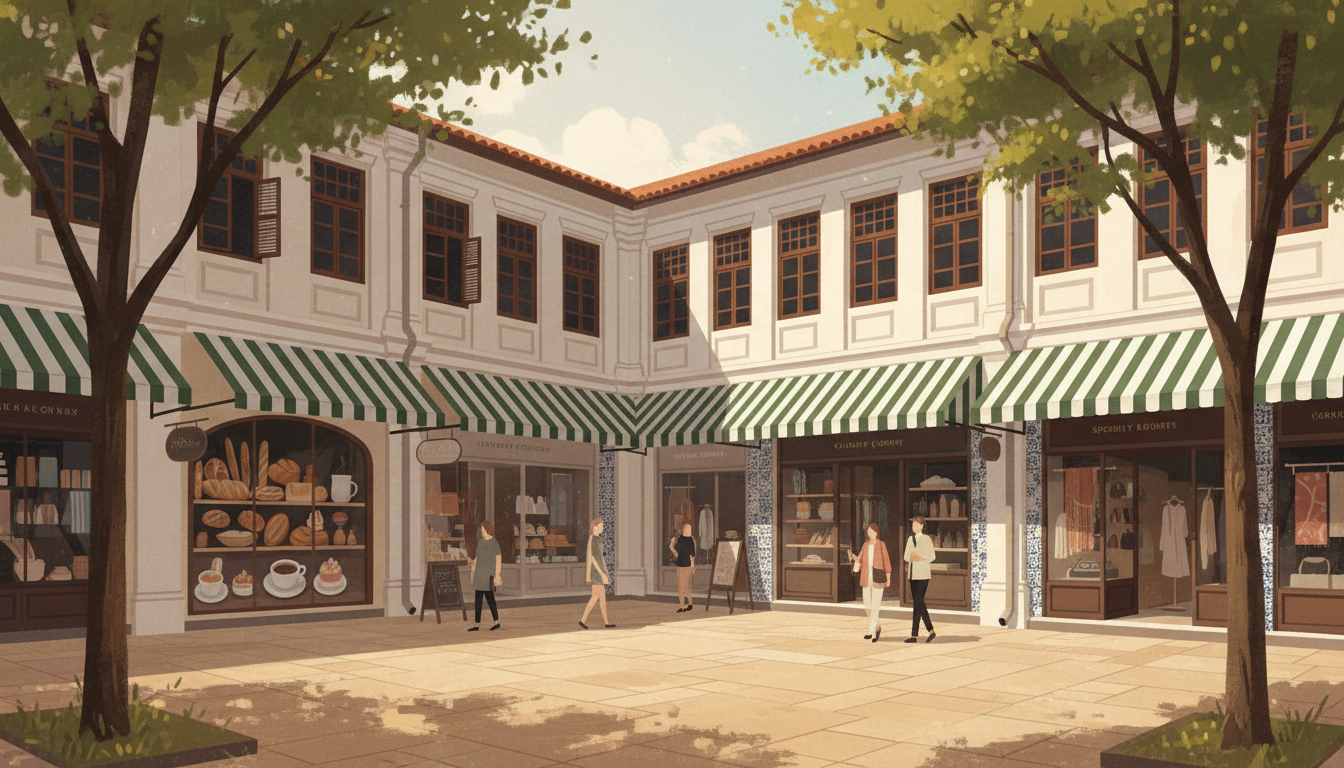
The featured image is an original conceptual illustration inspired by Cluny Court’s conserved shophouses, not a site photograph or verified depiction of current retailers.
Find the answer: Why is 1928 an important clue? · What is a fluted column? · Why conserve a row of everyday shops? · How does adaptive reuse work here? · How is Cluny Court different from Serene Centre? · How does the Botanic Gardens change the setting? · What can students learn by looking closely? · How should you plan a heritage visit?
1. Why is 1928 an important clue?
The construction date places Cluny Court among Singapore’s early twentieth-century commercial buildings, long before the current MRT network or most of the neighbourhood’s modern shopping facilities.
At that time, mixed residential and shop buildings were a familiar feature of Singapore’s urban landscape. Ground-floor commerce and rooms above could create a compact way to use valuable land, although the exact arrangements varied from one building to another.
The National Heritage Board’s heritage trail highlights Cluny Court as an example of the decorative shophouse style seen in the period roughly from 1900 to 1940.
That doesn’t mean every decorative element visible today must be an untouched original from 1928. Conservation may involve careful repair or replacement based on documented evidence. A building can preserve historical character while receiving maintenance.
2. What is a fluted column?
A column is a vertical architectural element, sometimes structural and sometimes partly decorative. Fluting refers to grooves running along its surface.
At Cluny Court, the fluted columns help give the façade a distinctive rhythm. The repeated lines catch changing light and create texture, rather than leaving the front as a completely flat wall.
Nearby decorative features include bas-relief panels, where forms are raised only slightly above the background, and patterned tiles that bring colour and detail to parts of the frontage.
These are not random ornaments. Together they show the materials, tastes and craftsmanship of a period in which shopping streets often used decorative architecture to create a recognisable identity.
3. Why conserve a row of everyday shops?
A building need not be a palace or monument to be historically valuable. Ordinary shopping and residential buildings preserve evidence of how people organised their streets, lived and traded.
Cluny Court’s value includes its scale, street-facing frontage, materials and relationship with surrounding roads. Replacing it with a generic modern block could remove those tangible connections to an earlier neighbourhood.
Conservation therefore asks a different question from demolition and replacement: how can the historically significant elements be retained while the building remains useful?
This is different from saying no part of the property may ever be repaired or adapted. The work needs to comply with the applicable URA conservation requirements and other building-safety rules.
4. How does adaptive reuse work here?
Adaptive reuse is the practice of giving an existing building a suitable contemporary function while preserving important parts of its historic fabric. A shophouse can serve different businesses over generations without ceasing to be recognisable as a shophouse.
That can create a pleasant continuity: customers use modern payment methods and services while entering a building with much older columns, tiles and proportions.
It also takes practical work. Electrical systems, accessibility, ventilation, maintenance and fire safety have to be considered alongside conservation. The best outcomes respect both heritage and the people who use the premises now.
What should not be assumed is that a retailer mentioned in an old guide is still trading. Tenants can change without the protected architectural character disappearing.
5. How is Cluny Court different from Serene Centre?
The National Heritage Board discusses Cluny Court beside neighbouring Serene Centre, but the two names refer to different buildings with different histories.
Cluny Court is known for its 1928 conserved shophouse row. Serene Centre is a later suburban shopping complex whose businesses and role in the area evolved across decades.
Because the buildings are neighbours, a passer-by may think of them as one cluster of cafés and shops. From a heritage perspective, however, the older Cluny Court façades represent a different architectural period and conservation story.
This is a wider lesson in urban history: two places can serve similar modern needs without having the same origins.
6. How does the Botanic Gardens change the setting?
Cluny Court lies near the Bukit Timah Entrance of Singapore Botanic Gardens. That helps explain why the neighbourhood sees both regular local visitors and people arriving for a heritage or garden walk.
The Gardens has been located at its present site since the nineteenth century, making it an older layer of the area’s history. The nearby MRT connection arrived much later.
A visitor may see a conserved commercial façade, a UNESCO-listed botanical landscape and a modern underground station within a relatively small district. Each represents a different type of civic investment.
This is why a good local guide should distinguish the public garden, the shops and the station instead of treating the whole area as a single attraction.
7. What can students learn by looking closely?
Try an observation exercise from a public pavement. First, identify repeated architectural features: columns, windows, arches, tiles and the roofline. Then look for contemporary modifications such as shop signs and lighting.
Ask which elements contribute to the historical identity of the building and which are necessary for a present-day business. Look for patterns, but be careful not to label every unfamiliar feature ‘original’.
You can then compare Cluny Court with a much newer mall elsewhere along Bukit Timah Road. How do their entrances, storeys, external walkways and façades reflect different periods of design?
This exercise works for architecture, history, art and even mathematics: repeated shapes, proportions and symmetry appear all around us.
8. How should you plan a heritage visit?
Did you know a row of everyday shops can tell as much about a city as a grand government building? At Cluny Court, that history survives in the scale of the street and the details of the façade.
- Location: Cluny Court, 501 Bukit Timah Road, near Botanic Gardens MRT.
- History: a conserved shophouse development dating from 1928.
- Details: look for fluted columns, bas-relief ornament and patterned tiles.
- Neighbourhood: compare it with adjacent Serene Centre and the nearby Botanic Gardens entrance.
- Access: observe from public routes; respect operating shops and private parts of the property.
- Current businesses: check the latest directory or individual tenant listings before visiting for a particular service.
Frequently asked questions
When was Cluny Court built?
NHB records that the Cluny Court shophouses were built in 1928.
Is Cluny Court a conserved building?
Yes. The National Heritage Board identifies Cluny Court’s shophouses as conserved by the Urban Redevelopment Authority.
What architectural details should visitors look for?
Fluted columns, bas-relief panels and patterned tiles are among the features highlighted by NHB.
Is Cluny Court the same as Serene Centre?
No. They are neighbouring developments with different architectural and historical backgrounds.
Which MRT station is near Cluny Court?
Botanic Gardens MRT, served by the Circle and Downtown Lines, provides rail access to the area.
Official sources and further reading
Historical and ecological facts are grounded in official agency references. Check current directories, trail notices and opening times before visiting.
- NHB: Cluny Court heritage landmark
- NHB: Bukit Timah Heritage Trail booklet (Serene Centre and Cluny Court)
- NHB: Bukit Timah Learning and Leisure Trail
- URA: Conservation guidance
Continue the How Bukit Timah Works series
- How Jalan Jurong Kechil’s shophouses were conserved
- How Botanic Gardens MRT connects two rail networks
- Why the Botanic Gardens is UNESCO heritage
More from this batch: How Bukit Timah Works | Why Coronation Plaza Became a School-District Meeting Point · How Bukit Timah Works | How Singapore Quarry Became a Wildlife Lake · How Bukit Timah Works | How Evolution Garden Explains 3.5 Billion Years of Life
Earlier neighbourhood guides: bukit timah road dunearn road one way system · beauty world food centre fourth floor hawker heritage · learning forest keppel discovery wetlands · botanic gardens mrt circle downtown interchange