
Did you know that some rainforest trees at Bukit Timah do not produce the same number of flowers and fruits each year? During certain unusual periods, many trees of a species—or sometimes several species—can flower and fruit in a large burst that looks quite different from the quieter years between.
This phenomenon is known as general flowering and, when many seeds are produced in a concentrated event, mast fruiting. It creates a temporary change in the amount of food and reproductive material available in a forest.
The quick answer: Bukit Timah’s dipterocarp trees, including Seraya and related giants, can participate in irregular episodes of increased flowering and fruiting. Studies documented an exceptional event in 1987 following a very dry, sunny period, and researchers studied another event in 2009. One leading explanation is that producing many seeds at once can leave some uneaten by seed predators, increasing opportunities for regeneration. Drought and other environmental signals may help trigger flowering, but the mechanism is complex and not a guaranteed annual timetable.
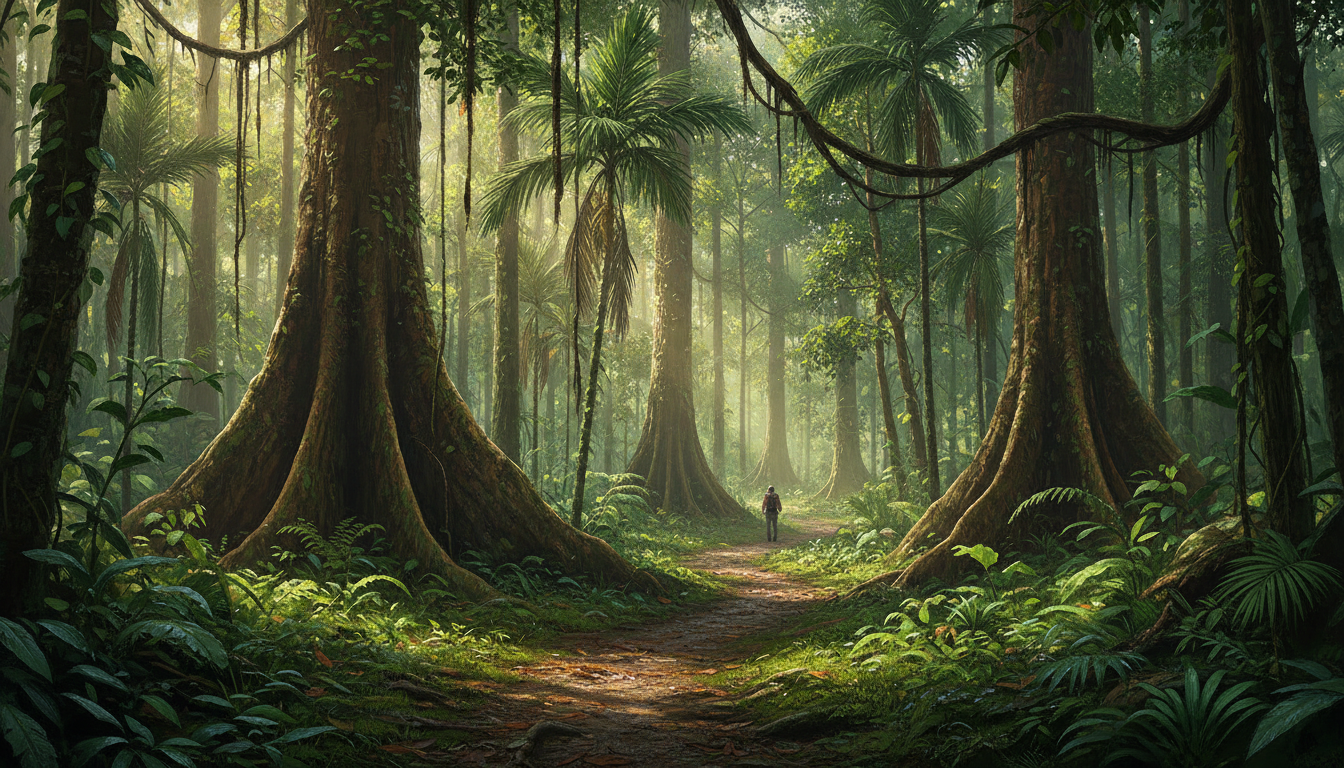
Featured image is an original conceptual illustration of a shaded tropical rainforest trail, not a photograph of a documented mass-flowering or mast-fruiting event.
Quick navigation: What is a dipterocarp? · Why is flowering more than a colourful event? · What does mast fruiting mean? · Why might many trees reproduce together? · What happened during Bukit Timah’s 1987 event? · Did another episode occur in 2009? · Why do weather signals matter? · What do winged fruits do after flowering? · How could a sudden seed crop change wildlife activity? · Does masting mean every tree is the same age or genetically identical? · Why is the phenomenon important to conserving a small forest? · How can students observe mast fruiting without collecting protected seeds? · What is the best way to interpret a ‘mass flowering’ headline?
1. What is a dipterocarp?
Dipterocarps are a family of tropical trees prominent in Southeast Asian rainforests. Many become tall canopy or emergent trees, with straight trunks rising above neighbouring vegetation.
Bukit Timah Nature Reserve includes important hill dipterocarp forest. NParks’ visitor guidance describes Seraya and Keruing among the familiar members of this tree group. Older references may use the genus Shorea for some species, while more recent taxonomy reassigns certain species to groups such as Rubroshorea.
The name dipterocarp is connected with winged fruits, although fruit form varies across the family. Some have prominent wings that help their descent through the air; others differ considerably.
These trees help shape the structure of a forest, but their reproduction depends on events that may be difficult for casual visitors to predict or observe.
2. Why is flowering more than a colourful event?
Flowers contain structures involved in plant reproduction. Pollen must reach the appropriate reproductive tissues for fertilisation to occur, and successful fertilisation can lead to development of seeds and fruit.
In a large tropical tree, many flowers may be produced high above eye level. A visitor walking beneath the canopy may notice fallen petals or fruits without seeing much of the flowering activity itself.
Flowering is not the same as fruiting. A tree can produce flowers that do not develop into viable seeds. Pollination, fertilisation, damage, weather and resource availability all affect what follows.
A useful record therefore distinguishes flower counts, fruit production and seedling establishment. They are related stages, not interchangeable measurements of reproductive success.
3. What does mast fruiting mean?
Mast fruiting refers to an unusually large production of seeds or fruits, often synchronised among plants over a relatively short period and separated by quieter years.
The definition does not mean every tree in a forest must fruit at the same time or that the event always affects exactly the same species. Some trees can participate strongly while others produce little or no fruit.
NParks explains that populations of dipterocarps may produce large quantities of fruit once every few years, instead of maintaining the same high output in every year.
The contrast is what matters. A researcher must know what normal or background production looks like before deciding that one season represents an exceptional reproductive event.
Because masting can be irregular, it is misleading to publish a precise ‘next mass fruiting date’ without a well-supported and current prediction.
4. Why might many trees reproduce together?
One leading explanation is predator satiation. Animals that eat seeds can consume only a limited amount during a short period. If a large number of trees produce an unusually heavy crop together, more seeds may remain uneaten.
Imagine an animal population that can eat a certain number of seeds in one week. If seeds arrive in small, steady quantities, a high proportion may be consumed. If a very large crop arrives at once, the number of available seeds can temporarily exceed the animals’ feeding capacity.
That is a simplified model, not proof that every seed survives or that all predators remain constant. A masting event can also change animal movements and food-web relationships.
Other hypotheses consider how synchronised flowering may help pollen movement between trees and how environmental cues affect plant reproductive decisions.
The best interpretation is that several interacting processes may influence the timing and ecological consequences of mass flowering and fruiting.
5. What happened during Bukit Timah’s 1987 event?
A scientific study of the reserve’s reproductive history reported that after an exceptionally dry and sunny period in February 1987, more than 150 plant species from 42 families flowered between late March and late May.
The study then recorded a pronounced fruiting peak about 13 weeks later, between late June and late August. The long delay illustrates that a flowering burst and the later seed or fruit output are separate stages.
This was not a claim that all 150 species were dipterocarps. The general event included many plant families. Dipterocarps are especially notable, but the forest-wide response involved a broader community.
The historical observation is important because it ties a biological event to a particular period and measurable flowering and fruiting patterns. It does not establish a universal rule that any dry February will produce the same result.
6. Did another episode occur in 2009?
Researchers studied a 2009 general flowering event involving several Shorea species and hybrids in Bukit Timah. Their study examined a defined sample of trees to compare which individuals flowered and how their flowering periods overlapped.
The percentage of flowering trees varied between species. In some of the studied species it was below 30%, while another species had a much higher proportion of its sampled individuals flowering.
That result matters: even during a general flowering event, the response is not uniform. Species identity, tree condition, local environment and other factors can affect participation.
The researchers discussed the possibility that an unusually dry period helped trigger flowering. A single event does not prove that drought is the only trigger or reveal a simple temperature-and-rainfall formula that can predict every subsequent episode.
Good ecological science makes room for both a striking pattern and unresolved questions about its cause.
7. Why do weather signals matter?
Plants respond to environmental conditions through physiological processes. Changes in rainfall, light availability, temperature or resource status can influence growth and reproduction, but different species may respond in different ways.
General flowering in some Southeast Asian forests has been associated with irregular climatic events, including periods of unusual dryness. The particular combination of conditions may be important, and responses may involve more than one environmental signal.
It would be misleading to say that simply withholding water from any dipterocarp would make it flower. That would confuse a research hypothesis about large forest populations with a safe horticultural method.
Researchers need long-term records because individual years are not enough to separate unusual events from the ordinary variability of tropical weather and plant development.
8. What do winged fruits do after flowering?
Many dipterocarps produce fruits with wing-like structures. As a fruit falls, the wings can make it rotate or slow its descent, affecting how far it may travel from its parent tree.
NParks compares this movement with a tiny helicopter. The exact distance depends on fruit structure, wind, release height and surrounding vegetation, so a winged fruit is not guaranteed to land far away.
Seed dispersal is only the beginning. A seed must find an environment where it can germinate, escape damage and grow into a seedling. Deep shade, soil conditions, pathogens and competition can all affect its fate.
That is why a remarkable fruiting year is not automatically a successful forest-regeneration year. Ecologists look for evidence of seedlings and their survival after the fruits fall.
9. How could a sudden seed crop change wildlife activity?
A large pulse of fruit and seeds can provide food for many organisms. Animals may forage differently during a period when particular foods become temporarily abundant.
Some consumers may eat or destroy seeds; others may move them to new locations. Insects, rodents, birds and other organisms can respond in different ways depending on their diets and the structure of the forest.
However, it would be inaccurate to claim that every Bukit Timah animal depends on dipterocarp mast years or that a specific wildlife population increased without measured evidence.
The scientific question is not simply ‘were there more fruits?’ but ‘which organisms used them, how did their activity change, and what happened to the next generation of plants?’
Long-term monitoring helps connect visible reproductive events with broader ecological consequences.
10. Does masting mean every tree is the same age or genetically identical?
No. Synchronisation does not require the trees to be clones or members of one age class. Different individual trees may be capable of responding to some of the same environmental signals.
Even within one species, tree size, health, exposure and resource status can affect whether it flowers. Studies of Bukit Timah’s Shorea species and hybrids illustrate that responses can vary considerably.
The word ‘together’ therefore describes a statistical pattern at the population or community level, not identical timing and output for every tree.
This matters when reading news headlines. A report about general flowering does not guarantee that a particular tree along a hiking route is in bloom on the day you visit.
11. Why is the phenomenon important to conserving a small forest?
Bukit Timah Nature Reserve is a small but biologically valuable remnant of Singapore’s natural rainforest. Reproduction by large forest trees can contribute to the persistence of their populations over generations.
Yet producing seeds is only part of conserving a species. Trees also need suitable space, soil, pollination opportunities and genetic diversity, while seedlings need time to mature.
Fragmented habitats may make movement of pollinators, seeds or animals more difficult. This helps explain why surrounding green connections and buffer parks are relevant to rainforest conservation.
One good fruiting season cannot overcome every long-term challenge faced by an isolated forest. Protecting ecological relationships matters between major reproductive events as much as during them.
12. How can students observe mast fruiting without collecting protected seeds?
Begin with photos or official descriptions of a dipterocarp fruit. Identify the seed, protective fruit parts and wing-like structures. Explain that the wings may help the fruit rotate as it descends.
For a safe classroom analogy, make lightweight paper models with varying wing shapes. Drop them from the same low, supervised height and observe whether they rotate or take different times to land.
Record the limitations: paper models are not real fruits, indoor air is not forest wind and one drop cannot predict the dispersal distance of a seed falling from a tall tree.
At Bukit Timah Nature Reserve, stay on designated trails. Do not collect forest seeds, break branches or leave the path to photograph a canopy event. A scientific demonstration can be meaningful without removing anything from protected habitat.
13. What is the best way to interpret a ‘mass flowering’ headline?
Did you know a quiet-looking rainforest may be waiting between extraordinary reproductive pulses? Bukit Timah’s giant trees remind us that nature follows longer and less predictable rhythms than a human calendar.
- Identify the date and study period: a 1987 event is not an update about today.
- Check the species and sample: some reports involve many families; others focus on a few dipterocarps.
- Distinguish flowering, fruiting and seedling survival.
- Treat unusual dry weather as a possible signal, not a guaranteed trigger.
- Recognise predator satiation as a leading explanation that needs supporting data in each setting.
- Do not expect an announced general event to make every tree on a hiking route flower visibly.
- Use official NParks information for visitor access, and leave forest material undisturbed.
Frequently asked questions
What is mast fruiting?
A period of unusually large seed or fruit production, often synchronised among many plants and separated by less productive years.
Do all rainforest trees fruit together?
No. Participation varies by species and individual tree. A general event does not involve every plant equally.
Why might producing many seeds at once help trees?
One proposed benefit is predator satiation: a very large seed crop can exceed the amount that animals can consume, leaving some seeds to establish.
Was there mass flowering at Bukit Timah in 1987?
Yes. A scientific study documented over 150 species across 42 families flowering after a very dry, sunny period, followed by a later fruiting peak.
Did researchers also study a 2009 event?
Yes. A 2009 study compared flowering among several Shorea species and hybrids, finding considerable variation in participation.
Can we predict the next mast-fruiting year?
Not reliably from a simple calendar. Climate and biological factors interact, and current field observations would be needed to establish an event.
Can visitors collect winged seeds to make an experiment?
Do not collect material from protected forest. Use supervised paper models and authorised educational resources instead.
Official and scientific sources
This guide distinguishes research findings, explanations and hypotheses. Use current agency notices for permitted visitor activities and remember that historical events are not forecasts.
- NParks: Conserving Tropical Forest Giants, dipterocarps and mast fruiting
- Cambridge Journal of Tropical Ecology: Bukit Timah reproductive phenology and 1987 general flowering
- Forest Ecology and Management: Shorea general flowering in Bukit Timah in 2009
- NParks: Bukit Timah Nature Reserve details
- NParks: Bukit Timah hiking routes and forest biodiversity
Explore related How Bukit Timah Works guides
- Why Bukit Timah’s rainforest survives
- How tropical rain turns granite into forest soil
- How the Singapore Herbarium records plant evidence
Other guides in this batch: How Bukit Timah Works | Why Long-Tailed Macaques Approach Hikers and How to Respond · How Bukit Timah Works | How Rubber Trees Changed Singapore’s Botanic Research · How Bukit Timah Works | How Tropical Rain Turns Granite into Forest Soil