
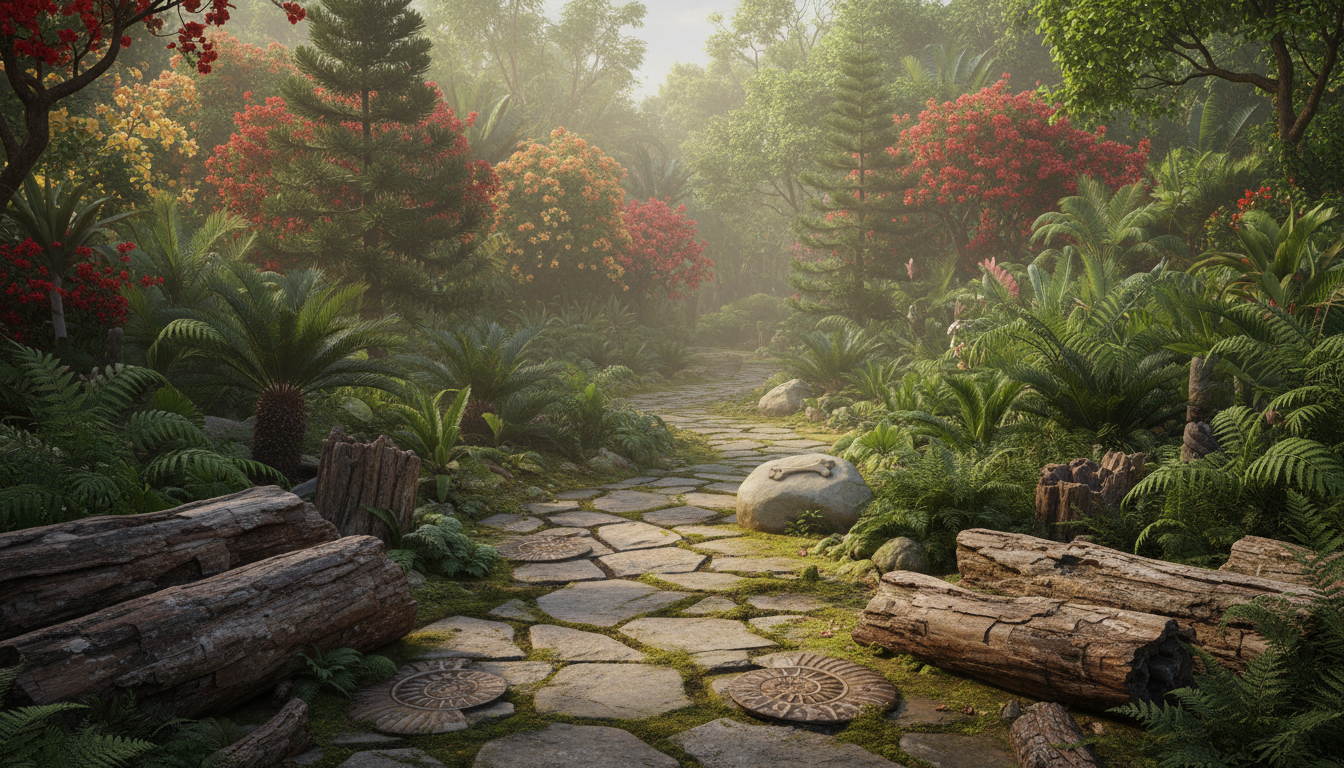
Did you know that you can walk through billions of years of Earth’s history without leaving Singapore? At the Evolution Garden inside Singapore Botanic Gardens, plant displays, geological references and reconstructed prehistoric forms help visitors imagine a world before modern forests.
It is not a time machine. It is a carefully designed educational walk that turns a very long scientific story into a sequence people can understand.
The quick answer: the Evolution Garden, designed by Junichi Inada, represents approximately 3.5 billion years of the history leading to modern plant life. It features petrified wood, models of extinct tree-like plants and collections illustrating major evolutionary groups. The early part of the timeline predates land plants; that distinction is essential when interpreting the display.
The featured image is a conceptual editorial illustration inspired by the Evolution Garden, not a documentary photograph of a particular exhibit.
Find the answer: Why begin billions of years before there were trees? · What is petrified wood? · What did the earliest land plants look like? · Why are there models of giant clubmoss-like trees? · How did seeds change the story? · When did flowers appear? · How can students read an evolutionary timeline correctly? · What should visitors do at Evolution Garden?
1. Why begin billions of years before there were trees?
The history of modern plants starts long before a recognisable forest existed. Early life included simple organisms in aquatic environments, and photosynthesis eventually transformed the conditions under which later life evolved.
The Singapore Botanic Gardens describes Evolution Garden as a trail through 3.5 billion years of plant evolution. The theme embraces the long biological background to land plants, not a claim that trees existed 3.5 billion years ago.
This is an important scientific distinction. A visitor looking at a timeline should separate the earliest known life, the evolution of photosynthesis and the much later emergence of plants on land.
The walk helps us understand one of Earth’s most astonishing patterns: a planet that initially lacked forests eventually supported the complex tropical ecosystems we know today.
2. What is petrified wood?
Petrified wood is a fossil in which minerals have replaced or filled portions of ancient wood, preserving aspects of its structure. It is not ordinary timber that has simply become unusually hard with age.
Examples along a themed evolution trail help visitors picture how scientists study evidence of environments that no longer exist. Fossils preserve only part of the record, and the absence of a fossil does not prove that an organism never lived.
Geological time is so long that human calendars feel tiny by comparison. A fossil may record a plant from millions of years ago, while a modern visitor experiences the trail in a matter of minutes.
That contrast is one reason museums and gardens use physical objects and models: they give our imagination an anchor for dates that are otherwise difficult to grasp.
3. What did the earliest land plants look like?
The first plant-like organisms to colonise land were very different from today’s towering tropical trees. Early land plants were comparatively simple and depended on environmental conditions that supported their survival and reproduction.
Mosses and other bryophytes offer modern examples of small, non-flowering plants with a very different structure from flowering trees. They are not exact replicas of the first land plants, but they help explain some evolutionary contrasts.
NParks notes that Evolution Garden includes the Gardens’ only dedicated moss collection. Such a collection rewards slow observation: tiny green cushions can reveal much about moisture, surfaces and how plants live without the same kinds of roots and vascular tissues as large trees.
A sensible visitor does not pick moss from the display. You can learn a great deal simply by looking closely at its form and habitat.
4. Why are there models of giant clubmoss-like trees?
The Evolution Garden includes models of Lepidodendron, an extinct group of enormous tree-like plants related to clubmosses. These plants were especially prominent in Carboniferous-period landscapes, long before modern human civilisation.
At first glance, the models can look like strange palm trees with patterned trunks. But their evolutionary relationships and life cycles differed from those of today’s palms, which are flowering plants.
The Carboniferous world included extensive swamp forests and plant communities that contributed organic material to some later coal deposits. The important lesson is not that a single model explains all coal formation, but that plant evolution helped alter Earth’s atmosphere, landscapes and long-term carbon cycle.
This is a great opportunity to ask: when did plants become tall enough to shape forests, and what structural features made that possible?
5. How did seeds change the story?
Before seed-bearing plants became widespread, many land plants reproduced by spores and needed particular conditions for successful life cycles. The evolution of seeds brought new ways to protect developing plant embryos and support dispersal.
The Evolution Garden highlights cycads and conifers, important representatives of seed-bearing plant lineages. They are sometimes called ancient or ‘living fossil’ plants, but that phrase needs care.
A cycad alive today is not an unchanged individual from millions of years ago. Its lineage has a long history, while living species continue to evolve and reproduce in modern environments.
Look at how their forms differ from mosses or ferns, and ask why a seed might help a plant spread or survive under different conditions.
6. When did flowers appear?
Flowering plants—also called angiosperms—became extraordinarily diverse over geological time. Their flowers, fruits, seeds and interactions with pollinators and seed dispersers produced many ecological possibilities.
The fossil record places early angiosperm diversification in the age of dinosaurs; flowering plants did not first appear only after dinosaurs disappeared. Later, they became dominant in many modern terrestrial ecosystems.
A modern rainforest in Singapore contains countless flowering plant lineages. Some are trees, some climbers, some herbs. Seeing those very different forms as members of a broad evolutionary group helps visitors connect a prehistoric timeline with living plants outside the exhibition.
The important point is that evolutionary history describes branching relationships. It is not a ladder in which every moss turns into a fern, every fern into a cycad and every cycad into a flowering tree.
7. How can students read an evolutionary timeline correctly?
A time line can accidentally encourage a misleading idea: that evolution always moves directly from ‘simple’ to ‘better’. Biology is more complicated. Organisms change in different directions, some lineages disappear and others remain successful for very long periods.
During a visit, try three questions at each display. What kind of evidence supports our understanding of this period? Which organisms were actually present then? Which modern organisms share ancestry with them but have their own evolutionary histories?
It also helps to remember that the length of time between events is not equal. Millions of years can separate important transitions, while humans have existed for a relatively brief interval on a geological scale.
This is why a well-designed physical timeline can be more memorable than a paragraph listing dates.
8. What should visitors do at Evolution Garden?
Did you know that looking at one fossilised piece of wood or one patch of moss can open a conversation about continents, climate and life’s history? Evolution Garden turns that enormous story into a walk people can actually discuss.
- Location: Evolution Garden is inside Singapore Botanic Gardens, near the Bukit Timah side of the Gardens.
- Theme: the displays trace an approximately 3.5-billion-year biological and botanical story.
- Look for: petrified wood, moss displays, models of extinct Lepidodendron and living seed plants.
- Ask questions: distinguish the earliest life on Earth from the later arrival of land plants.
- Compare: after the trail, look at living plants in other Botanic Gardens collections.
- Check access: use the current official Gardens map and notices before travelling.
Frequently asked questions
Where is Evolution Garden?
It is a themed attraction within Singapore Botanic Gardens, accessible from the Gardens’ public paths.
Does Evolution Garden cover 3.5 billion years?
Yes. NParks describes a trail spanning 3.5 billion years of history associated with plant evolution; the earliest part predates land plants.
What is Lepidodendron?
It is an extinct genus of tall, tree-like lycophytes related to modern clubmosses, highlighted by models in the Garden.
Are cycads living fossils?
Cycads belong to ancient seed-plant lineages, but living species have continued to evolve. They are not unchanged copies of prehistoric individual plants.
When did flowering plants evolve?
Angiosperms were present by the age of dinosaurs and later diversified into the many flowering plant groups seen today.
Official sources and further reading
Historical and ecological facts are grounded in official agency references. Check current directories, trail notices and opening times before visiting.
- Singapore Botanic Gardens: Plant collections and Evolution Garden
- NParks: A Guide to Evolution Garden
- Singapore Botanic Gardens: Visitor information
- Singapore Botanic Gardens: How the historic Gardens developed
Continue the How Bukit Timah Works series
- Why Singapore Botanic Gardens is UNESCO heritage
- How the Botanic Gardens Seed Bank protects plant diversity
- How the Learning Forest recreates lost wetlands
More from this batch: How Bukit Timah Works | Why Coronation Plaza Became a School-District Meeting Point · How Bukit Timah Works | How Singapore Quarry Became a Wildlife Lake · How Bukit Timah Works | How Cluny Court Preserves Its 1928 Shophouses
Earlier neighbourhood guides: bukit timah road dunearn road one way system · beauty world food centre fourth floor hawker heritage · learning forest keppel discovery wetlands · botanic gardens mrt circle downtown interchange