
Did you know that a garden named after ginger can teach you about bananas, heliconias and bird-of-paradise plants too? The Ginger Garden at Singapore Botanic Gardens is an outdoor demonstration of how botanists classify the living world by relationships, not simply by what plants taste like.
In its one-hectare space, the Gardens displays more than 550 species and other cultivated forms associated with the ginger order, Zingiberales. A visitor might arrive expecting the familiar spicy ingredient from the kitchen and instead discover tall leaves, unexpected flowers and a remarkably varied group of tropical plants.
The quick answer: ginger is a member of the family Zingiberaceae, but the wider order Zingiberales includes eight related plant families. Some are culinary spices, some are ornamental, and others are known for leaves and flowers that look nothing like supermarket ginger. The Garden uses geographical zones, plant labels and contrasting forms to make those relationships easier to see.
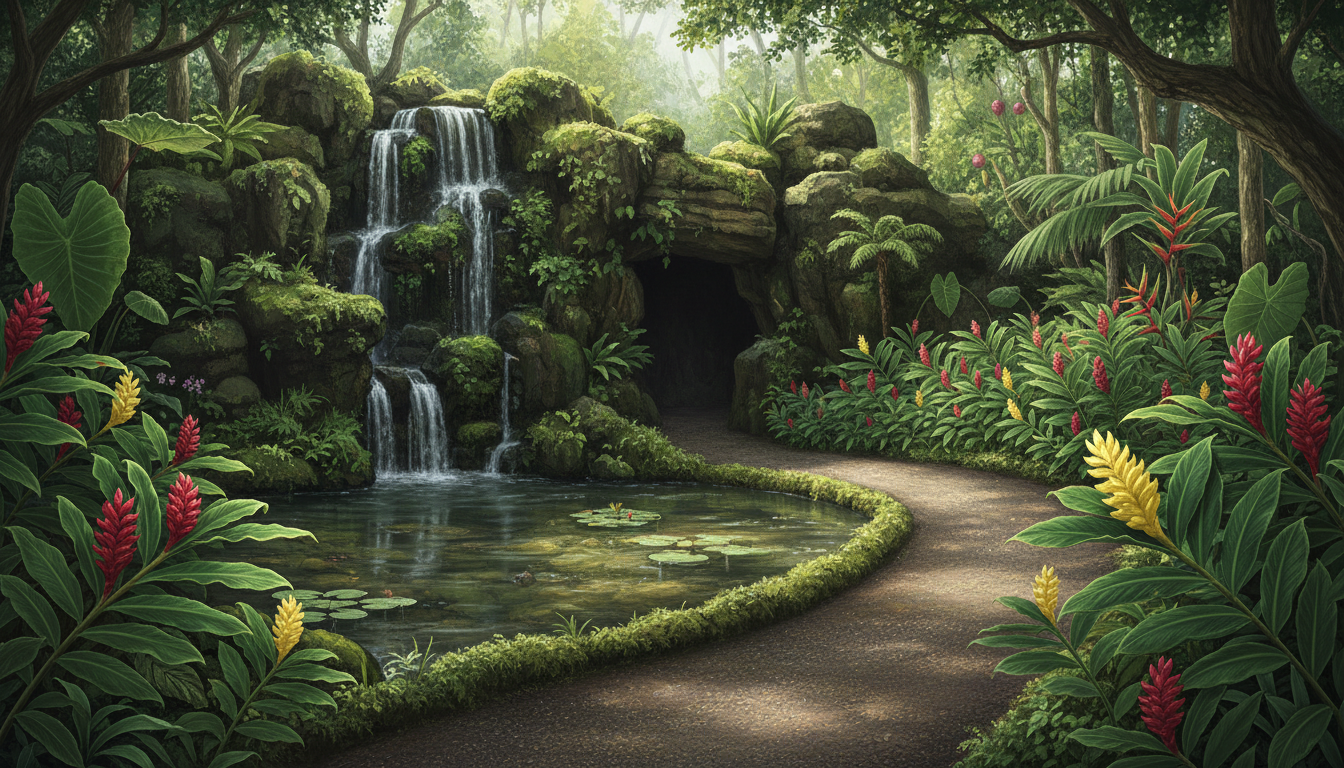
Featured artwork is an original conceptual illustration inspired by the Ginger Garden waterfall and plant displays, not a site photograph.
Quick navigation: What is the difference between an order, a family and a species? · Is the root we eat actually a root? · Why does the Garden include banana plants? · What are heliconias and why are their flowers so vivid? · How do torch ginger and cooking connect to plant biology? · How does the Garden’s geography help explain biodiversity? · What is the waterfall actually doing in a botanical collection? · Why is this garden useful for Singapore’s botanical research story? · How can children make a useful 30-minute observation walk? · What should visitors know before going?
1. What is the difference between an order, a family and a species?
Botany groups plants into nested categories. A species is one level used to identify a particular biological lineage. Related species belong to genera, related genera to families, and families can be grouped into larger ranks such as an order.
That is why two plants can look different but still share a place in the same order. A banana and a ginger plant are not the same species or family. They are grouped within Zingiberales because of evolutionary relationships and characteristics investigated by botanists.
The Singapore Botanic Gardens’ official guide lists eight families of the order, including ginger plants, bananas, heliconias, bird-of-paradise plants, spiral gingers, cannas, prayer plants and orchidanthas. Some old common-name descriptions sound confusing because ‘ginger’ may refer broadly to the order or more narrowly to the culinary spice.
A helpful analogy is a library. The entire section might be labelled plant evolution; one shelf is Zingiberales; a smaller shelf is the ginger family; and one book is the familiar culinary ginger, Zingiber officinale. The labels relate to one another, but they are not interchangeable.
2. Is the root we eat actually a root?
The familiar knobbly ginger sold in grocery shops is primarily an underground rhizome, a modified stem, rather than an ordinary root. It stores resources and bears buds from which new shoots can develop.
NParks describes the rhizome of Zingiber officinale as a thickened, branched underground organ. Above ground, leaves grow on shoot structures that can appear stem-like; different parts have different jobs.
This distinction is useful when comparing ginger with a carrot. A carrot is a swollen storage root. A ginger rhizome is stem tissue with nodes and potential shoot buds. They can both be stored underground and eaten, but they are not the same kind of plant organ.
Not every member of Zingiberales is cultivated for a kitchen rhizome, and not every decorative plant with ginger-like foliage is edible. Never sample a garden plant because it resembles something used in cooking.
3. Why does the Garden include banana plants?
Bananas belong to the family Musaceae, one of the families classified within the order Zingiberales. Their large leaves and distinctive flower-and-fruit arrangements give students an immediate visual contrast with the narrow leaves and rhizomes of common ginger.
Botanical relationships do not require every plant in a group to perform the same human use. Some relatives provide fruits, others aromatic underground structures, and still others are grown mainly for the beauty of their foliage.
The Gardens’ trail introduces the ginger order as a broader evolutionary group. A child can therefore ask a scientific question rather than a shopping question: what characteristics and evidence led botanists to place these plants together?
The short answer is classification based on shared ancestry and plant characteristics. The deeper answer involves reproductive structures, development and molecular data. For beginners, noticing that a related group has diverse forms is already a major conceptual step.
4. What are heliconias and why are their flowers so vivid?
Heliconias are members of Heliconiaceae, another family within Zingiberales. They are well known for conspicuous structures around their flowers, often coloured red, orange, yellow or pink.
Those colourful structures may include bracts, modified leaves associated with an inflorescence. A visitor should not assume the entire bright display is made of ordinary petals. Learning to distinguish bracts, flowers and foliage changes what you notice.
In nature, flower form, colour, nectar and floral structures can influence how pollinators interact with plants. Different species have different partners and strategies, so one bright colour does not prove a specific pollinator visits every heliconia.
At the Ginger Garden, compare an ornamental heliconia with culinary ginger. The plants share a broad taxonomic order, yet humans notice and use very different parts of them.
5. How do torch ginger and cooking connect to plant biology?
One of Southeast Asia’s most recognisable plants is torch ginger, Etlingera elatior, also known locally as kantan. Its flowering head is visually dramatic, with bracts creating a torch-like form.
The NParks Ginger Garden guide explains that young flower buds and tender shoot parts are used in dishes in parts of Southeast Asia. This is an example of people using a different plant organ from the familiar culinary ginger rhizome.
Why do plants make aromatic compounds? In different species, natural chemicals can contribute to defence, signalling or interaction with other organisms. Human cooking traditions have discovered that certain compounds also produce pleasing tastes or aromas.
Plant chemistry is not a universal statement of safety. The fact that a particular cultivated plant part is used in traditional food does not imply all related species, or all parts of the same plant, can be safely eaten.
6. How does the Garden’s geography help explain biodiversity?
The current Gardens overview describes four geographical zones showcasing plants associated with Asia, Africa and tropical America. The older official trail guide also discusses Asian and Pacific-region collections and areas devoted to ornamental or useful gingers.
The exact collection and labels can change as plants are maintained or moved, so a guide should not promise that a particular species flowers at a particular corner on every day of the year.
The geographical arrangement helps readers see that related plants do not all occur in the same part of the world. Different climates, islands, dispersal histories and evolutionary trajectories affect where species are found.
Asia is particularly rich in ginger-family diversity. A student might compare a ginger from Southeast Asia with a related ornamental plant from tropical America and ask what their similarities reveal—and what their differences might suggest about adaptation.
7. What is the waterfall actually doing in a botanical collection?
The Ginger Garden includes a waterfall, lily pond and moss-covered cave. These features make the visit memorable, but they are also useful for discussing how water, shade and surrounding vegetation influence conditions experienced by living plants.
Near water and under foliage, a visitor may feel cooler or notice more humidity than on a sun-exposed pavement. The exact change depends on temperature, wind, evaporation, shade and the location where measurements are taken.
It would be inaccurate to claim the waterfall reproduces every feature of a tropical rainforest microclimate or guarantees a specific temperature reduction. The Garden is a curated display, and the water feature is also part of its visual landscape design.
A simple investigation is to compare the feeling of the shaded path with an exposed route, then ask which physical processes might explain the difference. Without instruments, describe observations rather than announcing precise temperatures.
8. Why is this garden useful for Singapore’s botanical research story?
The Singapore Botanic Gardens has studied ginger relatives for many years. The historic trail guide identifies botanists Henry Nicholas Ridley and Richard Eric Holttum among researchers who investigated Southeast Asian gingers.
Research collections allow scientists to compare living plants, flowers and cultivated material. Preserved herbarium specimens provide a different kind of record, while live collections can help researchers observe growth and flowering.
The Ginger Garden is therefore more than a decorative extension of the National Orchid Garden. It helps make botanical classification and regional plant diversity visible to people who may never enter a research laboratory.
That does not mean every display plant was discovered there. The Garden brings together species from different places, and its labels help people learn about those origins.
9. How can children make a useful 30-minute observation walk?
Begin near the Zingiberales introduction mural. Ask a child to choose three plants that look different: for example, a banana, a heliconia and an identifiable ginger-family plant. Record their labels instead of guessing species from common names alone.
Sketch each plant’s leaf shape and the structure that draws your attention. If it is flowering, try to identify whether the conspicuous part is a petal, bract or inflorescence. Then ask what evidence would be needed to say two plants belong to the same family.
Make a simple table: plant name, family if labelled, part of plant used by people, and one visible characteristic. A complete entry might be ‘common ginger — Zingiberaceae — rhizome used in cooking — narrow leaves’.
The aim is not to memorise 550 names. It is to learn how scientific categories organise a diversity that otherwise looks overwhelming.
10. What should visitors know before going?
Did you know a single familiar spice could lead to a lesson about bananas, evolutionary families, pollination, plant chemistry and geography? That is the deeper value of the Ginger Garden: it turns a supermarket ingredient into a way to understand biodiversity.
- The Ginger Garden is within Singapore Botanic Gardens, not the separate Bukit Timah Nature Reserve.
- General admission to the Singapore Botanic Gardens is free; check the official map for the Ginger Garden route.
- Current Gardens-wide hours are 5am to midnight, but attraction-specific maintenance notices may apply.
- The historical NParks trail guide suggests about 30–45 minutes for its Ginger Garden walk; this is a planning guide, not a guaranteed time.
- Stay on designated paths, do not pick rhizomes or flowers, and do not taste unknown plants.
- For a current directory, route or maintenance notice, use the official Singapore Botanic Gardens visitor website.
Frequently asked questions
Why does the Ginger Garden display bananas?
Bananas belong to Musaceae, one of the eight families within the plant order Zingiberales, alongside the ginger family.
How many plant types are displayed?
The current Gardens overview describes more than 550 species and related cultivated forms in its one-hectare Ginger Garden.
Is the piece of ginger we eat a root?
It is mainly a rhizome, a modified underground stem with buds that can produce new shoots.
Are heliconias the same as ginger?
No. Heliconias belong to a different family within the wider Zingiberales order.
Can visitors taste the plants?
No. Do not pick or sample living garden plants; familiar food uses do not establish the safety of unverified species or plant parts.
How long does a visit take?
The older official trail guide suggests roughly 30–45 minutes, but the appropriate duration depends on your interests, pace and current access.
Official sources and further reading
Read the official botanical collection information and visitor notices for scientific details, access and changing arrangements.
- Singapore Botanic Gardens: Ginger Garden current collection overview
- NParks: A Guide to Ginger Garden (official plant families and trail)
- NParks: Zingiber officinale, ginger rhizome description
- Singapore Botanic Gardens: Visitor hours and maps
- Singapore Botanic Gardens: Official notices
Explore related Bukit Timah explanations
- How the National Orchid Garden creates new hybrids
- How the Singapore Herbarium turns plants into records
- How Evolution Garden explains plant history
In this batch: How Bukit Timah Works | Why Healing Garden Groups Plants by Body Systems · How Bukit Timah Works | Why the Railway Station Has Kampung and Spice Gardens · How Bukit Timah Works | How Jacob Ballas Children’s Garden Teaches the Water Cycle Through Play