
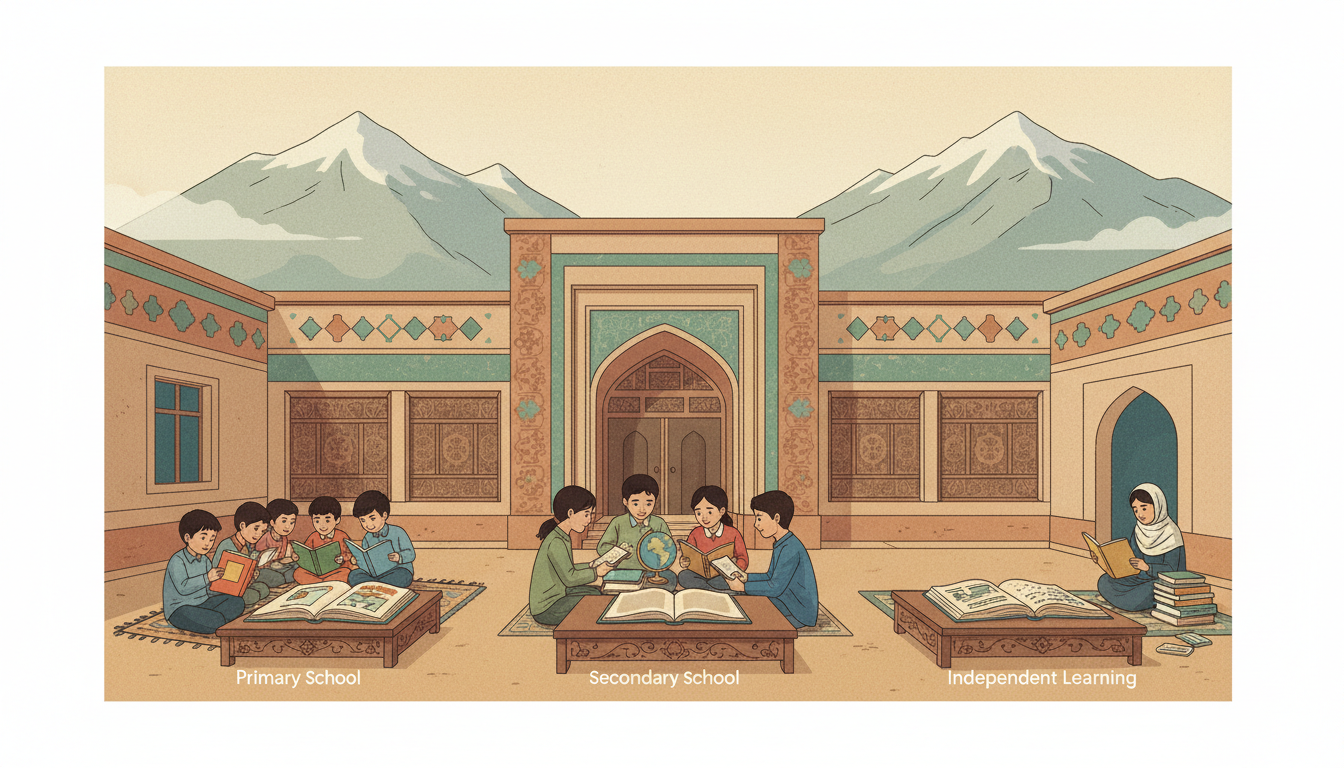
How Afghanistan’s education system works in 2026 begins with an uncomfortable but essential distinction: a school structure exists on paper, while access to that structure is restricted in practice. General schooling is commonly organised as Grades 1–6, Grades 7–9 and Grades 10–12. However, girls are barred from formal education beyond Grade 6, and women remain excluded from university education by the de facto authorities. A complete explanation must show how school stages, rules, classrooms, examinations and credentials interact—and where that chain is broken.
For families, teachers and researchers, the fastest useful approach is to identify which stage a learner has actually reached, which schooling is presently accessible, what learning can be demonstrated, and which institution recognises the next qualification. A grade number alone will not answer these questions. Nor does a historic description of compulsory schooling prove that a particular child can attend today.
UNICEF reported on 14 August 2026 that more than 2.6 million girls had been denied secondary education since 2021. That figure is a cumulative reporting measure, not a personal prediction or a count of girls in one town. This guide explains the moving parts of Afghanistan’s education system as at 18 October 2026, with dated primary-source links and practical examples. For the full stage-by-stage country overview, see Understanding the Education System of Afghanistan.
Afghanistan’s education system at a glance
| Operating question | Quick answer |
|---|---|
| What is the normal school ladder? | Primary Grades 1–6, lower secondary Grades 7–9, upper secondary Grades 10–12. |
| Where is the most consequential transition? | Between Grade 6 and Grade 7: formal secondary schooling is presently closed to girls. |
| Who sets policy? | Education functions are exercised by de facto authorities; documents from earlier governments must be dated and checked against current practice. |
| Is basic education compulsory? | Earlier legal frameworks envisaged compulsory basic schooling, but a historic right cannot be confused with present-day access. |
| What determines learning? | Teacher availability, safe access, textbooks, language, continuity, assessment, and opportunities to practise. |
| How are pupils assessed? | School-level progression and records vary; a genuine institutional record matters more than a presumed universal examination equivalence. |
| Are higher education routes open equally? | No. Women’s university education remains prohibited under the de facto authorities. |
| Where should an overseas learner begin? | With the receiving institution’s current recognition rules, actual records, learning diagnostic and safeguarding needs. |
This is an operating guide, not simply an education ladder. The difference matters: a ladder tells you which rung comes next; an operating guide explains who can reach that rung, which authority permits it, what evidence is required, and what happens if the connection fails.
How the system turns a school rule into a real lesson
A ministry may specify a school stage and curriculum. A district or school must then translate that into a timetable, available teaching staff, materials, classrooms, student registers and some way to assess progress. Families must be able to enrol children and get them to school. Students must have time, language support and continuity sufficient to learn.
That is the sequence: policy → school capacity → admission → teaching → assessment → recognised progress. The system succeeds only when the arrows between the stages work. A new textbook does not by itself repair missing teachers. A place on a register does not guarantee regular attendance. Completing a grade does not automatically establish that its mathematics or reading competencies are secure.
Afghanistan makes these distinctions especially important because many school rules have changed over time, while displacement, poverty, disaster and restrictions can interrupt the ordinary movement of a learner. A diagram copied from a previous decade may accurately represent an institutional design without accurately describing 2026 provision.
There are at least four records to read: the rule in force, the service actually delivered, the pupil’s demonstrated learning, and the qualification accepted by a receiving institution. The first record is administrative; the second is operational; the third is educational; the fourth determines a formal transition. Confusing them produces unfair advice.
What primary school is designed to do: Grades 1–6
Primary education is usually where children become independent readers, writers and users of arithmetic. Each later subject assumes these tools. When reading remains fragile, the problem often appears to be science, history or mathematics because instructions and explanations become harder to decode. When number sense is fragile, later fractions and algebra become mechanically difficult even when the pupil is curious and motivated.
In the Afghan context, foundational language work needs careful attention to the language of the home and the language used in the classroom or assessment. Dari and Pashto are significant languages in schooling, while other home languages and local contexts also matter. No responsible educator should diagnose a student as weak merely because they are new to a particular medium of instruction.
A practical diagnostic can begin with a short passage in a language the learner understands. Ask for the central idea, two supporting details and a spoken explanation of an unfamiliar word. Next, try a short multiplication or fraction question and ask the learner to explain the steps. Do not turn this into an examination of accent, fluency or speed. The goal is to find the first unstable prerequisite.
A child who can orally explain a scientific process but struggles to write it may need written-language scaffolding. A child who reads a paragraph accurately but cannot explain its meaning needs comprehension work rather than yet more speed-reading. A child who solves 18 ÷ 3 but cannot explain what equal groups mean needs concept work, not twenty more identical calculations. These distinctions inform a humane and efficient teaching response.
Why the Grade 6-to-Grade 7 transition now changes everything
On the structural diagram, Grade 7 begins lower secondary school. In the lived 2026 system, formal secondary schooling beyond Grade 6 is closed to girls. The authorities’ restrictions also exclude women from university education. This is not an elective vocational track, a normal school choice or a temporary missing subject option that a family can simply solve with ordinary admission paperwork.
UNICEF’s August 2026 statement records the scale and duration of the exclusion. UNESCO’s August 2026 analysis likewise describes the long-term loss of learning opportunities. These findings concern education rights as well as economic and social consequences.
The restriction also affects how careers and public services develop. Teacher education, medical training, and the future supply of qualified female professionals depend on earlier stages. A blocked Grade 7 transition today can weaken the pipeline to skilled work years later. This is one reason the issue cannot be relegated to a brief footnote inside a generic 6–3–3 infographic.
Readers must also distinguish continued learning from formal recognised admission. A girl may continue independent, family-based or community-supported learning where it is safe and possible. Such learning matters, but it does not automatically create a recognised Grade 7 certificate or university entitlement. Do not promote programmes as formally accredited without checking the actual awarding body’s recognition.
How lower secondary changes the classroom: Grades 7–9
Lower secondary normally widens subject learning: reading expands into evidence-based interpretation; mathematics becomes more symbolic; science requires comparison of evidence and cause; social subjects require longer explanations. This transition involves new demands on memory and communication, not merely harder worksheets.
For a student who can access the stage, the useful questions are concrete. Which curriculum edition is being taught? Which languages are used in each subject? How many teaching hours are actually delivered? What assessed tasks does the school expect? Which topics were completed before an interruption? Which recognised record will show completion?
For an interrupted learner, start with evidence rather than assumptions. Test four modest things: comprehension of a short paragraph; calculation with fractions and percentages; explanation of a science observation; and construction of a short written argument. Keep the tasks age-respectful. A teenager should not be infantilised because a school year was lost.
A learner may be strong in arithmetic yet struggle to translate a word problem. Another may understand the physical science but lack the language to produce an assessed explanation. A third may have studied advanced ideas independently while lacking official documentation. Each case calls for a different bridge. Placement should come from programme rules plus demonstrated learning, not a guessed international grade conversion.
How Grades 10–12, pathways and school completion fit together
Upper secondary conventionally extends the general academic route toward completion and possible higher education. It is useful to distinguish general schooling, technical and vocational training, religious education and non-formal learning opportunities: they can have different administrators, curricula, institutions and awarding arrangements.
The phrase “finished secondary school” needs detail. A record might show attendance through Grade 12, completion of subjects, an institution-issued certificate, or an examination result. Those are not identical claims. Ask what is printed on the document, who signed or issued it, what year it represents, and what a receiving school or university will accept.
Women and girls face the decisive present-day barriers to formal secondary and university education; a guide that merely lists conventional onward qualifications would conceal that exclusion. Boys and men may also encounter interruptions caused by access, poverty, displacement, reduced learning quality or insufficient school capacity. The ethical approach is not to assume a child has received the full expected curriculum because the official stage diagram says they should have.
For vocational routes, check whether an institution is accredited, the programme’s exact qualification, work-placement and practical components, and whether the award is recognised by any employer or college the learner is considering. Avoid promises of portability that no receiving body has made.
Governance: who decides, who teaches and who verifies?
Afghanistan’s education administration has changed under successive governments and institutions. Older legal and administrative documents remain useful for historical understanding, but should not be presented as a reliable 2026 admission handbook. Descriptions of de facto authorities are factual descriptions of current control, not endorsements of their restrictions.
A learner’s practical path can involve several decision points. First is the authority controlling access to the programme. Second is the school or provider that can actually deliver lessons and generate records. Third is the examining or awarding mechanism. Fourth is an outside institution that decides whether to recognise the evidence for onward study.
Why does this matter? A school may truthfully report that a pupil attended a particular grade; a foreign university may still require an authenticated final certificate, a language result or a bridging course. Conversely, a displaced student may lack a paper record yet possess knowledge that can be demonstrated in placement tests. Institutional requirements are not solved by enthusiasm alone, and learning should not be dismissed because paperwork is missing.
Maintain a small evidence file: grades and subjects actually studied; dated school records where obtainable; curriculum and language of instruction; examples of authentic work; interruptions and their dates; independent assessments if available; and written guidance from the receiving institution. Protect the student’s personal data and do not publish a child’s documents online to obtain advice.
Languages, curriculum and the danger of old information
The educational reality of a multilingual society cannot be compressed into a statement that “schools teach in one language”. Classroom medium, examination wording, textbooks, spoken home language and language of an overseas application can differ. These differences affect comprehension and credential evaluation.
Likewise, Afghanistan’s policies and curriculum conditions have changed since 2021. The UNESCO–UNICEF education situation reporting discusses access and quality problems and offers a dated reference point. Distinguish a new instruction, an announced curriculum revision, a delivered textbook, a teacher’s lesson plan and the material students have actually learned.
Do not infer national uniformity from one urban school or one document. Ask a school which books and assessment formats it uses now. Ask whether its present term sequence matches the learner’s previous programme. And remember that a small foundation check can sometimes prevent a much larger secondary-school learning gap.
A worked education-pathway case: the interrupted Grade 8 learner
Consider a fictional learner, aged fifteen, who completed much of Grade 8 before displacement and now seeks admission elsewhere. There is a photograph of a school report but no accessible school office to issue a replacement. An advisor might be tempted to say, “Grade 8 is Year 8 everywhere.” That would be careless. Age, completed topics, assessment evidence and school-entry policy all matter.
Begin by making a record map: confirm which original report exists, the language, the school year, subjects and grading scale. Separate what the document proves from what relatives remember. Preserve the original file or image. Obtain translations only to the standard required by the receiving institution.
Next build a small learning map. Ask the learner to solve 4x − 5 = 23: add 5 on both sides, giving 4x = 28, then divide both sides by 4 to obtain x = 7. Check: 4(7) − 5 = 23. In reading, give a short age-appropriate text and request a summary with one supporting quotation. In science, compare “the water level fell” (observation) with “some water evaporated” (possible explanation). Ask what evidence would help distinguish evaporation from leakage.
Finally build a route map. The receiving school’s admissions authority may use age placement, diagnostic tests, a bridge class or a formal equivalence decision. Do not guess the result. The learner’s best educational support is often a short, targeted bridge built around actual missing skills while formal documentation is being checked.
If the learner is a girl whose schooling was interrupted by restrictions, acknowledge the reason accurately and do not demand a normal attendance pattern that was denied to her. Safeguarding, privacy and realistic recognised options must be considered before advocating any specific activity.
An operating checklist for families considering a school move
- Identify the learner’s current situation. What schooling can they safely and lawfully access now? Is there an interruption, and why?
- Record the education stage. Which grades and subjects were actually completed, in which years?
- Check learning evidence. Do reading, numeracy and subject diagnostics support the recorded stage?
- Ask the receiving institution. Which original documents, translations, assessments and admission conditions are required?
- Verify provider status. Who recognises any alternative, distance or vocational qualification? Is a promised credential genuine?
- Bridge only the missing topics. Avoid an expensive generic tutoring package before a diagnosis.
- Protect records. Keep personal identification and reports off public forums and unverified messaging groups.
- Review after four weeks. Has the learner improved in the specific skill or gateway that matters?
The checklist is a decision instrument, not a substitute for up-to-date legal, protection or admissions advice. Schooling availability can vary sharply by locality and group. Where a proposed route raises safety concerns, seek locally informed and trusted safeguarding guidance rather than relying on an online article’s generalities.
What policymakers, teachers and researchers should measure
A useful national education dashboard does not stop at the number of buildings or places offered. It distinguishes access, attendance, instruction delivered, learning outcomes, completion, credential quality and transition into further education or livelihoods. Changes in one indicator cannot simply be substituted for changes in another.
For example, a programme might raise the number of learning centres while the number of qualified teachers declines. A government may publish a curriculum while distribution of textbooks remains incomplete. An emergency programme may deliver valuable basic education yet not award the same formal qualification as a school. Those are different outcomes and deserve separate reporting.
Report indicators with their year, source, population, geography, gender coverage and definition. The UNICEF 2026 exclusion figure is not interchangeable with a 2019 primary-enrolment estimate. A statistic calculated for children aged seven to eighteen cannot automatically become a statistic about children aged twelve to fifteen.
The UNICEF August 2026 statement and UNESCO’s 2026 account are suitable starting points. Their dates and definitions should travel with every quoted number.
Where targeted teaching can help—and where it cannot
Good teaching can repair knowledge gaps, rebuild fluency and help a student demonstrate understanding. It cannot on its own repeal restrictions, create formally accredited qualifications, replace an absent school or guarantee foreign admissions. The distinction protects families from false promises.
A useful four-week academic bridge begins with a diagnosis in Week 1; one unstable reading or mathematics prerequisite in Week 2; varied practice and feedback in Week 3; and an unfamiliar transfer task in Week 4. Keep a record of the original mistake, the correction, and what the learner can now do independently.
Success should be defined precisely: perhaps the student can now solve linear equations with negative numbers, summarise a paragraph with evidence, or explain the difference between a scientific observation and a claim. If an institution requires a certificate, that administrative matter remains separate.
Readers who need further country-level context should use the Afghanistan education-system overview. Readers exploring the underlying learning mechanics can use How Education Works and the eduKateSG Education gateway. These are connected questions but not interchangeable article functions.
Frequently asked questions
Does Afghanistan have twelve years of schooling?
The conventional general-school structure runs from Grade 1 through Grade 12, with primary, lower-secondary and upper-secondary stages. That structure does not mean twelve years are currently accessible to every child. The restrictions against girls beyond Grade 6 must appear in any accurate 2026 answer.
Is Grade 9 the same as an overseas Grade 9?
Not automatically. Grade names offer a rough starting point, but placement requires curriculum review, age considerations, documentary evidence, assessed learning and the receiving institution’s rules.
Can independent study replace a secondary-school certificate?
Independent study may preserve and improve learning. Whether it leads to a recognised qualification depends on an actual authorised examination or awarding arrangement. Never treat an informal course certificate as automatically equivalent to formal secondary completion.
Can tuition solve an interrupted education route?
Tutoring can strengthen knowledge and confidence. It cannot itself open a prohibited school stage, resolve immigration status, or compel an institution to recognise a document.
Why describe girls’ exclusion before the rest of the curriculum?
Because access determines whether the curriculum is a practical route. Presenting an unobstructed ladder first, without that fact, would mislead readers making real decisions.
Sources and editorial evidence
- UNICEF, 14 August 2026: Girls denied secondary education since 2021 — most important current access statement.
- UNESCO, August 2026: Five years of restrictions on Afghan girls’ learning — rights and learning continuity.
- UNESCO and UNICEF: Afghanistan education crisis reporting — access, quality and foundation.
- eduKateSG: Understanding the Education System of Afghanistan — companion stage and qualification reference.
Checked: 18 October 2026. Structural descriptions are not guarantees of individual access. Worked learners, exercises and decision matrices are illustrative; they are not official Afghan examination questions.
Continue reading about Afghanistan: Afghanistan education and tutor country crosswalk · World Tuition Master Hub. These published guides distinguish schooling, official curricula, examinations and tutoring choices. The country reference is educational information and does not imply local eduKate service availability.
Related education-system and tutoring guides: Education Systems country directory · Afghanistan companion education guides. Use the learner’s actual institution and cohort requirements when comparing country pathways; publication of a guide does not indicate a local eduKate centre.