
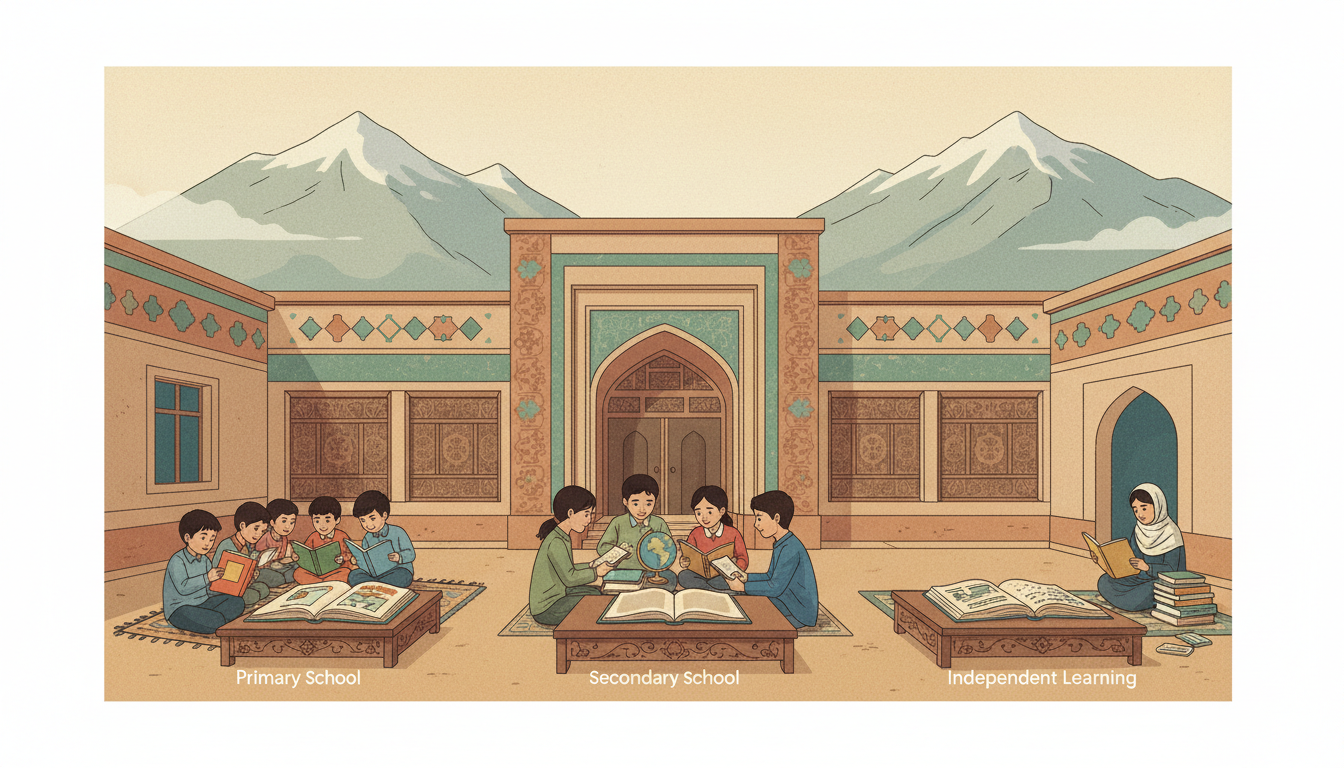
Schools of Afghanistan are usually described through a 6–3–3 general-school structure: six primary grades (1–6), three lower-secondary grades (7–9), and three upper-secondary grades (10–12). That description explains the institutional ladder, but it does not describe what every child can attend. In October 2026, girls remain barred from formal secondary school after Grade 6 and women from universities under the de facto authorities. A truthful guide must explain both the school structure and the access restrictions from the first page.
An Afghan school can be a general public school, an authorised non-state provider, a religious learning institution, or a community-supported learning setting. These do not automatically provide interchangeable curricula, examination routes or recognised completion records. The correct starting question is not merely “Which grade?” but “Which school, which programme, what education actually took place, and which evidence can confirm it?”
This guide is for families, teachers, students, international admissions teams and readers who want a clear picture of Afghanistan’s primary schools, secondary schools, madrasas, vocational routes, language of instruction and educational access. It is a structural guide, not an endorsement of restrictions. The most urgent facts are grounded in UNICEF’s August 2026 report and the UNESCO–UNICEF education situation analysis. See UNICEF’s August 2026 update.
Afghanistan’s schools at a glance
Usual general-school ladder: Primary Grades 1–6 → lower secondary Grades 7–9 → upper secondary Grades 10–12.
What Grade 6 means in 2026: For boys, it may be a normal transition subject to local circumstances. For girls, the next formal secondary stage is blocked under current restrictions.
Institutional landscape: General education, religious/madrasa education, community-based primary education, technical and vocational learning and higher education have different purposes and arrangements.
Compulsory schooling: The pre-2021 Education Law envisaged compulsory basic education through Grade 9. This historical legal statement is not evidence of universal access in 2026.
Languages: Dari and Pashto are central to many school contexts; other community languages matter. Always confirm the actual teaching and assessment language.
Learning evidence: Subject list, grade history, school and issuing body, samples of work, dates, curriculum, examination record and verified admission rules.
Last reviewed: 18 October 2026. Access measures and implementation may change; verify current conditions with authoritative humanitarian and education organisations.
The first distinction: a school ladder is not an access map
Draw twelve boxes on a page and divide them into groups of six, three and three. You now have a useful description of the general school sequence. You do not yet have an answer to whether a particular twelve-year-old can reach Box 7. That distinction is fundamental to understanding Afghanistan.
UNICEF reported on 14 August 2026 that more than 2.6 million Afghan girls have been denied secondary education since the de facto authorities took power in 2021. Girls have been excluded from formal schooling beyond Grade 6 since September 2021; women have been barred from universities since December 2022. A diagram that treats girls’ Grade 7 attendance as an ordinary, open route is therefore materially false. Readers should consult the dated UNICEF statement, not an undated ranking of world school systems.
Restrictions are not the only access issue. Schools and communities contend with poverty, displacement, under-resourced facilities, disrupted teaching, shortages of suitably trained teachers and long travel distances in some areas. A child may be out of school despite not being targeted by a particular ban. Another child may attend a classroom regularly but have very weak literacy. Enrolment, attendance, safety and learning outcomes are four distinct measures.
This is why any comparison of Afghan schools with foreign systems should show a column for the formal qualification and another for opportunity to pursue that qualification. Leaving the second column blank creates a misleading appearance of equivalence.
1. Primary schools: Grades 1–6 and the foundation of learning
The six primary grades are the foundational part of Afghanistan’s ordinary general-school structure. Children encounter language and literacy, mathematics, science-related knowledge, social subjects and other curriculum components. Timetables and materials can be affected by school type, language, geography and recent policy decisions. The stage’s central educational job remains recognisable: learning to read meaningful text, write intelligibly, understand quantities and develop habits for further study.
In a primary classroom, the same observed difficulty can have several causes. A learner may struggle to decode the written script, may read fluently without understanding a paragraph, may understand speech in a home language but not the textbook language, or may have missed several years of schooling. A responsible diagnostic does not treat these as the same problem.
Consider two pupils who cannot answer a written science question about why water disappears from an open vessel. The first cannot read the question. The second reads it but does not understand evaporation. Giving both children the same extra science worksheet is unlikely to solve either problem. The first needs supported reading and vocabulary; the second needs a concrete explanation, observation and a chance to connect evidence to a scientific idea.
A similar distinction matters in mathematics. A child who can recite “eight times four is thirty-two” may still fail to explain what eight groups of four mean. Later, this becomes a problem in fractions, ratios and algebra. A good primary-school programme must check meaning, not only correct numerical answers.
UNESCO and UNICEF’s January 2026 statement reported that 93% of children at the end of primary school were still working toward basic reading proficiency. This is a system-level warning about foundational learning, not a measurement of any particular child. It reinforces the importance of teacher support, materials, continuity and careful diagnosis. See the joint January 2026 statement.
2. Lower-secondary schools: Grades 7–9
In the standard general-school sequence, lower secondary spans Grades 7 through 9. Schools increase the subject demand on pupils, especially in extended reading, mathematics, natural sciences and more independent work. The learner is expected to organise information, reason across several steps and explain a conclusion rather than merely recall a definition.
For an internationally mobile student, the label “Grade 8” is not enough to assign an equivalent class abroad. Ask what the student actually studied. Did the timetable include algebra? Was laboratory science taught with practical investigations? What texts could the student read and explain? Was the school year completed and assessed? These questions protect both the learner and the receiving institution from a superficial grade conversion.
The decisive reality in Afghanistan is that the general lower-secondary route is not available to girls through ordinary formal schools under current restrictions. Educational efforts outside formal schooling may help maintain learning, but they must not be presented as if they automatically confer a recognised Grade 9 school certificate.
For a boy attending a lower-secondary school, a sensible transition check covers reading comprehension across subjects, fractions and equations, science explanations based on evidence, written organisation and attendance continuity. The presence of a textbook chapter on a syllabus does not establish that the learner mastered it. A short set of actual questions can tell more than an institution’s name.
3. Upper-secondary schools: Grades 10–12
The familiar upper-secondary stage occupies Grades 10 to 12 and historically prepared learners for school completion, employment-related training or higher education subject to admissions conditions. At this level, distinctions between programmes and actual course choices become consequential. School history, subjects, language of instruction, examination documents and the authority recognising a qualification all affect the next step.
The standard example of “finish Grade 12 and apply to university” needs a major qualification in present-day Afghanistan. Women are barred from university education. Restrictions and practical conditions must be checked at the time of any application. No responsible advisor should promise a route simply because a student has studied the academic material or obtained an informal certificate.
The academic progression is also not a universal guarantee for boys. Even when institutions operate, affordability, displacement, curriculum changes, subject availability, examination access and qualification rules can constrain choices. Every transition should be verified against the receiving institution’s current written requirements.
A useful question for Grade 12 records is: “Which subjects and assessments are actually evidenced by this document?” That is more meaningful than relying on the English translation of a school name.
4. General schools, madrasas and community-based classes: what is different?
A general school is oriented to a broad school curriculum. A madrasa is a religious learning institution whose syllabus and balance of religious and general subjects may differ. Afghanistan’s school landscape has included formal Islamic education alongside general education, and developments in 2025 proposed a closer relationship between primary curricula. It would be inaccurate to describe every madrasa as identical, or to presume any madrasa certificate automatically equals a general-school qualification.
UNESCO and UNICEF’s 2025 Afghanistan Education Situation Report describes policy directions and the limits of implementation. A planned unified curriculum for general primary schools and madrasas was not, by itself, proof that every school had adopted identical materials. When checking a particular institution, ask for the current programme and assessed subjects, not a generic claim of curriculum equivalence.
Community-based education has another role. It can bring foundational learning closer to children who cannot readily attend formal classes. UNICEF reported supporting hundreds of thousands of children through community-based education classes during 2025. Such work matters profoundly for access and learning continuity, but a community class is not automatically a nationally recognised secondary school. Record the provider, teaching period, level, subjects and any documented progression arrangements.
There can also be non-governmental, private and specialist learning providers. Their recognition should be checked institution by institution. For international evaluation, ask whether the programme was authorised, what it assessed and which public or independent entity can authenticate the record.
5. Who governs a school, and why does governance matter?
A school system is more than its sequence of years. Governance determines who approves a curriculum, hires teachers, controls examinations, registers institutions, maintains records and sets entry conditions. In Afghanistan these questions are especially sensitive because the de facto authorities’ rules and the humanitarian response affect actual availability.
Three descriptions should never be collapsed into one. “An institution exists” means it has a location or organising body. “A student is allowed to enrol” means current rules permit entry. “The completed course is recognised” means a receiving authority accepts evidence of achievement. A family can have one without the other two.
When checking a school’s claim, begin with its name in the original language and precise location; ask what type of school it is and who supervises or accredits it. Then request an explanation of the curriculum, progression rules and what evidence survives if the learner moves abroad. Do not assume a historical accreditation guarantees current recognition.
6. Language of schooling and the reading problem
Afghanistan is multilingual. In some communities children grow up speaking Dari; in others Pashto; and there are additional languages and dialects. The language used with family and neighbours is not necessarily identical to the language of textbooks, tests or school administration.
For an international teacher, this matters immediately. A student who gives an excellent oral account in a familiar language but struggles with a translated written question may need language support rather than lower-level subject content. Conversely, smooth conversation can disguise unfamiliarity with technical reading and academic writing. Assess spoken comprehension, decoding, vocabulary, extended reading and disciplinary knowledge separately.
Do not label a learner “weak in science” solely because they cannot write a long scientific answer in a newly acquired language. Allow the student to demonstrate a concept with a diagram, labels, explanation or appropriately translated material, then plan development of the required classroom language.
A school’s choice of language also matters for credential translation. Transliteration of names, dates and subjects can differ. Keep an original-language copy of records wherever possible and seek accepted translations when a receiving institution requests them.
7. The geography of school access
The same formal rule can have different practical consequences in a crowded urban neighbourhood, a remote rural district and a displaced community. Distance, transport, winter conditions, teacher shortages, classroom capacity, water and sanitation, safety and documentation can all affect attendance. It is misleading to assume that the availability of a school in a provincial centre means access throughout the province.
A reader assessing the school network should separate the number of buildings from the number of functioning classrooms, actual teaching days and available trained teachers. A school may be counted as open while pupils learn in shifts or lack materials. A separate check should examine whether children with disabilities can enter, attend, participate and receive appropriate educational adjustments.
For a family moving between districts or across borders, changes in teaching language and textbook sequence can create learning gaps unrelated to ability. The first priority is not to assign blame; it is to establish what content has been missed and how the receiving school can restore it safely.
8. What the 2025–2026 evidence shows
Three dated references offer a useful sequence. The UNESCO–UNICEF 2025 report examined the system’s structural strain and curriculum developments. The joint January 2026 statement highlighted a severe foundational reading crisis. UNICEF’s August 2026 statement confirmed the continued exclusion of girls from formal secondary schooling and women from universities, reporting more than 2.6 million girls denied secondary education since 2021.
These reports answer different questions. A learning-poverty estimate is not the same as a school-enrolment count. The cumulative number of girls denied education is not an estimate of how many schools exist. A policy announcement about textbooks is not proof of consistent classroom implementation. Comparing them without reading the definitions can produce confident but false conclusions.
Use dated sources because the educational environment changes. Where a statistic is from 2024 but published in a 2025 report, label both the reference year and the publication year. Where a statement is from August 2026, do not silently redate it to October. Such distinctions are not academic fussiness; they determine whether the reader is learning the current school situation or a historical one.
9. Worked example: comparing an Afghan Grade 6 record with a foreign school
Imagine a 12-year-old learner has completed part or all of Grade 6 in Afghanistan and is entering a school outside the country. A receiving administrator might be tempted to place the learner into Grade 7 solely because the certificate says Grade 6. That would be a weak decision.
First, verify the school record and dates. Second, interview the learner sensitively about attendance and teaching language; interruptions must not be interpreted as dishonesty or lack of motivation. Third, sample literacy, numeracy and subject understanding. Fourth, account for local age rules and safeguarding needs. Fifth, decide on placement with a short follow-up review, not an irreversible label.
For example, a reading task could ask the student to read a short informational passage, identify the main idea and explain two supporting details. A mathematics task could test fraction equivalence, whole-number operations and a simple missing-value equation. A science task could ask the student to interpret a diagram of heating and evaporation. A strong school will observe where the reasoning succeeds and where language obstructs it.
The conclusion might be Grade 7 placement with additional literacy support; it might be a bridging programme before full subject access. The correct route depends on demonstrated readiness, local law and the pupil’s welfare, not a mechanistic conversion table.
10. Worked example: interrupted secondary schooling
Imagine an older Afghan learner who previously attended secondary school but cannot produce a complete transcript after displacement. It is wrong to assume either “no documents means no learning” or “oral assurances are enough for formal university entry.” Both extremes harm the learner.
Build a chronology: school names, towns, years, approximate grades, subjects, languages, periods of interruption and any remaining documents. Note where dates are uncertain. Preserve original copies, photographs of certificates if available and any contact with issuing authorities that is safe and feasible.
Then separate academic skills assessment from formal eligibility. A learner may know substantial mathematics or English without holding the qualification required by a specific receiving institution. A short diagnostic can guide teaching immediately, while the admissions office determines whether alternative evidence or preparatory study is accepted. Education and recognition are related but separate processes.
For girls and women affected by restrictions, seek lawful and safe options relevant to the learner’s actual location, rather than suggesting risky or supposedly universally recognised online credentials. Rights, safeguarding and credible qualification advice should sit ahead of marketing.
11. How to evaluate a school or learning provider responsibly
Ask what the school teaches, who teaches it, how learning is measured and whether pupils can progress. A school should explain its stage, teaching language, timetable, assessment cycle, textbook list, attendance policy and support for children with learning differences.
For younger pupils, investigate foundational literacy and numeracy. For older pupils, ask for examples of assessed writing, mathematical reasoning, science work and the progression route after completion. For any provider promising international recognition, request the specific awarding body, accrediting authority, examinations and conditions in writing.
Be wary of claims such as “our Grade 12 is accepted everywhere,” “religious study automatically equals public secondary school,” or “an English-medium label guarantees English proficiency.” A serious school can explain its evidence without exaggeration.
Where the child faces access restrictions, ordinary school comparison advice is insufficient. The first enquiry must be about safety, lawful access and educational protection. Consult trusted international organisations and official receiving institutions rather than an anonymous online agent promising a shortcut.
12. A practical four-week learning-restart plan
Week 1: Establish what is known. Gather records, identify teaching languages, talk through the learner’s educational history, and assess reading, writing and number meaning. Keep the diagnostic supportive, not punitive.
Week 2: Repair the first blocking skill. If decoding or comprehension prevents success in several subjects, prioritise meaningful texts and vocabulary. If mathematical operations are insecure, use models and explanations before timed exercises. One concrete bottleneck repaired well is more valuable than thirty unrelated worksheets.
Week 3: Transfer learning into subjects. Use a short science explanation, a social-studies passage or a practical problem so the learner must apply reading and numerical understanding beyond isolated drills. Encourage the student to explain what they know, what is uncertain and what evidence helped.
Week 4: Review and decide the next route. Repeat a comparable task, document progress and identify the next achievable goal. A documented learning profile should include strengths, barriers, attendance or access constraints and recommended supports. Do not turn an informal plan into a claim of official grade certification.
13. What parents and educators should monitor
A school journey has at least five indicators: whether the child can enrol, whether they attend, whether teaching occurs, whether learning is demonstrated and whether a next recognised step exists. Each can fail independently. Someone may enrol but stop attending. Someone may attend but not read proficiently. Someone may learn substantial skills but lack a recognised certificate.
Parents can monitor simple evidence: can the learner retell a passage, show the reasoning behind a calculation, explain an observed science phenomenon and use feedback to improve a second attempt? Teachers can keep short dated samples rather than relying on a single exam score.
For policymakers and researchers, the questions extend to functioning school capacity, teacher preparation, safe and inclusive environments, language equity, transitions and reliable data collection. A headline about the total number of schools is not a substitute for understanding educational opportunity.
14. Frequent misconceptions
“Afghanistan has twelve school grades, so every child can complete twelve grades.” False. Structure and access must be reported separately, especially for girls.
“If a class is called a madrasa, its diploma has one standard international meaning.” False. Curriculum and recognition require institution-specific verification.
“A child who does not read well is necessarily incapable of learning science.” False. Reading proficiency and scientific understanding should be investigated separately.
“Online lessons automatically replace an accredited secondary qualification.” False. Learning participation and recognised certification are different; rules depend on the provider and receiving institution.
“Primary enrolment proves primary proficiency.” False. School attendance is not evidence of mastering reading or mathematics.
“A Grade 9 or Grade 12 label is enough for international admissions.” False. Ask for verified subjects, documents, assessment and the receiving institution’s rules.
15. Questions readers ask most often
What is primary school in Afghanistan?
What is middle school?
What counts as high school?
Can girls attend Grade 7 in 2026?
Can women attend universities?
Are community classes ordinary public schools?
What is the main schooling problem beyond access?
How should another country place a learner?
16. The more useful question: what can the learner do next?
An education system can be described with arrows and boxes. A young person’s future cannot. The right next step depends on the learner’s actual access, safety, current skills, recognised evidence and aspirations. The sensible sequence is: establish the facts, identify what is blocked, measure what the learner can already do, support an attainable learning route and document progress.
For readers studying the broader national system, continue to Understanding the Education System of Afghanistan, which covers the full education ladder. For the wider field, consult How Education Works and the Clementi learning reference for examples of diagnostic teaching.
17. The school-to-school transition map: what changes at each stage?
A school stage should be understood as a change in learning demands, not simply a number added to the learner’s age. In Afghanistan’s general system, Grades 1–6 are meant to establish the foundations for later work. Grades 7–9 normally require students to handle greater subject complexity and organise longer answers. Grades 10–12 are associated with more demanding secondary study and preparation for whatever recognised continuation routes are available to the student. These descriptions concern the formal structure; in 2026 they do not remove the severe restrictions affecting girls’ access to later grades.
For a pupil moving from the final primary year to lower secondary, the risk is that an unnoticed foundational weakness becomes visible all at once. A child who can read a brief story may not understand a two-page science chapter containing unfamiliar vocabulary. A child who performs basic operations may struggle when a word problem introduces ratios or a variable. The answer is not to declare the child unsuitable for secondary study. It is to locate the first missing prerequisite and teach it carefully.
At a later transition, the learner needs additional abilities: recording evidence, comparing explanations, interpreting charts and recognising which academic document is needed to apply for the next level. These requirements cannot be inferred from the school name alone. Ask an institution what learning occurs at the transition, how readiness is checked, and what support is available when attendance has been interrupted.
The same reasoning applies to a school change within Afghanistan. Moving to an institution that uses a different teaching language or textbook sequence can create a temporary dip in marks even if the learner has strong underlying understanding. The receiving teacher should gather samples of authentic work and ask the learner to explain concepts, not simply compare test percentages.
18. A reader’s framework for comparing school structures internationally
International school comparisons become misleading when they match only grade labels. A rigorous comparison should cover stage, age range, ordinary subjects, language of teaching, assessment, credential, access and safe progression. Two school systems may both have twelve grades but differ greatly in the timing of examinations, the legal right to attend, vocational alternatives and the recognition of documents.
A first comparison question is what this school offers. Is it a six-grade primary institution, a middle-school programme, an upper-secondary school, a madrasa or a community-supported class? A second is who can access it today. For Afghanistan, the current restrictions on girls’ secondary education are not a footnote; they fundamentally shape what the nominal grade chart means. A third is what the programme proves upon completion. A student can gain knowledge without obtaining a document that another institution recognises.
For each institution, create a small record with the following fields: official name, district, school type, education authority or supervising body, grades delivered, teaching language or languages, primary subjects, curriculum reference, examination or assessment process, completion record, and date on which each detail was confirmed. If a field cannot be verified, mark it as unknown instead of guessing.
A school comparison should also identify educational continuity. Did the student attend all terms? Were there closures or major interruptions? Is the student studying through a recognised formal programme, informal tuition or independently? Those experiences can all contribute to learning, but they need different descriptions for admissions and public statistics.
Finally, avoid calling one country’s Grade 9 equivalent to another country’s Grade 9 purely because both use the same numeral. Build a curriculum crosswalk that tests real reading, mathematical reasoning and subject knowledge. This reduces the risk of placing a capable student too low or placing an unprepared student into a class without support.
19. A detailed learning diagnostic for pupils with interrupted schooling
An interrupted educational history requires patience and precision. A short assessment should show the learner where support will begin, rather than reproduce the experience of an examination they were prevented from attending. Establish a comfortable language of communication, explain that the tasks are used to choose help, and allow the learner to show their understanding through more than one format when appropriate.
Start with reading and listening. Offer a short passage at a reasonable difficulty and ask the pupil to identify its main idea, explain two facts and distinguish an inference from a statement made directly. If reading breaks down, check decoding and familiarity with the written language before drawing conclusions about comprehension. The same pupil may understand the passage when it is read aloud or explained in a better-known language.
Next examine number and structure. Ask a few operations with whole numbers, then a fraction comparison. For example, is three quarters greater than two thirds? One way to justify the answer is to compare nine twelfths with eight twelfths. The pupil may use pictures, a number line or calculation. Record whether the explanation reveals a general idea or a memorised answer.
Then check reasoning with information. Present a small table of daily temperatures and ask which day was hottest, how much the temperature changed, and what the data do not tell us. A learner who reads the table correctly but lacks the language to write a full English sentence has displayed a different need from a learner who does not understand the quantities.
For scientific explanation, show a diagram of evaporation and condensation. Ask the learner to identify what happens to water and why an observation supports the explanation. The task should not assume that practical experiments were available in the learner’s previous classroom. A verbal or diagrammatic explanation may reveal conceptual understanding even when specialised technical vocabulary is still developing.
For writing, ask for a short explanation of a familiar process or event. Look for a clear idea, ordering, reasons and the ability to revise after feedback. If the learner writes in a different script or language, separate transliteration or second-language difficulties from general ability to organise information.
At the end, record a profile rather than a single “school level.” It might say: strong verbal explanation; adequate basic fractions; insecure extended reading in the new language; interrupted formal attendance; next four-week priority to develop comprehension of subject texts. That record is far more useful for a teacher than a score out of one hundred without context.
20. A safe document trail for families and receiving schools
Families can face genuine problems when school buildings have closed, records have been lost, or movement across borders has interrupted access to an issuing office. A receiving organisation should distinguish the absence of a document from evidence that a learner did not study. At the same time, it must not label an unverified statement as an authenticated public qualification.
An educational record package can contain a copy of the original school report, identification of the institution, dates of attendance, subjects taught, original scripts or examination papers where available, translated materials accepted by the receiving body, and a simple chronology that flags uncertain dates. An assessor may also request direct verification where it is practical and safe.
Families should avoid submitting private documents to unverified online agents or paying for a guaranteed equivalence certificate from an unknown provider. A school, university or authorised credential evaluator should explain its own requirements through official channels. The promise that one certificate is “accepted worldwide” should always be treated sceptically.
For learners excluded from formal schooling, preserving evidence of independent or community learning may support educational planning even when it does not satisfy formal admissions rules. Where the rules are uncertain, ask what alternatives the receiving institution accepts rather than asserting recognition that has not been granted.
Teachers can preserve a different kind of record: dated work samples showing a learner’s explanation, corrections, next goals and measurable progress. This evidence is particularly important when the learner’s educational history is fragmented.
21. Understanding school access without reducing pupils to statistics
A school-access report may count out-of-school children, operating classrooms, teacher posts or basic learning proficiency. Those measures are not interchangeable. A person can be registered but unable to attend regularly. A pupil can attend but be taught inconsistently. A young person can learn significant material outside formal classrooms without holding a recognised certificate.
A useful school profile therefore separates physical access, legal access, actual attendance, quality of teaching and recognition of completion. Each field asks a different question and requires its own evidence. This separation is especially important in Afghanistan because the nationwide restrictions affecting girls beyond primary school coexist with geographic, economic and institutional obstacles affecting children more broadly.
Readers should also treat a humanitarian programme’s enrolment as evidence of access to that programme, not automatically of enrolment in nationally recognised Grade 7 or Grade 12 schooling. Community-based provision may be critically important for maintaining learning and relationships with teachers, while its eventual certification route remains a separate issue.
For local school decision-making, focus on what is known at the time: Is the class operating? Is attendance safe? Are teachers present? Are materials and feedback available? Can the pupil demonstrate learning? What lawful, documented next step exists? Where the answer is unknown, the correct editorial response is to report uncertainty.
22. How to study this country’s schools as a student or researcher
A research project on Afghan schools can be structured around the contrast between formal design and real opportunity. Begin by drawing the basic grade structure. Then prepare a second diagram of available school types: public general schools, community-based provision, religious schools, and relevant vocational or non-state pathways. Do not connect them with arrows labelled “automatic equivalence” unless an official rule supports the connection.
Next, attach a date to each claim. A statutory age range from a pre-2021 law is historical legal context; a UNICEF report from August 2026 is evidence about contemporary restrictions. Both are useful, but they answer different questions. Keep quotations and statistics associated with the exact source, reporting period and definition.
The research should finish with a human-level test. Choose an imaginary learner at the end of Grade 6 and explain what the next two years could look like under current restrictions and opportunities. Then choose a pupil returning after an interruption and show how fair placement could be planned. A country profile becomes useful when readers can apply it responsibly rather than merely recite its grade numbers.
If policy conditions change after this article’s October 2026 review, update the affected claims and dates explicitly. Until then, readers should not interpret a hypothetical future reform as an implemented right of entry.
Authoritative sources and verification notes
- UNICEF, 14 August 2026: Girls denied secondary schooling since 2021 — contemporary restriction status and cumulative count.
- UNESCO and UNICEF, 24 January 2026: Right to education statement — foundational proficiency and access concerns.
- UNICEF and UNESCO, Afghanistan Education Situation Report 2025 — structural challenges, learning quality and curricular change.
- UNICEF, 2025 humanitarian response — community-based provision and humanitarian context.
- eduKateSG, Understanding the Education System of Afghanistan — broader companion guide.
Editorial method: This article distinguishes stable structural descriptions from dated access rules and measured learning. It avoids equating planned curriculum changes with completed implementation, school attendance with proficiency or informal learning with credential recognition. It does not claim to be an Afghan government admissions service.
Continue the country learning route: Country education and tutoring crosswalk · World Tuition Master Hub. Compare the published school structure with current curriculum and subject tutor guides. This is educational context rather than a local tuition-centre directory.
Related education-system and tutoring guides: Schools country directory · Afghanistan companion education guides. Use the learner’s actual institution and cohort requirements when comparing country pathways; publication of a guide does not indicate a local eduKate centre.