
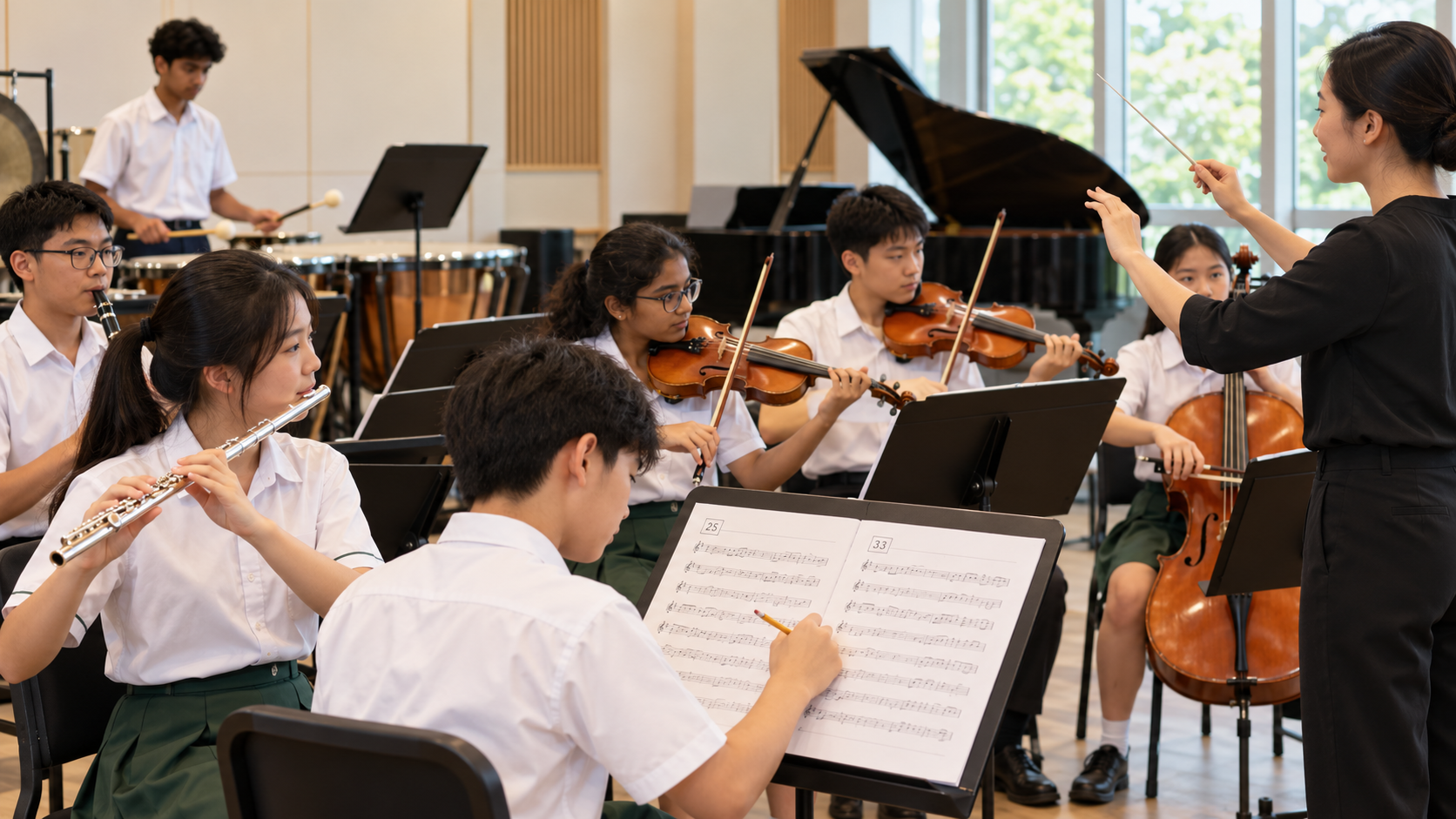
G1 Music is an SEC subject, not simply a school club or performance exam. In Singapore’s 2027 Secondary Education Certificate, the subject uses syllabus K128. Students learn to listen attentively, understand music from different traditions, arrange and perform musical material, and create a short original cue for film or television using appropriate music technology.
The distinction between listening and creating is central to the examination. Paper 1, a one-hour listening examination, accounts for 40%. Paper 2 is creating-and-performing coursework worth 60%, divided between an arrangement with a live performance and an original short film or television cue. Students who practise only their instrument while ignoring listening, digital production and explanation will not be preparing for the complete subject.
This independent eduKateSG guide explains the actual requirements, the musical decisions behind them and how to practise without turning music into a list of genres to memorise. It includes original learning illustrations, realistic problem diagnosis and a four-week routine. Only the official SEAB syllabus and the school’s supervisor determine authentic examination work.
Quick answer: K128 Paper 1 is one hour of recorded-extract listening (40 marks, 40%). Paper 2 is 60% coursework over about five months with 30 hours of supervision: Task 1 arrangement plus a live recorded part (40%), and Task 2 an original 30-second instrumental cue for a given film/TV clip with a short supporting note (20%).
Check SEAB’s official 2027 K128 syllabus PDF and the G1 subject list. This is independent educational commentary, not an official MOE/SEAB publication.
Contents — choose the section you need
- What G1 means
- 2027 examination format
- How the subject works
- Two worked examples
- Common mistakes
- Four-week plan
- How parents and teachers can help
- Frequently asked questions
- Official sources and next steps
G1 Music under Full Subject-Based Banding
The 2027 Singapore-Cambridge SEC replaces separate GCE O-Level, N(A)-Level and N(T)-Level certification arrangements. The qualification shows the level at which each subject is taken: G1, G2 or G3. The level of Music does not label the whole child and does not automatically decide the level of other subjects.
The published SEC 2027 code for this subject is K128. Families should check the actual syllabus and school registration rather than use general ‘secondary’ revision advice. A school test may have a different format from the final national SEC assessment.
A useful learning question is not simply ‘Can my child remember the answer?’ It is ‘Can my child explain a relevant principle and use it in a changed situation?’ That distinction helps parents respond to confusion constructively.
The official K128 examination papers
| Component | Marks and time | What is required |
|---|---|---|
| Paper 1 — Part A | 20 marks; 20% | 20 multiple-choice questions using 8–10 recorded music extracts of about 20–40 seconds each. |
| Paper 1 — Part B | 20 marks; 20% | 12–16 one-word or short-answer questions using 4–6 recorded extracts of about 20–40 seconds each. |
| Paper 1 total | 40 marks; 40%; 1 hour | Listening across the four Areas of Study. Extracts accessed on a school laptop/headphones; internet access disabled. |
| Paper 2 — Task 1: Creating and Performing | 40 marks; 40% | Produce a 1–2-minute song or instrumental arrangement in an eligible Area of Study and record the candidate performing one part live, with required authentication evidence. |
| Paper 2 — Task 2: Creating and Evaluating | 20 marks; 20% | Produce an original 30-second instrumental music cue for one provided film/television context; synchronise it with the clip and explain choices in a supporting note of no more than 100 words. |
| Paper 2 total | 60 marks; 60%; about 5 months | Coursework completed with 30 hours of supervised time under the direct supervision of the school’s G1 Music teacher. |
The syllabus says candidates must be under the direct supervision of a G1 Music teacher in their own school. For Paper 1, recordings can be played repeatedly during the examination according to the published format, but students should confirm operational instructions. Task 1 is an arrangement rather than a requirement to write an entirely original song. Task 2 specifically requires an original cue, without excerpts from existing music. The permissible use of loops and tools has conditions; copied background music and automatic accompaniment are not a substitute for a candidate’s work.
The external assessment scheme is official, but real coursework, lab work and permitted tools remain subject to examination and school instructions. Nothing in this independent guide authorises a candidate to use outside assistance or restricted material.
How G1 Music actually works — principles and practice
Each skill below is explained through the learner’s decisions. Understanding tends to improve when learners identify what information is relevant, try an action and check whether the outcome fits the task. The most useful feedback names the exact decision that needs repair.
Listen actively instead of guessing the genre
Recognising a song is not the same as understanding what makes its sound distinctive. Active listening means noticing pulse, rhythm, texture, instrument roles, changes in dynamics and how the musical idea develops. A student who merely says ‘this is rock’ may miss the evidence that a question asks them to identify.
Take a short permitted practice recording or a teacher-composed excerpt. First describe what is audible in ordinary words: regular beat, repeated phrase, prominent percussion, change from soft to loud. Only then connect the observations to musical terms or an area of study.
Pulse, rhythm and tempo are related but different
Pulse is a recurring beat that listeners can follow; rhythm describes how sounds are placed in time; tempo describes how quickly the beat moves. Students may notice a rapid drum pattern and automatically call the underlying beat fast, even when the pulse remains moderate.
Ask a student to tap the steady pulse while listening to an original short percussion pattern. Discuss whether some sounds occur between the taps. Speed up the taps without changing their relative rhythm and describe what changes.
Timbre and texture explain how a musical sound is built
Timbre refers to the character of a sound, while texture concerns how many musical layers are present and how they interact. The same melody can have a very different character when played on a muted instrument rather than a bright electronic sound.
Use two school-approved sound sources playing an original three-note idea. Compare what each adds to the mood. Then add a bass or accompanying line and listen for what changes in the relationship among the parts. Explain the actual audible difference rather than claiming one instrument always sounds happy.
Music from 2000 onwards should be understood, not just named
The syllabus includes pop, rock, R&B and electronic dance remix in its popular-music study. These categories overlap and evolve. Recognising a label is less useful than noticing genre-relevant features of beat, instrumentation, vocal style or production.
Discuss how a rhythmic groove, percussion pattern or arrangement supports a particular style. Where official indicative repertoire includes copyrighted works, listen through authorised sources and analyse short permitted examples rather than copying audio into a new project.
Western programme music connects sound with an idea
Programme music can suggest scenes, characters or events, but students need to support an interpretation through audible details. A sudden dynamic contrast may suggest a dramatic change; a register shift may draw attention. These are compositional possibilities, not universal translations.
Give two learners different descriptions of a short teacher-composed passage, then ask which evidence in the music makes one explanation more plausible. The goal is to reason from sound to interpretation, not insist that one sound always corresponds to one image.
Film and television music serves the picture
A cue should fit the emotional or dramatic situation and its timing. Music may begin quietly, change when an action occurs or leave space for dialogue. A strong short cue does not require dozens of tracks; it requires musical decisions appropriate to what appears on screen.
In a fictional silent clip of a person searching for a missing key, mark important moments: entrance, discovery and resolution. Describe where a cue could change in texture or energy. These are practice decisions for an invented scene, not a solution to an official coursework brief.
Local musical traditions have their own context
G1 Music also examines Malay, Chinese and Indian ensemble traditions in Singapore. Learning them responsibly means recognising instrumentation, musical roles, context and cultural significance without reducing every tradition to one stereotype or one instrument.
When studying an approved recording, identify audible instruments or musical relationships, then consider the social setting and whether the source is reliable. The student should distinguish a specific ensemble from a claim about all music made by an entire community.
Arranging begins with the role of each part
Task 1 requires a 1–2-minute arrangement of a song or piece of instrumental music from eligible study areas. The required arrangement includes melody, harmony, bass line and, when appropriate, percussion. Additional parts are optional. More tracks are not necessarily better.
For an original or appropriately selected study melody, draw a plan: opening, main phrase and ending. Give the bass a supporting job and ensure harmony does not bury the melody. Ask whether each part contributes a musical purpose. Work within the teacher’s approved material and assessment scope.
Performing live means demonstrating an independent musical part
The Task 1 performance is not just pressing play on a pre-recorded file. The candidate performs one part live, records it into the digital audio workstation and submits the required authenticating evidence. The performed part should not simply duplicate another part.
During permitted practice, use an original backing idea and perform a simple distinct line while staying in time. Listen back for rhythm, clear starts and musical expression. Choose practice targets based on the student’s actual current skills rather than demanding concert-level technique.
DAW skill is a means to realise music
A digital audio workstation lets a learner record tracks, arrange clips, edit timing and mix audio. It is possible to create a complicated project that sounds muddy. Organisation and sensible balance matter more than using every available plug-in.
Create a practice project with clear track names. Check the relationship of melody, accompaniment and bass, and keep levels balanced. Export a short test, play it back through another listening device and verify that no important layer disappears.
Task 2 originality matters
The Task 2 cue is a 30-second original instrumental piece synchronised to a provided clip. It cannot contain excerpts of existing songs or music. The published syllabus permits certain DAW tools and loops but restricts automatic accompaniment and existing background tracks. Copyright compliance and coursework originality should be treated as separate responsibilities.
Instead of copying a recognisable theme from a film, design a short musical gesture for an imaginary visual action: a two-note rise, a contrasting register and a quiet resolution. Explain the reasoning in words. Do not compose or submit authentic examination material on behalf of a candidate.
The supporting note should explain decisions, not retell the video
Task 2 requires a brief note, capped at 100 words, explaining the musical choices for the film/TV context. A paragraph that only recounts ‘someone walks into a room’ does not show why the cue uses a particular texture, timbre or change.
A practice explanation could say that the music thins when the character pauses, leaving room for the scene to feel uncertain, then adds a brighter layer at the resolution. Name what is audible and how it serves the picture. Keep the statement connected to what was actually produced.
Exam listening strategy is about evidence
The listening paper uses extracts with multiple-choice and short-answer questions. Students need a routine for separating what they hear from what they assume. Even a familiar sound may be part of a different musical texture in the given excerpt.
Before answering, identify the exact feature the question asks about. Listen once for the whole and again for the target feature if permitted. For short answers, use a precise term, not a long unsupported story. Review wrong answers by locating what was actually heard.
Two worked examples
These situations were invented for teaching. They are not SEAB questions, model answers from an actual examination or permission to complete assessed coursework.
Worked example: why a quieter middle section can help
An original classroom exercise arranges a short melody for a fictional school film. The music begins with a simple beat and melody, then removes percussion while a character is thinking, before returning to a fuller texture.
A student can justify this decision: thinning the texture makes the pause noticeable; the return of the rhythm signals movement. The exercise connects musical features to meaning without copying an existing commercial cue.
Worked example: identify the role of a bass line
An original music practice has a short melody in a high register and a low part repeating on strong beats. The student is asked why the low part was added.
A reasonable answer is that it provides low-register support and helps establish the harmonic foundation and rhythmic structure. ‘It makes the song better’ is too vague because it does not refer to an audible feature.
What mistakes tell us about the real difficulty
| Observed difficulty | Likely misconception | Better next step |
|---|---|---|
| Names genres without hearing the relevant features | Recognition is replacing analysis | Describe rhythm, timbre or texture first, then justify the genre label. |
| Adds too many tracks to an arrangement | No clear role or musical balance | Name the purpose of each part and remove unnecessary layers. |
| Records a performance that duplicates another track | Live-performance requirement misunderstood | Create a distinct live part and confirm the arrangement with the teacher. |
| Uses a recognisable soundtrack theme in Task 2 | Originality requirement overlooked | Create an independent cue without excerpts of existing songs. |
| The music seems unrelated to the picture | No mapping from cues to moments | Mark important visual events and align audible changes with them. |
| Supporting note describes only the scene | Musical decisions are unexplained | Name the cue’s timbre, texture, rhythm or dynamics and their purpose. |
| Leaves audio export unchecked | Production verification is weak | Play the rendered file and confirm timing, balance and required format. |
Record the mistake, the reasoning behind it and a corrected independent attempt. After several days, try a different example with the same underlying structure. A method is not secure when the student can only repeat the original corrected answer.
Four-week learning plan
This is a home-study and general-learning example, not an official coursework schedule or a guarantee of a particular grade. Follow the school for examination tasks and keep assessed work authentic.
Week 1 — Listen with a purpose
Compare authorised short excerpts from different study areas, recording one audible observation and one supported explanation per excerpt.
Week 2 — Understand musical roles
Create an unassessed short original musical sketch with melody, bass and accompaniment, identifying the musical job of each track.
Week 3 — Practise performance and technology
Record a simple distinct part in a school-approved DAW practice environment, refine timing and export an audio file. Verify the result independently.
Week 4 — Link sound to a picture
Use an invented short silent clip, identify three visual events and create a brief original practice cue, then write a concise explanation. Do not pre-complete or imitate the actual SEC coursework.
The small learning loop to use each week
- Recall one idea from the previous lesson without notes.
- Attempt a short, new application using that idea.
- Explain one reason why an answer or choice is justified.
- Log one point of confusion, then revisit it on another day.
- Review genuine school feedback before increasing the workload.
How parents, school teachers and tutors can help
A learner may need foundation repair, more stable retrieval or thoughtful extension. These are different needs. Ask where understanding first breaks down instead of prescribing a large pile of practice papers. Improvement can come from more precise feedback, not simply more hours.
The immutable Secondary 1 Mathematics Tutor Clementi small-group teaching reference informs the structure of this series. Its clear reader purpose, first-principles explanation, close attention to misunderstanding and practical study advice provide a model for helpful educational writing. This Music guide retains those strengths without copying Mathematics content or implying that Google rankings are guaranteed by a particular page structure.
eduKateSG’s three-student tutorials are a possible form of additional support, but students who make steady progress with school teaching and an appropriate independent routine need not add tuition. Parents and external tutors should teach the skills, not create or edit the candidate’s genuine SEC coursework. School supervisors control assessment authenticity.
Frequently asked questions
What is the official G1 Music code in SEC 2027?
K128, according to the 2027 SEAB syllabus.
Is there a listening examination?
Yes. Paper 1 is a one-hour recorded-extract listening paper worth 40%.
How much is Music coursework worth?
60%, divided into Task 1 arrangement and live performance (40%) and Task 2 original cue and explanation (20%).
Does the student need to be a concert-level performer?
The syllabus describes a basic level of technical competency for the live part; musical understanding, accuracy and the ability to communicate an idea matter as well.
Must Task 1 use an original song?
No. It asks for an arrangement of an eligible selected song or piece of music, while Task 2 requires an original instrumental cue.
Can a student use existing film music for Task 2?
No. The cue must be original and must not feature excerpts of existing songs or music; consult the detailed restrictions in the K128 syllabus.
Does music-production software replace the live performance?
No. The Task 1 arrangement includes a distinct part performed and recorded live by the candidate.
Can a parent or private music teacher produce the coursework?
No. The assessed work is the candidate’s own, under the school Music teacher’s direct supervision. Outside support should remain skill-building, not authorship.
Does G1 limit all future options?
G1 identifies the level of a particular SEC subject, not an entire person’s potential. Post-secondary choices depend on the student’s complete results and the latest individual course requirements.
What should I do if my child is struggling?
Find one representative question or task the student cannot complete independently. Identify whether the difficulty is understanding the instructions, content knowledge, a practical method, confidence or time management. Use the evidence to speak with the school teacher before buying more materials.
Official references and further reading
- SEAB official SEC 2027 K128 syllabus (PDF)
- SEAB 2027 G1 syllabus index
- SEAB Secondary Education Certificate overview
- eduKateSG all-subject syllabus directory
- Related G1 Music parent guide
- Immutable Clementi tutoring reference
Beyond the examination: Music education teaches people to hear relationships, make creative decisions and communicate emotion and culture through sound. Those skills have value even beyond a music examination.
Request an eduKate Singapore parent–student consultation · Contact eduKateSG
Reviewed on 4 November 2026 using published SEAB 2027 SEC syllabuses. The official papers and school notices govern if information changes. Examples are original teaching illustrations.