
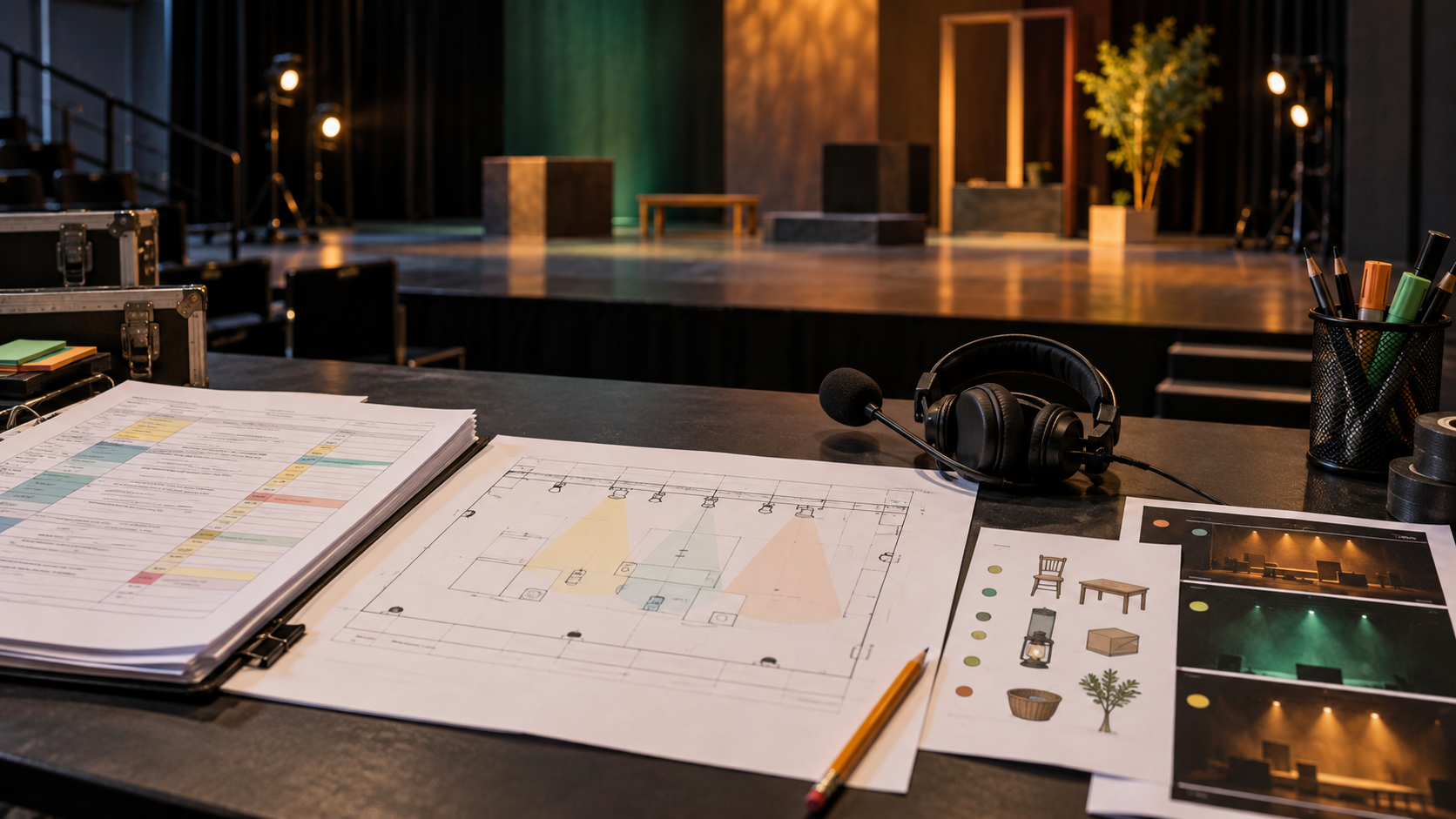
G3 Drama’s Group Devised Piece is part of Paper 2 Coursework in the 2027 SEC syllabus K352. It must be an original live-stage performance created by a group of two to five candidates, lasting no more than 15 minutes and allowing each candidate broadly equal exposure. It is not an improvised film, a written essay or a pre-existing play pasted together from online scripts. The teacher chooses a stimulus; candidates devise their own subject, style, characters, structure and intention from it.
The overall K352 Drama result is Written Examination 40% (80 marks) and Coursework 60% (120 marks). Coursework comprises an individual scripted performance (45 marks), a group devised performance (45 marks) and a Development Journal (30 marks: 20 associated with the individual piece and 10 with the group’s process). The Group Devised Piece is therefore 45 of the 120 coursework raw marks, with an additional individual reflection on that piece within the journal. All practical work is staged for a live audience and video recorded for moderation, but must be conceived for theatre rather than film.
SEAB’s 2027 K352 rules require candidates to declare their coursework as their own and expressly disallow work published or assisted by others, including work created using Artificial Intelligence. This guide therefore teaches the underlying acting, devising and evaluative principles through a fictional non-assessed classroom example. It does not provide a script, journal entry or performance plan for an actual candidate’s assessed piece.
- SEC subject: G3 Drama K352 (2027 revision).
- Paper 1 Written: 2 hours, 80 marks, 40%.
- Paper 2 Coursework: 120 raw marks, 60%, internally assessed and externally moderated.
- Group Devised Piece: original teacher-stimulated stage piece, 2–5 candidates, max 15 minutes, broadly equal exposure.
- Group performance marks: AO1 15 + AO2 30 = 45 raw marks.
- Development Journal: group-contribution evaluation 10 raw marks; individual scripted process evaluation 20 more.
- Individual Scripted Performance: 3–5 minutes, 45 raw marks in the same coursework.
- Integrity: live stage focus, video for moderation, candidate’s own unaided contributions, no AI-created assessed work.
Official syllabus: SEAB 2027 G3 Drama K352 Paper 2 Coursework, devising and Development Journal guidance and SEAB 2027 G3 school-candidate subject directory. This is independent educational explanation, not an approved stimulus or candidate submission.
Quick answer: what the Group Devised Piece involves
A teacher supplies a suitable stimulus, and two to five candidates develop an original live dramatic work of no more than 15 minutes. Each candidate must contribute meaningfully, perform to a live audience, demonstrate understanding of dramatic conventions and physical/vocal control, and evaluate their own contribution through the authentic Development Journal. Individual marks are assessed even though the work is created with a group.
Where the Devised Piece fits in the whole Drama qualification
K352 Drama assesses both analytical thinking and practical performance. Paper 1 is a two-hour, 80-mark written examination worth 40%; it includes an unseen extract, a pre-release extract and written evaluation of work done on the pre-release material. Paper 2 is coursework worth 60%, bringing together an individual published-play extract, original group devising and individual journal reflection.
These are separate tasks. The Group Devised Piece is not the individual scripted extract, and the Development Journal is not a shared group diary written by one designated classmate. The coursework is marked candidate by candidate under official criteria even when a group performs together.
The source states that the pre-release written-examination material is issued to schools in the May preceding the exam and should be studied and rehearsed informally for analysis. That material is not necessarily the same as the teacher-selected stimulus for the Paper 2 Group Devised Piece. Mixing the two creates avoidable confusion.
Official K352 assessment requirements
Paper 1 Written Examination: 2 hours, 80 marks, 40%. Section A has three compulsory ten-mark questions about an unseen extract (30 marks). Section B uses a pre-release play extract with one five-mark, one ten-mark and one chosen fifteen-mark question (30). Section C uses two ten-mark questions evaluating rehearsals/informal performance on pre-release material (20).
Paper 2 Coursework: 120 marks, 60% of the overall grade, internally assessed and externally moderated. It requires the Individual Scripted Performance, Group Devised Piece and Development Journal. Each is a distinct source of marks and a distinct authentic learning process.
Group Devised Piece: one original work developed by two to five candidates. The planned performance is no longer than 15 minutes, with broadly equal candidate exposure. The teacher provides the stimulus. The candidates themselves decide subject matter, style, characterisation, structure and intended effect.
Group performance marking: AO1 Knowledge and Understanding carries 15 raw marks and AO2 Application of Drama Skills carries 30, totalling 45. Students are individually assessed for understanding, dramatic relationships, vocal/physical skills, ensemble work and communication with a live audience.
Development Journal: each candidate completes their own journal covering both the individual scripted and group devised processes, including evaluation after the final performance. AO3 Analysis/Evaluation is 20 marks for individual scripted work and 10 for the group devised contribution.
Individual Scripted Performance: a distinct extract selected by the teacher from an existing published full-length stage play. The planned duration is 3–5 minutes and the marks are AO1 15 plus AO2 30. A classroom mini-play written purely for the exam is not the intended source of this separate component.
Stimulus examples: the teacher may use music, an article, picture, poem, sculpture, an issue such as inequality or community, or a dramatic performance style. These examples are not an exhaustive list. The group should not use this guide’s fictional example as though it were the official teacher stimulus.
Live-theatre requirement: the group work must be created for live performance in an appropriate space. Video recording is used for moderation, but the piece must not be conceived or assessed as a film or television scene.
Integrity declaration: candidates complete the official declaration that coursework is their own and does not contain published or externally assisted work, including content created with AI. A tutor, parent or AI writer cannot prepare the assessed plot, dialogue, staging, characters or journal on their behalf.
Teacher and journal responsibility: the syllabus allows authentic planning activity under its course guidance and requires teachers to provide appropriate consultation while ensuring the journal is completed without external assistance. The precise school timetable and submission method should be followed.
Mark-total caution: the group’s 45 raw performance marks are part of the 120 coursework marks, which contribute 60% to the subject grade. Do not call the group piece 45% of the whole SEC result or add the journal’s ten marks as another independent national paper.
First principles of creating dramatic meaning for an audience
1. Devising starts with a stimulus, not a ready-made script
A devised work grows from a source or question, not from taking a published play and changing the names. The teacher’s chosen stimulus invites candidate-led exploration, research, improvisation and decisions about meaning.
In ordinary, non-assessed training, discuss how one image could provoke different questions without writing a candidate’s real plot. The actual teacher-issued stimulus and each group’s decisions must determine its assessed piece.
- Identify what the audience can actually observe
- Explain the intended dramatic effect and evidence
- Protect original candidate-led live-stage devising
2. Drama is an action performed for an audience
A dramatic idea becomes theatre when performers communicate through actions, relationships, voice, space and time before people who interpret what they see. Merely describing a theme in an essay is not the same as staging a meaningful experience.
Ask what the audience can actually observe, rather than what the candidate intends privately. If a relationship is important, performers need stage actions or interactions through which it becomes perceptible.
- Identify what the audience can actually observe
- Explain the intended dramatic effect and evidence
- Protect original candidate-led live-stage devising
3. The intended audience shapes choices
A live audience may include peers, teachers or a broader group within the production’s actual arrangements. Their knowledge, sightlines, listening conditions and expectations affect how drama can communicate.
Practise identifying audience needs in a fictional theatre workshop. A quiet gesture might be effective up close but invisible in a large space; the performance context matters.
- Identify what the audience can actually observe
- Explain the intended dramatic effect and evidence
- Protect original candidate-led live-stage devising
4. Characterisation grows from objective and obstacle
A character is not merely a name and a personality adjective. In drama, an actor’s objective, obstacle, action and changing relationship help shape the scene. Characters can contradict what they say through body and voice.
In a generic workshop, ask why one performer approaches or avoids another and what action shows the relationship. Do not generate the assessed group’s characters or dialogue.
- Identify what the audience can actually observe
- Explain the intended dramatic effect and evidence
- Protect original candidate-led live-stage devising
5. Conflict must create a change, not only noise
Raising voices or staging an argument does not automatically create dramatic conflict. The important question is what the characters want, why their aims are incompatible and what changes because of their choices.
Discuss cause, stakes and progression with a separate invented scenario. A scene that begins and ends at exactly the same relationship may need clearer development.
- Identify what the audience can actually observe
- Explain the intended dramatic effect and evidence
- Protect original candidate-led live-stage devising
6. Ensemble work depends on listening
Performers need to respond to others’ timing, gesture, emotional changes and physical position. A student who delivers an excellent individual speech but ignores the rest of the group may weaken the dramatic effect.
In a non-assessed workshop, practise attention and cue response with simple neutral actions. The actual assessed exchange must be devised by the group itself.
- Identify what the audience can actually observe
- Explain the intended dramatic effect and evidence
- Protect original candidate-led live-stage devising
7. Equal exposure is not necessarily identical word count
The syllabus requires broadly equal exposure for every candidate, but dramatic contribution can include meaningful physical action and ensemble roles as well as spoken lines. A group should not simply divide dialogue into equal-length blocks with no artistic reason.
During authentic planning, students should consider whether each candidate has sufficient opportunity to demonstrate meaningful drama skills. The teacher’s guidance and assessment criteria govern the actual work.
- Identify what the audience can actually observe
- Explain the intended dramatic effect and evidence
- Protect original candidate-led live-stage devising
8. Voice carries more than spoken words
Projection, pitch, pace, pauses, emphasis and articulation can create relationships and intentions. A student who speaks loudly throughout may lose nuance, while a consistently quiet delivery can fail to reach a live audience.
Practise vocal control using non-assessed, self-generated neutral language, and ask what effect a change in pace or emphasis creates. Do not rehearse AI-generated lines as part of the examined group piece.
- Identify what the audience can actually observe
- Explain the intended dramatic effect and evidence
- Protect original candidate-led live-stage devising
9. Physical expression can communicate unspoken meaning
Posture, gesture, gaze, distance and movement can show status, fear, trust or hesitation without explanatory dialogue. The audience interprets the performer in the context of relationships and staging.
In an unrelated classroom workshop, experiment with distance or orientation in a neutral situation. Analyse why an action might create an impression without turning every posture into a universal symbol.
- Identify what the audience can actually observe
- Explain the intended dramatic effect and evidence
- Protect original candidate-led live-stage devising
10. Proxemics explains relationships in space
Proxemics considers how physical distance and position can communicate relationships. Moving close to another person can imply support, pressure or confrontation depending on the scene and performance context.
Ask what the audience knows when a performer changes distance. A good analysis states what happened and why that action might support the intended tension, rather than reciting the definition of proxemics.
- Identify what the audience can actually observe
- Explain the intended dramatic effect and evidence
- Protect original candidate-led live-stage devising
11. Blocking must be practical and purposeful
Blocking describes where performers move and stand. A visually elaborate sequence can obscure the audience’s view or make the purpose of an action unclear if changes in space lack intention.
In a separate workshop, sketch broad sightline problems and discuss alternative arrangements. The examined staging remains the group’s own creative decision within an appropriate live space.
- Identify what the audience can actually observe
- Explain the intended dramatic effect and evidence
- Protect original candidate-led live-stage devising
12. Dramatic form gives the audience structure
Scenes may develop chronologically, contrast viewpoints or shift in time. A dramatic piece still needs a clear enough progression that the audience can follow the important changes. Experimentation without meaningful organisation may become confusing.
Analyse published plays or fictional non-assessed outlines for opening, development and ending. For coursework the group must decide its own structure based on its teacher’s stimulus.
- Identify what the audience can actually observe
- Explain the intended dramatic effect and evidence
- Protect original candidate-led live-stage devising
13. Time limits influence what the piece can contain
A maximum of fifteen minutes gives limited space for a large cast of fictional characters, multiple locations or lengthy exposition. A strong work can focus on one conflict or a manageable sequence rather than many disconnected scenes.
Discuss how pacing affects comprehension in a generic rehearsal exercise. An overcomplicated plot may reduce each candidate’s opportunity to demonstrate acting and ensemble skills.
- Identify what the audience can actually observe
- Explain the intended dramatic effect and evidence
- Protect original candidate-led live-stage devising
14. Rehearsal is an investigation, not repetition alone
Repeating a scene exactly can help memory and timing, but improvement often depends on questioning whether the action communicates its intended effect. A useful rehearsal tests a choice, observes a result and considers a change.
Keep honest candidate-authored observations and use teacher consultation as authorised. Do not have an external coach create a finished performance solution for the assessed group.
- Identify what the audience can actually observe
- Explain the intended dramatic effect and evidence
- Protect original candidate-led live-stage devising
15. Improvisation explores possibilities
Improvisation can help performers discover objectives, relationships and unexpected responses. It is a method for exploration rather than permission to avoid planning or to present an incoherent improvised performance as a complete piece.
In a non-assessed workshop, practise listening and accepting relevant information from another performer. For the real coursework, all generated material must be candidate-led and appropriately original.
- Identify what the audience can actually observe
- Explain the intended dramatic effect and evidence
- Protect original candidate-led live-stage devising
16. Tension can be built through restraint
Silence, delayed response, physical separation or a change in pace may create tension without shouting. The dramatic effect depends on context and how the audience reads the relationship.
Compare two fictional stage descriptions and ask what different information each makes visible. There is no universal rule that louder, faster or more emotional is always stronger.
- Identify what the audience can actually observe
- Explain the intended dramatic effect and evidence
- Protect original candidate-led live-stage devising
17. Symbolic objects need an interpretable role
A chair, book, ticket or piece of fabric can take on meaning when connected to action and narrative development. An object placed on stage purely as decoration does not automatically become a powerful symbol.
Explain what the audience knows about the object and how its use changes. Do not assign fixed universal symbolism divorced from the actual piece.
- Identify what the audience can actually observe
- Explain the intended dramatic effect and evidence
- Protect original candidate-led live-stage devising
18. Music, light and sound are resources with limits
Sound and lighting can support mood or transitions, but technical complexity is not proof of dramatic quality. A sound cue that distracts from dialogue or cannot be executed safely may weaken the live experience.
Use available school resources responsibly and lawfully. A candidate should be able to explain why a technical choice supports the group’s own intention instead of relying on an expensive effect to create meaning.
- Identify what the audience can actually observe
- Explain the intended dramatic effect and evidence
- Protect original candidate-led live-stage devising
19. Costume and props serve character and context
Costume and props can signal period, status or practical action. Their usefulness depends on the style and what the audience needs to understand. Excessive realism may not be needed for an abstract devised work.
Analyse the general relationship between a prop and a stage action in non-assessed teaching. Authentic assessed props and choices belong to the candidates and their authorised production arrangements.
- Identify what the audience can actually observe
- Explain the intended dramatic effect and evidence
- Protect original candidate-led live-stage devising
20. Devised drama can address sensitive issues responsibly
A teacher may select a social or cultural issue as stimulus. Candidates should avoid stereotyped portrayals or unsupported claims about real communities. A fictional narrative can explore differing perspectives without pretending to speak for everyone.
Discuss accuracy, respect, consent and audience impact with school guidance. The purpose is meaningful drama, not sensationalism or partisan advocacy.
- Identify what the audience can actually observe
- Explain the intended dramatic effect and evidence
- Protect original candidate-led live-stage devising
21. Audience reaction is evidence with limitations
A workshop sharing to peers may reveal that a particular action is unclear or a scene’s pacing loses attention. Feedback is valuable but not a universal verdict about every possible audience.
Distinguish direct observation from one spectator’s opinion and record only genuine feedback. The real coursework journal must not invent a test audience or fabricate comments.
- Identify what the audience can actually observe
- Explain the intended dramatic effect and evidence
- Protect original candidate-led live-stage devising
22. Reflection explains an action and its consequence
The Development Journal should analyse what a candidate actually contributed, why they made choices, how rehearsal affected the work and whether intended effects were achieved. A chronological list of rehearsals without evaluation is less informative.
For generic learning, practise naming a decision, reason, observed response and possible improvement. The assessed journal must be independently completed by the candidate and never ghostwritten.
- Identify what the audience can actually observe
- Explain the intended dramatic effect and evidence
- Protect original candidate-led live-stage devising
23. Individual responsibility remains within a group
Group devising is collaborative, but each candidate is individually assessed. One performer who does all the planning or takes every prominent moment can limit others’ exposure and undermine the process.
In the actual group, candidates should share decision-making fairly within teacher guidance. Outside adults must not allocate roles or write dialogue that students present as their own invention.
- Identify what the audience can actually observe
- Explain the intended dramatic effect and evidence
- Protect original candidate-led live-stage devising
24. Live theatre differs from filmed performance
A camera can change the audience’s attention through framing, edits and close-ups. The official K352 coursework must be conceived for a live audience and an appropriate performance space; video is for external moderation.
Plan and rehearse the theatrical relationship between performers, space and audience. Do not create a film with edits as a substitute for the live piece.
- Identify what the audience can actually observe
- Explain the intended dramatic effect and evidence
- Protect original candidate-led live-stage devising
25. The individual scripted piece is a separate task
The same coursework includes a three-to-five-minute extract from an existing published stage play, chosen by the teacher. A group-created script does not automatically satisfy that requirement.
Keep distinct records and preparation for individual scripted and group devised components. The journal addresses both, but each involves different source material and assessed decisions.
- Identify what the audience can actually observe
- Explain the intended dramatic effect and evidence
- Protect original candidate-led live-stage devising
26. The pre-release extract belongs to the written paper
The written exam includes a pre-release play extract studied and rehearsed informally; questions evaluate the actor/director’s response and rehearsal decisions. This is not necessarily the teacher’s chosen stimulus for the original group devised coursework.
Identify the correct paper number and material before practice. Do not let a student answer Section C of Paper 1 with unrelated group-devised experience if the question concerns pre-release rehearsal.
- Identify what the audience can actually observe
- Explain the intended dramatic effect and evidence
- Protect original candidate-led live-stage devising
27. The journal should record real process, not imagined excellence
The syllabus expects evaluation of the candidate’s actual contribution after the group performance. A polished fictional account of successful collaboration is misleading if rehearsals revealed different challenges.
Describe only what occurred, the choices personally made and genuine evidence of effects. The declaration expressly rules out externally authored or AI-created coursework.
- Identify what the audience can actually observe
- Explain the intended dramatic effect and evidence
- Protect original candidate-led live-stage devising
28. External AI or published material cannot be incorporated as candidate work
The 2027 K352 coursework declaration states that submitted work contains no published or externally assisted material, including AI-created work. This is stricter than a generic suggestion to acknowledge a borrowed script.
Use AI for general subject understanding only, where school rules permit; do not use it to create assessed plot, dialogue, scenes, characters, journal sections or performance choices. Ask the school about any procedural uncertainty.
- Identify what the audience can actually observe
- Explain the intended dramatic effect and evidence
- Protect original candidate-led live-stage devising
29. A strong performance is not only technical control
Good projection and movement matter, but they must serve the dramatic situation, ensemble relationships and intended audience effect. A technically impressive moment unrelated to the piece can weaken overall coherence.
In independent skills practice, connect technical action to dramatic intention and revise choices when they do not communicate. The assessed piece should be evaluated honestly against these principles.
- Identify what the audience can actually observe
- Explain the intended dramatic effect and evidence
- Protect original candidate-led live-stage devising
30. Coursework is part of a wider assessed discipline
Drama involves interpretation, analysis, creation, performance and reflection. The Devised Piece is important but does not replace 40% written analysis or the individual scripted and journal elements within 60% coursework.
Schedule appropriate practice for both papers and respect each component’s authenticity rules. A full course grows an independent performer and critical reader, not only a confident stage presence.
- Identify what the audience can actually observe
- Explain the intended dramatic effect and evidence
- Protect original candidate-led live-stage devising
An original non-assessed workshop example, not a stage script
1. A fictional classroom-only situation
Imagine a separate ordinary Drama lesson about a community centre’s noticeboard being moved and a newcomer struggling to find an activity. The teacher asks students to think about what theatrical decisions might communicate uncertainty and helpfulness. This is not K352’s actual assigned stimulus.
The educational goal is to practise observing dramatic choices, not to supply a plot or finished script for the candidate’s assessed Group Devised Piece.
2. Identify an audience question
A spectator would need to understand that one person is unfamiliar with the environment while another possesses local knowledge. How might a performer communicate that relationship without narrating it verbally?
This is a question about readable stage action. The real coursework group must invent its own characterisation and structure.
3. Compare proxemics conceptually
A wide distance between two imaginary people might suggest unfamiliarity; a reduced distance after an offer of help might suggest growing trust. But distance can have different meanings under other circumstances, and the context must support the interpretation.
The pupil should explain what stage movement could indicate and how an audience would know its significance. It is not a prescribed blocking diagram.
4. Think about vocal choices, not copied dialogue
A hesitant speaking pace and later clarity could show changing confidence, but the effect depends on the performer’s intention and how the audience sees the action. A stage direction is meaningful only if it helps communicate the relationship.
Do not ask AI or an external adult to write lines for the student’s real devised piece. Discuss general vocal technique using unrelated neutral examples.
5. Identify an objective and obstacle
The fictional newcomer wants to find an event but cannot interpret the rearranged noticeboard. That is a basic objective and obstacle; the learner can discuss why audience knowledge matters and how a scene might make the situation visible.
A dramatic objective is not the same as a detailed script. The actual assessed plot and creative choices must come from the group itself.
6. Check what a prop does
A noticeboard could be simply scenery, or it could provide information the audience notices before the character does. Its function depends on how performers interact with it. The question is what new information the object makes available.
Avoid assuming that every object is a symbol. A prop should have a specific role in the intended live scene rather than be added for visual density.
7. Consider accessibility and stage space
In a hypothetical workshop, moving a noticeboard into a narrow path might obstruct performance movement or sightlines. The best solution depends on space and safety, not dramatic aesthetics alone.
Real coursework staging requires school-approved performance arrangements. A generic teaching example is not a safety certification for an actual venue.
8. Reflect on an imagined rehearsal limitation honestly
If a classroom demonstration showed that a subtle gesture was not visible to peers sitting far away, the learner could discuss why a clearer movement might be considered. But since this exercise is fictional, it cannot be recorded as an event that actually happened in the candidate’s journal.
The real Development Journal must refer only to authentic rehearsals, personally made decisions and actual feedback.
9. Distinguish physical change from dramatic development
A character walking from one side of the stage to another is movement, but not necessarily story development. Dramatic development requires a shift in knowledge, intention, relationship or circumstance.
A student should ask how the imaginary audience’s understanding changes because of the action, not merely count gestures and entrances.
10. Analyse group exposure rather than equal monologues
Imagine a workshop with three participants. It could give each person a meaningful stage function without dividing lines into mechanically equal thirds. The important question is whether each has an appropriate opportunity for expressive work.
The official group piece uses two to five candidates and broadly equal exposure. Authentic decisions about the real work remain with the candidates under teacher guidance.
11. Practise general evaluation language
A neutral learning statement might be: ‘The intended effect was uncertainly communicated because the audience could not see the gesture; a more visible action might help.’ This is an illustrative method, not a completed candidate journal paragraph.
The assessed journal must be written unaided by the candidate based on actual work and cannot copy this hypothetical account as if it were evidence.
12. Transfer to an unrelated setting
Ask the student to consider a fresh neutral workshop situation involving a queue, community event or shared public space. They should independently identify objective, relationship, dramatic action and a plausible audience effect.
This demonstrates that the pupil understands the logic of theatre-making without needing an externally written real coursework plot.
13. Revisit the correct mark categories
In the actual Paper 2, group devised work is assessed for AO1 and AO2, while individual journal analysis of the group contribution forms part of AO3. A fluent journal does not substitute for a performance, and a memorable performance does not replace genuine individual evaluation.
Keep each assessed criterion visible in study discussions and never claim the external example itself is evidence for the candidate’s coursework.
14. Preserve the authentic creative boundary
The guide’s purpose stops at explaining techniques and asking analytical questions. It does not choose the group stimulus, compose dialogue, allocate roles, direct rehearsals or produce the official journal.
The students and school must create and authenticate the actual material in accordance with K352’s explicit prohibition on externally assisted and AI-created coursework.
Frequent assessment mistakes and concrete repairs
Confusing the group piece with the whole coursework
Problem: Only one live performance is prepared.
Targeted correction: Remember individual scripted, group devised and Development Journal requirements.
Wrong group size
Problem: A devised group has one or six candidates.
Targeted correction: Follow the official two-to-five-candidate requirement.
Longer than 15 minutes
Problem: The group adds extra scenes beyond the maximum.
Targeted correction: Create a complete work within the official duration.
Unequal candidate exposure
Problem: One performer dominates while others remain peripheral.
Targeted correction: Use the school’s criteria to ensure broadly equal meaningful opportunity.
Published play copied as group devising
Problem: An existing script is presented as original group work.
Targeted correction: Candidates must create their own piece from teacher-selected stimulus.
AI-generated scenes used as coursework
Problem: External text or plot is presented as candidate-authored.
Targeted correction: Do not use AI or externally assisted material in the assessed piece.
Film editing substitutes for theatre
Problem: The work depends on camera close-ups and cuts.
Targeted correction: Design for live performance; record only for moderation.
The teacher-selected stimulus is ignored
Problem: A favourite prepared show is imposed on the task.
Targeted correction: Respond genuinely to the assigned stimulus.
Audience is not considered
Problem: Subtle actions cannot be perceived in the chosen space.
Targeted correction: Analyse the real live audience’s view and hearing conditions.
Gesture is used without meaning
Problem: Movement adds busyness but no dramatic development.
Targeted correction: Connect action to objective, relationship and audience effect.
Projection mistaken for shouting
Problem: All lines are delivered at maximum intensity.
Targeted correction: Use vocal control and variation suited to the scene.
Ensemble response is weak
Problem: Performers deliver lines without listening to others.
Targeted correction: Practise genuine cue attention and relationships.
Cultural material becomes stereotyped
Problem: A whole community is portrayed through one assumption.
Targeted correction: Research respectfully and represent a specific viewpoint accurately.
Prop or technical effect overwhelms acting
Problem: Complex staging obscures the dramatic action.
Targeted correction: Choose resources for intelligible artistic purpose.
Group journal is written by one student
Problem: Multiple candidates submit shared prose as personal reflection.
Targeted correction: Each candidate completes unaided authentic evaluation.
Journal invents rehearsal feedback
Problem: Fictional audience comments appear as actual observations.
Targeted correction: Record only real events and evidence.
Paper 1 pre-release material confused with devised coursework
Problem: Written evaluation answers refer to unrelated group work.
Targeted correction: Prepare the correct pre-release extract and its informal rehearsal.
Individual scripted piece omitted
Problem: The 3–5 minute published-play extract is forgotten.
Targeted correction: Maintain separate individual performance preparation.
Journal grade added as extra national percentage
Problem: Raw submarks are counted twice.
Targeted correction: Keep all 120 coursework marks within its 60% subject weighting.
Outside tutor directs the assessed piece
Problem: The external coach makes candidate creative decisions.
Targeted correction: Teach general Drama skills on non-assessed material only.
No final evaluation after performance
Problem: Journal stops before the group piece is shared.
Targeted correction: Candidate independently evaluates the real completed performance.
A technical display lacks dramatic purpose
Problem: An impressive movement or sound cue does not support meaning.
Targeted correction: Explain how the choice affects relationship or audience interpretation.
Preparing properly for the Drama coursework and written paper
Understand the official stimulus and originality boundary
Ask the school what teacher-selected stimulus and current coursework instructions apply. Study how devising generally works through unrelated neutral workshops, but do not obtain external authored scenes, lines or performance structures for the real group piece.
The candidates must make their own decisions about subject, character, style, structure and intention. The 2027 declaration explicitly rules out AI-created and externally assisted coursework.
Practise body and voice using separate exercises
Develop projection, pace, pitch, emphasis, posture, gesture and spatial awareness with ordinary teacher-approved technique exercises. These can improve expressive control without supplying examined dialogue.
Use specific feedback about intelligibility and purpose. The goal is technique the candidate can apply independently, not a ready-made dramatic scene.
Learn ensemble listening and time awareness
General non-assessed workshop games can support responsiveness, attention and coordination. Candidates should understand that group performance requires broadly equal opportunity and live-audience engagement within fifteen minutes.
The school’s authorised rehearsal process determines actual group decisions. An external tutor should not assign stage blocking or an ending for the assessed piece.
Understand the Development Journal’s authentic purpose
Learn to distinguish description, analysis and evaluation. A good reflection identifies a real contribution, why it was chosen, its actual effect and a plausible improvement. It should not be composed from fictional rehearsals or outside-written prose.
Each candidate’s real journal must be independently completed without external assistance and evaluated after the actual group performance as instructed.
Maintain distinct Individual Scripted Performance preparation
The candidate also prepares a separate three-to-five-minute stage extract from an existing full-length published play selected by the teacher. The student should understand style, context and acting choices relevant to that material.
Do not confuse that published source with the originality rules for the devised group piece. Both contribute to the 120-mark coursework, but their source requirements differ.
Prepare Paper 1 Unseen and Pre-release analysis
The written paper examines acting, directing and evaluation choices for an unseen extract and a separate pre-release extract. Practise reading stage directions, character relationships and performance possibilities on appropriate lawful educational material.
Paper 1 uses 30/30/20 across its sections, not 45 group performance marks. The analysis should refer to the correct source and authentic pre-release rehearsal where required.
Keep current school instructions central
Check dates, recording arrangements, journal submission, intended live stage space, moderation evidence and the declaration of candidate work. The school and SEAB determine procedures; an outside website cannot replace them.
If an external learning aid risks crossing the authenticity boundary, use it only to study general dramatic concepts on unrelated material and ask the teacher before proceeding.
Four-week general Drama-skills cycle, separate from coursework
Week 1 — diagnose acting and analysis fundamentals
Use unrelated neutral drama exercises to test vocal clarity, physical intention, ensemble listening and understanding of audience. Try one short unseen extract analysis question without touching the live assessed group piece.
Select two recurring weaknesses and give appropriate teacher feedback, keeping any assessed journal separate.
Week 2 — build intentional body and voice
Practise variations in pace, pitch, pause, gesture and proxemics on new unrelated classroom situations. Ask what the spectator would understand and how the performer could change that effect.
A changed exercise tests whether the pupil can apply technique independently without externally supplied coursework material.
Week 3 — practise evaluating general rehearsal choices
Watch a lawful non-assessed performance or peer workshop and distinguish observation from interpretation. Discuss how stage spacing or timing affected a moment and what alternative might be considered.
Do not invent this discussion as a real group coursework journal entry. The actual AO3 reflection belongs to each candidate’s own rehearsal and performance.
Week 4 — integrate written and performance understanding
Practise paper-specific written analysis, along with unrelated group listening exercises and general technique. Review the 40/60 assessment map and the group’s 2–5, 15-minute and authenticity rules.
Use the school’s official rehearsal sequence for the live coursework. Four weeks of external skills preparation cannot replace the required independent devised process.
A sustainable weekly Drama-learning rhythm
- Read a stage extract for character objective and obstacle.
- Practise one neutral vocal technique with a clear intended effect.
- Observe how a stage gesture changes audience understanding.
- Discuss a proxemic choice without assigning fixed symbolism.
- Listen actively during a general ensemble exercise.
- Analyse an unrelated fictional scene without scripting examined work.
- Write a non-assessed factual observation and separate interpretation.
- Check school coursework integrity and journal requirements.
What parents, schools and small-group tutors can do
Parents can support attendance, confidence and understanding of dramatic terminology. Asking why a performance choice matters can help learning, but supplying the group’s actual scenes, dialogue, roles or journal wording would breach the candidate’s ownership.
Schoolteachers choose the devising stimulus and assess the work under the approved procedure. The candidates decide creative content, and the individual journal must reflect actual contributions. Because K352 explicitly excludes AI-created coursework, online script generation is not an appropriate shortcut.
Small-group tutorials may offer ordinary neutral acting exercises and discussion where a qualified Drama teacher is available, but an external three-student group is not automatically the same as the official coursework group of two to five candidates. The authentic performance remains under school arrangements.
The guide follows the reader-first structure of eduKateSG’s immutable Clementi small-group reference: immediate practical facts, first-principles explanation, original non-assessed teaching examples, precise mistakes, realistic study advice and official syllabus links.
Frequently asked questions
What is the K352 Group Devised Piece?
An original teacher-stimulated live stage performance within G3 Drama Paper 2 Coursework.
How many candidates must be in the group?
Two to five candidates.
How long can the group performance last?
No longer than fifteen minutes, with broadly equal candidate exposure.
Who chooses the stimulus?
The Drama teacher chooses the stimulus; candidates devise the original work.
Can candidates use a published play script for Group Devised?
No. The group work must be original. The separate Individual Scripted Performance uses an existing published stage-play extract.
How is the overall Drama subject weighted?
Paper 1 Written 40%, Paper 2 Coursework 60%.
What is the coursework raw total?
120 marks.
How many marks are for the Group Devised Piece?
45 raw marks: AO1 15 and AO2 30.
What other coursework components are assessed?
Individual Scripted Performance 45 raw marks and Development Journal 30 raw marks.
How does the Development Journal cover group work?
Each candidate evaluates their own contribution to the group process and final performance; ten journal marks relate to the group work.
What is the individual performance duration?
Three to five minutes for a teacher-selected extract from an existing full-length play.
Is a film submission acceptable instead of live theatre?
No. Performance must be intended for live audience; video is recorded for moderation.
Can AI generate the group’s examined drama?
No. The K352 coursework declaration excludes work created using AI or assisted by others.
Can a tutor write the assessed journal?
No. Teachers ensure candidates complete it independently without external assistance.
How does Paper 1 work?
Two hours, 80 marks: unseen extract 30, pre-release extract 30 and written evaluation of pre-release rehearsal 20.
Is the written exam’s pre-release extract the same as group devising?
Not necessarily; they are distinct components governed by different material and tasks.
What does broadly equal exposure mean?
Every candidate should have a meaningful opportunity to demonstrate acting and ensemble contribution; it does not demand identical dialogue lengths.
Where can families verify the requirements?
The official SEAB 2027 K352 syllabus and school-candidate subject index linked below.
Official sources and related SEC guides
- SEAB official 2027 G3 Drama K352 syllabus, Group Devised and Journal rules
- SEAB 2027 G3 syllabus directory
- How G3 Drama Works | SEC Guide
- How G3 Art Works | SEC Guide
- How G3 Music Creating Paper 2 Works | SEC Guide
The lasting principle
Devised Drama is original meaning created through people in live space. The K352 Group Devised Piece asks candidates to interpret a stimulus, make their own creative decisions, communicate through ensemble acting and evaluate their authentic contributions. The lasting skill is responsible dramatic collaboration and independent judgement—not a polished script supplied by someone else.