
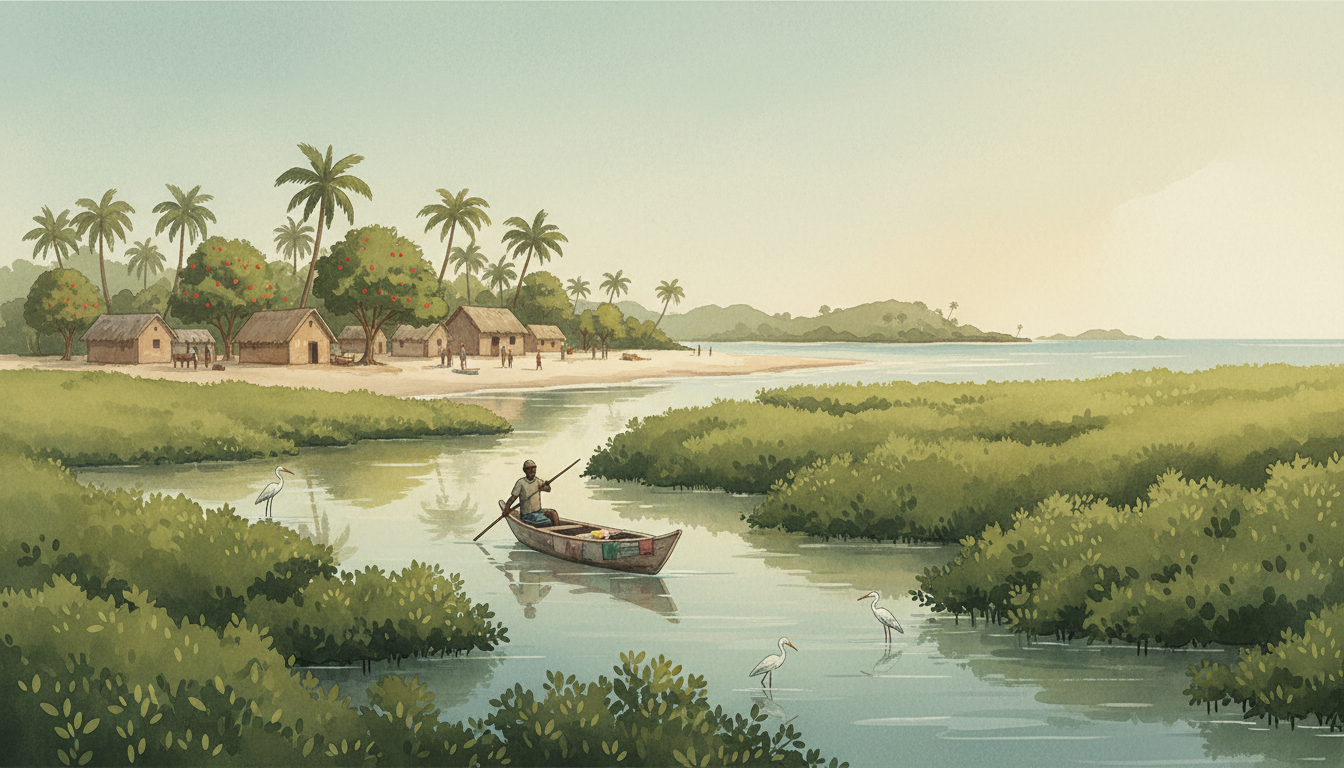
How does Guinea-Bissau work? This West African country connects rural cashew farms, Atlantic ports, the Bijagós islands, shared regional currency systems, schools and public services. National political institutions have been disrupted by a contested transition following the November 2025 elections. As of October 2026, transitional authorities exercise government power and presidential and legislative elections are planned for 6 December. What makes the country work for ordinary families is whether transport, public finance, healthcare and education remain accessible through that uncertainty.
Why are cashews so important to Guinea-Bissau? The crop provides income to numerous rural households and contributes substantially to export earnings. But an orchard cannot generate broad development alone. Nuts need grading, collection, transport, finance and buyers; families need electricity, safe water and workable schools. Weak links can prevent valuable farm production from becoming secure household opportunity.
This guide begins with a practical answer, then explains the political transition, shared currency, land and islands, cashew economy, health and education. Exact government arrangements and election plans can change. For current actions, consult the responsible authorities and reliable independent reporting.
Guinea-Bissau at a glance
| Government in October 2026 | Military-backed transitional administration following the interrupted November 2025 election process. |
| Next elections planned | 6 December 2026, according to the World Bank’s country overview; check current announcements. |
| Major rural export | Cashew nuts. |
| Money used | West African CFA franc issued by BCEAO. |
| Famous island group | Bijagós archipelago; a portion was inscribed as UNESCO World Heritage in 2025. |
| Core challenge | Turning rural production and public investment into reliable services during institutional uncertainty. |
1. Why does the country’s coastal and island geography matter?
Guinea-Bissau borders Senegal and Guinea and faces the Atlantic Ocean. Its estuaries, wetland areas, inland farms and offshore islands create different patterns of settlement and access. Bissau is a central political and trading hub, but people in smaller places depend on roads, waterways and local facilities. A map of administrative districts alone cannot explain how long a journey to a market or clinic might actually take.
Imagine sending a carton of textbooks from a central warehouse to an island school. First comes inland transport, then a port or landing place, a safe boat connection and someone to receive the materials. Bad weather or a missing transport link can delay a service even if a ministry authorised it correctly. Geography is therefore part of government capacity, not decoration.
A good national plan distinguishes dense urban delivery from rural and maritime delivery. The same rights can require different budgets, routes and staffing models to become real. Ask not only whether a school exists but whether students, teachers and books can reach it predictably.
2. Who runs Guinea-Bissau in 2026, and why is the transition contested?
Following elections held on 23 November 2025, military officers seized power before results were announced. The World Bank identifies Major-General Horta Inta-A as Transitional President and Ilídio Vieira Té as Prime Minister. The transitional framework included a charter and a National Transition Council. This is the structure exercising authority, not a claim that every domestic or regional actor accepts its legitimacy.
ECOWAS condemned the intervention and demanded restoration of constitutional government in a December 2025 summit declaration. The authorities meanwhile scheduled December 2026 presidential and parliamentary elections. A referendum in August 2026 approved changes to constitutional arrangements, according to the World Bank, while some political groups challenged or declined to endorse those changes.
For civic understanding, distinguish legal claims, effective control and independent observation. A ministry can continue operating even as an election result is disputed. A date placed on an election calendar does not prove an election will be conducted or accepted. Readers should verify later developments rather than treat this snapshot as timeless.
3. What do elections, Parliament and public accountability have to do with daily life?
Parliaments and electoral systems provide routes for representation, lawmaking and scrutiny when constitutional arrangements are functioning. Public budgets require authorisation and administration. Citizens need ways to inspect decisions and question misuse of authority. Political stability helps businesses plan, but the deeper aim is accountable government that serves the population.
Suppose a health ministry proposes purchasing medicine for rural clinics. Someone must approve and manage the spending, select lawful suppliers, check stock needs, arrange transport and monitor delivery. Political uncertainty can complicate any one of those steps, while illnesses and shortages continue regardless of the political timetable.
The useful citizen question is: who has responsibility for the next step, what rule or budget supports the decision, how can the result be verified, and what correction is available if the service fails? Those questions explain public institutions more clearly than the names of the officials alone.
4. How does a cashew farm connect to the wider national economy?
Cashew income begins with production but continues through drying, grading, collecting, buying, transport, storage and export. Farmers depend on yield, quality, prices and access to legitimate buyers. A damaged feeder road may reduce what a farmer receives even if the international price is favourable. Buyers also need working capital and reliable documentation.
The World Bank reported that Guinea-Bissau’s economy expanded by 5.8 percent in 2025, supported by a strong cashew season. Yet the same 2026 economic update warned of declining productivity growth and heavy dependence on unprocessed exports. A strong harvest cannot on its own guarantee skilled jobs or dependable services.
Domestic processing may create more local work through shelling, sorting, packaging and food manufacturing, but only if investment, electricity, machinery, skills, safe standards and customers are available. Value addition is a connected business system rather than a policy slogan.
5. What can a cashew price tell us about a family’s real income?
The IMF reported a government-set producer price around CFAF 410 per kilogram for the 2026 export season. This is historical context from a specific season, not a quote guaranteed for every future sale. Farmers should check actual current legal buying arrangements and quality requirements.
Illustrative calculation: A farmer selling 300 kilograms at CFAF 410 per kilogram has gross receipts of 300 × 410 = CFAF 123,000. If hypothetical production and delivery costs were CFAF 38,000, CFAF 85,000 would remain before any further obligations. This is a classroom example, not an average farmer’s profit.
Now suppose difficult road conditions reduce the quantity sold by 30 kilograms. Receipts would fall to 270 × 410 = CFAF 110,700. The lost gross revenue is CFAF 12,300 despite no change in the announced price. Repairing a rural route or improving drying may therefore support incomes as directly as changing a producer-price policy.
6. How does the West African CFA franc work in Guinea-Bissau?
Guinea-Bissau is a member of the West African Monetary Union, whose common currency is issued by the Central Bank of West African States, the BCEAO. It shares this monetary arrangement with countries including Senegal and Côte d’Ivoire. The West African CFA franc is different from the Central African CFA franc issued by BEAC for another group of states.
A common currency can ease certain regional transactions, but financial arrangements do not remove the physical costs of farming and freight. A trader still needs a road, a vehicle, customs compliance, banking services and a buyer. Monetary decisions are made through regional arrangements, while Guinea-Bissau retains its own fiscal and service-delivery responsibilities.
For students, compare two prices: the local sale price of cashews and the price an exporter receives. The difference is not automatically profit. It includes transport, storage, quality handling, finance, risk and other costs. Money helps coordinate trade; real institutions and infrastructure determine whether trade functions.
7. Why do roads, ports and cross-border links matter?
Bissau’s trade system depends on ports, roads and connections toward neighbouring countries. A shipment of medicine or equipment can arrive by sea and still be delayed by inland transport. The World Bank’s country portfolio includes improvements to the Safim–Mpak northern road corridor toward Senegal, reflecting the practical importance of reliable access.
A road can reduce travel time for a farmer, allow students to attend more consistently and improve healthcare referrals. Yet it requires drainage, bridge maintenance and traffic safety after opening. A port needs cargo handling, customs arrangements, trained staff and onward routes. Each is a network rather than a single construction object.
Ask where the whole journey begins and ends. A modern pier means little if the rural road to it fails; an improved road means less if the port cannot move goods. National competitiveness and everyday wellbeing meet in the quality of these connections.
8. Why are the Bijagós islands so important?
The Bijagós archipelago contains mangroves, tidal flats, sandbanks and habitats supporting marine biodiversity and migratory birds. UNESCO inscribed the Coastal and Marine Ecosystems of the Bijagós Archipelago – Omatí Minhô on the World Heritage List in 2025. The designation recognises outstanding ecological value and the importance of protecting natural processes.
The islands also contain communities, local knowledge and livelihoods. Fishing, transport and appropriately managed visitor activity must be considered alongside environmental protection. Conservation is strongest when people affected by restrictions and opportunities have meaningful roles in decision-making.
A settlement may need a boat to receive school materials, medicines or food. The same coastal waters support an ecological network. Wise public decisions therefore consider livelihood needs, maritime safety, water quality and habitat protection together rather than treating them as separate worlds.
9. How do island communities receive schools, clinics and essential supplies?
Living on a smaller island changes the delivery cost of a public service. A local school may serve fewer children than a school in Bissau, yet it still needs qualified teachers, materials, safe buildings and maintenance. A clinic needs medicines, trained staff, sanitation and referral arrangements. Transport becomes part of education and healthcare rather than an unrelated convenience.
Imagine a teacher waiting for laboratory materials and a health worker waiting for medicine. Both deliveries need a vessel and a receiving point, but medical supplies may require special handling and careful timing. Sharing logistical planning can reduce delays, yet some safety requirements cannot be compromised.
Public authorities should measure whether services remain accessible during bad weather, whether an emergency referral can proceed safely, and whether the community has a clear way to report a problem. A promise made in the capital becomes meaningful only when these links work for actual families.
10. What is the relationship between farming, public revenue and national development?
Rural cashew earnings and the national budget are connected but should not be treated as the same account. Farmers earn income from their production; licensed firms buy, handle and trade; government collects revenues under applicable laws and finances public obligations. Each stage has different owners, incentives and costs.
The World Bank’s 2026 economic update highlighted low tax revenue and constrained public finances. Even a strong crop year does not guarantee that ministries can spend without limits. Salaries, recurring service costs, debt obligations and planned infrastructure compete for available resources.
Measure development through outcomes that survive beyond the next harvest: a maintained road, a school with qualified teachers, a reliable water point or a clinic that can keep medicines safely stocked. The core question is whether export activity contributes to lasting human capability rather than temporary spending alone.
11. How does education work in Guinea-Bissau?
School education depends on teachers, safe spaces, learning materials, regular attendance and routes toward further study or work. Geography and household circumstances affect each element. Children in a rural community may need to travel farther or study under different material conditions from pupils in a larger town.
A common learning problem can help explain why the whole system matters. A child who makes mistakes when solving an equation may lack familiarity with negative numbers, the concept of balance or the language of the problem. Simply assigning more examples may hide the original gap. Good teaching identifies the missing step, shows why a method works and verifies that the learner can repeat the reasoning independently.
The World Bank’s Guinea-Bissau Human Capital Project (2024–2030) connects teacher training, education and social support. It recognises that learning outcomes are shaped by family stability and health as well as classroom instruction. A specialised eduKateSG guide to Guinea-Bissau’s education system explains school stages and exam routes in greater detail.
12. Why are health, electricity and clean water one connected problem?
An electricity supply does more than power household lights. It supports communications, refrigeration, equipment and water pumping. A clinic needs safe storage, clean water, medical staff and dependable supplies. If one supporting system fails, the quality of healthcare and education can deteriorate even when the buildings are still standing.
The World Bank’s October 2026 country overview describes regional electricity-access investment and a solar-energy programme, alongside plans to improve EAGB’s operations. Technical investments require sustainable management: staff, parts, billing, maintenance and transparent financial decisions.
Imagine a public clinic with a refrigerator containing temperature-sensitive medicines. If the power fails for too long, a backup arrangement and safe procedures may be necessary. A utility failure becomes a health risk. Better development policy evaluates hours of service and fault-response times, not simply the number of new connections.
13. How do community health and social-support programmes work?
Community-level health services can help families obtain preventative advice, basic care and referral information closer to home. A wider public-health system must still connect local workers to appropriate hospitals, laboratories, medicines and emergency transport. No single village facility can realistically deliver every specialised service.
The Human Capital Project also includes elements of social protection and a national social registry. Such a registry can help authorised programmes understand household vulnerability and target assistance, provided data are reliable and people can correct mistakes. It is not a magic list that automatically reveals every need.
Consider a household whose cashew earnings fall after a poor season. The family may struggle with food, transport or school expenses. Responsive support requires eligibility rules, accurate data, a safe delivery route and an appeal or correction process. National planning works best when it recognises how quickly rural income can change.
14. What role do women and small enterprises play in the economy?
Many households combine farming, trading, processing, paid work and informal services. Women can be active across these activities while facing distinctive constraints involving access to finance, transport, care responsibilities, assets and market opportunities. Development should not assume that one formal job statistic fully describes how a family earns its living.
Imagine a trader who collects produce for a local market. The business needs working capital, reliable pricing information, a safe route and customers who can pay. A smaller interest burden or a more dependable road can improve earning potential without changing the product itself.
To support small businesses, public policy can improve predictable rules, basic infrastructure, financial inclusion and fair market access. Training is useful, but it must be matched to actual demand. A certificate in bookkeeping means more when the trader can keep records, obtain stock and sell reliably.
15. How do regional cooperation and borders support the country?
Guinea-Bissau shares economic and geographic links with Senegal and Guinea, participates in West African cooperation and uses the common currency of the West African Monetary Union. Trade, migration, energy connections and public health are practical reasons neighbouring countries must coordinate.
A road from the capital toward Senegal illustrates regional cooperation: national maintenance, border procedures, commercial drivers and trade partners all influence the cost of goods. A high-quality road on only one side of a border may leave other bottlenecks untouched.
Regional rules can offer stability and shared institutions, but Guinea-Bissau still needs accountable domestic decisions. The goal is to use cooperation to improve choice and resilience without confusing shared monetary arrangements with complete political integration.
16. How do fisheries, mangroves and climate resilience connect?
Coastal fisheries support food and livelihoods, while mangrove systems and intertidal habitats support marine ecosystems. The Bijagós World Heritage designation highlights ecological relationships that cross the boundaries of individual villages or fishing areas. Responsible use must consider long-term habitat health.
Climate and environmental risks can affect crops, roads, shoreline communities and water supplies. Heavy rainfall can damage an unmaintained road; coastal erosion can threaten a landing area; disrupted fishing grounds can reduce household income. A national resilience plan therefore spans agriculture, ecology, transport and disaster preparation.
Conservation and family welfare are not opposing goals by definition. Programmes should explain who can use resources, what safeguards apply, how local knowledge is heard and which alternatives exist if activities are restricted. Fairness helps environmental protections survive in practice.
17. Why does reliable public information matter during a transition?
When institutions are changing, a family still needs to know which office can issue a document, how to enrol a child, or where to obtain a service. Conflicting messages can lead to wasted travel, lost income or missed support. Public information is therefore infrastructure in its own right.
Good notices distinguish a proposal from a rule that is in effect. They give dates, eligibility, contact details, responsibilities and a route for correction. In an election year, it is especially important to separate an announced timetable from completed voting and verified results.
Readers should compare official records with credible independent reporting for politically contested issues. Neither an institutional title nor a viral message is enough to settle the underlying question. Evidence, attribution and dates protect understanding.
18. Worked example: how does an island student receive textbooks?
Illustrative scenario: A school serving an island community requests new books before the academic term. A ministry or authorised education body must determine the quantity, approve procurement and identify a supplier. The books then travel to a warehouse or distribution point and must be loaded onto a suitable vessel.
The island team receives the shipment, checks quantities and distributes the books. If a boat is delayed, the school needs a temporary learning plan and a clear communication channel. If the books arrive but teachers are missing, the delivery has not solved the learning challenge.
Create a checklist with five stages: request, authorisation, supply, transport and classroom use. For each stage, write one possible cause of failure and one realistic response. This exercise shows how education depends on administrative integrity and transport just as much as on a national syllabus.
19. What can Guinea-Bissau teach readers about strong public systems?
The country shows how livelihoods, ecosystems and political institutions interact. A farmer needs market access; a fishing community needs healthy coastal habitats; a student needs a teacher and safe transport; a clinic needs electricity and medicine. None of these outcomes can be achieved by one institution acting alone.
Its political transition also teaches an important distinction between authority, legitimacy and practical service continuity. A credible long-term national system needs lawful representation and independent scrutiny, while its everyday services must remain dependable and responsive to households.
Compare Guinea-Bissau with Guinea’s mineral economy, Ghana’s cocoa sector, Fiji’s island transport or Singapore’s concentrated networks. Each country has a different bottleneck. The most useful comparison is not which country is best; it is how each turns constraints into usable opportunities.
20. How can a population census improve public services?
The World Bank reports that Guinea-Bissau completed a population census for the first time since 2009, with preliminary results released in July 2026. Accurate population information helps planners understand where children live, how settlements have changed and which communities may need additional health facilities, teachers or safe transport routes.
Imagine distributing new classroom places based on outdated numbers. A growing community could be left with too few teachers, while another location receives facilities based on residents who have since moved. Better data helps reduce those errors, though it must be interpreted alongside local knowledge.
A census cannot itself build a school or staff a clinic. Its value appears when officials combine accurate statistics with transparent budgets, community feedback, procurement and the responsibility to deliver usable services.
21. What could reduce dependence on raw cashew exports?
Cashews support many families, but reliance on one export crop makes earnings sensitive to harvest quality, international prices, freight costs and buyer demand. Diversification should not mean abandoning successful farmers. It means creating additional reliable jobs and businesses while helping existing producers become more productive.
Consider a cashew-processing company that wants to package more of its output domestically. It needs machinery, dependable electricity, safe food handling, trained staff, finance and customers. An announcement that the country will process more nuts is not an operational plan until those requirements are resolved.
The World Bank’s 2026 economic update highlights productivity rather than investment quantity alone. An enterprise only becomes a development success when its people and equipment produce value over time and when the business can operate without constant emergency assistance.
22. What is the difference between a road and a reliable connection?
A new road appears as a line on a map. Its economic benefit depends on whether people can actually use it during heavy rain, whether bridges remain safe, whether transport is affordable and how quickly damage is repaired.
For a farmer, one missed vehicle can lower the price obtained for perishable produce. For a school, a washed-out access route can interrupt lessons. For a clinic, a delayed delivery may mean running short of essential supplies. The same infrastructure failure reaches many sectors.
Successful transport programmes should therefore measure journey reliability, seasonal closures, vehicle costs, safe access and long-term maintenance. Counting kilometres constructed is helpful, but it does not tell the entire story.
23. How can residents tell whether government spending delivered results?
Public accountability becomes practical when residents can compare a programme’s approved budget with procurement, progress reports and completed outcomes. A school project can record which buildings were repaired, whether teachers were appointed and whether students actually gained more safe days of learning.
A water project should report dependable supply, safe treatment, fault repair and affordability, not only the number of pipes installed. A small island may have a greater delivery cost per user than a city district; this should be explained rather than concealed.
Publishing clear responsibilities does not resolve a disputed political transition, but it allows communities to see whether public administration is functioning and where promises remain incomplete.
24. Why does resilience depend on more than one institution?
A strong cashew season may boost family income, but a storm can interrupt roads. An education project may supply books, but a shortage of teachers prevents their effective use. An electricity line may be installed, but poor maintenance can limit its value. These are different organisations linked through one resident’s daily life.
A useful exercise is to trace a single service from its source to the person who uses it, marking every handoff. Look for the institution responsible, the information it needs, the money that supports it and the alternative when something fails.
This is how the country’s strengths become dependable capabilities. The aim is not merely to add more separate projects, but to connect what already exists so that one weak link does not defeat everyone else’s work.
Five questions that reveal how Guinea-Bissau works
- Who has responsibility for the policy and what is the verified institutional basis?
- What household, worker or community needs the service?
- Which road, boat, financial transfer, staff member or utility connection enables delivery?
- How could a price shock, bad weather or political disruption change the result?
- What trustworthy evidence shows the service actually reached its users?
Frequently asked questions about Guinea-Bissau
Is Guinea-Bissau the same country as Guinea?
No. They are neighbouring countries with different capitals and institutions. Guinea-Bissau’s capital is Bissau; Guinea’s is Conakry.
Who governs Guinea-Bissau in October 2026?
According to the World Bank’s country overview, transitional authorities led by Major-General Horta Inta-A and Prime Minister Ilídio Vieira Té exercise power. ECOWAS disputed the legitimacy of the takeover.
When is the next election scheduled?
The authorities scheduled presidential and legislative elections for 6 December 2026; consult current verified information before relying on the date.
Why are cashews so important?
They are a major export and an important source of rural household income, though the concentration also creates vulnerability.
What currency does Guinea-Bissau use?
The West African CFA franc issued by BCEAO, not the Central African CFA franc.
Where are the Bijagós islands?
They lie off the Atlantic coast. A portion of their marine ecosystems was listed as UNESCO World Heritage in 2025.
Can resource earnings solve every public-service problem?
No. Public institutions must collect and allocate revenue lawfully, maintain infrastructure, employ skilled workers and verify actual outcomes.
Why do road projects matter to education and healthcare?
They help children, teachers, medicines, patients and supplies reach destinations predictably. Physical connection is part of service access.
Continue reading across the country-systems library
- How Countries Work — global country-systems archive
- How Singapore Works — sibling civilisation series
- Education in Guinea-Bissau — school and examination routes
- Top 100 Shorebird Ecology Vocabulary Words | Guinea-Bissau
- How Guinea Works — bauxite, government and water
- How The Gambia Works — river transport and economy
- How Ghana Works — cocoa, gold and public services
- How Guyana Works — oil, rivers and investment
- How Haiti Works — services and resilience
- How Honduras Works — government and trade
Sources and update note, 20 October 2026
Current political arrangements and planned election dates are time-sensitive. The information above distinguishes factual control of institutions from ECOWAS’s position on constitutional legitimacy; use updated official and independent information for consequential decisions.
- World Bank — Guinea-Bissau country overview, political transition and projects
- ECOWAS — December 2025 response to the Guinea-Bissau political transition
- World Bank — June 2026 Economic Update, cashews and productivity
- IMF — June 2026 Guinea-Bissau review and cashew price context
- BCEAO — West African Monetary Union and CFA franc
- UNESCO World Heritage — Bijagós Archipelago, 2025
- World Bank — Guinea-Bissau climate and development study