
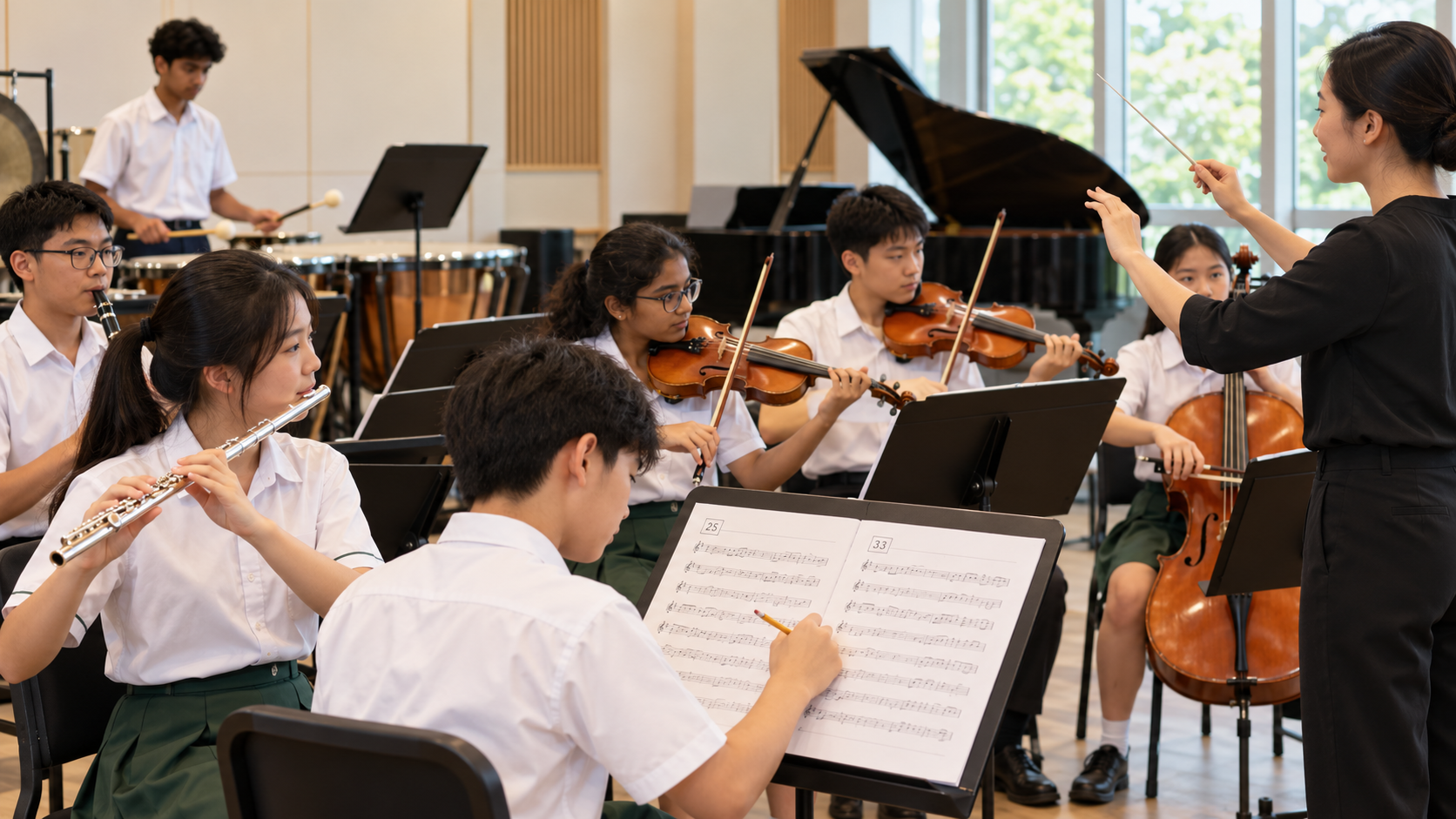
Did you know? A school band can own a suitable instrument while a pupil cannot practise at home because borrowing permission, case contents or repairs have not been coordinated. An instrument counted in stock is not yet a learning opportunity.
Quick answer: School CCA instrument loans fail when asset availability, individual matching, parent authorisation, accessories, qualified maintenance, home practice and return records disconnect. Good programmes preserve musical learning and fair custody rather than merely issue expensive instruments.
This Singapore guide explains how school CCA instrument loans fail using MOE’s secondary Band CCA reference guide and published guidance from North Vista Primary, Admiralty Primary, River Valley High, and other genuine instrument programmes. It distinguishes school-specific rules from general principles and uses clearly fictional cases.
Choose your reading route
- Understand school differences — actual Singapore borrowing examples
- Know permissions — school ownership and signed forms
- Check complete gear — cases, accessories and condition
- Preserve musical learning — repairs and meaningful practice
- Handle returns — actual assets and fair custody
- Audit the process — seven practical questions
- Quick answers — FAQs
An instrument can belong to the band without reaching its musician
Did you know a school band can own a full set of instruments while a student cannot practise at home because their assigned instrument has not been approved for borrowing? The instrument may exist in a cupboard, work during rehearsals and still be unavailable for independent learning. Ownership, allocation, permission and usable access are different parts of a school service.
School CCA instrument loans fail when inventory, appropriate matching, family consent, maintenance, transport, rehearsal needs and returns do not remain connected. The intended result is a student who can participate in music, develop technique and care responsibly for a suitable instrument. A storeroom inventory is not proof that every learner has the equipment needed for their next practice session.
The complete chain from enrolment to ensemble readiness
A student joins a band, orchestra, guitar ensemble or related CCA. Teachers and instructors identify a suitable instrument and whether one is available through school, family purchase or another arrangement. If borrowing is permitted, the student and caregiver complete any required authorisation, receive the correct instrument and accessories, practise appropriately and attend rehearsals. Staff maintain equipment, resolve faults and manage its eventual return.
Every handoff has a distinct risk. A correctly signed form may refer to the wrong asset. A well-maintained clarinet may have no usable mouthpiece or case. A student may practise but miss rehearsal because a repair is pending. A strong system follows the actual learning outcome, not only the signature at issue or the number of instruments purchased.
Singapore schools use different borrowing arrangements
North Vista Primary’s Vista Concert Band encourages students to borrow instruments for self-practice at home and requires caregivers to complete an indemnity form. Admiralty Primary’s Guitar Ensemble says it loans guitars to pupils and encourages families to consider purchasing by the end of the first year. River Valley High’s Chinese Orchestra information also describes loans that students may take home.
These examples do not create one nationwide rule that every CCA lends any instrument for free or permits overnight use. A family should confirm the actual school, ensemble, instrument and current policy. A useful introduction makes the available route and its limits clear instead of treating one school’s generous arrangement as an entitlement at every institution.
MOE’s band guidance makes musicianship the purpose
Singapore MOE’s secondary-band CCA reference guide describes music participation as a way for students to discover interests, appreciate cultures, form friendships and develop creative expression and collaboration. A functioning musical instrument supports those broader learning opportunities, not just the sound heard during a competition.
An instrument programme should be assessed by whether pupils can listen, practise, interpret, create and contribute to an ensemble. Counting impressive instruments in a performance room is useful for inventory, but not enough to prove the programme helps learners develop. The loan system should serve musical capability and belonging rather than become a display of costly equipment.
Availability is more specific than the number of cases
A storeroom may contain twenty instrument cases, but some are empty, awaiting servicing or assigned to other pupils. Others may be reserved for a certain ensemble section. A staff member promises a newcomer an available instrument based on the case count and discovers that none of the suitable instruments can actually be issued.
Record the instrument’s identity, condition, current assignment and realistic readiness. A useful register distinguishes stored, reserved, issued, under maintenance and retired equipment. The measure is not the number of cases lined up on shelves; it is the number of suitable, functioning instruments available for the relevant learners and rehearsals.
The right instrument must match the learner and ensemble
A child may express interest in a large brass instrument because it looks exciting, or arrive with a small borrowed violin that does not fit appropriately. Matching can involve musical roles, physical suitability, teaching progression, available stock and an instructor’s assessment. The choice is not simply first-come, first-served distribution from a storeroom.
Follow the authorised CCA music teachers and instrument professionals rather than make unqualified ergonomic or medical judgments. A good allocation supports a learner’s progress within the ensemble without treating current beginner skill as proof of permanent potential. Suitability means more than obtaining any instrument capable of making a sound.
A junior and main ensemble may have different requirements
North Vista Primary describes a progression from P2 recruits to Junior Band and then Main Band. A beginning student may need a different level of support and practice structure from a more experienced member. A general loan policy that assumes equal needs at every stage can create confusion.
Design instrument access around the actual school’s pathway and the teacher’s guidance. Beginners may need clearer handling and setup instructions, while advanced pupils may need reliable access for more demanding repertoire. The policy should not make promises about grade or instrument progression that belong to a particular ensemble’s current arrangements.
CCA membership is not automatic permission to take equipment home
A student may use a school clarinet at rehearsal and assume it can be put in a bag and taken home for the weekend. The intention is to practise, but school property may require specific authorisation, conditions or a custody record. Bringing it home without approval can create uncertainty if it is lost or damaged.
North Vista Primary explicitly requires an indemnity form for its home instrument borrowing. Other institutions may use a different agreement or restrict certain shared instruments to school premises. Students and caregivers should know the actual rules before moving the item. Permission to play at school and permission to remove school property are separate decisions.
A signed indemnity form is more than a courtesy
Caregivers may sign a loan or indemnity form quickly, believing it is another routine administrative notice. The form can contain significant obligations about custody, care, damage, loss or return. A family should understand what has actually been accepted rather than assume every school handles liability identically.
Use the school’s authorised document and clarify uncertain terms with responsible staff. Do not treat a parent-chat thumbs-up as a substitute for a required form. This article does not interpret or rewrite any particular indemnity agreement; it explains why valid consent and clear custody are essential to fair instrument lending.
School-loaned, rented and family-owned instruments are different
A learner may use an instrument owned by the school, privately rented from a shop or purchased by their family. The same type of violin or flute can come with very different maintenance, insurance and replacement responsibilities. A parent who hears “the school provides instruments” may mistakenly infer that every future repair is covered.
Keep ownership and support routes explicit. St Margaret’s Secondary’s 2026 handbook says loan sets may be available for selected CCAs and that personal purchases are not always necessary. NUS Yong Siew Toh Conservatory has a separate formal university instrument-loan policy; its conditions are informative but not a binding MOE-school standard. Always follow the actual provider’s agreement.
Purchase pressure can discourage a promising beginner
Some students believe they must buy an expensive instrument before being allowed to explore a music CCA. A family may make a large purchase during a child’s first weeks, then learn that the school offered an approved loan or that a different instrument was a better match.
Admiralty Primary’s public Guitar Ensemble FAQ says a child does not need to buy a guitar to join because the school loans one, though it encourages later personal ownership as learning develops. Other schools may differ. Before purchasing, ask the teacher-in-charge what is available and what future commitments are genuinely expected. Access should support exploration without misleading financial promises.
A loan record must identify the instrument, not only the student
Two similar flutes or violins may have different condition histories and accessories. If staff record only “one violin borrowed,” they cannot later identify which specific asset was issued or whether a reported defect existed before handover.
Use an appropriate asset identifier and a concise signed issue record under school procedures. The student should know which case and components belong to the loan. A clear record protects the school’s stock and the borrower’s fair treatment, without requiring the family to maintain an elaborate technical inventory of school property.
Accessories are part of the usable instrument
A clarinet without a suitable case or necessary mouthpiece component may be difficult or impossible to use properly. A violin can be present while a required bow or approved accessory is missing. The item can appear as an issued instrument in a register while the child cannot practise as intended.
List essential components and their actual condition at issue, according to the specific instrument. Do not assume every type has an identical kit or make families buy accessories without understanding the agreement. A complete loan is one that provides the authorised, usable set for the intended musical activity.
A hard case can be as important as the instrument itself
A fragile instrument carried through school corridors and public transport without suitable protection can be damaged even when the student handles it carefully. An old case with broken catches or an inappropriate fit may create a hazard during ordinary movement.
Use a suitable case under the instrument maker’s or music instructor’s guidance and check its functional condition. A learner should know how to transport the asset responsibly without being expected to diagnose internal mechanical defects. Maintaining cases and straps is part of protecting the equipment over its school life.
The correct case label prevents swaps
Several black instrument cases may be stored in the same room after rehearsal. Pupils collecting them quickly can take the wrong one, leaving the asset record and physical instrument with different owners. The problem may emerge only when someone opens a case at home.
Use appropriate asset labels and student identifiers consistent with school privacy rules. Avoid exposing unnecessary home details on an outer case. A brief check before leaving can prevent difficult disputes and lost practice time. A reliable loan system connects the actual item with the authorised borrower rather than assuming visual similarity is enough.
Condition at issue matters for fair liability
A school instrument can have normal scratches or a pre-existing minor defect. If staff record it as perfect without checking, a later caregiver may be blamed for a mark that already existed. A borrower who is worried about liability may hesitate to report a real new problem.
Use proportionate condition notes and appropriate evidence before and after issue. Distinguish ordinary wear from defects affecting sound or safety, and follow the agreement’s actual terms for disputed damage. The aim is not to make every child feel under suspicion; it is to keep accurate shared records that support responsible care and fair decisions.
The instrument can be clean but mechanically unusable
A music room may store polished brass and woodwind instruments that appear attractive. A sticking key, damaged pad or another fault can prevent a student from producing the intended notes reliably. A cleaning record does not prove that a specialist inspected playability.
Qualified music teachers and appropriate repair specialists should assess and maintain relevant functions under school procedures. Students should report symptoms rather than attempt internal adjustments beyond their training. A successful asset check tests readiness for teaching and practice, not merely surface appearance.
Reeds, strings and small parts require honest planning
Some instruments depend on consumables that wear or break during normal learning. A child may have a functional main instrument but lack a necessary reed, string or other approved component when practice begins. Another student may be told to buy an item without being given the correct specification.
Clarify which parts the school provides, which families may need to obtain and what substitutions are appropriate under teacher guidance. Do not invent one national purchase requirement. A reliable loan programme considers recurring small costs and availability as part of access, not as an unspoken surprise after the expensive instrument has been issued.
Improper cleaning can create damage instead of care
An enthusiastic student may try an online cleaning method using household liquids or improvised tools. The approach might be unsuitable for the instrument’s material or mechanism and cause damage that a trained professional could have avoided.
Teach only manufacturer- and instructor-approved basic care appropriate to the specific instrument. More complex cleaning, repair or adjustment should be handled by competent personnel. The NUS Conservatory’s published instrument-loan policy illustrates that formal programmes can require approved cleaning and maintenance responsibilities, but those university terms must not be presented as the rule for every secondary school.
Humidity and storage conditions affect long-term readiness
In Singapore’s humid environment, instruments, cases and accessories may be affected differently by heat and moisture. A school could issue an instrument in good condition and leave it for long periods in unsuitable storage, then discover that further attention is needed before the next student can use it.
Follow material-specific care guidance and qualified instrument staff recommendations. Avoid offering a universal storage temperature or humidity figure for all woodwind, brass, string and electronic instruments. A responsible management plan considers the actual design and environment rather than treating every case in the storeroom as immune to deterioration.
A repair ticket can outlast several rehearsals
A damaged instrument is sent for assessment or specialist servicing. The repair may be legitimate but take longer than one school week. The student has a concert approaching and continues attending CCA without an instrument that works adequately for the assigned part.
Separate the repair process from continuity of musical learning. The teacher may consider an appropriate temporary loan, reassignment or other legitimate rehearsal adaptation. Do not promise that any spare instrument is identical or suitable. The practical goal is to keep the learner meaningfully engaged while equipment decisions are handled responsibly.
A replacement instrument may need reassessment
A school lends a student a substitute instrument while the original is repaired. The model, size, condition or setup may differ, even when both are broadly described by the same name. The student may have difficulty with familiar fingering or response and mistakenly believe that progress has disappeared.
Have a qualified music instructor check the suitability and necessary adaptation. A replacement should not be declared ready solely because it produces sound. The learner may need appropriate practice or adjustments within the approved programme. Continuity means preserving musical development, not only changing the inventory status from under repair to issued.
Changing instruments can alter ensemble balance
An orchestra may have more pupils wanting to play one popular instrument than its musical arrangement needs. A director might assign a different instrument to balance the ensemble. This decision affects the student’s practice, equipment access and motivation.
Communicate the learning rationale respectfully and provide suitable guidance and gear. MOE’s band reference emphasises creative expression, musicianship and collaborative learning, not merely filling an inventory sheet. A student should understand how the part contributes to the whole ensemble while still receiving appropriate individual development.
Practice access must fit the family’s actual situation
A pupil may be permitted to borrow an instrument home but have limited space, neighbours sensitive to noise or caregivers concerned about transport. The school might assume every loan automatically leads to frequent practice. The actual environment can be more complicated.
Discuss realistic practice arrangements with the instructor without requiring public disclosure of family details. A school can consider appropriate on-site access or other authorised options where feasible. The goal is meaningful improvement, not a punitive tally of minutes that ignores the constraints of real households.
An instrument loan does not guarantee a suitable practice plan
A child receives a guitar and practises the same familiar tune repeatedly without learning how to address timing, posture or the difficult section assigned by the instructor. The instrument is available, but the practice does not target the next musical skill.
Admiralty Primary’s Guitar Ensemble encourages regular home practice while teaching fundamental note-reading and scales. A useful loan should be paired with age-appropriate teacher guidance about purposeful practice. The instrument is the resource; specific feedback and progressively challenging musical activity turn access into learning.
A practice diary can become another empty signature
Some programmes ask students or parents to record practice. A diary can demonstrate a routine but may also become a form signed without honest detail about what the learner worked on. An hour written in a notebook does not show whether a rhythmic or technical problem improved.
Use a few specific practice goals and allow students to describe what they attempted, what changed and what remains difficult. Teacher feedback can then connect the record to actual progress. A parent may support consistency without becoming an examiner of every musical phrase. The intended outcome is musical growth rather than impressive totals.
Equipment must be ready for the actual rehearsal
An instrument that worked during individual home practice may arrive at school with a missing accessory, damaged case or technical issue discovered just before ensemble rehearsal. Other sections are ready, but the student’s part cannot contribute as planned.
A practical pre-rehearsal routine checks relevant accessories and reports defects early through the authorised music teacher. Do not advise unsafe or complex emergency repairs backstage. The school should have a clear procedure when a necessary part is unavailable, protecting both rehearsal continuity and the instrument’s long-term condition.
Concert preparation increases pressure on shared instruments
As a performance approaches, pupils may practise more often and need instruments for sectionals, full ensemble rehearsals or approved home sessions. A limited loan pool can become overcommitted when several people need the same asset at overlapping times.
Schedule actual instrument access, not merely student attendance. An authorised sign-out process should reflect when an instrument is needed on site and when it may go home. A shared asset cannot serve two commitments simultaneously. Good planning protects pupils from being blamed for not practising on equipment that was unavailable to them.
A school hall performance can have different equipment needs
An instrument suitable for normal rehearsal may need additional approved support during a concert, such as safe stands, transport cases or appropriate specialist setup. These needs can be overlooked if organisers consider only the list of performers and musical pieces.
Coordinate with music and technical staff ahead of the event. The loan programme should distinguish school-owned instruments, separately rented items and equipment provided by a venue. A confirmed performance slot does not guarantee every required asset is in the right place, ready and safe for use.
Taking an instrument on a school trip changes custody
A learner may travel to another school or concert venue carrying an instrument loaned for ordinary rehearsals. Its transport, storage and handover arrangements may differ from usual home practice. The student cannot safely assume the same informal desk-drop procedure applies to a large off-site event.
Confirm who authorises transport, who keeps the asset secure and how the equipment is counted before return. A practical plan should fit age, travel and instrument type without inventing one required national checklist. When several organisations are involved, custody must not disappear in the gap between rehearsal hall and vehicle.
The case may be returned without the complete instrument
A student brings back the school instrument case at year end, but an accessory remains at home or a smaller component is missing. Staff mark the case returned before checking its contents. The next borrower receives an incomplete set despite the inventory showing full stock.
Use a proportionate component-level return check suited to the instrument. An issue record should identify what the student received and what the school expects back. A complete handover means an actual usable asset, not simply a matching bag or case on the floor.
Returns should not be scheduled after the next pupil needs the asset
A student finishes the CCA year but keeps a loaned instrument beyond the expected handback date. Another learner is scheduled to begin training with that same item. The school may have an accurate historical record but cannot satisfy the next student’s immediate needs.
Communicate return dates or triggers clearly and manage legitimate extensions through authorised staff. Different schools and CCAs have different holiday-loan arrangements. A fair system balances continuing home practice against shared availability rather than assuming every loan must be returned at exactly the same time in every school.
An instrument returned during a busy shift can lose its record
A child leaves a violin with an office staff member because the music room is closed. The item is safely received, but the formal music inventory still shows it checked out. The student and teacher later disagree over whether the loan ended.
Give borrowers a clear authorised alternative when the usual receiving point is unavailable. Reconcile the actual instrument and custody record before declaring a loss. A verbal handover may be well intentioned yet difficult to verify weeks later. Good administration protects both the learner and school equipment.
The next borrower needs an actual condition check
An instrument is returned and shelved quickly before being issued to a new member. The case looks intact, but a functional fault remains from the previous term. The newcomer spends several rehearsals struggling with an instrument that should have been serviced first.
Check actual playability and relevant accessories through qualified staff before reissue. A ready-to-loan status should mean suitable for learning, not merely stored. A shorter queue of truly functional instruments may provide better access than a full inventory with unresolved faults.
Some instruments must stay in designated spaces
A pupil may assume a school piano, percussion setup or large ensemble instrument can be borrowed in the same way as a violin or clarinet. Certain items may be shared, fixed in place or unsuitable for normal home transport.
The NUS Yong Siew Toh Conservatory loan policy distinguishes instruments available for individual assignment from equipment such as some harps, pianos and percussion that remain on site. That is a university example, not an automatic rule for every school. It illustrates why asset type and usage permissions must be stated before pupils plan practice.
The school should not publish borrowers’ private details
A music department may need student names and contact routes for asset management. A coordinator could find it convenient to post a full loan spreadsheet, including phone numbers and damage notes, into a class group. That would expose far more than other members need.
Keep borrowing and personal records within authorised school systems. Share practical rehearsal instructions without publicising a pupil’s financial or disciplinary circumstances. A useful loan policy supports accountability and privacy together; transparent general rules do not require displaying individual case histories to every parent.
A missing instrument calls for evidence, not an immediate accusation
A school-owned guitar cannot be located after rehearsal. It might have been put in another storage location, borrowed legitimately but not recorded or genuinely misplaced. A teacher who immediately blames the last student seen near the room may harm trust before the evidence is checked.
Review authorised issue, return and storage records and follow the school’s appropriate reporting procedure. Do not publish accusations in student chats. Shared instruments deserve careful custody management, but fair investigation matters as much as protecting stock.
Maintenance spending should be planned across the asset’s life
A school can invest in excellent new instruments but budget too little for cleaning, servicing, cases and replacement components. At first the CCA looks well equipped. Later, more assets become unavailable while repairs accumulate.
Treat ongoing maintenance as part of what makes the original purchase educationally valuable. Record recurring faults and realistic service needs by instrument type, with qualified help where required. A programme succeeds when usable instruments remain available to pupils for years rather than simply when a new batch arrives for the opening ceremony.
Fictional case: the signed form but missing clarinet component
Illustrative case: a student receives a school clarinet for home practice after a caregiver completes the required form. The case contains the main instrument but not a component needed for ordinary playing. The loan is recorded as complete, and the pupil practises nothing useful that weekend.
A pre-issue component check and suitable instruction would have identified the gap before handover. The story is fictional and does not describe a real school. It shows why a signed loan and a workable musical resource are different outcomes.
Fictional case: the repaired instrument that returns to the wrong student
Illustrative case: two similar school violins are sent for repair. One returns with a changed case and incomplete asset label. A student receives it as the original loan, while the other pupil is told their instrument is still under service. The physical devices and school records have diverged.
A reliable asset identifier and careful vendor-to-school handover would support the correction. The case is fictional. It demonstrates why accurate custody through repair matters, especially when instruments look similar and multiple families are relying on the same shared stock.
Fictional case: home practice stopped by uncertainty
Illustrative case: a Primary 4 guitarist enjoys CCA but is unsure whether they may borrow the school guitar during holidays. Their family assumes an expensive purchase is necessary. The pupil stops practising while waiting for a decision that could have been clarified through the teacher.
An accurate local loan guide and a respectful enquiry route would help the family plan. Admiralty Primary’s public guidance provides one school-specific example of guitar lending. This fictional situation shows why the absence of clear information can interrupt learning even when physical equipment is available.
A seven-question instrument-loan audit
Can students identify what equipment is genuinely available? Is the instrument suitable for the learner and programme? Are permission and custody terms clear? Does the issued set include the necessary accessories? Is the condition verified before practice? Is repair coordinated with learning continuity? Can items be returned and reissued accurately?
These questions are practical management prompts, not professional instrument certification or legal interpretation of indemnity forms. The aim is to identify the handoff where real musical access becomes uncertain, assign the appropriate staff member and verify that a student can actually practise or participate.
A practical four-week improvement cycle
Week one: reconcile loan stock, assigned students and current instrument conditions. Week two: review parent guidance, issue records and accessory checks. Week three: organise qualified maintenance and rehearsal continuity for unavailable items. Week four: verify return and reissue procedures and examine pupils’ practical experience of access.
The schedule is illustrative, not a reason to delay urgent safety or instructional support. An instrument needing specialist repair must not be used unsafely while awaiting a routine audit. Schools should follow their actual vendor and CCA schedules. The review’s purpose is durable access and fair stewardship rather than an attractive spreadsheet.
What parents and students should ask before borrowing
Which instrument and accessories are included? May it go home? Is a signed form required? What basic care is appropriate? Who pays under the actual agreement if damage occurs? What should the student do if a defect appears? When and where is the item returned?
Ask the teacher-in-charge or authorised programme coordinator rather than rely on another school’s informal advice. A family can support musical practice while respecting the fact that school equipment remains shared property. Clear expectations reduce unnecessary spending and help the child take responsibility confidently.
The final principle: ownership must become musicianship
School music ensembles can build creative expression, teamwork and a lifelong relationship with music. The instruments that enable those experiences are not merely assets to count. They must be assigned appropriately, maintained, transported, used and returned through reliable processes.
A loan programme succeeds when students can participate and improve without being held back by missing accessories, confusing permissions or unresolved repairs. Good custody protects the instruments; good teaching gives them purpose. When both agree, a school’s musical investment becomes actual learning rather than expensive equipment waiting behind a storeroom door.
Frequently asked questions
Does every Singapore school lend free band or orchestra instruments?
No universal rule applies. North Vista Primary, Admiralty Primary and River Valley High describe particular school loans, but eligibility, fees, permission and home use vary.
Can pupils take a school instrument home automatically after rehearsal?
Not necessarily. North Vista Primary requires parent indemnity forms for its instrument borrowing. Follow the child’s actual CCA permission and custody rules.
Does a student need to buy a guitar to join Guitar Ensemble?
Admiralty Primary says it loans guitars to new members and encourages later ownership. Other schools may have different equipment arrangements.
Who pays if a borrowed instrument is damaged?
The specific loan or indemnity agreement and applicable circumstances govern responsibility. Do not assume one fee or liability rule covers every MOE school.
Can an instrument stay at school instead of going home?
Some shared or large instruments may be restricted to designated areas. Ask the relevant school or instructor rather than infer from another programme’s policy.
What happens when the school instrument needs specialist repair?
Report the fault to authorised music staff and avoid complex self-repair. The school can consider a legitimate practice or rehearsal alternative if one is appropriate and available.
How can a school measure instrument loan success?
Check correct matching, suitable condition, complete accessories, authorised practice access, timely maintenance and accurate returns, alongside real student musical progress.
Evidence and further reading
- Singapore MOE: Secondary Band CCA Reference Guide — musical education, participation and ensemble learning
- North Vista Primary: Vista Concert Band — instrument borrowing for home practice and parent indemnity form
- Admiralty Primary: Guitar Ensemble — guitar loans and beginner development
- River Valley High: Chinese Orchestra — school instrument loan and home use
- St Margaret’s Secondary: 2026 Secondary One Handbook — optional loan sets for certain CCAs
- NUS Yong Siew Toh Conservatory: Instrument Loan Policy — a distinct university example of detailed custody terms
- Ministry of Education V2.0 Reference 162 | School Musical Instrument Loans and Repairs
- How School CCA Selection Fails | When Interests, Trials and Limited Places Collide
- How Community Sports Equipment Loans Fail | When Availability, Condition and Returns Disconnect
- Secondary 1 Mathematics Tutor Clementi | Small Groups Tutorials — unchanged editorial reference
Scope and care: This is general education and equipment-management guidance, not instrument repair instructions or legal advice on a particular indemnity agreement. Loan permission, liability and care rules are programme-specific; the NUS Conservatory policy is not automatically binding on MOE schools. Unsafe or damaged instruments should be examined through appropriate qualified staff. All student examples are fictional.