
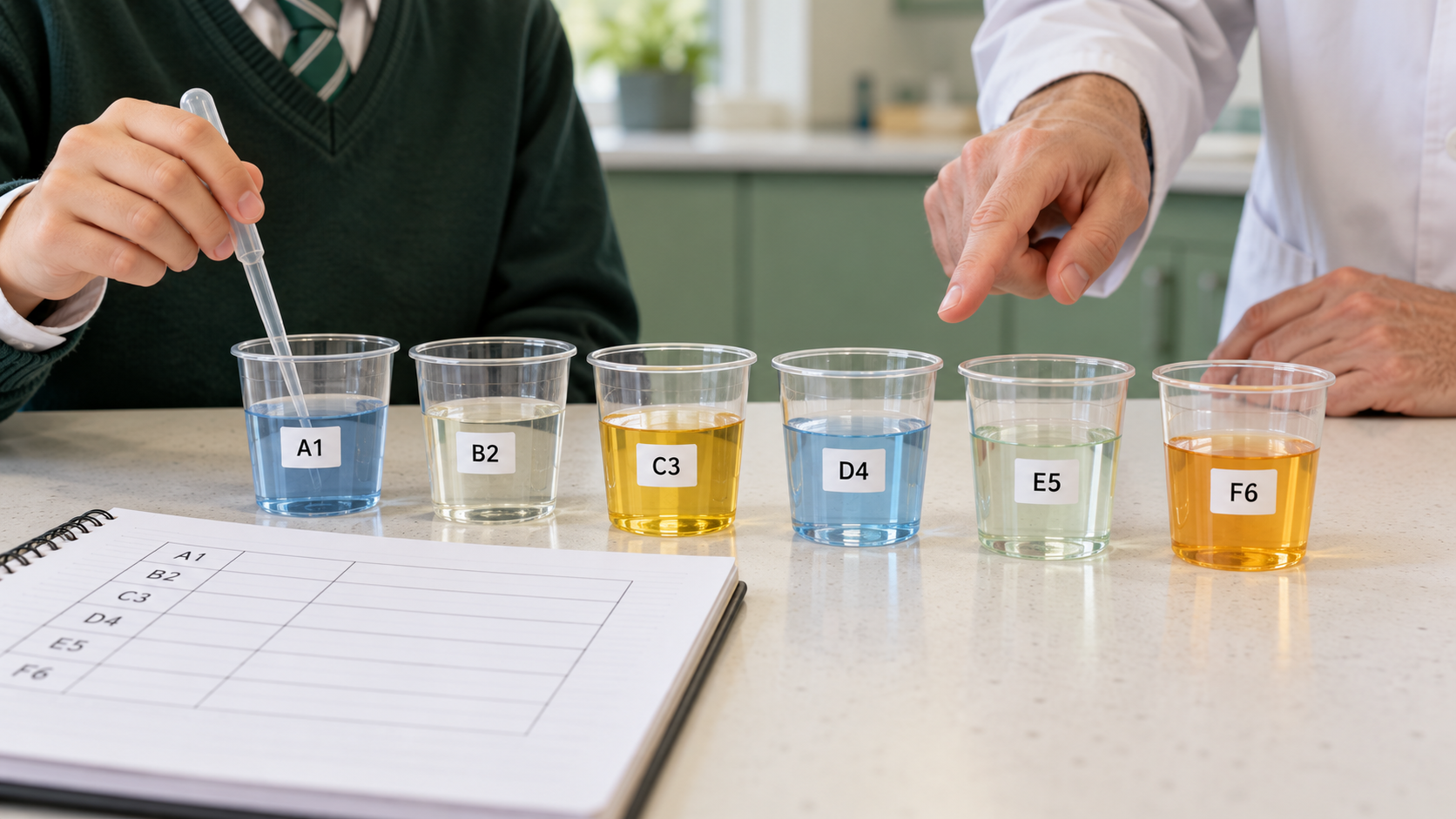
Did you know? A student can build an impressive science-fair display, include colourful charts and deliver a confident speech while never truly investigating the question on the poster. The ‘conclusion’ may have been chosen before data were gathered. The photographs may show an activity but not a controlled comparison. A beautiful result can hide a missing scientific process.
School science projects fail when a presentation of certainty replaces the work of asking a testable question, designing a fair method, recording authentic observations, interpreting evidence and admitting what remains unknown. The problem is not ambition. Young learners deserve interesting scientific problems. The failure occurs when the project is treated as a marketing demonstration rather than a genuine inquiry.
One-minute answer: A useful school science project starts with a question that evidence can address, uses a safe and age-appropriate method, distinguishes observations from interpretations, documents what was actually done and allows findings to challenge the starting idea. The teacher or mentor should coach reasoning without fabricating results or doing the work for the student. A modest honest investigation teaches more than an elaborate display whose answers were scripted in advance.
The exhibition is not the experiment
Imagine a Secondary 1 student standing beside a model of a sustainable city. The model has miniature gardens, solar panels, a water tank and a convincing explanation of environmental benefits. Visitors are impressed. But the pupil cannot describe which variable was measured or which evidence supports a specific claim.
The work may still be a valuable design project, depending on the brief. It becomes problematic when labelled as proof that a proposed system produces an outcome it was never tested for.
The first task is to distinguish a scientific investigation, an engineering design challenge, a research review and a demonstration. Each can be educational, but each needs its own standards of evidence.
The question must be capable of a meaningful answer
‘How can we save the planet?’ may inspire a child, but it is too broad for an ordinary school experiment. ‘How does the amount of light affect the growth of a particular plant under specified conditions?’ is narrower, although the final procedure still needs careful design.
A good question identifies what can be observed or measured, within available time, safe materials and realistic school facilities. It may also reveal that an experiment is not the right method.
The point is not to remove imagination. It is to give imagination a structure through which the learner can learn something true.
A hypothesis is not a promised conclusion
Some pupils are taught to state a hypothesis before an experiment. They may interpret it as a statement that their project must later prove correct.
That reverses scientific reasoning. A hypothesis is a proposition to examine with evidence. The investigation may support it, challenge it or remain inconclusive. All three possibilities can teach the learner something.
A child who finds unexpected results should not be encouraged to change the observations merely to preserve the original claim. Scientific integrity begins with the permission to be wrong.
Why negative results can be genuine achievements
Suppose a student expects one condition to produce a larger measured effect, but the recorded values show little difference. The immediate temptation is to call the project a failure.
Perhaps the effect was genuinely small, the measurement method insufficiently precise or the observation period too short. Those possibilities are questions for interpretation, not reasons to invent a dramatic conclusion.
The student can state what the experiment showed, which uncertainty remains and what a better future investigation would require. A responsible limitation is an intellectual result.
A scientific process needs a record of what happened
A polished final report may omit the messy middle: changing a method, recording a failed trial, noticing a broken measuring tool or correcting an entry.
A useful project notebook records the question, planned procedure, dates, observations, relevant conditions, changes and decisions. Teachers can adapt its complexity to the child’s age.
A dated record helps pupils distinguish their original plan from what they actually did. It also allows somebody else to understand how the final chart was produced.
What the Singapore Science syllabus values
The Singapore Ministry of Education’s 2023 Primary Science teaching and learning syllabus presents science as an evidence-based, model-building enterprise. Its practices include posing questions, designing investigations, analysing and interpreting data, evaluating explanations and communicating ideas with evidence.
That emphasis is wider than memorising keywords. It asks pupils to see that scientific knowledge is tested, reasoned and open to revision when stronger evidence appears.
For a school project, the natural question becomes: ‘How did the evidence change your thinking?’ rather than ‘Does your poster have enough technical vocabulary?’
Science fairs are learning opportunities, not only competitions
Singapore’s Youth STEM Fair builds on a history of youth science activities and describes inquiry, design thinking, communication, collaboration and problem-solving as important goals. The fair’s current programme guidance should be consulted for eligibility, submission and safety conditions.
A student may understandably want an award. But an award is not a substitute for ownership of the thinking. Mentors should help young people understand why a method fits a question and how to describe what they actually found.
An outstanding competition entry should be defensible by the students who submitted it, not merely impressive to viewers who only glance at its visual presentation.
The first hidden failure: choosing the answer and working backwards
A child reads that plants grow better in sunlight, then plans an experiment whose sole purpose is to produce a graph that rises neatly. Results that do not fit the expectation may be ignored.
Working backwards from a desired conclusion creates confirmation bias. It can influence where measurements are taken, which observations are repeated and what the report chooses to display.
A simple remedy is to record the proposed question, expected result and planned comparison before beginning. That provides a reference against which later changes can be explained honestly.
The second hidden failure: changing several variables at once
Suppose two groups of plants receive different light, different amounts of water and different soil. One grows taller. Which difference caused the result?
The observed outcome cannot be assigned confidently to light because several factors changed together. The project may still yield observations, but its causal claim is weak.
Students should learn to identify the factor intentionally varied, the response measured and the important conditions held comparable. A teacher may need to use simpler models before expecting an independent experiment.
The third hidden failure: the measurement is not defined
A student writes that one plant ‘grew better’. Does this mean taller, more leaves, darker leaves, greater mass or survival for a longer time?
Without defining the outcome, the conclusion can shift to whatever looks most favourable. Different observers may also judge ‘better’ differently.
Choose an appropriate observable indicator, define how it will be recorded and keep that definition consistent. If measurement is uncertain, say so.
The fourth hidden failure: too little evidence for the claim
One sample in each condition often provides little basis for a broad conclusion. Chance variation, differences between samples and measurement errors may all matter.
Students should consider what the number of observations allows them to claim. The correct design depends on the question, resources, expected variation and school constraints; there is no universal magic sample number.
A pupil can learn substantial science by explaining why a limited trial does not justify a claim about every plant or every situation.
The fifth hidden failure: the perfect chart
Real observations are often uneven. A chart where every measurement lands on a perfectly smooth line may be genuine, but its neatness should not be accepted as proof of quality.
The scientific question is where the numbers came from, whether values were recorded consistently and which transformations were applied. Cosmetic smoothing and selective omission can change the story.
Keep the original data appropriately, show the calculation route and explain any exclusions. Do not manufacture measurements to make a poster more attractive.
The difference between a table and a model
A table records observations in a structured way. A model proposes how a system works or predicts behaviour under assumptions. A fitted line or simulation can be useful, but it is not itself the original observation.
Students should separate measured values from calculated or predicted values. Use clear labels and explain where each number comes from.
A model that fits some observations may still fail elsewhere. A good report tells the reader what has been checked, not simply that a computer produced an elegant picture.
Why graphs can accidentally mislead
A graph may omit measurement units, use uneven time intervals as though they were equal or display a very narrow vertical scale that exaggerates small differences.
A well-designed graph identifies the measured variable, unit, relevant interval and comparison being made. It should not quietly conceal inconvenient observations.
Teaching pupils to explain axes and limitations is as important as teaching them to insert a chart into presentation software.
A fictional plant-growth project
Four students investigate a safe classroom plant question using a school-approved procedure. One group places plants where lighting differs, but also uses a different watering routine because one location is harder to access.
After a week, the plants look different. The students initially conclude that light caused the entire difference.
Their teacher asks what else changed. The students revise their conclusion and design a more careful next attempt. The first project was not wasted. It taught them why controlled comparisons matter.
A fictional paper-bridge project
A pupil builds paper structures that support different amounts of weight. It appears to be a simple engineering challenge, but the method changes each time: paper size, fold shape and support distance all vary.
The child cannot decide which design feature made one structure stronger. A better next step is to compare structures under an appropriately consistent, school-approved test.
This is an opportunity to connect Mathematics and Science: measurement, comparison, fair testing and the difference between performance and explanation.
The parent who unknowingly completes the project
A parent wants to help a child succeed. They purchase sophisticated materials, produce a professional poster, choose the analysis and rehearse the explanation. The project looks excellent.
But when the student is asked why an observation matters, the child cannot answer. The adult has taken away the most valuable part of the assignment: making decisions, discovering uncertainty and correcting mistakes.
Parents can ask questions, provide suitable supervision and help source safe materials. They should leave the central reasoning and explanation with the learner.
What an ethical mentor does
A teacher or tutor can help a student refine a question, understand variables, check the safety of a planned activity and learn how to record observations.
Mentoring becomes inappropriate when the adult invents data, conceals failed trials, writes conclusions the child does not understand or performs essential work while claiming it is the student’s own.
Ownership of the idea and ownership of the evidence should be clear. The exact permissions depend on the school’s or competition’s rules.
The first meeting should produce a project contract
A practical school project can begin with a short agreement about the question, the type of project, the intended observation, safety requirements, available time and who will perform the work.
For a group, give each learner a meaningful role in reasoning, not merely a poster-production job. Ask how everyone will learn to explain the central method.
The agreement need not be a legal document. It should prevent the project from drifting into a collection of decorative tasks.
What to do before collecting any data
Confirm that the question is feasible within the class’s time, equipment and safety limits. Decide how observations will be recorded, what comparison is fair and what will count as evidence.
Talk through what could produce misleading results. Can the same sample be counted twice? Can the measuring method change unexpectedly? Could an observer’s expectations influence the judgment?
The earlier these questions are asked, the less likely the student is to find out at submission that the results cannot support the conclusion.
Safety is not a side note
Children and teenagers should not imitate viral experiments involving fire, toxic chemicals, electrical hazards, pressurised equipment, biological exposure or risky modifications.
Use school-approved, age-appropriate methods with the required supervision and risk assessments. A spectacular outcome is not worth an unsafe activity.
When a proposed project exceeds the available safety arrangements, redesign the question rather than demanding that the student take greater risks.
Ethical questions beyond physical hazards
Projects involving interviews, photographs, personal information or observations of people may raise consent and privacy issues. A school survey about classmates is not automatically free of ethical obligations.
Consult school policy and appropriate adult supervisors before collecting personal or sensitive information. Do not publish identifiable student data, private health details or photographs without legitimate permission.
Scientific inquiry includes respect for the people and environments involved. Ethics cannot be added after the report is finished.
When the internet supplies a ready-made result
A pupil finds a website with an appealing investigation, photographs and a completed results table. It becomes tempting to reproduce the presentation and change only the title.
Reusing a published method as a learning reference may be appropriate if the assignment permits it. Passing off another person’s observations as one’s own is not.
Teach students to distinguish a source that explains a method, an example data set and their own original evidence. A citation credits what the student learned from others; it does not turn copied results into observations.
Why AI-generated data are not observations
An AI assistant can suggest possible hypotheses or explain how a chart is read. It may also generate plausible-looking numbers that have no connection to any physical experiment.
Those numbers cannot be presented as measurements. If a simulation is part of a permitted project, label its outputs as simulated and explain the assumptions.
The child should be able to show which parts were actually observed and which parts were modelled, predicted or generated by a tool.
The distinction between simulation and experiment
A simulation can help explore a model’s behaviour when changing inputs. An experiment tests aspects of the real world under specified conditions.
For certain school questions, simulation may be more practical or safe than physical experimentation. That can be excellent learning as long as the project accurately describes what it demonstrates.
Do not infer that a computer model proves how a real system behaves without appropriate evidence. Ask which assumptions the simulation depends on and whether they were checked.
A method is reproducible when its steps are understandable
A reader should be able to understand the relevant materials, conditions, observations and calculations from the report. That does not mean every experiment will produce identical measurements.
The aim is sufficient clarity to evaluate how evidence was generated and, where appropriate, repeat a comparable method safely.
A vague instruction such as ‘Observe how the plant changes’ leaves too much uncertainty. A clearly defined observation schedule is more useful.
The role of a lab notebook
A notebook can hold dates, sketches, measurements, changes in method and questions to revisit. Students should record actual observations near the time they occur instead of reconstructing perfect entries from memory weeks later.
A photo can supplement records but rarely replaces them. It may not show the measurement conditions or how many observations were attempted.
The notebook can be modest. Its value lies in making the reasoning trail visible, not in decorative formatting.
What happens when a trial goes wrong
Equipment may not behave as expected, an observation may be missed or an early method may prove unsuitable. The learner should document the problem and ask how it affects the claim.
Sometimes the next step is to repeat an appropriate trial. Sometimes the method must be changed and the results clearly separated. Sometimes the conclusion is simply limited.
A responsible project does not hide every difficulty. Learning often begins with discovering why the original plan was insufficient.
Avoid turning every surprise into a scientific discovery
An unusual measurement may be a real pattern or an error. It could result from faulty equipment, inconsistent procedure or natural variation.
Teach students to check the observation, compare other evidence and describe uncertainty before making a sweeping claim.
A single surprising result is a question to investigate. It is not automatically proof of a new phenomenon.
Data analysis begins with the unit of measurement
A table that mixes centimetres and millimetres, minutes and hours or percentage and raw counts can produce serious errors.
Identify the units and make transformations explicit. In Mathematics, ask the student to show an example conversion and check whether the calculated values are reasonable.
This habit is transferable across Science, Geography, data analysis and ordinary life. A credible conclusion needs quantities that mean what their labels claim.
The denominator problem in science reports
Suppose eight out of ten seedlings germinate in one condition and six out of twenty in another. Raw counts suggest similar results, but the proportions are eighty per cent and thirty per cent.
Those fictional figures demonstrate why comparing counts without the relevant denominators can mislead.
Students should explain sample sizes and avoid using percentages to conceal very small observation sets. A percentage may be correctly calculated and still support only a limited inference.
Correlation is not an automatic cause
A project shows that two quantities rise together. That does not prove one causes the other. Shared environmental factors, timing or a third variable may influence both.
The student should distinguish what was observed from the explanation proposed. Causal claims demand stronger reasoning and an appropriate design.
Learning this distinction is more valuable than memorising the phrase ‘correlation is not causation’ without applying it to a concrete example.
Why a strong discussion is not a victory speech
A discussion section should explain the relationship between results, the question and the limits of the method. It may compare expectations with what was observed.
The tone need not be apologetic when results are uncertain. Science improves by communicating uncertainty honestly.
A conclusion that says ‘The evidence in this small study was insufficient to determine the effect’ can be more academically mature than a confident assertion drawn from a weak comparison.
Limitations should be specific
‘Human error may have occurred’ is so broad that it explains almost nothing. Better limitations name what actually mattered: a changing measurement method, small sample, inconsistent conditions or an unmeasured factor.
Explain how the issue might have influenced the result and what practical change would help in a future study.
Avoid inventing limitations as a ritual. They should arise from the actual design and observations.
A fair science-fair judge’s questions
A good evaluator can ask what the student wanted to find out, why the method was chosen, which observations were surprising and what evidence supports the claim.
For group work, individual pupils should be able to discuss the core reasoning, even when responsibilities differ. A sophisticated poster is not a substitute for comprehension.
The purpose of questioning is to reveal the learner’s thinking, not to trap children with advanced terminology beyond their level.
When a poster becomes too crowded
Students may assume that more text, pictures and charts make a project stronger. The key point can become invisible beneath decorative features.
A reader-first poster gives the question, approach, important observations, cautious conclusion and limitations in a clear sequence.
Use charts where they clarify evidence. If a graph adds no insight or cannot be explained by the student, it may not deserve space.
A student-friendly research summary
Try five short prompts after completing an appropriate investigation:
- We wanted to find out whether …
- We compared or observed …
- We recorded …
- The evidence suggests …
- We cannot yet conclude … because …
These sentences reveal whether the pupil can distinguish aim, method, result, interpretation and uncertainty. They also offer a usable structure for oral explanation.
The importance of discussing contradictory evidence
A graph may partly support the hypothesis and partly conflict with it. Rather than deleting inconvenient points, the student should investigate whether those observations were collected consistently and how they affect the conclusion.
Conflicting evidence may expose a limitation or a more complex relationship than the original idea allowed.
Scientific maturity is the ability to revise one’s explanation when the evidence demands it. The project should reward that habit, not penalise every result that is untidy.
How to handle group contributions fairly
A team may divide equipment preparation, observations, calculations and presentation. Every member still needs a route to understanding the whole project.
A short decision log can record what question the team discussed, which options were considered and why a decision was made. Individual reflections may reveal what each student learned.
Avoid assigning one child only the task of making graphics while another controls all scientific decisions. The final result should reflect shared intellectual work.
The danger of last-minute project assembly
When a project begins shortly before its deadline, students may not have time to collect observations properly. They may rush into borrowing numbers from the internet or writing results before testing.
A feasible schedule includes method approval, observation time, analysis and revision. It should also allow for ordinary school demands and delays.
If the available time is too short, reduce the question’s scope. A smaller valid project is preferable to a grand claim with fabricated support.
An example of honest revision after feedback
A teacher notices that a student’s project compared two containers of different shapes and sizes while trying to study only the effect of material. The initial design was confounded.
The student can explain why the comparison is weak, revise the method safely if time allows and distinguish earlier observations from later ones.
That correction is part of the project’s learning. The student has practised how scientific methods improve, not simply how posters are polished.
How families can support without taking over
Ask what the child is trying to learn, how the chosen method answers the question and whether all activities are approved and safe. Help the student organise materials and time.
Avoid writing the report or creating artificial observations. If a parent offers an idea, help the learner understand and evaluate it rather than making the choice for them.
The ideal outcome is a pupil who can defend the method in their own words and recognise when an adult’s suggestion needs checking.
How tutors can contribute legitimately
A tutor may teach the meaning of variables, data tables, graph interpretation, unit conversion and fair comparison. They can help a child practise explaining a limitation.
They should not supply invented results, secretly conduct the experiment or replace a pupil’s genuine work with an advanced report beyond their understanding.
Good support builds the conceptual tools that enable independent inquiry. The child should leave better equipped to investigate, not merely better equipped to present someone else’s answer.
How to read an exciting science-project headline
A project might declare that a household invention reduces energy use, improves water quality or protects health. Those claims deserve scrutiny because they may influence real decisions.
Ask whether relevant measurements were collected, whether a suitable comparison was made, whether safety and regulatory requirements were met and whether the conclusion fits the evidence.
A school prototype can be a valuable design exercise without establishing that the device is commercially safe or effective. Keep educational demonstration separate from professional certification.
A practical five-stage repair plan
Stage one: define the type of project. Is it an experiment, design prototype, simulation or literature review? State the proper evidence standard.
Stage two: narrow the question. Choose something testable or evaluable within the time, materials and safety arrangements.
Stage three: approve the method. Confirm appropriate supervision, variables, observations and record keeping before proceeding.
Stage four: analyse honestly. Preserve original observations, label models and simulations clearly, and explain limitations.
Stage five: verify learning. Ask each student to explain the method, evidence, unexpected results and what could be improved.
The stages describe educational reasoning, not permission to conduct unsafe activities.
What teachers should watch for before the deadline
A project may need help when the conclusion was written before observations, the method is difficult to describe, the quantities have no units or a student cannot explain where values originated.
Other warning signs include an excessively polished adult-authored presentation, inaccessible data files or a claim that an unapproved experiment is harmless because it was seen online.
Use these signals to ask better questions, not to assume misconduct automatically. A pupil may simply be confused about what scientific inquiry requires.
What success actually looks like
A strong student project may be small and visually simple. Its question is clear, the method suits the purpose, observations are authentic and the conclusion is proportional to the evidence.
The student knows which part of the original idea survived testing and which part changed. That ability is more important than the price of the model or the size of the poster.
School science projects work when children learn to let evidence change their minds. A conclusion chosen in advance may produce a fine display, but it cannot replace investigation.
How to verify a project’s independent contribution
A student can be responsible for an authentic investigation even when a teacher supplied equipment or explained a technique. The key is whether the learner understands the question, can reconstruct the method and can defend the decisions the project required.
Ask which parts the student chose, which parts were specified by the assignment and how adult guidance changed the work. Accurate attribution respects mentoring while protecting the child’s genuine achievement.
The student who changes the hypothesis midway
During an investigation, new evidence may suggest that the original expectation was poorly framed. The learner might want to revise the hypothesis so it matches the observations.
A transparent report should preserve the original expectation and explain the later change. Revising an idea because of evidence is valuable; pretending the revised idea was the prediction from the beginning erases the learning process.
Why a failed measurement can improve the next trial
A measuring method may produce inconsistent observations or fail to distinguish the differences students hoped to detect. That is a limitation of evidence, not proof that the child is incapable of science.
Students can explain how the measurement method affected their ability to answer the question and what a safer, more precise future procedure would need. The improvement plan should be reviewed by a competent teacher before any new experiment.
An appropriate response to missing data
A pupil may forget one observation or discover that a recording sheet is incomplete. Inventing a plausible value makes the chart look tidy but destroys the distinction between evidence and guesswork.
Mark the missing observation honestly, explain any resulting limitation and ask whether the available data can still answer a narrower question. When a repeat is appropriate, it must be conducted through the authorised safe method, not reconstructed from memory.
Data tables must preserve the source values
Students may round measurements for presentation or convert values to a common unit. Those steps can be legitimate if the calculations are correct and the original observations remain traceable.
A well-organised project keeps raw measurements separately from processed data, labels derived values and explains transformations. A final rounded answer should not silently replace the evidence needed to evaluate how it was obtained.
A school investigation is not a product certification
An engineering prototype may behave well during a classroom demonstration. That does not establish safety, reliability or suitability for commercial or public use.
Students should distinguish educational proof of concept from formal testing under applicable standards. A project involving health, drinking water, electrical devices or structural loads must not make real-world assurances that the school experiment cannot support.
The value of an oral explanation without slides
A student can memorise a presentation and still misunderstand the experiment. One useful check is to set aside the slides and ask the learner to explain the question, first measurement and biggest limitation in plain language.
Follow up with a new but appropriate example: ‘What if the observation period were shorter?’ or ‘What would happen if both variables changed?’ The answers show whether the pupil has acquired reasoning that transfers beyond the display.
The quiet learner’s scientific contribution
Group science work may reward the person who speaks most confidently during judging, even when another student contributed careful observations or meaningful analysis.
Allow appropriate ways for pupils to explain methods and evidence. Evaluate their actual understanding, not only presentation style. A fair process asks each learner about the parts they participated in and the core conclusion they are expected to understand.
What to do the week after the project ends
After a fair, students may immediately move on and forget how uncertainty affected their investigation. A brief reflection can preserve the most useful insights.
Ask what the original question was, which method worked, what evidence changed their expectation and what they would do differently under suitable supervision. This connects a one-time competition to an enduring habit of scientific thinking.
A five-question test for the final poster
Before submission, a teacher can ask whether the title accurately describes the investigation, the method generated the reported data, the chart labels are meaningful, the conclusion follows from the evidence and the limitations are honestly stated.
If one answer is uncertain, revise that part rather than adding more design effects. A poster can be concise and visually attractive without hiding the scientific reasoning that makes it valuable.
What the child should remember a year later
A year after the poster has been packed away, the most durable learning is not the design of the cover. It is the habit of asking what would count as evidence, which explanations the results support and which assumptions remain uncertain. That habit helps a child evaluate product claims, online graphs, classroom experiments and everyday news. A small honest project can cultivate scientific judgment well beyond the competition date.
Official sources and further learning
Singapore Ministry of Education — 2023 Primary Science Teaching and Learning Syllabus describes evidence-based inquiry, experimental design, interpretation and scientific thinking. Singapore Youth STEM Fair — Programme Overview explains the fair’s educational goals and current participation information. Science Centre Singapore — School Competitions provides further science-engagement context. Confirm current school or competition rules before attempting any project.
Connected eduKateSG reading
Explore How Scientific Experiments Fail, How Student Group Projects Fail, How Scientific Measurement Fails and the How Things Fail archive.