
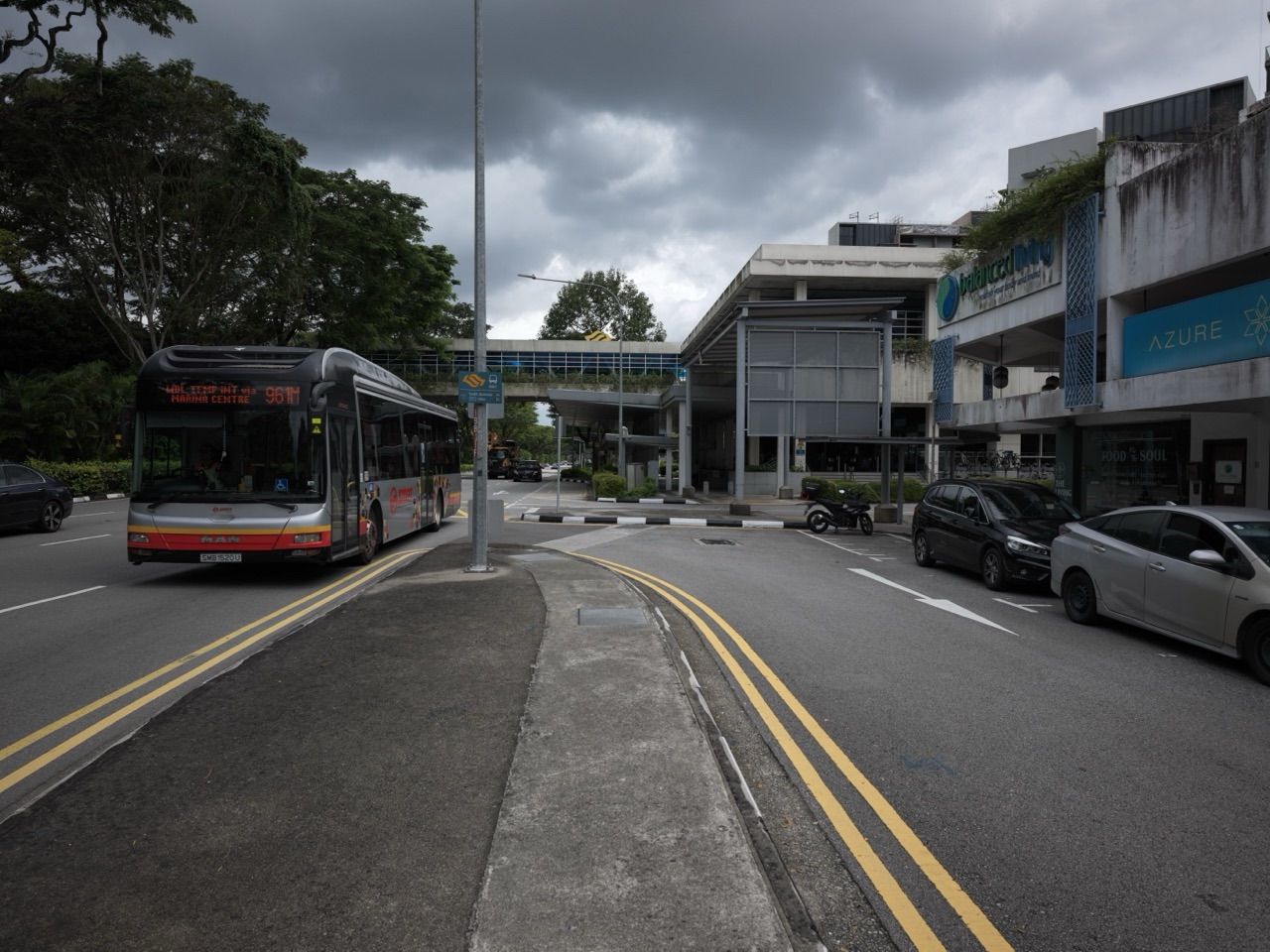
How Singapore connects is not only about how many buses exist.
It is also about whether road space lets those buses move reliably.
Did you know that a bus lane is really a public-transport capacity decision?
A road lane can carry private cars, taxis, goods vehicles or buses.
A bus may carry dozens of people at once.
Giving buses priority during busy periods can move more people through the same corridor without widening the road.
The paint is simple.
The transport policy underneath is not.
This article follows Singapore’s bus-priority connection layer: part-day bus lanes, full-day bus lanes, bus-only lanes, Bus Priority Boxes, queue jumping, bus stops, enforcement and the way road space is allocated to move people rather than simply vehicles.
The road network is explored in How Singapore Connects | Roads, Expressways and Junctions. The bus-stop layer is explored in How Singapore Connects | Bus Stops, Shelters and Real-Time Arrival Information. Here we ask the priority question: when road space is scarce, how can Singapore help buses carry more people more reliably?
Did You Know? Singapore Uses Three Types of Bus Lane
LTA’s current Driving Rules and Information page lists three main bus-lane arrangements:
- part-day bus lanes;
- full-day bus lanes; and
- bus-only lanes.
The difference is primarily when other traffic is excluded.
Part-Day Bus Lanes Protect the Peaks
LTA’s current operating hours for part-day bus lanes are Monday to Friday from 7.30am to 9.30am and from 5pm to 8pm.
Those are the periods when commuting demand is especially high.
The road changes priority according to time.
Full-Day Bus Lanes Protect a Longer Window
Full-day bus lanes operate from 7.30am to 11pm on Mondays to Saturdays under LTA’s current rules.
That covers most of the day when bus demand and road activity remain significant.
Bus-Only Lanes Are the Strongest Form
A bus-only lane is reserved for buses all the time under the applicable road arrangement.
That creates the clearest separation between high-capacity public transport and ordinary traffic.
The Lane Is Not Empty Capacity
A bus lane may look underused when one bus passes every few moments.
Count people instead of vehicles.
One bus can carry far more passengers than one car.
The purpose of the lane is person-throughput and service reliability.
Did You Know? Some Non-Scheduled Buses Can Use Bus Lanes
LTA permits selected non-scheduled buses, such as school and factory buses, to use bus lanes during operating hours, although they cannot stop to pick up or drop off passengers along the lane.
The rule recognises that those vehicles also carry many people.
Emergency Vehicles Can Use the Lane
Emergency-service and police vehicles on urgent duty can use bus lanes.
The public-transport priority does not override emergency response.
Bicycles Can Use Bus Lanes in Single File
LTA’s current rules allow bicycles to travel in bus lanes in single file.
That means the same priority corridor can support another efficient mode while preserving predictable lane behaviour.
The Dotted Bus Lane Is a Permission Interface
Near junctions or access points, a solid bus-lane line may become dotted.
That tells other drivers they may enter the lane for turning or access where permitted.
Road markings are a language.
Bus Priority Boxes Solve the Bus-Stop Exit Problem
A bus can enter a stop easily and still lose time trying to rejoin traffic.
LTA’s Bus Priority Box uses road markings and give-way rules to give buses priority when exiting selected bus stops.
The stop becomes part of the traffic-control system.
The Bus Priority Box Changes Who Gives Way
Drivers approaching the marked area slow and give way to buses entering or waiting to enter the yellow box.
The usual road hierarchy temporarily changes.
A bus carrying many passengers receives priority over individual vehicles.
Did You Know? A Bus Stop Can Create Delay Without Any Congestion Ahead
Imagine a bus with 50 passengers ready to leave the stop.
Traffic in the adjacent lane never creates a gap.
The bus waits 30 seconds.
The delay affects all 50 passengers and the next stop arrival.
Bus Priority Boxes attack that small but repeated delay.
Small Delays Multiply Across a Route
Ten seconds at one stop.
Twenty seconds at another.
A long signal wait.
A queue at a junction.
By the end of the route, small interruptions become several minutes.
Transit priority works by removing repeated friction.
Reliability Matters as Much as Average Speed
A bus that usually takes 35 minutes but occasionally takes 60 is hard to plan around.
Priority measures can reduce variability by shielding buses from some traffic congestion.
Predictability is a transport service.
Bus Priority Connects to Real-Time Arrival Information
The arrival predictions in How Singapore Connects | Bus Stops, Shelters and Real-Time Arrival Information become more useful when buses move consistently.
Road priority improves the physical service.
Real-time information explains the service to passengers.
Bus Lanes Protect Scheduled Travel Time
A timetable assumes buses can move through the corridor within some expected range.
If general traffic grows without priority, buses become less reliable.
A bus lane protects part of the scheduled path.
The Same Road Can Carry Different Priorities by Time
At 2am, a general traffic lane can serve almost anyone.
At 8am, the same physical lane may be much more valuable to high-capacity public transport.
Time-based allocation lets one piece of road serve different objectives.
This Is Infrastructure Without Building Another Road
Road widening is expensive and consumes land.
Changing lane priority can improve public-transport performance using existing asphalt.
Operational design can create capacity without concrete.
Did You Know? Bus Lanes Are Enforced
Using a bus lane illegally during operating hours is an offence.
Enforcement protects the lane from being gradually reclaimed by general traffic.
A priority rule only works if drivers expect it to be real.
Enforcement Creates Reliability
If a few vehicles enter the lane casually, buses begin weaving around them.
The travel-time advantage disappears.
Enforcement preserves the operational function of the road marking.
Camera Enforcement Can Extend Human Enforcement
Bus-lane compliance can be monitored using cameras and enforcement operations.
The road becomes another measured system.
Bus Lanes Connect to Junction Design
A bus lane that disappears at every junction may lose much of its value.
Signals, turning pockets and stop placement determine whether priority remains continuous.
The lane is one component of corridor design.
Transit Signal Priority Can Extend the Idea
Some cities give approaching buses earlier or longer green lights.
The general principle is the same as a bus lane: reduce delay for high-capacity public transport.
Road priority can be spatial or temporal.
Queue-Jump Lanes Give Buses a Head Start
A short priority lane near a junction can let a bus move ahead of general traffic before lanes merge.
A few dozen metres can protect several minutes of schedule under the right conditions.
Bus Stops Need Enough Kerb Space
Several buses arriving together can block one another if a stop is too short.
Berth length, stop design and passenger demand affect dwell and re-entry time.
Bus priority begins at the kerb.
The Bus Lane Connects to Interchanges
Interchanges from How Singapore Connects | Bus Interchanges, MRT Stations and Transfer Hubs concentrate many routes into one node.
Bus lanes help those routes leave and approach busy town centres more reliably.
The Bus Lane Connects to Electric Buses
Electric vehicles from How Singapore Connects | Electric Buses, Charging Depots and Clean Public Transport still face road congestion.
Changing the motor does not remove the need for transit priority.
Cleaner Buses Stuck in Traffic Are Still Slow Buses
Electrification improves emissions and noise.
Bus lanes improve movement and reliability.
The strongest public-transport strategy combines vehicle technology with road operations.
Bus Priority Connects to Accessibility
A senior or wheelchair user may rely more heavily on buses than a driver does.
Reliable bus movement therefore supports How Singapore Connects | Public Transport Accessibility, Barrier-Free Routes and Priority Travel.
Bus Priority Connects to School Journeys
Students travelling during morning peak share road space with office commuters.
A protected bus corridor can improve arrival reliability for school and work simultaneously.
Bus Priority Connects to Employment Geography
People choose jobs partly based on commute time and reliability.
A reliable bus corridor expands practical access to workplaces without requiring private car ownership.
Road Space Is a Public Resource
Every metre of urban road occupies scarce land.
The important question is not only how many vehicles fit.
It is how much useful movement the road produces.
People-Throughput Changes the Calculation
Ten cars may carry twelve people.
One bus may carry fifty or more.
A priority lane can therefore look less busy while moving more people.
The Bus Lane Is a Fairness Question Too
Drivers lose some general road space during bus-lane hours.
Bus passengers gain faster, more reliable movement.
The policy choice is about how shared road capacity is allocated across modes.
A Small Example: Morning Peak
Traffic slows on arterial road.
General lanes queue.
Bus enters operating bus lane.
Passes part of congestion.
Reaches next stop closer to schedule.
Fifty passengers each save time.
One lane has multiplied its social value.
A Small Example: Bus Leaving Stop
Bus finishes boarding.
Adjacent traffic is continuous.
Bus signals to leave.
Bus Priority Box requires approaching driver to give way.
Bus rejoins stream.
Thirty seconds of potential delay disappears.
A Small Example: Driver Turning Left
Driver approaches a left turn.
Solid bus-lane line becomes dotted.
Driver enters dotted section carefully.
Completes turn.
The road marking has balanced bus priority with property and junction access.
What Can Break the Bus-Priority Connection?
- illegal vehicles occupying the lane;
- delivery vehicles stopping in the corridor;
- junction bottlenecks;
- bus stop congestion;
- roadworks;
- poor enforcement;
- drivers not yielding at Bus Priority Boxes;
- priority ending too frequently;
- incidents blocking the bus lane; and
- passengers experiencing long dwell times even when road movement is fast.
A priority corridor is only as continuous as its weakest interruption.
How to Read a Bus Corridor Like a Systems Thinker
1. Count people, not vehicles
How many passengers move per lane?
2. Find the congestion
Where do buses lose time?
3. Find the priority
Bus lane, priority box or signal treatment?
4. Find the operating hours
When is the priority active?
5. Find the conflict
Turning traffic, deliveries, parking or junction queues?
6. Find the enforcement
How is the priority protected?
7. Find the passenger outcome
Did travel time and reliability improve?
The eduKate Singapore Graph: Road Space Can Carry Policy
A road marking is paint.
It can also express a transport strategy.
Give priority to a bus.
Move more people.
Reduce delay.
Make public transport more competitive.
The infrastructure did not get wider.
The allocation got smarter.
Frequently Asked Questions
What types of bus lanes does Singapore have?
Part-day bus lanes, full-day bus lanes and bus-only lanes.
When do part-day bus lanes operate?
LTA currently lists Monday to Friday, 7.30am–9.30am and 5pm–8pm.
When do full-day bus lanes operate?
LTA currently lists Monday to Saturday, 7.30am–11pm.
Can bicycles use bus lanes?
Yes, LTA allows bicycles in single file during operating hours.
Can school buses use bus lanes?
Selected non-scheduled buses such as school and factory buses may use them, but cannot stop for passenger pickup or drop-off along the lane.
What is a Bus Priority Box?
A marked area requiring other drivers to give way so buses can exit bus stops more easily.
Can cars enter a bus lane to turn?
Where the bus-lane line is dotted, vehicles may enter as needed for the permitted turn or access, following road rules.
Why do buses need priority?
Because buses carry many passengers and repeated traffic delay reduces reliability across the whole route.
Do electric buses still need bus lanes?
Yes. Electrification changes propulsion, not congestion.
Where can I check the official rules?
LTA OneMotoring | Driving Rules and Bus Lanes.
Helpful Reading and Singapore Graph Connections
- LTA OneMotoring | Bus Lanes and Bus Priority Box
- How Singapore Connects | Roads, Expressways and Junctions
- How Singapore Connects | Bus Stops, Shelters and Real-Time Arrival Information
- How Singapore Connects | Electric Buses, Charging Depots and Clean Public Transport
How Singapore Connects: The Lane Moves People, Not Paint
Did you know that a bus lane can increase road usefulness without adding one metre of asphalt?
Protect the corridor.
Give buses a clean path.
Help them leave stops.
Keep schedules stable.
Count passengers instead of cars.
The road has not changed size.
Its public-transport capacity has.