
HOW SINGAPORE EDUCATION WORKS · Kindergarten light, outline and careful observation
Find your next learning step
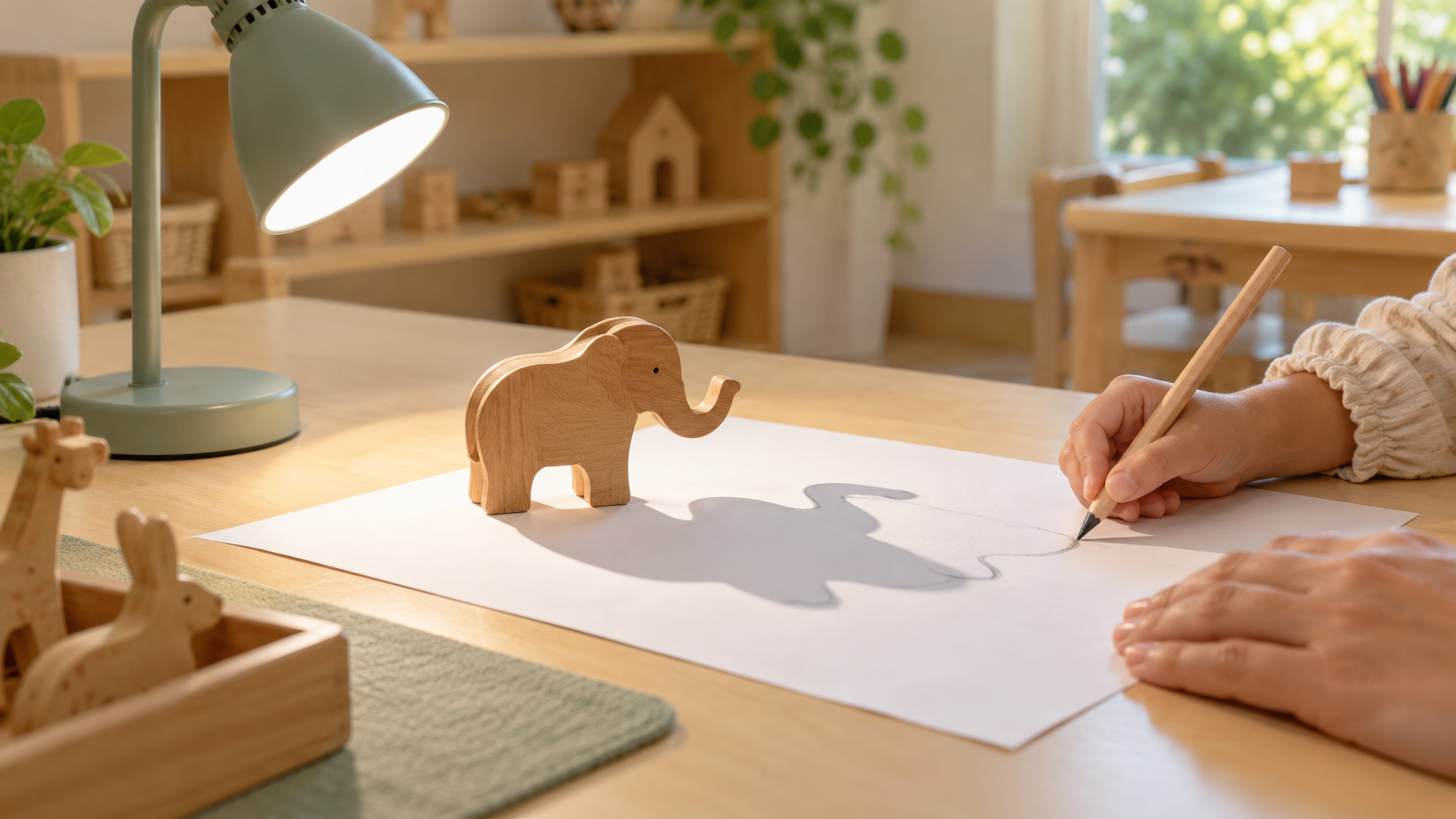
Begin with one lamp, one safe object and one fixed sheet. Trace one outline, move only the light, then compare what changed and what stayed the same.
Full chapter index · Practice and checking · Sources and next reading · How Singapore Education Works
Shadow tracing turns a familiar sight into a small investigation. A child watches an object block light, follows the dark outline and then checks how the outline changes when the light or object moves. The useful sequence is place, predict, trace, change one thing and compare.
This is a supervised teaching suggestion, not a prescribed preschool lesson. Singapore’s Nurturing Early Learners framework supports purposeful play, observation and meaning-making. Use a cool, stable lamp or indirect sunlight; keep cords, hot bulbs, sharp objects and direct viewing of bright light out of reach; and adapt the task to the child and setting.
The choices at a glance
| What you notice | Likely issue | Useful next move |
|---|---|---|
| The outline keeps moving while the child traces | The light, object or paper is not fixed | Tape the paper, mark the object position and let an adult steady the lamp |
| The child says the shadow is the object | Object, blocked light and outline are being merged | Point to the object and its shadow separately; move one and watch the other respond |
| A changed shadow is treated as a mistake | Variation has not yet become evidence | Replay the setup and ask which single position changed |
Full chapter index
Repair and practise
Recall, transfer and questions
Light travels from a source towards a surface. When an opaque object interrupts part of that path, a darker area appears behind it. The shadow is not paint on the paper and it is not a second object; it is an area receiving less light.
For a young learner, keep the first model concrete: lamp, toy, paper. Name each part and touch only the safe object and paper. Turn the lamp off and on so the child can see that the outline depends on the light.
NASA’s Bear’s Shadow activity similarly invites families to move a flashlight around an object and observe the resulting shadow. That global science connection begins with the same small relationship: source, blocker and receiving surface.
| Feature | Question | Useful observation |
|---|---|---|
| Direction | Which side is the lamp on? | The shadow falls mostly away from the lamp |
| Edge | Sharp or soft? | The edge is darker near the object and softer farther away |
| Size | Larger or smaller than before? | The outline grew when the lamp moved closer |
| Position | Where does it begin? | The shadow touches the object’s base |
| Shape | Which parts are recognisable? | Two ears form two pointed sections |
Young children may call every dark patch a shadow. Compare it with a printed mark: the printed mark remains when the lamp is off, while the shadow changes or disappears.
A tracing records one moment and one setup. It does not prove the object’s exact size unless distance, angle and surface position are controlled.
Assumptions: a small wooden animal stands on a marked spot beside white paper. A cool lamp begins 40 centimetres to the left at table height. The paper and toy remain fixed. An adult traces the first outline with the child.
The lamp then moves to the right, at the same distance and height. The new shadow crosses to the opposite side. Its overall size is similar, although the outline is not perfectly identical because the lamp position and tracing hand cannot be reproduced exactly.
Checked answer under these assumptions: the planned change is light direction. The object and paper stayed fixed, so the shadow’s side change is consistent with light arriving from the opposite direction. Small outline differences may come from setup or tracing error.
This answer distinguishes the intended variable from uncontrolled details. That habit later supports fair comparisons in science.
If there is no visible shadow, first check whether the room is too bright or whether the lamp points at the paper. Next check whether the object actually sits between source and paper. Do not immediately move everything.
If the outline doubles, something moved during tracing. If the edge is too faint, reduce competing light or move the receiving surface, while keeping the child away from the lamp. If the shadow leaves the page, enlarge the paper or change one distance deliberately.
Use precise repair language: ‘Hold the toy on its mark’ is more useful than ‘Do it properly’.
- Fix the paper and mark the object position.
- Place the safe light and predict the shadow side.
- Trace only enough of the edge to recognise the outline.
- Change one position: light, object or paper.
- Replay the first setup and check whether the earlier outline returns closely.
Replay matters because memory can be vague. Returning the lamp to its mark lets the child test whether the earlier relationship is repeatable.
Never use the Sun as something to stare at or point optical devices towards. Outdoor shadow observation should keep eyes away from direct sunlight and follow the setting’s safety rules.
Guided
The adult fixes the setup and traces most of the outline. The child points to the lamp side and the shadow side.
Shared
The child chooses between two marked lamp positions, predicts left or right, then helps trace and compare.
Independent within boundaries
Using pre-approved materials, the child makes two labelled outlines, circles one difference and explains which single position changed.
A day later, show the two outlines without the apparatus. Ask what the child can infer and what still needs checking. The child may infer that the light probably changed side, but the drawing alone cannot reveal every distance.
Outside, shadows shift as the Sun’s apparent position changes through the day. Across the world, learners use shadow observations in art, storytelling, timekeeping and astronomy. Keep the comparison grounded: similar observations can have different cultural meanings and should not be reduced to one universal story.
Changed-context transfer: use two objects together and predict which outline overlaps. Then separate them and explain the new gap.
Does the child need to trace the whole shadow?
No. A short recognisable edge may be enough for comparison, especially while fine-motor control is developing.
Why is one edge blurry?
Real light sources have size, and other light may enter the room. The activity can notice this without requiring advanced optics.
What if the child fears the dark?
Keep the room comfortably lit and use a small clear shadow. Participation should remain calm and optional.
Is the biggest shadow the best result?
No. The useful result is stable enough to compare and explain.
Sources and next reading
- MOE — Nurturing Early Learners Framework 2022
- NASA Science — Exploring Earth: Bear’s Shadow
- NASA Science — Moon Shadow Play Activity