
HOW SINGAPORE EDUCATION WORKS · Kindergarten movement, fair comparisons and purposeful play
Find your next learning step
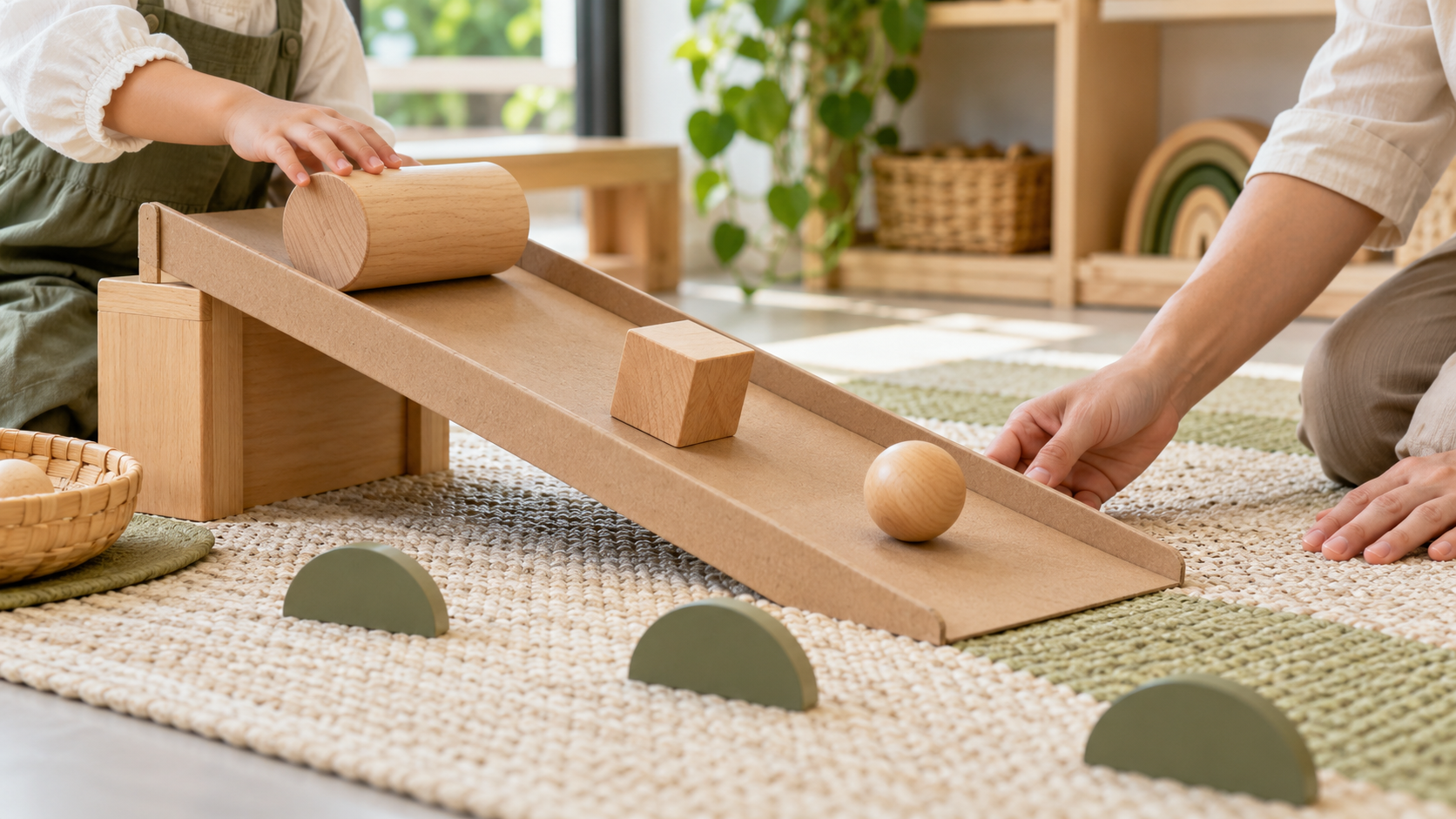
Choose two safe objects, one short ramp and one stopping line. Predict, release without pushing, compare the movement and replay before changing one condition.
Full chapter index · Practice and checking · Sources and next reading · How Singapore Education Works
Rolling and sliding are ordinary movements, but they become powerful learning when a child makes a prediction, changes one condition and checks the result. A ball may roll, a block may slide, and the same object may behave differently when its orientation, surface or slope changes.
This is a supervised teaching suggestion, not a prescribed preschool lesson. Singapore’s Nurturing Early Learners framework supports purposeful play, active learning and reflection. Use large, non-choking objects on a low, stable ramp; keep fingers clear of moving items; and work away from stairs, roads, glass and other hazards.
The choices at a glance
| What you notice | Likely issue | Useful next move |
|---|---|---|
| The child pushes one object harder | Release force changed as well as the object | Use a simple gate or the same two-finger release point |
| The object turns sideways halfway down | Orientation or ramp edge affected the path | Mark a starting outline and widen or straighten the ramp |
| One result is treated as a rule | A single trial may include chance or setup error | Replay three times and record what usually happens |
Full chapter index
See the structure
Repair and practise
Recall, transfer and questions
An object rolls when it turns around an axis while moving forward. It slides when a surface moves across another surface without that repeated turning. Some objects can do both: a cylinder may roll on its curved side and slide on a flat end.
Young learners do not need a formal physics lecture. Begin with visible evidence: Did the shape turn? Did the same face stay against the ramp? Did it wobble, stop or change direction?
The first learning goal is not “round things roll”. It is “I can describe what this object did in this setup and test whether it happens again”.
| Condition | Keep or change? | What to notice |
|---|---|---|
| Object shape | Change one object at a time | Curved side, flat face, corners |
| Slope height | Mark one setting | Faster, slower, stops or overshoots |
| Ramp surface | Swap one covering | Smooth, rough, soft or hard |
| Release point | Keep the same line | No extra push |
| Orientation | Mark the starting outline | Curved side or flat end down |
A fair comparison does not mean perfect laboratory control. It means the child and adult can say what they tried to keep the same and which one condition they changed.
Use descriptive language before causal language: “The can rolled past the tape” is evidence; “because it is heavier” is a claim that would need another test.
Assumptions: a 40-centimetre cardboard ramp is raised 8 centimetres. A wooden cube and a wooden cylinder have similar mass. Each starts behind the same line and is released without a push. The floor has a stopping line 30 centimetres beyond the ramp.
Across three trials, the cube slides down and stops before the line. The cylinder, placed on its curved side, rolls beyond the line in all three trials. When the same cylinder stands on one flat end, it mostly slides and stops near the cube.
Checked answer under these assumptions: orientation and contact shape matter. The evidence supports saying that this cylinder rolled farther on its curved side in this setup. It does not prove every cylinder always moves farther than every cube.
The checked answer names the limits of the test. That habit later supports scientific comparison and responsible generalisation.
If trials scatter widely, inspect release before changing the object. A hidden push, different starting line or tilted ramp can overwhelm the intended comparison. If an object leaves the side, check alignment and ramp width.
If nothing moves, confirm that the slope is high enough for the chosen surface and that the object is not caught on tape. Raise the ramp only in small, supervised steps.
If a child says one object “won”, redirect from competition to evidence: Which condition was different? Where did each object stop? Did the replay agree?
- Mark the ramp height, release line and object orientation.
- Predict roll, slide, wobble or stop.
- Release without an extra push.
- Record the stopping place with a removable marker or simple picture.
- Replay at least twice, then change only one chosen condition.
A picture record can be enough: draw the object, circle roll or slide, and add one line for where it stopped. The record should help the child compare, not turn play into paperwork.
Stop the activity if objects become projectiles, the ramp shifts or children crowd the path.
Guided
The adult fixes the ramp and releases two objects. The child points to rolling or sliding and matches each object to its stopping mark.
Shared
The child chooses one of two safe objects, predicts the movement and helps replay three trials from the marked line.
Independent within boundaries
The child selects one permitted change—shape, surface or orientation—makes two records and explains what stayed the same.
A day later, show photographs of the objects without the ramp. Ask what can be predicted and what still depends on the setup. The child can suggest likely movement, but should know that slope, surface and orientation still matter.
The Exploratorium’s Downhill Race demonstrates that even round objects need not roll at the same rate. NASA images show material sliding and rolling down Martian slopes. The global connection is not that a toy ramp explains a planet completely, but that careful observers compare shape, slope, traces and repeated evidence at very different scales.
Changed-context transfer: cover half the ramp with cloth, predict where motion changes and explain the evidence without assuming “rough always stops everything”.
Must objects have the same mass?
Not for every exploration. If the question is about shape, similar mass can reduce one extra difference, but the important step is to state what was and was not controlled.
Should we time the movement?
Only if timing helps and can be done simply. Stopping positions and movement words are enough for many young children.
Can a cube roll?
It may tumble over edges on a steep slope. Ask what is turning and whether the pattern repeats.
Is the fastest object the best?
No. The goal is a safe, explainable comparison.
Sources and next reading
- MOE — Nurturing Early Learners Framework
- Exploratorium — Downhill Race
- NASA Science — Martian Features Formed When Material Moves Downslope