
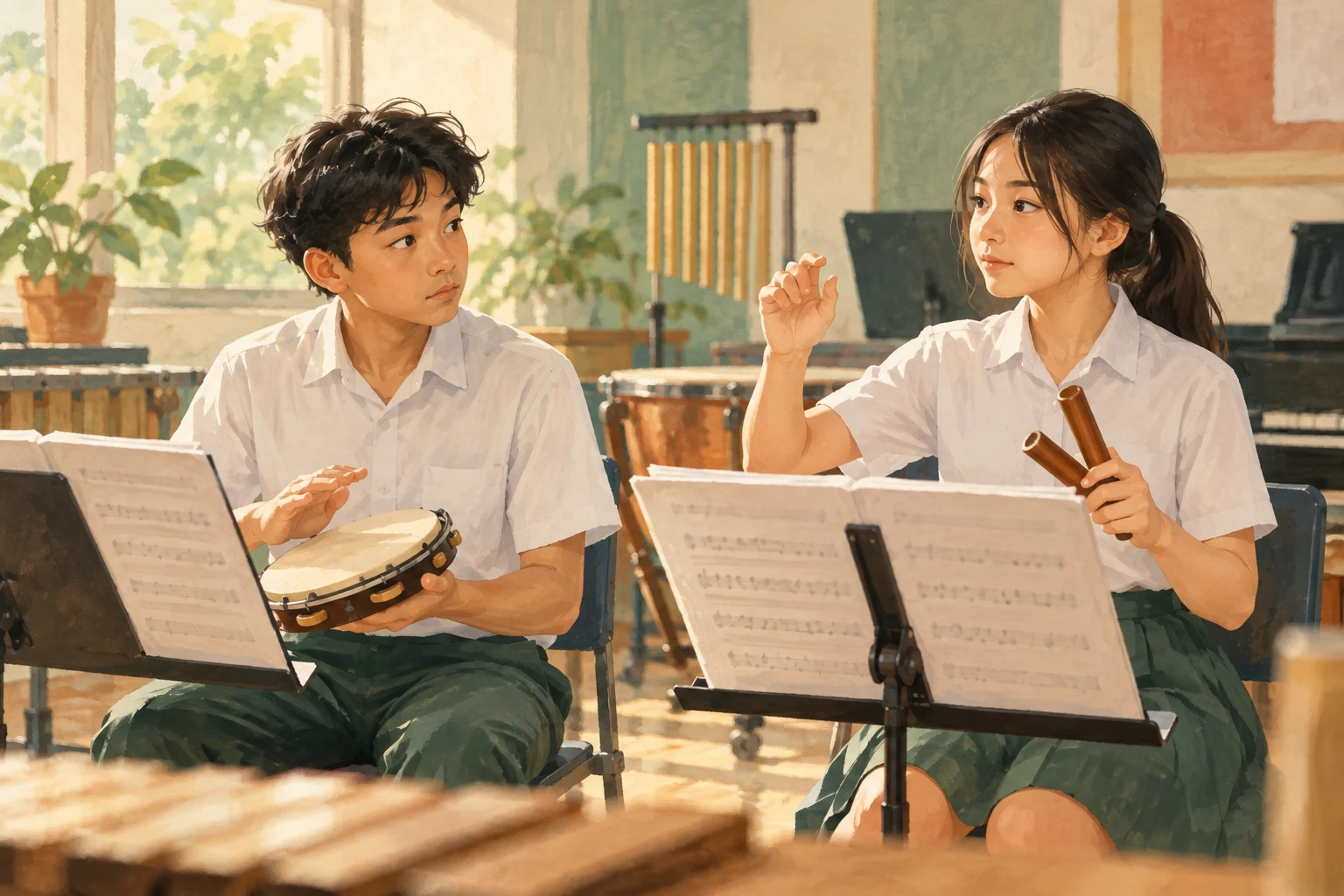
HOW SINGAPORE EDUCATION WORKS · Counting musical rests at school
Find your next learning step
During a musical rest, keep tracking the beat and your position in the bar. Before playing, identify the time signature, the beat unit, how long your part is silent and the precise beat on which you enter. Listen to the group while counting; silence in your part does not mean the music has stopped.
Full chapter index · Practice and checking · Sources and next reading · How Singapore Education Works
This guide starts with simple 4/4 and 3/4 examples in Western staff notation. It is a suggested rehearsal method for school learners, not a Singapore examination rubric. Follow your teacher or ensemble leader when the actual score includes pickups, changing metre, pauses or other instructions.
The choices at a glance
| What you notice | Possible issue | Useful next move |
|---|---|---|
| Enters one beat early | A silent pulse was skipped | Locate every rest before restarting |
| Keeps the pulse but loses the bar | Beat and bar counts were not coordinated | Name the bar separately during practice |
| Reuses the 4/4 count in 3/4 | The changed metre was ignored | Recalculate the entry before performing |
Full chapter index
Understand beat and silence
Repair and practise
Recall and perform
In the 4/4 examples here, each bar contains four quarter-note beats. Count a steady “one, two, three, four,” then begin the next bar. A bar is a group of beats; a beat is the regular pulse you are tracking.
In the 3/4 practice example, each bar contains three quarter-note beats. Both examples use the quarter note as the beat unit, but the number of beats in each bar changes.
Do not turn the lower number into a universal counting rule for every time signature. Compound metres such as 6/8 need a separate explanation of grouping and pulse. Establish these simple examples first.
The Open Music Theory chapter on simple metre explains the relationship between beat grouping and time signatures. Use the score's notation and the teacher's count-in together.
CHAPTER 2 OF 8 · Understand beat and silence
2. Silence has a duration and a location
A rest tells your part to remain silent for a specified duration. That silence still occupies musical time. If other parts keep playing, you need to follow their progress without joining them too soon.
For these first exercises, distinguish a rest lasting one quarter-note beat from a direction to rest for an entire bar. An entire silent bar takes four beats in our 4/4 example and three in our 3/4 example.
The printed context matters. The same rest sign may serve a whole-bar function in a score; read it with the bar, metre and surrounding notation. Ask the teacher when you cannot tell whether you are seeing a duration, a whole-bar rest or a multi-bar indication.
Counting should help you know where you are. It should not become so loud that it masks classmates or disrupts the rehearsal. Begin aloud during a practice exercise, then move to a quiet internal count as appropriate.
Here is an original fictional rehearsal task. The metre is 4/4. There is no pickup, pause or change of tempo. Your part is silent throughout bar one. In bar two, it rests for beats one and two, then plays one short sound on beat three and another on beat four.
| Position | Count | Your part |
|---|---|---|
| Bar 1 | 1, 2, 3, 4 | Silent on all four beats |
| Bar 2, first half | 1, 2 | Silent for two more quarter-note beats |
| Bar 2, second half | 3, 4 | Play on beat three, then beat four |
Checking answer: the first entry is bar two, beat three. Six quarter-note beats pass silently before that entry: four in the first bar and two in the second. The entry is on the next pulse; do not wait through an extra beat three before playing.
Mark the location on your own permitted practice copy or make a separate note. Say, “Bar two, beat three,” before starting. This checks the destination before you have to reach it in real time.
A partner can maintain the pulse while you perform only your part. Then switch roles. Neither player should speed up to finish the silent section.
If you count “one, two, three, four” repeatedly, you may keep the pulse but forget which bar you have reached. Practise naming the bar separately: “Bar one: one, two, three, four. Bar two: one, two, enter, play.”
For a longer silent passage, a teacher may suggest replacing the first beat's spoken number with the bar count. Learn what that rehearsal convention means before using it: a bar count is a memory aid, not an additional musical beat.
Look ahead to the entry while keeping your current place. You need to know both where you are and where you are going. Looking only at the first note can make the intervening silence disappear from attention.
Use an audible cue from another part as a supporting landmark when the teacher identifies one. Check the bar count too. A cue may be missed or played incorrectly, so it should not be your only route through the score.
If you enter one beat early, point to every silent beat in the worked case. Did you count only five, or mistake “enter on three” for “play after two bars”?
If you enter one beat late, check whether you waited until the end of beat three before playing. An instruction to play on a beat normally means the sound begins at that beat's arrival.
If your entry is in the correct bar but the group has moved ahead, check the pulse. You may be counting at your own comfortable speed instead of maintaining the agreed tempo.
If you lose your place entirely, use the ensemble's agreed recovery method. In practice, stop and restart from a clearly identified bar. During a run-through, follow the leader's direction rather than making a conspicuous guessed entry.
For guided practice, use the original 4/4 task. A partner counts two complete bars steadily. Stay silent for the first six pulses, then tap on the seventh and eighth. Afterwards name each tap's bar and beat.
Checking answer: pulse seven is bar two, beat three; pulse eight is bar two, beat four. Numbering pulses across the exercise is a temporary checking tool, not a replacement for reading bars.
For independent practice, change the task to 3/4. Rest throughout bar one, rest on beat one of bar two, then play on beats two and three of bar two. Work out the entry before performing.
Checking answer: four quarter-note beats pass silently: three in bar one and one in bar two. Enter on the fifth pulse, which is bar two, beat two. Carrying over the earlier “six silent pulses” would ignore the changed metre and task.
Finally, describe the difference between the examples in words. You changed the number of beats per bar and the entry location; you did not simply perform the old count faster.
Tomorrow, explain how a beat differs from a bar without looking at the table. Then reconstruct the 4/4 entry with a partner. Check the score afterwards.
Transfer to a part that rests while a classmate plays a melody. Listen for the shared pulse and the agreed cue while tracking your own silent bars. This adds coordination; it does not make your part's counting optional.
Singapore's Geylang Methodist School (Secondary) music page describes listening, creating and performing within that school's curriculum. It supplies one local learning context, not a requirement for every school to rehearse this example.
The global connection is a shared notation system used by musicians in many places. Open Music Theory provides an international, openly available explanation of rhythmic and rest values. Shared marks support coordination, while the actual style, metre and rehearsal practice still need attention.
Should I count every subdivision?
Use the subdivision needed to place the actual notes and rests accurately, with the teacher's guidance. A first exercise with quarter-note beats need not become an unnecessarily complicated stream of syllables.
Does a rest mean I can relax completely?
You remain silent but continue following the music. Prepare the next entry without adding unwanted sounds. The physical preparation depends on the instrument.
Can a metronome replace listening to the group?
It can help practise a steady pulse. It does not replace following an ensemble leader, responding to an agreed tempo change or listening to other players.
Is this an audition rule?
No. Auditions may give specific instructions about rests, extracts or accompaniment. Read the actual instructions rather than applying a classroom practice routine as an institutional rule.
Sources and next reading
Reviewed 23 October 2026. The rehearsal tasks, pulse counts and checking answers are original.
Geylang Methodist School (Secondary): Music provides the institution-specific Singapore example. Open Music Theory's chapters on simple metre and rhythmic and rest values support the notation explanation.
Continue through the How Singapore Education Works hub for learning guides at other stages.
Learning at other stages
Continue with a different learning task in this series. Each guide has its own worked cases, practice and limits.
Comparing container capacity in kindergarten