
HOW SINGAPORE EDUCATION WORKS · Comparing container capacity in kindergarten
Find your next learning step
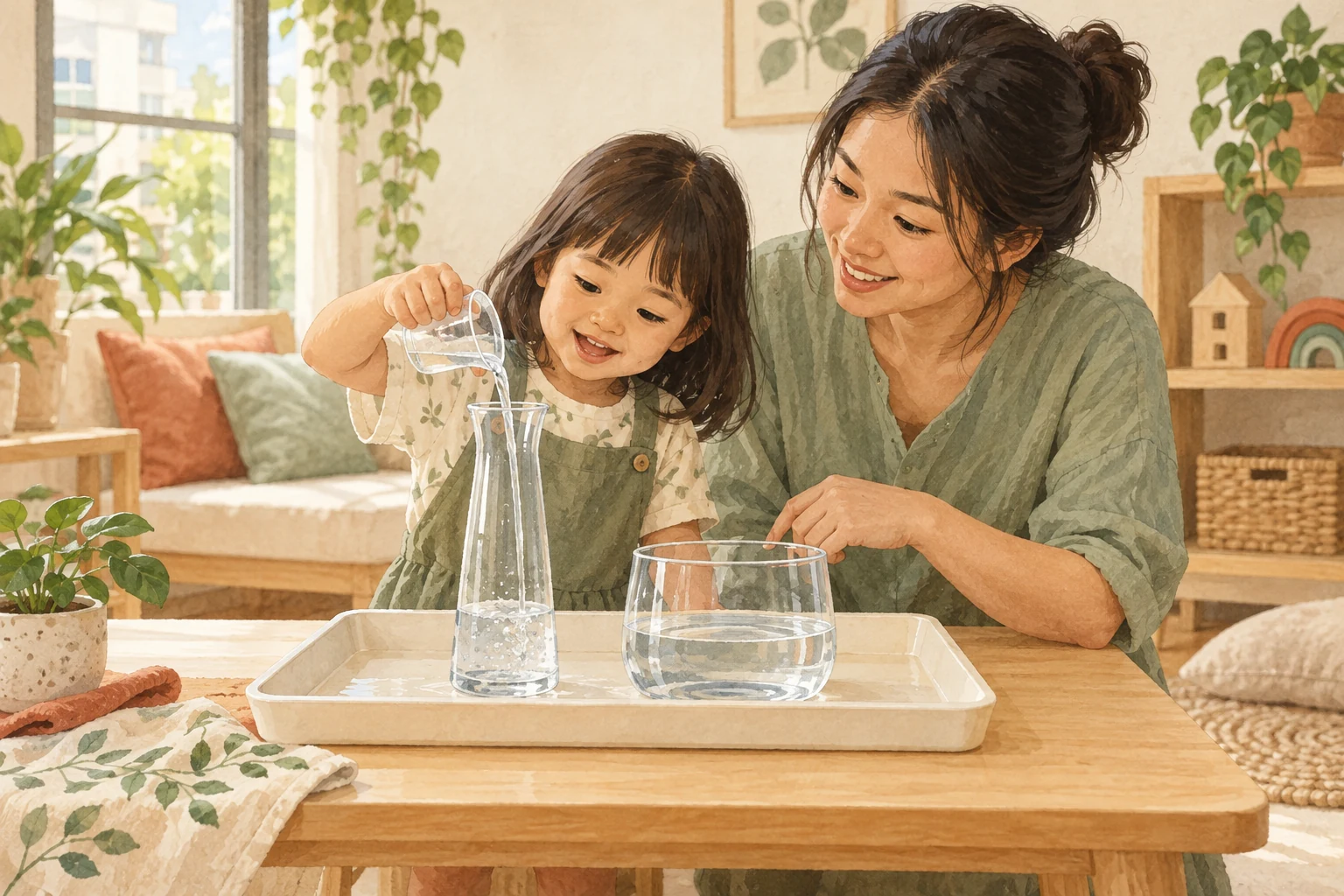
To compare how much two containers hold, fill each to the same agreed endpoint using the same small cup, filled to the same level each time. Count the cupfuls and check for spills. A taller container does not necessarily hold more than a shorter, wider one.
Full chapter index · Practice and checking · Sources and next reading · How Singapore Education Works
For a young child, this is an invitation to predict, test and explain. Keep the collections and counts small, use a shallow tray and let an adult manage the water. These are suggested learning activities, not a kindergarten admission test or a claim that preschoolers must calculate volumes.
The choices at a glance
| What you notice | Possible issue | Useful next move |
|---|---|---|
| Chooses the tallest container | Height is being used as a shortcut | Compare equal cupfuls to agreed endpoints |
| Counts different-sized cupfuls together | The measuring unit changed | Repeat with one cup and one fill level |
| Loses count while pouring | Two actions compete for attention | Assign one large counter per completed pour |
Full chapter index
Set a fair comparison
Repair and practise
Recall and transfer
A container has several properties: height, width, shape, weight and capacity. “Which one is bigger?” leaves the comparison open. Ask instead, “Which container can hold more water when we fill it to here?”
Point to the agreed endpoint. For this activity, use a clear fill line below the rim so the child can stop without balancing water at an overflowing edge. You are comparing the amount each container holds to that line, which may differ from its full-to-the-brim capacity.
Singapore's Nurturing Early Learners numeracy overview encourages comparison, mathematical language and everyday investigation. It does not prescribe this particular pouring lesson. Capacity play is our chosen context for those habits.
Choose stable, unbreakable containers that are easy to handle. An adult should supervise water play and empty the tray afterwards. No drinking, glass containers or heavy lifting are needed for the learning task.
Choose one small measuring cup as the unit. Fill it to a visible line, pour it into the first empty container and place a large counter beside the tray. Repeat until the container reaches its agreed line.
Use the same cup and fill level for the second container. Start it empty too. If one cupful is nearly full and another is half full, the count no longer represents equal amounts.
Pause after a spill. You may need to empty that container and start again, because some counted water did not reach it. Restarting is a repair to the method, not a punishment for messy play.
Do not silently round a partly filled final cup into a whole cup. At first, select containers whose agreed endpoints take whole cupfuls. Later you can describe a remainder as “some more than four cups” without requiring fraction notation.
Here is a fictional investigation with convenient whole-cup results. Both containers start empty. The same small cup is filled to its marked line for every pour, and no water spills. Each container has its own agreed endpoint below the rim.
Before testing, Arun predicts that the tall, narrow container will hold more. The adult writes down the prediction without correcting it.
| Container | Equal cupfuls to its agreed line | Evidence after the test |
|---|---|---|
| Tall and narrow | Four | Four large counters record four successful pours |
| Short and wide | Six | Six large counters record six successful pours |
Checking answer: the short, wide container holds two more of these cupfuls to its agreed line. Six minus four equals two. The evidence concerns the tested containers and their endpoints; it does not establish a rule that wide containers always hold more.
Ask Arun to explain why his prediction changed. “This one took six equal cups and that one took four” connects the answer to the method. “Short ones are bigger” replaces one unreliable rule with another.
You do not need to assign millilitres to the cup. The fair comparison depends on equal units, not on knowing the cup's standard volume.
Now pour four cupfuls into each empty container. In the worked case, four cupfuls reach the tall container's agreed line, while the wider container remains below its line.
The water levels can look different even though the amounts poured are equal. Ask two separate questions: “Did we pour the same amount?” and “Are the water surfaces at the same height?” A correct answer to one does not answer the other.
Move the containers close together on the same level surface for observation. Do not change the water while asking what stayed the same.
This distinction prepares children to resist an appearance-based guess. It does not require them to explain cylinder formulas or the geometry of every irregular container. A clear account of the pouring is enough.
If the child forgets the count while pouring, separate the jobs. The adult pours and the child places one large counter for each completed cupful. Later switch roles if handling the cup is comfortable.
If the child compares counts from different cups, ask whether each counted unit represented the same amount. Demonstrate one full marked cup beside a partly filled one before repeating the comparison.
If the child says the taller water level must mean more water, return to equal cupfuls in different shapes. Let the child track what enters each container.
If the test is too demanding, compare just two and three cupfuls in smaller containers. Reduce the number of steps rather than requesting faster counting. Stop while the investigation still feels like a manageable question.
For guided practice, an adult reports that container A took three cupfuls and container B took five. The cup and fill level were unchanged, both started empty and nothing spilled. Ask which held more and what information makes that conclusion fair.
Checking answer: B held two more cupfuls to its agreed endpoint. The counts are comparable because the unit and procedure were consistent. If the cups had differed, the counts alone would not settle the comparison.
For independent practice, give the child this problem: “A took four small cups. B took three large cups. Can we tell which holds more just from these numbers?” Ask for a way to improve the test.
Checking answer: no. Three large cupfuls might contain more or less than four small ones. Repeat both measurements with the same cup and fill level. The useful answer is a repaired method, not a guess.
Invite the child to choose a new pair of containers and predict before testing. Record the prediction and result in separate places so a changed mind remains visible.
The next day, ask the child to explain what made yesterday's comparison fair before bringing out the containers. Then offer the cup and let them demonstrate.
Change the context to packing pretend food into two containers using identical large blocks. Ask which holds more blocks under the same packing rule. Discuss why gaps and block arrangement may affect this new test. Results with blocks need not match results with water.
The University of Cambridge's NRICH Water, Water activity provides a global connection through exploratory water play and capacity language. It offers a teaching resource, not Singapore's institutional requirements.
If your child is comparing the number of objects rather than what a container holds, the earlier guide to comparing collections addresses one-to-one pairing and misleading spacing. Keep those reader jobs distinct.
Is capacity the same as the amount currently inside?
No. A container's capacity concerns how much it can hold. Its current contents may occupy only part of that space. State whether your test concerns the brim or an agreed fill line.
Should we introduce litres now?
They are optional for this activity. Begin with equal cupfuls and a clear explanation. Follow the child's preschool approach when standard units are introduced.
What if the final cup is only partly used?
Say that the endpoint required a number of full cups and part of another. Do not count the partial amount as an equal full unit. Choose easier endpoints if the remainder distracts from the first learning goal.
What counts as progress?
Look for a child who asks about the cup, checks the starting condition and explains why the count supports the answer. That reasoning matters more than immediately choosing the right container by sight.
Sources and next reading
Reviewed 23 October 2026. All worked quantities, practice cases and teaching sequences are original suggestions.
MOE Nurturing Early Learners: Numeracy supplies the Singapore learning context. NRICH: Water, Water supplies the international early-years connection.
Explore the How Singapore Education Works hub for other learning stages.
Learning at other stages
Continue with a different learning task in this series. Each guide has its own worked cases, practice and limits.
Counting musical rests at school