
HOW SINGAPORE EDUCATION WORKS · Music repeat signs and endings
Find your next learning step
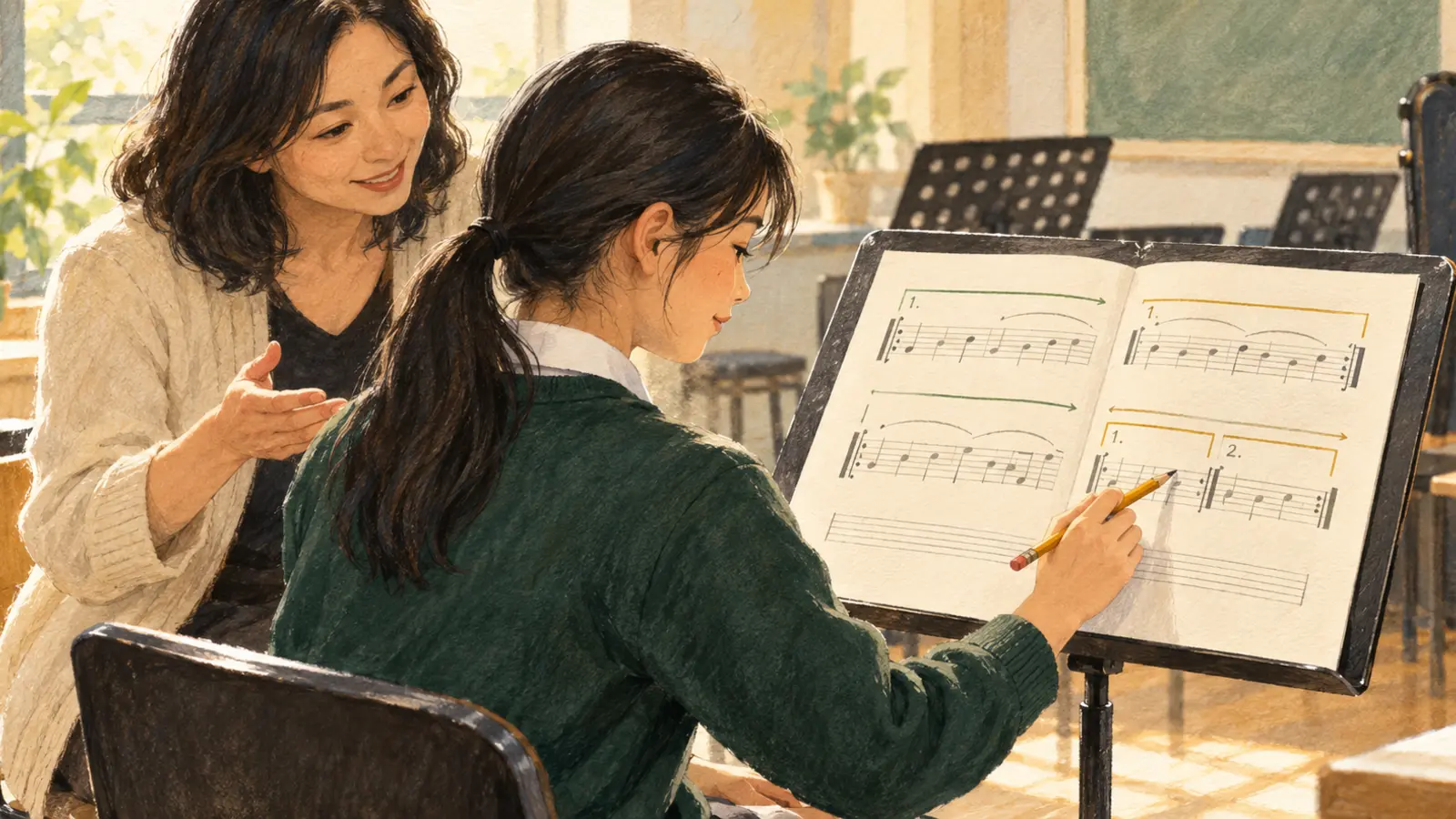
The immediate method is: number the bars, locate the repeat start and repeat end, label the first and second passes, and write the performed bar order before playing. A repeat sign changes the route through the score; it does not change the notes inside a bar.
Full chapter index · Practice and checking · Sources and next reading · How Singapore Education Works
Singapore's primary and lower-secondary music syllabus emphasises direct experience in listening, creating and performing. This article is a teaching route for one notation problem. It is not an examination rule, and teachers or conductors may give edition-specific instructions that take priority.
The choices at a glance
| What you notice | Possible issue | Useful next move |
|---|---|---|
| Plays the repeated section three times | The first pass and the repeat are not being counted | Mark pass 1 and pass 2 above the route |
| Plays both endings on both passes | Endings are treated as adjacent bars | Circle the ending number that belongs to each pass |
| Restarts from bar 1 automatically | The repeat start was missed | Trace backward to the nearest matching repeat start |
Full chapter index
See the route through the score
Work repeats and endings
Repair and practise
Rehearse, transfer and questions
A page of music is not always performed from the top-left straight to the bottom-right once. Barlines divide the music into bars, while repeat signs and numbered endings tell the performer where to go next.
Think of the notation as a route map. The double barline with dots facing into the music can mark a repeat boundary. When the performer reaches the repeat end, they return to the matching repeat start. If no earlier repeat start is printed, common practice may send the performer to the beginning, but check the edition and teacher's instruction.
First and second endings create two exits from the repeated passage. The first pass takes ending 1. The repeat then sends the performer back. On the second pass, the performer skips ending 1 and takes ending 2.
CHAPTER 2 OF 8 · See the route through the score
2. Separate symbols, passes and bars
Three things are easy to mix. A bar number identifies a place. A repeat symbol changes movement. A pass number tells whether the performer is travelling through the section for the first or second time.
Before playing, point to each bar and say its number. Draw a light arrow from the repeat end back to the repeat start on a practice copy when permitted. Above the first ending write “pass 1”; above the second write “pass 2”. Do not mark an original library or ensemble part without permission.
The route should be decided silently before tempo, fingering, bowing, breathing or expression competes for attention.
CHAPTER 3 OF 8 · Work repeats and endings
3. Worked case: bars 1 to 6 with two endings
Assumptions: bars 1–4 form the repeated body; bar 5 is marked as ending 1 and contains the repeat end; bar 6 is marked as ending 2; the section is intended to be played twice; there are no other navigation instructions.
First pass: play bars 1, 2, 3, 4 and 5. At the repeat end in bar 5, return to bar 1.
Second pass: play bars 1, 2, 3 and 4 again. Skip bar 5 because it belongs to ending 1. Continue to bar 6, the second ending.
Checking answer: the performed order is 1, 2, 3, 4, 5, 1, 2, 3, 4, 6. Bars 1–4 are heard twice; bar 5 is heard once on pass 1; bar 6 is heard once on pass 2. There are ten performed bars in this route, even though the printed example has six numbered bars.
If a learner plays bars 1–6 twice, the repeat boundary and the ending choice have been merged. Ask the learner to stop at bar 5 and point to the next bar for pass 1, then do the same for pass 2.
If the learner restarts at bar 1 when a nearer repeat start exists, the backward scan is too broad. Cover the notes and search only for the matching repeat sign.
If both endings are played on both passes, ask, “Which ending number matches this pass?” Do not correct the whole performance at once. Repair the precise decision point.
If notation varies between editions, use the printed score and conductor's directions. A classroom exercise should not be treated as a universal rule for every edition or performance convention.
Clap one sound per bar while speaking the bar order. Step on numbered cards placed on the floor. Tap the first ending card on pass 1 and the second ending card on pass 2. These representations remove pitch and technique so the navigation can stabilise.
Then add rhythm only. Finally return to the instrument or voice. This sequence makes it easier to tell whether an error comes from reading the route, counting the rhythm or controlling the sound.
For ensemble work, agree on one rehearsal landmark: “start at bar 1, second time” or “begin at the second ending.” A bar number alone may not reveal which pass the group intends.
For guided practice, draw eight empty bar boxes. Put a repeat start before bar 3 and a repeat end after bar 6. Ask the learner to write the performed order if the opening bars 1–2 are played once and bars 3–6 are repeated.
Checking answer: 1, 2, 3, 4, 5, 6, 3, 4, 5, 6. The opening bars are outside the repeat.
For an independent task, add ending 1 as bar 6 and ending 2 as bar 7, with bars 3–5 as the repeated body. Ask the learner to write the full route, then clap it. A correct answer is 1, 2, 3, 4, 5, 6, 3, 4, 5, 7 under those stated assumptions.
CHAPTER 7 OF 8 · Rehearse, transfer and questions
7. Recall, rehearsal and changed-context transfer
Later, show only the symbols and ask the learner to explain the route in words: “first time, take ending 1 and repeat; second time, skip ending 1 and take ending 2.” Retrieval should happen away from the worked numbers.
Change the context by moving the repeat start into the middle of a line or placing the endings on the next line. The visual layout changes, but the logic does not. At a rehearsal, trace from the actual starting instruction rather than assuming the piece begins at bar 1.
Global connection: repeat signs, numbered endings and navigation words allow musicians from different places to coordinate using shared notation. Conventions are powerful because they are shared, yet editions and performance requirements can still differ. Read the score in front of you.
Does every repeat mean play the section twice?
Often a basic repeat creates a first pass and one return, but written instructions, conductor directions and assessment requirements may specify otherwise. Follow the responsible source.
Do I play both endings on the first pass?
Not in the worked convention here. Ending 1 belongs to pass 1; ending 2 belongs to pass 2.
What if there is no repeat start?
Many scores imply a return to the beginning, but notation and editions vary. Ask the teacher or check the edition rather than guessing during performance.
Why write bar order if I can hear the piece?
Hearing helps, but a written route exposes the exact navigation decision and transfers to unfamiliar music that the learner has not heard.
Sources and next reading
Singapore MOE 2023 Primary and Lower Secondary Music Syllabus — official curriculum context for listening, creating and performing; it does not prescribe this article's invented exercise.
Singapore MOE G3 Music syllabus — official secondary subject context; consult the current school and assessment instructions for actual course requirements.
ABRSM syllabuses and guidance — an institutional example showing that performance instructions can distinguish da capo and dal segno directions from other repeats; requirements depend on the named syllabus.
Counting musical rests at school — a companion guide to maintaining pulse and finding the next entry.
Learning at other stages
Continue with a different learning task in this series. Each guide has its own worked cases, practice and limits.