
The Train System That Turns a Small Island Into a Moving City
Singapore is small. That is the obvious problem.
There is not much land. There is not much room to let everyone drive everywhere. There is not enough space for every family to own multiple cars, for every road to keep widening, for every worker to live beside the office, for every student to live beside the school, or for every shop to sit beside every home. If Singapore tried to solve movement only by cars, the island would choke itself. The road would become the classroom, the office, the dining table, and the waiting room of the nation.
So Singapore built another answer.
The MRT is not just a train system. It is one of the great hidden structures that allows Singapore to function as a dense, organised, high-speed city. It takes the problem of smallness and turns it into a working advantage. Because when people, homes, schools, malls, offices, hospitals, airports, ports, and town centres are connected by rail, a small island becomes bigger in usable terms. Distance is no longer measured only by kilometres. It is measured by access.
That is why the MRT is one of the clearest examples of How Singapore Works.
It is not glamorous every day. It is not poetic when the train is crowded. It is not romantic when everyone is standing shoulder to shoulder during peak hour. But civilisation is not only built out of dramatic speeches and shiny skyline photographs. Civilisation is built from the ordinary systems that work again and again, morning after morning, evening after evening, moving millions of people through the day.
Today, Singapore’s rail network has more than 160 stations across six MRT lines, spanning about 240km, with more than three million daily ridership. The LRT system adds more than 40 stations across two lines and carries more than 200,000 daily riders.
That number matters because the MRT is not simply transport. It is national circulation.
The MRT Is Singapore’s Bloodstream
Every working city needs movement. People must move from home to work. Students must move from home to school. Parents must move between office, childcare, tuition, supermarket, clinic and home. Goods, services and opportunities must cluster around places where people can reach them.
In a large country, the answer may be highways, suburbs, long commutes and private cars. In Singapore, that answer cannot carry the whole civilisation. The island is too tight. Every lane of road competes with housing, schools, parks, drains, military land, commercial space, nature reserves and industrial estates.
So the MRT becomes the bloodstream.
It moves people in large numbers without using as much surface land as cars would require. It lets dense HDB towns remain liveable. It allows businesses to hire from across the island. It allows schools, hospitals and shopping centres to draw people from different estates. It allows the CBD to concentrate jobs without requiring every worker to park a car nearby.
The MRT compresses Singapore.
A person can live in Punggol, work in the city, meet friends in Orchard, visit family in Jurong, go to Changi Airport, or reach a polyclinic or school in another town. That movement is not always perfect, but the system gives the island a basic promise: you are not trapped inside your neighbourhood.
That promise is more important than it looks.
When a city is dense but disconnected, density becomes pressure. When a city is dense and connected, density becomes power. The MRT is one of the systems that turns Singapore’s density from a weakness into an advantage.
The MRT Is Not Just About Trains
A train station is not only a place where trains stop.
In Singapore, an MRT station changes the meaning of the land around it. Homes near stations become more convenient. Malls grow around interchanges. Bus routes feed into the station. Schools become more accessible. Offices cluster near major nodes. Food courts, tuition centres, clinics, supermarkets, banks and services appear where people naturally pass through.
The MRT station becomes a magnet.
This is why the MRT must be understood together with HDB towns, bus interchanges, shopping malls, office districts and school access. Singapore’s systems do not work separately. They plug into one another.
The MRT moves people.
The bus collects people.
The HDB town houses people.
The mall gathers people.
The school prepares people.
The office employs people.
The airport and port connect people to the world.
The MRT is the line drawn through many of these systems.
When a new station opens, it does not merely shorten a journey. It changes the possible map of daily life. A student can reach a better subject combination. A parent can take a job farther away. A shop can receive more footfall. A neighbourhood can become more attractive. A town can feel less distant. A new economic district can begin to function.
This is the deeper Singapore logic: infrastructure is not just concrete and steel. Infrastructure changes behaviour.
The MRT Makes the HDB Town Possible
Singapore’s HDB model depends on movement.
If people live in high-density towns but cannot move easily, those towns become isolated storage containers for families. But if towns are connected by MRT and bus networks, they become working parts of a national city.
This is why the MRT and HDB must be read together.
The HDB town provides the home base. The MRT provides the reach. Together, they allow Singaporeans to live in one part of the island and work, study, shop, worship, exercise and socialise across many others.
Without strong public transport, the HDB model would feel much heavier. People would feel the distance more sharply. Towns far from the city would feel punished. New estates would feel unfinished. The cost of owning a car would become an even larger social divide.
The MRT helps soften that divide.
It does not remove inequality. It does not make every commute short. It does not make every estate equally convenient. But it gives the ordinary household a national mobility system that does not require car ownership. That matters in a country where cars are deliberately expensive because land is scarce.
The train system makes the city more democratic in practical terms. Not perfectly equal, but more reachable.
The MRT Turns Time Into National Productivity
Every commute is not just a private journey. It is also national time.
If one million people each lose ten extra minutes a day, the country loses millions of minutes. If workers cannot reach jobs efficiently, businesses suffer. If students travel too long, learning suffers. If parents spend too much time in transit, family life suffers. If transport is unreliable, confidence in the city falls.
So the MRT is also a productivity system.
It protects time. It reduces friction. It allows economic concentration without total road collapse. It lets the city absorb large daily flows of people.
This is why public transport planning is not a side issue. It is central to how Singapore works.
A country can have good schools, good offices and good hospitals, but if people cannot reach them, the systems fail at the point of use. The MRT is one of the bridges between national planning and everyday life.
It is where policy becomes footsteps.
The MRT Creates the Singapore Rhythm
Every city has a rhythm.
Singapore’s rhythm is visible at MRT stations.
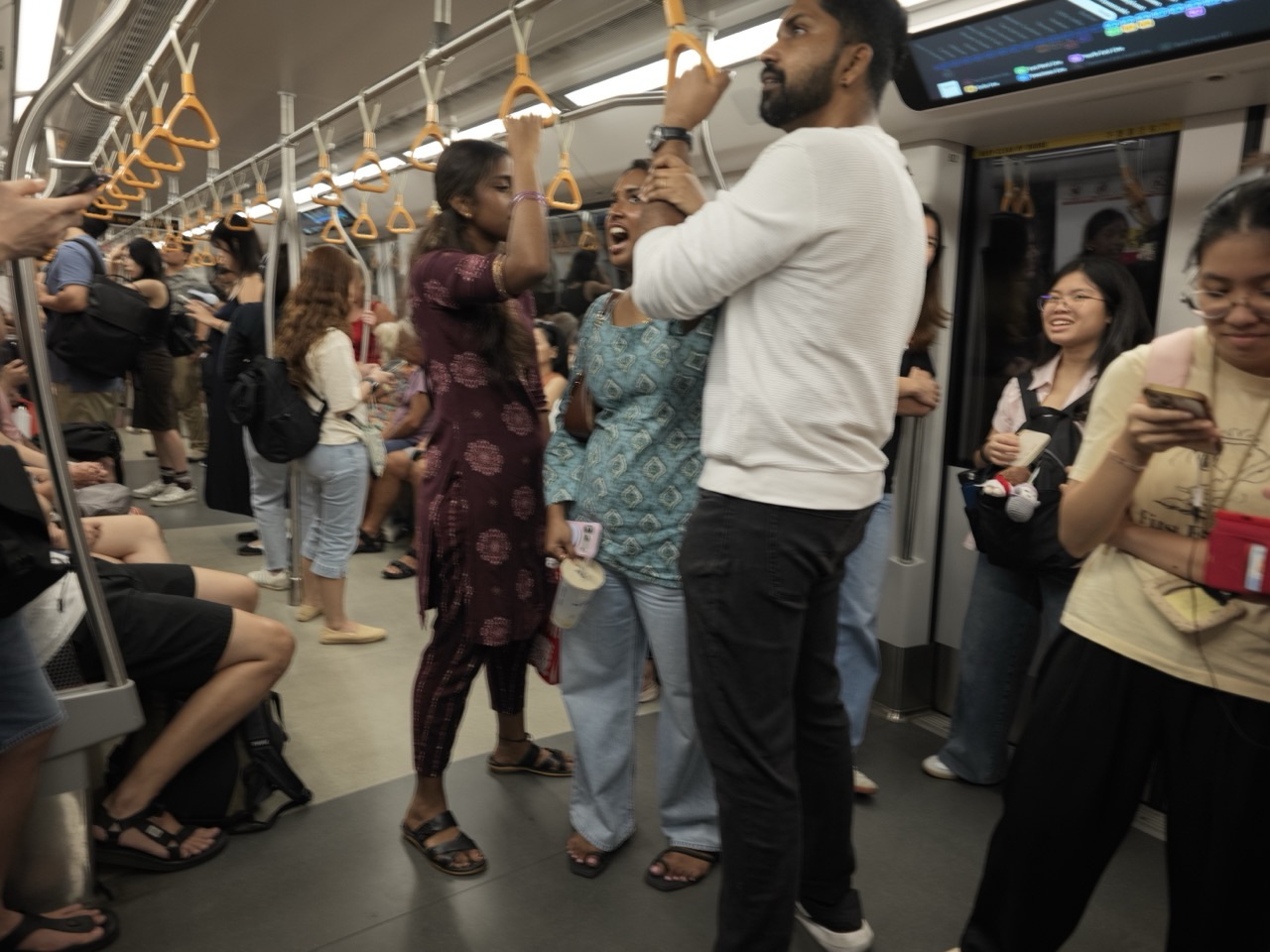
Morning: students in uniforms, office workers with bags, parents with children, cleaners, nurses, retail staff, construction workers, tutors, executives, service crew, tourists and domestic helpers all entering the same system.
Afternoon: older residents, preschool pickups, shift workers, lunch crowds, students moving to tuition or CCAs.
Evening: the long reverse flow home, people carrying groceries, laptops, bubble tea, school bags and tired faces.
Weekend: families, shoppers, churchgoers, sports groups, tourists, grandparents, teenagers, couples, children heading to enrichment classes.
The MRT is one of the few places where Singapore’s layers become visible together. It is not just a transport machine. It is a social machine.
It gathers the country into shared space.
That shared space is not always comfortable. It can be crowded, noisy, rushed and impatient. But it is part of the Singapore bargain. We accept certain inconveniences because the larger system gives us something more valuable: movement, access and order in a land-scarce country.
The MRT Shows Singapore’s Trade-Offs
Every system has trade-offs.
The MRT gives Singapore efficient mass movement, but it also creates crowding. It increases land value near stations, but it can also make some areas feel more expensive. It reduces car dependence, but it requires discipline, maintenance and public patience. It supports dense planning, but dense planning means Singaporeans must share space closely.
This is important.
How Singapore Works should not pretend that systems are perfect. Singapore works because systems are built, adjusted, repaired, expanded and argued over. The MRT has breakdowns. People complain. Stations get crowded. Construction is disruptive. New lines take years. Older lines need renewal. The system is never “finished.”
But that is exactly the point.
Civilisation is maintenance.
A train network is not something a country builds once and forgets. It must be renewed, expanded, cleaned, upgraded, secured, signalled, staffed and trusted. It requires engineers, drivers, station staff, planners, cleaners, technicians, security teams, designers, software systems, fare systems, emergency planning and long-term funding.
When we see the train arrive, we see the simple part. Behind it is a civilisation of work.
The MRT Is Still Expanding
Singapore’s rail system is not complete. It is still being extended because the country is still being rebalanced.
LTA has stated a target to expand the rail network to about 360km by the early 2030s, with the aim of connecting eight in 10 households to within 10 minutes of a train station.
That tells us something important: Singapore does not treat the MRT as a finished map. It treats rail as an evolving national skeleton. As new towns, economic hubs and population patterns develop, the train network must keep adapting.
The Cross Island Line is one example of this next layer. LTA describes it as Singapore’s eighth MRT line and its longest fully underground line at more than 50km. It is planned to serve eastern, western and north-eastern corridors, connecting major hubs such as Jurong Lake District, Punggol Digital District and the Changi region.
This is not only about faster travel. It is about future geography.
The MRT helps decide which parts of Singapore become more central, more useful, more investable and more liveable. A line on the map can shift how people imagine the island.
Yesterday’s “far” can become tomorrow’s “connected.”
The MRT Is the Answer to Singapore’s Smallness
This is the deeper idea.
Singapore’s lack of land is a problem. But the MRT helps convert that problem into a system.
Because land is scarce, the city cannot sprawl endlessly.
Because the city cannot sprawl endlessly, people must live closer together.
Because people live closer together, mass transport becomes necessary.
Because mass transport becomes necessary, the MRT becomes powerful.
Because the MRT becomes powerful, dense towns can work.
Because dense towns work, Singapore can house people, move people and organise opportunity within a small island.
This is the Ouroboros again.
The weakness feeds the strength.
Singapore’s smallness forced the country to become serious about connection. The MRT is one of the clearest physical expressions of that seriousness.
It is not just a train. It is a national solution to the geometry of the island.
The MRT as Civilisation at Work
The MRT teaches us how Singapore works in miniature.
First, it begins with constraint. There is not enough land for car-based freedom for everyone.
Second, it creates a system. Build rail. Connect towns. Integrate buses. Link stations to housing, malls, offices, schools and airports.
Third, it shapes behaviour. People plan around stations. Businesses open near footfall. Families choose homes based on access. Students and workers cross the island daily.
Fourth, it produces a national result. A dense island remains mobile.
That is Singapore’s method.
It does not remove every problem. It reorganises the problem until the problem becomes manageable. Then it keeps upgrading the system.
The MRT is one of the best places to see this clearly because every Singaporean understands it. We do not need theory to understand the train. We have stood on the platform. We have watched the doors open. We have squeezed into peak-hour cabins. We have changed lines. We have waited for the last train. We have used the MRT to reach school, work, tuition, a hospital, a mall, an airport, a date, an interview, a friend, or home.
The MRT is ordinary.
That is why it is powerful.
It proves that Singapore is not held together only by big national ideas. It is held together by working systems that ordinary people use every day.
And when those systems work, the island moves.
Closing Thought
To understand Singapore, do not only look at Marina Bay, Parliament House, the skyline, or the airport.
Stand at an MRT interchange during peak hour.
Watch the trains arrive. Watch the people move. Watch the signs, gates, escalators, platforms, tunnels, buses, malls and walkways connect into one flowing machine.
That is Singapore.
A small island, made larger by systems.
A dense city, made liveable by connection.
A civilisation, moving on rails.