
Did you know? A website can look broken even when the web server is still running. The homepage loads, but nobody can sign in. Or students can open a lesson yet cannot submit an answer. The screen shows one simple failure, but the real cause may sit several systems away.
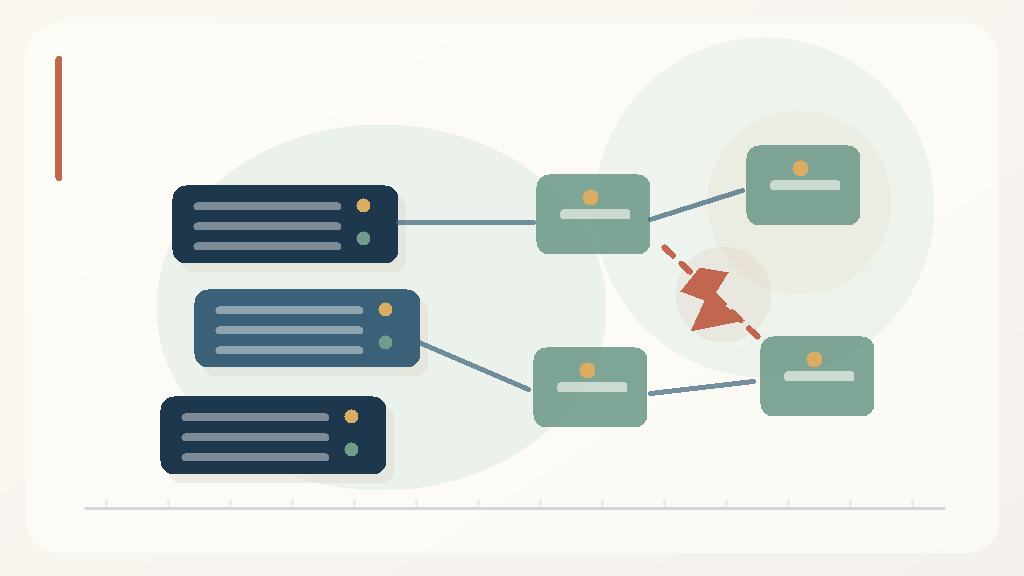
That is the central idea behind how software systems collapse. Modern services are made of connected components: web pages, identity services, databases, message queues, storage, cloud platforms, payment providers and networks. If they cannot handle one another’s delays or errors, a local problem can become a much wider outage.
Quick answer: a cascading software outage happens when failure in one component increases pressure or errors in others, which in turn causes more failures. Risky changes, overloaded resources, repeated retries, shared dependencies and weak observability can make recovery slower. Preventing the spread matters as much as fixing the first component.
The first surprise: one user action can involve many systems
Imagine clicking ‘Submit’ in an online learning platform. Behind that button, the application might check your session, validate your answer, store your work in a database, update a progress record and send a confirmation.
If the database works but the identity service is unavailable, submission can fail before the answer is stored. If storage succeeds but the confirmation message fails, the learner may retry because they do not know whether the first attempt was successful. The same visible error can represent very different internal states.
The first diagnostic question is therefore not ‘Which screen is broken?’ It is ‘At which dependency did the request stop making trustworthy progress?’
How one failure becomes a chain reaction
- The trigger: a dependency becomes slow, unavailable or inconsistent because of overload, an update, a configuration change or some other problem.
- Waiting requests accumulate: other services keep connections, memory or processing slots occupied while waiting for a response.
- Retries add more demand: users and automated clients repeat requests, sometimes multiplying the work precisely when the system has less capacity.
- Healthy components become overloaded: remaining servers or alternatives must handle more requests than they were prepared for.
- Error rates rise across the service: login, search, checkout, messages or other functions may fail together, even if the original problem began in a smaller part.
- Recovery becomes harder: components restart into the same backlog, caches are cold and unprocessed work must be reconciled.
Google’s Site Reliability Engineering chapter Addressing Cascading Failures describes how overload can move from a failed service instance to others and how uncontrolled retries can amplify pressure. The essential lesson is that each part must know when to stop making a wider problem worse.
A simple school-platform outage example
Illustrative example. At 7.50 p.m., many students try to upload homework before a deadline. The identity service becomes slow. Every browser and application repeatedly tries again. More requests pile up, some students refresh the page and teachers begin receiving reports of missing submissions.
The operators discover the platform’s login component is overloaded. Even after that component becomes available, the queue of retries and pending uploads takes time to clear. Some students cannot tell whether their files were actually saved.
Good recovery should address both availability and correctness. The platform needs to stabilise requests, verify what was successfully stored and provide a clear status update. Simply showing a green ‘online’ indicator is not enough if the records are incomplete.
Five common failure patterns
- Single dependency: several services rely on one authentication server, database or external provider without an acceptable fallback.
- Retry storm: automated attempts multiply traffic when a backend is slow or unavailable.
- Risky release: a code or configuration change affects many users before an error is detected.
- Insufficient capacity or weak resource limits: a component cannot deal with peak demand and fails rather than degrading predictably.
- Unclear system state: the service has been restored, but delayed jobs, duplicate actions or missing confirmations leave users unsure what happened.
A software incident does not automatically imply a cyberattack. Outages can occur without hostile activity, and security incidents can occur without a visible outage. Diagnosis should follow evidence, not speculation.
Why adding servers is not always the cure
Extra capacity can help when the bottleneck truly is a lack of resources. But it may not solve a defective configuration, a failed dependency or a runaway retry pattern.
Google’s production-service guidance explains the value of predictable degradation, controlled request handling and sensible retries when systems are under pressure. A service that drops or delays nonessential work can sometimes preserve its essential function instead of collapsing completely.
For a learning platform, that could mean keeping basic lesson reading available while temporarily postponing thumbnails, recommendations or other optional features. The precise priorities should follow user safety, data integrity and the service’s obligations.
A dangerous misunderstanding: saved is not always confirmed
Imagine an online order that charges a card successfully but fails before displaying confirmation. A user might press ‘Pay’ again. Unless the workflow is designed to recognise repeated attempts safely, duplicate actions or conflicting records may result.
This is why reliable systems need careful treatment of transactions, request identity and confirmation. Some operations can be safely repeated; others need special handling. The details vary by technology and payment provider.
An education example is equally useful. If a student submits an assignment and the confirmation fails, the platform should help distinguish ‘saved successfully but the notification was delayed’ from ‘never received’. Otherwise learners may have to resubmit and teachers may misjudge their work.
What a responsible response looks like
- Establish the actual impact: identify which users, services and data are affected, rather than relying on one dashboard light.
- Protect critical outcomes: prevent unsafe or inconsistent new actions where necessary, while preserving reliable functions.
- Reduce the cascade: manage unnecessary retries and excessive demand so remaining capacity can recover.
- Investigate recent changes and dependencies: determine whether a deployment, configuration, provider or capacity event is involved.
- Restore carefully: use approved recovery procedures and confirm the service behaves correctly with realistic test transactions.
- Reconcile outstanding work: verify delayed submissions, payments, messages or other records rather than assuming every action completed.
- Communicate clearly: tell users what was affected, which functions are restored and whether they need to do anything.
- Learn afterwards: document the timeline, contributing factors and measurable changes to reduce recurrence.
These are conceptual incident-management steps, not instructions to alter a production system without appropriate authorisation or expertise. Exact operational procedures depend on the service, its architecture and incident severity.
Why the postmortem matters
Once a service is restored, it is tempting to declare victory. But if teams merely reboot a component and never examine what allowed the failure to spread, the next incident may look almost identical.
Google’s postmortem analysis guidance describes classifying incident triggers and underlying causes across many service incidents. An effective review studies the chain of contributing conditions, not just the last visible error.
The useful questions include: Which early signal was missed? What changed just before the incident? Why did retries amplify demand? How did users learn about the issue? Which fallback did not work? What would show that the repair is effective?
An honest review should distinguish individual mistakes from system design. Learning is less likely if people hide errors out of fear. Accountability remains important, but so does understanding how conditions made the mistake consequential.
Early warnings of a fragile service
- Small errors or latency spikes repeatedly spread into unrelated user-facing functions.
- Several critical workflows depend on one provider, account or system with no tested continuity plan.
- Large deployments cannot be rolled back or isolated in a controlled way.
- Monitoring reports that servers are ‘up’ while users consistently cannot finish their tasks.
- Backups exist but no one has verified that essential data can be restored safely.
- Incident reviews are written but recurring defects never receive time or ownership for repair.
Not every technical weakness creates an immediate outage. Prioritise based on how the service is used, the severity of potential harm and the likelihood of failure.
A reader-friendly reliability checklist
- Map the chain: what systems must work for a single important user action to complete?
- Identify the essential outcome: what must continue working during a partial failure?
- Ask about safe retries: can repeating an action create duplicates or additional load?
- Check the fallback: if one dependency fails, can the platform degrade safely and predictably?
- Prove recovery: how will the team establish that data are correct, not merely that pages load?
- Test the communication: do users know what failed, what is uncertain and which action is safe?
The checklist applies to services much smaller than global platforms. A tuition booking form, an online quiz or a local business checkout all depend on people being able to tell whether an action completed.
What software failure teaches other fields
A cascading outage resembles the failure of a physical supply chain: one delayed input interrupts downstream work, and rushed reactions can increase pressure elsewhere. The same feedback-loop thinking is useful for learning, public services and teams.
Compare How Supply Chains Collapse | How One Delay Becomes a Shortage and How Teamwork Breaks | When Trust and Coordination Fall Apart. The important common theme is interdependence: a component cannot be judged only by whether it works in isolation.
Frequently asked questions
Does every software crash cause a cascading outage?
No. A well-isolated failure may affect one function while the rest of the service continues. Cascades occur when the initial problem adds enough pressure or dependency failures to spread.
Why do outages sometimes continue after the first bug is fixed?
Backlogs, retries, overloaded remaining services, delayed tasks and inconsistent records may take time to stabilise and reconcile.
Do backups prevent downtime?
Backups mainly support recovery of data when they are usable and tested. They do not by themselves prevent an overloaded website, identity outage or broken network connection.
How can a user tell whether an action succeeded?
Use the application’s trustworthy status or transaction history and its official support channel. Avoid blindly repeating sensitive submissions or payments when the outcome is uncertain.
The final idea
Software systems collapse when their dependencies turn small failures into growing feedback loops. Strong design does not require pretending that every component will always work. It requires making failure visible, limiting its spread, preserving important outcomes and recovering carefully.
Keep exploring how systems fail
- How Banking Systems Break | When Payments and Liquidity Freeze
- How Blockchain Technology Fails | When Code, Oracles and Keys Break
- How Countries Break | When Public Finance and Services Fail
- How Software Systems Collapse | One Dependency, Many Outages (this guide)
The wider cause-and-effect approach is also used in How Society Stalls | When Trust and Public Services Erode. For the unchanged learning reference, see Secondary 1 Mathematics Tutor Clementi | Small Groups Tutorials.
References and further reading
- Google SRE: Addressing Cascading Failures
- Google SRE: Production Service Best Practices
- Google SRE Workbook: Postmortem Analysis
- Google SRE Workbook: Incident Response
The examples in this article are hypothetical unless otherwise identified. Causes and appropriate responses depend on the real institution, place, system and circumstances.