
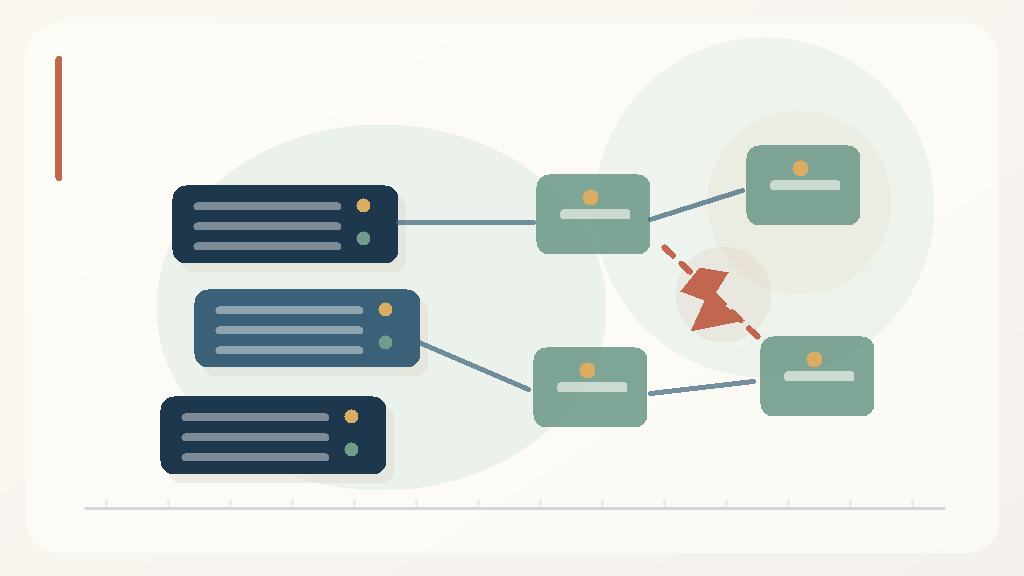
Did you know? The computer running an app may be perfectly healthy while users cannot complete a single purchase. Modern software is a network of promises—logins, databases, servers, payments, cloud platforms and third-party updates—and the entire experience can fail when one connection breaks.
Quick answer: Software systems fail when bugs, overloaded resources, unsafe deployments, shared dependencies, unreliable data or poor recovery processes prevent them delivering correct and timely results. Cascading failures can turn one broken service into a wider outage, and a green server dashboard does not prove the user’s task succeeded.
This readable guide explains why software systems fail, what causes outages, how retries and dependencies amplify problems, and what we can learn from documented GitHub, Cloudflare and CrowdStrike incidents. It also shows how teams test, detect, contain and repair problems without pretending that every software failure is a cyberattack.
The simplest map is user request → application → authentication and services → data and external dependencies → correct result. Real reliability is tested at the end of the journey.
Choose your reading route
- What does it mean for software to fail?
- The quick answer: why digital systems break
- Why one button can depend on ten systems
- Hidden dependencies turn local outages into widespread ones
- Capacity problems often begin as ordinary success
- What cascading failure looks like in a software service
- Why retries can make an outage worse
- Slow software can be broken even when it returns an answer
- A database can be alive while the application serves wrong information
- Case study: GitHub’s October 2018 incident
- Why deployment can be the most dangerous moment
- Case study: Cloudflare’s July 2020 routing outage
- Why third-party software updates can affect unrelated organisations
- Why a successful test does not guarantee production safety
- Canary releases and gradual rollout, in plain language
- What an effective rollback can and cannot do
- Monitoring should detect the user’s problem, not just a live server
- What service-level objectives and error budgets really mean
- Graceful degradation is better than indiscriminate collapse
- Recovery may require data checks after the site comes back
- Security incidents are not the same as ordinary outages
- Why human error is rarely the complete explanation
- What to do in the first hour of a major software incident
- A fictional ticketing app: the retry that doubles the trouble
- A second fictional scenario: the one shared provider
- What makes a dependable software system?
- A reader’s checklist for the next digital outage
- Frequently asked questions
What does it mean for software to fail?
Did you know? A website can display a reassuring green status message while the purchase you just made was charged twice, never recorded or sent to the wrong address. Software failure is not always an obvious crash. Sometimes the interface appears normal while the outcome is wrong.
Software can fail through unavailability, severe slowness, incorrect results, lost or inconsistent data, security problems or unexpected behaviour that prevents a user completing a legitimate task. These outcomes overlap but are not identical. A login outage is different from a privacy breach, and a slow response is different from a silently incorrect financial calculation.
A useful diagnosis begins with the person at the receiving end. What were they trying to do? What should have happened? What actually happened? When did the problem start, and how much of the service was affected? The technical explanation matters, but it comes after the observable harm is defined. Software reliability is the ability to deliver correct, timely and safe outcomes under the conditions the system is intended to handle.
The quick answer: why digital systems break
Modern software rarely consists of one independent program. A seemingly simple action can involve an application, login provider, database, payment service, network, operating system, cloud platform and several background processes. The user sees one screen, but the result depends on many successful handoffs.
Failures occur when assumptions across those components stop matching reality. An update may contain a defect. Traffic may exceed capacity. A database may become unavailable. A supplier may change an interface. A network may partition. An automated retry mechanism may add even more pressure to a struggling service.
The usual chain is request → application → dependencies → data and external services → correct response. Reliability requires each critical stage to be observable, tested, protected and recoverable. The first error may be small, but shared dependencies and feedback can spread it. The question is not simply “Who wrote the bug?” It is why the complete system failed to prevent that bug or condition from becoming a user-visible incident.
Why one button can depend on ten systems
Imagine booking a fictional train ticket. The app must identify you, display real availability, calculate a price, reserve a seat, accept payment, issue a ticket and notify you. Each step may be owned by a different component. A successful-looking button press does not prove the whole booking succeeded.
If the payment service responds but the reservation database is unavailable, the app must know whether the seat was actually reserved. If notification fails after payment succeeds, the user should not be charged again merely because the email did not arrive. Software needs clearly defined relationships among steps, especially when a transaction crosses service boundaries.
Good system design identifies the source of truth for each state and specifies what to do when a downstream dependency times out. It also distinguishes a failed operation from a delayed response. Without those distinctions, operators may repair a server while customers continue facing missing tickets or duplicate transactions. The right measure is the completed user journey, not the health of one component.
Hidden dependencies turn local outages into widespread ones
A service can run on healthy servers and still be unusable because its identity provider, database, content delivery network, payment processor or configuration service is unavailable. Modern platforms share infrastructure to gain speed and efficiency, but those shared layers can become points of concentrated dependence.
Two apparently independent applications may rely on the same cloud region, network route or external software update mechanism. Both can therefore fail under one event. It is not enough to count two backups if the backups share the same cause of failure. Independence must be tested against a realistic scenario.
A useful dependency map names critical providers, expected behaviour during failure, alternative routes and recovery procedures. It records unknowns instead of pretending they are harmless. Some third-party services are difficult to replace immediately, so honest resilience plans may involve degraded functionality or clear customer communication. The goal is not to eliminate every external dependency, but to understand which failures can propagate and which services can continue safely.
Capacity problems often begin as ordinary success
A promotional campaign succeeds, a popular video goes viral or a registration deadline sends thousands of people to one website. The increased demand is good news for the organisation, but infrastructure may not be prepared for the burst.
Servers need CPU time, memory, network capacity, database connections and other finite resources. As utilisation rises, requests may wait longer in queues. Slow requests remain in progress, consuming resources while new requests arrive. Eventually a service may reject work or become unstable. The failure can spread when other components are forced to wait or retry.
Capacity planning must consider traffic shape, not only daily averages. A system handling ten thousand requests spread across a day may behave differently when the same number arrive within one minute. Load testing, realistic headroom, queue limits and graceful degradation can prevent a temporary peak from becoming a total outage. A website should ideally fail in a controlled, understandable way rather than make every user wait indefinitely for a result that cannot be delivered.
What cascading failure looks like in a software service
Imagine three application servers sharing incoming work. One server fails. Traffic shifts to the remaining two, which are already close to capacity. Response times rise, causing new requests to accumulate. More failures prompt the routing system to remove additional servers from service, placing still more load on the survivors.
That feedback loop is a cascading failure. It is not inevitable whenever a server crashes; redundancy can work well when remaining capacity and control logic are suitable. The danger arises when the attempted recovery creates more stress than the network can absorb.
Google’s Site Reliability Engineering chapter on cascading failures describes mechanisms including overload, retries, timeouts and unhealthy service instances. The important insight for non-engineers is that backup capacity must be usable under stress. Moving all traffic to one remaining component is not recovery if doing so immediately overwhelms that component too.
Why retries can make an outage worse
When a service does not receive a response, it may try again. Retrying can be sensible when a transient network problem occurs, but repeated automatic attempts are not free. Each attempt consumes work in systems that may already be overloaded.
Imagine one customer request causing three internal calls. If several components independently retry each failed call, the total number of attempts can rise sharply. A small initial delay may become a flood of duplicate work. If users repeatedly press the same button, the effect may be worse.
Engineering teams reduce these risks through sensible deadlines, limits on retry attempts, randomised waiting where appropriate, and mechanisms that prevent unsafe duplicate transactions. For readers, the practical lesson is that an application should communicate uncertainty clearly. A timeout does not automatically prove that a payment or booking failed; safe designs give users a reliable way to check the actual result before repeating it.
Slow software can be broken even when it returns an answer
An application that returns correct information after an hour may be functionally useless if the user needed it in seconds. The required time depends on context. A routine report and an emergency dispatch system cannot share one universal definition of acceptable delay.
Engineers track latency, the time a request takes to complete. They also examine the distribution of waiting times, because an average can hide a small group of users who experience extreme delays. A service may have excellent typical performance while customers in one region or using one complex task face repeated timeouts.
Systems need deadlines, capacity information and honest signals about what they can deliver. Some features can become temporarily unavailable while essential functions continue. Others are too safety-critical to degrade without a defined protective response. Reliability requires priorities based on actual user needs, not only the appearance of a fast home page.
A database can be alive while the application serves wrong information
Software does not merely process requests; it stores and updates records. A database can be reachable but contain stale or inconsistent views if replication, synchronisation or application logic is not behaving as intended. Users may see an old inventory quantity, a missing update or conflicting account information.
Different systems make different trade-offs among availability, consistency and responses to network partitions. There is no single technique that solves every distributed-data problem. Designers must decide which state is authoritative and how to reconcile changes after a disruption.
This becomes especially important when money, orders, healthcare records or identity information are involved. Restoring availability without checking data correctness can compound the harm. A system may need to suspend some operations while integrity is verified. Good recovery therefore distinguishes “the page loads” from “the information can be trusted.” Data reconciliation and transparent handling of uncertain transactions are often essential after major incidents.
Case study: GitHub’s October 2018 incident
On 21–22 October 2018, GitHub experienced an incident involving a network partition and database problems. In its published post-incident analysis, GitHub described degraded service lasting 24 hours and 11 minutes, with some information appearing out of date or inconsistent during the event.
The incident illustrates how restoring a database-backed service involves more than bringing a machine online. Engineers had to consider replication state, the integrity of records and which recovery actions could safely preserve user information. GitHub reported that repository data was unaffected and that the incident did not result in user-data loss, while some reconciliation work was required.
The lesson is not that every network interruption lasts a day. It is that an apparently straightforward failover can be complicated by writes occurring in different locations and the need to preserve correctness. Reliable architecture must account for both the continued availability of the service and the integrity of the data that gives the service its meaning.
Why deployment can be the most dangerous moment
Software teams regularly release new code, adjust configurations and update dependencies. Changes are necessary: they fix defects, improve performance and close security gaps. But each change alters assumptions that the running system depends upon.
An update may work in a test environment yet fail in production because real traffic is larger, data have unexpected shapes or a configuration differs. A dependency may accept a parameter differently than expected. A small change to routing or security policy may affect a much wider set of services than the person making the change anticipated.
The answer is not to stop updating software. Leaving systems unmaintained creates other risks. Mature release processes use review, representative tests, staged exposure, monitoring and credible rollback or recovery paths where feasible. The key question is how much harm one bad change could cause before it is detected and contained. A safe deployment process assumes even competent engineers can encounter unanticipated conditions.
Case study: Cloudflare’s July 2020 routing outage
Cloudflare published an account of a 17 July 2020 outage caused by a backbone configuration change. According to the company’s postmortem, the error drew traffic toward one location, overwhelming it and affecting a number of connected locations. The incident lasted about 27 minutes.
Importantly, Cloudflare stated that the event was not caused by an attack or breach and that parts of its network continued operating. The event therefore should not be described as a complete global shutdown or a cyberattack. It was an operational routing failure with defined geographic effects.
The deeper lesson is that configuration is part of software reliability. A change that appears local can have wider effects because network paths and shared services connect geographically separated facilities. Preventive measures need to consider the scope of a change, the possibility of a configuration error and whether the network can contain the consequences rather than propagating them.
Why third-party software updates can affect unrelated organisations
Businesses often depend on operating systems, security software, cloud agents, drivers and management tools maintained by outside vendors. Automatic distribution allows improvements and protections to reach many computers quickly. The same reach can amplify an unintended defect.
On 19 July 2024, a faulty CrowdStrike content configuration update caused crashes on affected Windows systems. In its August 2024 root-cause-analysis announcement, the company acknowledged the widespread outage and described follow-up improvements. Its earlier incident review explained that the problematic update was part of routine protective content delivery rather than a cyberattack.
This historical case demonstrates an important trade-off: centrally managed updates can provide security and consistency, yet shared automated distribution can create common-mode failure if the update process does not detect a damaging condition early enough. Organisations need vendor risk management, continuity planning and tested recovery procedures. A strong dependency may still fail, and customers need a plan for critical services when that happens.
Why a successful test does not guarantee production safety
Testing can catch many defects, but no finite test suite covers every possible input, device, network condition and interaction. A system may perform well in a lab yet encounter unexpected data sizes, permissions or concurrency after release. The issue may be in the test design rather than simple carelessness.
Effective testing covers normal paths, boundaries, unusual inputs and failure behaviour. Integration tests examine whether different components still work together, while end-to-end checks follow a user journey. Performance tests explore behaviour under load, and security reviews address different kinds of risk. Each method answers a limited question.
Teams should avoid the claim “we tested it, so it cannot fail.” A more responsible statement identifies what was tested, what remains uncertain and what safeguards operate after deployment. Reliable engineering layers prevention with early detection and containment. The goal is to limit the consequences of what the tests did not foresee, not to pretend uncertainty has been eliminated.
Canary releases and gradual rollout, in plain language
Imagine a new recipe being introduced across hundreds of school kitchens. A sensible organisation might first try it in a small setting, check safety and satisfaction, then expand only if the evidence is good. Software deployment can use a similar principle.
A canary release exposes a new version to a limited, controlled portion of real traffic or systems so that unexpected problems can be detected before full rollout. The exact design matters; a tiny test that never exercises the risky feature may create false confidence. Rollout mechanisms also need to consider whether the effect can be safely reversed.
Staging is valuable, but not sufficient by itself. Some failures appear only at large scale or under particular data conditions. Teams therefore need realistic monitoring, release controls and well-rehearsed restoration procedures. Change safety is the discipline of limiting the blast radius of an error while still allowing improvements to reach users.
What an effective rollback can and cannot do
Rolling back means returning a software or configuration change to an earlier state. It may quickly resolve certain incidents, especially when a recent change caused a new fault and the earlier version remains compatible with current data and dependencies.
But a rollback is not always harmless. A database migration may have changed stored information, an external service may have altered its interface, or transactions may have occurred under the new version. Restoring old software without understanding those changes can create additional errors or data loss.
A good release plan considers reversibility before deployment. It identifies which changes are safe to undo, which require forward repair and how to protect the integrity of user data. During an incident, the fastest action is not always the safest one. Recovery decisions should be guided by the likely effect on real users and the ability to verify that the service is correct afterward.
Monitoring should detect the user’s problem, not just a live server
A server can respond to a health-check message while users cannot log in, buy a product or receive accurate results. Infrastructure monitoring is useful, but it is not the same as measuring service quality at the receiving end.
Google’s Site Reliability Engineering monitoring chapter describes four useful signals: latency, traffic, errors and saturation. These help teams see whether a service is becoming slow, overloaded or unable to deliver successful requests. The chapter also distinguishes internal monitoring from external checks that test what a user experiences.
For many services, operators need both. A dashboard might report that the payment server is responding, while a synthetic checkout reveals that orders are not completing. An alert should be tied to a meaningful, actionable condition. Too many low-quality alerts can overwhelm responders and hide the one that matters. Good observability improves decisions rather than simply multiplying colourful graphs.
What service-level objectives and error budgets really mean
Software reliability cannot always be expressed as a demand for perfection. A service-level objective, or SLO, defines a target for a chosen measure of service performance over a period, such as the proportion of eligible requests that complete correctly within an appropriate time.
An error budget is the amount of failure permitted by that target under the agreed measurement. It helps teams decide how much change risk may be tolerable and when reliability work deserves priority. The number must be meaningful for the users and purpose of the service. An emergency dispatch function may require a very different standard from a non-urgent photo gallery.
Targets can also mislead if chosen poorly. A service may meet a coarse uptime percentage while suffering one disastrous outage during the only hour customers needed it. Teams should examine critical paths, severity and concentration of failures along with aggregate measures. Objectives are useful when they lead to better trade-offs, not when they become public-relations decorations.
Graceful degradation is better than indiscriminate collapse
A digital service may have optional and essential features. During high load, temporarily omitting decorative images or recommendations could allow core transactions to continue. That is graceful degradation: preserving the most important functions while reducing nonessential work.
This requires design beforehand. Developers need to identify which features can be reduced without giving misleading information or breaking legal or safety requirements. A financial application cannot quietly substitute an estimated account balance for a verified one. A healthcare system cannot treat the loss of critical clinical records as equivalent to a missing background image.
Effective degradation is explicit about what is unavailable and protects data integrity. Sometimes the safest response is to stop a particular operation rather than provide a partial result that looks final. Good systems prefer controlled limitation over hidden corruption or a total crash, with safeguards matched to the seriousness of the user task.
Recovery may require data checks after the site comes back
After a major outage, engineers naturally focus on restoring access. But some transactions might have been interrupted halfway through. Messages may have queued, payments may be pending, background jobs may need replaying and records may disagree across systems.
Reconciliation checks what actually happened and brings records back into a correct, consistent state under the applicable business rules. An order might have been accepted but not confirmed; a notification may have been sent twice; a record might not have reached a secondary system. Automatic correction is possible for some cases, while others need careful human review.
This is why a status page can say the main service has recovered while support teams are still resolving specific customer effects. Responsible organisations distinguish service availability from complete data reconciliation. Customers should receive clear guidance on how to verify important transactions and report discrepancies. Finishing the incident means protecting the integrity of the result, not just making the homepage respond.
Security incidents are not the same as ordinary outages
A software outage can arise from configuration errors, overloaded services, hardware faults or unexpected interaction among components. A security incident may involve unauthorised access, harmful modification or exposure of confidential information. Some events affect both security and availability, but the categories should not be merged without evidence.
This distinction matters for public communication. Calling a routine operational error a cyberattack can generate unnecessary fear. Calling a verified breach a harmless outage can conceal important obligations to affected people. Investigation should preserve evidence, establish the actual incident scope and follow applicable notification requirements.
Security and reliability share disciplines such as tested recovery, controlled access and change management, but they also need different expertise. Organisations should maintain suitable incident procedures, verify which data or services were affected and resist premature attribution. Accurate communication is part of the repair.
Why human error is rarely the complete explanation
A person may make a configuration mistake or approve a defective deployment. That action can be important, but complex systems are designed precisely because people cannot predict every interaction under stress. A useful investigation asks why one mistake passed through multiple layers without being detected or contained.
Were the instructions ambiguous? Did testing represent the real environment? Were the approval process and access scope appropriate? Was rollback possible? Did warnings reach someone who could act? These questions do not remove accountability for reckless or deliberate conduct. They locate conditions that future engineers can improve.
The Google SRE chapter on postmortem culture explains how structured learning from incidents can support reliability. A high-quality postmortem documents impact, timeline, contributing factors, restoration and corrective actions. The goal is not a ceremony in which everyone agrees to “be more careful”; it is a set of changes whose effectiveness can be checked.
What to do in the first hour of a major software incident
For an organisation, the initial priority is to understand user impact and prevent additional harm. Establish who is coordinating the response, which functions are affected and which facts are verified. Avoid making several uncoordinated changes at once, because those changes can hide the original cause and create new failures.
Consider whether a recent deployment or configuration change is relevant, whether critical dependencies remain healthy and whether an established safe fallback is available. Protect important data and preserve evidence needed for investigation. Send clear updates that state what is known and what remains uncertain.
The exact technical response belongs to qualified operators following their incident procedures. Generic instructions to restart everything or delete data can make a difficult situation worse. A good process prioritises service safety, accountable decisions and evidence of recovery. After stabilisation, the team should verify user transactions and plan the longer-term correction.
A fictional ticketing app: the retry that doubles the trouble
Suppose a fictional ticketing platform takes payment and sends a seat reservation to a second service. On a busy morning, the reservation reply is delayed. The app assumes that the operation failed and immediately tries again without checking whether the first request was processed.
Some customers now see duplicate reservations or confusing payment statuses. Support queues grow as people repeat the purchase process. Extra requests increase load on the already struggling service. A temporary slowdown has become an operational and customer-service incident.
The example demonstrates why reliable systems must distinguish a missing acknowledgement from a definitely failed operation. Clear transaction identifiers, safe repeat handling and reconciliation are common design approaches, with details dependent on the application. For the reader, the essential lesson is that an uncertain response should not silently become an instruction to perform the same irreversible action again.
A second fictional scenario: the one shared provider
Imagine a school, a bank and a logistics company using different applications. They appear unrelated, but all depend on the same identity provider for staff logins. When that provider experiences an outage, employees at all three organisations cannot reach essential tools.
The applications themselves may be functioning. Their shared dependency is not. Restarting each application’s own server will not fix the provider’s outage. Teams need to understand whether suitable continuity processes exist and how to maintain security while restoring access.
This is a general illustration, not a claim about any particular supplier. It explains why third-party concentration is a strategic question, not merely an IT procurement detail. Organisations should examine which core functions depend on the same outside service and what a real outage would mean for people, payments, logistics or care. An alternative must work under the relevant disruption, not exist only in a contract.
What makes a dependable software system?
Dependability begins with well-defined user outcomes. Teams identify critical tasks, set realistic performance objectives and map the components required to complete them. They design for ordinary errors and credible disruptions, using safeguards appropriate to the consequences of failure.
Strong practices include representative testing, controlled deployment, meaningful monitoring, capacity planning, data protection, backup and recovery exercises, clear incident ownership and review of actual user impact. None of these creates a guarantee of zero defects. Together, they reduce the likelihood that an ordinary error becomes a crisis.
The final ingredient is institutional learning. When an incident occurs, the organisation should examine the timeline, make improvements and verify they work. A software system is not reliable merely because it has operated without a dramatic outage recently. It is reliable to the extent that its promises survive realistic stress—and when they do not, users can be told clearly what happened and what is being repaired.
A reader’s checklist for the next digital outage
When an application fails, ask what exactly stopped: login, access, a transaction, data accuracy or a background service? Check whether the problem affects one user, one region, one feature or the broader service. Compare the provider’s official status information with your own observed result.
Do not assume that an error message means an important transaction failed. Verify payment, booking or submission status through an appropriate official channel before repeating an action. Avoid sharing personal account information in public troubleshooting threads. If the service affects health, finances or essential operations, follow the provider’s and responsible authorities’ relevant continuity guidance.
For students, draw a request travelling through an app, authentication, database and notification service. Remove one dependency, then describe what the user should see and which operation must remain safe. The exercise reveals the larger principle: software reliability is the art of keeping a connected system truthful and useful when one part inevitably behaves differently from the plan.
Frequently asked questions
Why does software crash suddenly?
A new input, update, resource limit or dependency failure can trigger behaviour that earlier tests did not expose. The visible crash may be sudden while the underlying vulnerability has existed for some time. Examine the timeline and system conditions before choosing one cause.
What is a software outage?
It is an interruption or serious degradation of a digital service. A complete outage prevents access, while a partial outage may affect only selected features, regions or user groups. Some failures produce incorrect results without obvious downtime.
Why do software updates break working systems?
Updates can change code, configuration, data formats or interactions among components. Production environments contain conditions tests may not fully represent. Controlled rollout, monitoring and recovery plans help limit the impact of unexpected defects.
What is a cascading failure?
A problem in one component increases stress on others, leading to further failures. Overload, repeated retries and loss of shared capacity can contribute. Redundancy is useful only when remaining components can handle the changed conditions.
Is a software outage always a cyberattack?
No. Many outages result from operational or engineering problems rather than malicious activity. A verified security incident requires its own investigation and communications. Avoid inferring an attack from downtime alone.
What is a cloud outage?
It is a disruption affecting one or more services supplied through cloud infrastructure or platforms. Effects depend on the regions, functions and applications using the affected services. Not every cloud outage affects the entire internet.
Why does a website load while its buttons do not work?
The interface may be served successfully while an authentication, database, payment or other back-end dependency is unavailable. Monitoring only page availability can miss failed end-to-end tasks.
What is a canary release?
It is a controlled rollout that exposes a new version to a limited group so teams can check its behaviour before wider release. It reduces some risks but cannot guarantee that failures will not emerge later at full scale.
Can rolling back always fix a bad software release?
No. A rollback may be complicated by changed data, external interfaces or transactions performed under the new version. Safe recovery needs to preserve integrity, and some cases require a forward correction instead.
What happened in the July 2024 CrowdStrike incident?
A faulty content configuration update caused crashes on affected Windows systems. CrowdStrike published reviews and a root-cause-analysis announcement. The company described it as an update failure, not a cyberattack.
Why can a backup system fail too?
A backup may share the same power, network, credentials, software version or data corruption as the primary. Backups need appropriate independence and actual restoration tests to prove they support the intended recovery.
How do teams learn after an outage?
They document user impact, timelines, contributing factors, actions taken and tested improvements. A constructive postmortem looks beyond one individual’s mistake toward the safeguards and processes that should reduce recurrence.
What should customers check after an outage?
For important tasks, verify the actual transaction or record using an official channel. A timeout may mean the response was lost even if an action partly completed. Report discrepancies without exposing sensitive account information publicly.
Primary sources and further reading
Read Google’s Addressing Cascading Failures, Monitoring Distributed Systems and Postmortem Culture. Historical first-party investigations include GitHub’s 2018 incident analysis, Cloudflare’s July 2020 outage report and CrowdStrike’s August 2024 RCA announcement. Each report covers a distinct incident rather than a universal explanation of software failure.
Explore connected system failures: Why Power Grids Collapse | Cascading Failures, Blackouts and Recovery; Why Banks Collapse | Liquidity, Bank Runs and Hidden Risk; Why Healthcare Systems Fail | Capacity, Access and Patient Safety; Why Supply Chains Break | Bottlenecks, Dependencies and Delays. To understand a related but different kind of digital uncertainty, read How Artificial Intelligence Fails | Hallucinations, Bias and Overconfidence.
Final thought: The software isn’t dependable merely because it launches. It is dependable when the user receives the correct result—and when something goes wrong, the system can limit harm, tell the truth and recover without creating a second failure.