
How does Switzerland work? Switzerland has 26 cantons, a seven-member Federal Council, a two-chamber Parliament and direct-democratic rights. It uses the Swiss franc rather than the euro. Schools, hospitals, utilities and employers work through different federal, cantonal, municipal and private responsibilities.
People asking about Switzerland’s president, federal government, cantons, referendums, languages and economy can begin with an ordinary task: how does a family use school and healthcare services? The answer shows why local and national institutions need to cooperate rather than replace one another.
This guide belongs to How Countries Work, the international companion to How Singapore Works. It links to specialist country guides without duplicating them. Browse the complete How Countries Work A–Z directory of 195 countries for all country guides.
Switzerland at a glance
| Question | Answer |
| Federal executive | Seven-member Federal Council |
| 2026 president | Guy Parmelin, rotating annual presidency |
| Federal units | 26 cantons and their communes |
| Parliament | National Council (200), Council of States (46) |
| Political rights | Elections, referendums and popular initiatives |
| Currency | Swiss franc; not EU member |
Find your question
- How does Switzerland work in one minute?
- Why does Switzerland have a seven-member government?
- Who is Switzerland’s president in 2026?
- What powers do the 26 cantons have?
- What do municipalities and communes do?
- How does Swiss direct democracy work?
- How does Parliament work?
- Why is Bern called the federal city?
- Is Switzerland in the EU or Schengen?
How does Switzerland work in one minute?
Switzerland is a federal republic with 26 cantons, a seven-member Federal Council and a Parliament made up of two chambers. Residents also participate in direct-democratic votes on selected questions. The Swiss franc is its currency; Switzerland cooperates closely with the European Union without being a member. Its economy includes engineering, pharmaceuticals, financial services, research, tourism and many other activities.
An ordinary family experiences several levels of government. Cantons play a major role in schools and hospitals, municipalities manage assigned local tasks, federal institutions set countrywide rules, and businesses support jobs. A useful explanation follows how those different authorities and providers cooperate to deliver a real service.
Bern is the federal city, while Zurich, Geneva and Basel have major commercial, research or international functions. Mountain villages and metropolitan areas have different transport costs and public-service needs. It is therefore misleading to assume that a law or school arrangement works identically in all 26 cantons.
Why does Switzerland have a seven-member government?
Switzerland’s Federal Council consists of seven people elected by the Federal Assembly. It is the country’s highest executive authority and governs collectively. Each member leads a federal department; decisions belong to the Council rather than to a single permanent executive president.
The Federal Council’s official explanation describes how members work together. The arrangement creates continuity through the rotation of leadership, although political disagreements and differing priorities still require negotiation.
At the practical level, a decision to improve railway or energy services needs legislation or policy authority, a suitable budget, the relevant department and operators who can implement changes. Seven officeholders cannot personally maintain thousands of kilometres of infrastructure.
Who is Switzerland’s president in 2026?
Guy Parmelin is Switzerland’s president for 2026. The presidency is a one-year, rotating role among the seven Federal Council members. Its holder chairs Council meetings and performs special representative functions but remains first among equals, rather than receiving the powers of an executive president in another country.
The official 2026 Federal Presidency page identifies Parmelin and Vice President Ignazio Cassis. These are date-specific officeholder facts. In 2027 the names and roles may change through the established rotation.
The annual presidency illustrates the difference between an institution and the person currently representing it. Schools, health services and national transport networks must continue operating even when the person presiding at formal events changes.
What powers do the 26 cantons have?
Each canton has its own constitution, elected political institutions and responsibilities within the federal framework. Cantonal differences matter for education, healthcare, taxation and other services. The official cantonal election guide says cantonal governments are directly elected by voters, unlike the seven-member federal executive.
A family enrolling a child in a school in Vaud may receive different procedural requirements from one in Zurich or Ticino. That is a consequence of meaningful federalism, not simply a translation problem. Both are part of Switzerland and must operate within the applicable national framework.
Before making an administrative decision, establish the canton and the exact responsible office. National summaries can explain the structure but rarely supply all current local procedures and entitlements.
What do municipalities and communes do?
Communes or municipalities handle assigned local government tasks within cantonal law. They may administer resident records, facilities, local roads, waste services or related community matters. Their responsibilities and available services differ, especially between a small Alpine settlement and a large city.
Imagine a family moving into another commune. The family may need registration, information about schooling, waste collection and utilities. These tasks can involve several local organisations, even though the household experiences only one move.
Good local administration means that citizens can find the responsible office, understand the requirements, submit correct information and correct mistakes. A small commune may cooperate with neighbouring communities for services that are costly to provide alone.
How does Swiss direct democracy work?
Swiss citizens take part in national, cantonal and municipal elections, as well as certain votes on proposed changes and existing measures. Popular initiatives and referendums give eligible citizens distinct ways to put constitutional or legislative questions to a popular vote. Procedures and signature requirements vary with the type and political level.
This does not mean every public expense is directly voted on by everyone. Representative institutions continue making laws and budgets. A voter can influence selected questions through direct democracy, but implementing the outcome still requires administrators, lawful procedures and financing.
The Swiss official civic information portal provides current explanations and ballot information. The practical approach is to distinguish a popular initiative, a mandatory referendum and an optional referendum rather than using the words interchangeably.
How does Parliament work?
Switzerland’s Federal Assembly includes the National Council with 200 seats and the Council of States with 46. The National Council distributes its seats among cantons broadly by population, while the Council of States represents cantons through a different arrangement.
The official National Council and Council of States pages explain the two chambers. They pass laws, make national decisions within their constitutional powers and elect the Federal Council.
This structure balances people and federal units. Yet a parliamentary decision is not an operational public service. A school or hospital also requires qualified staff, buildings, equipment, reliable funding and local administration.
Why is Bern called the federal city?
Bern is where the Federal Council and Federal Assembly meet and is the country’s federal city. It is commonly called the capital, but federal city is its formal designation. Zurich is a larger commercial and financial centre, Geneva hosts international organisations, and Basel is important for life sciences.
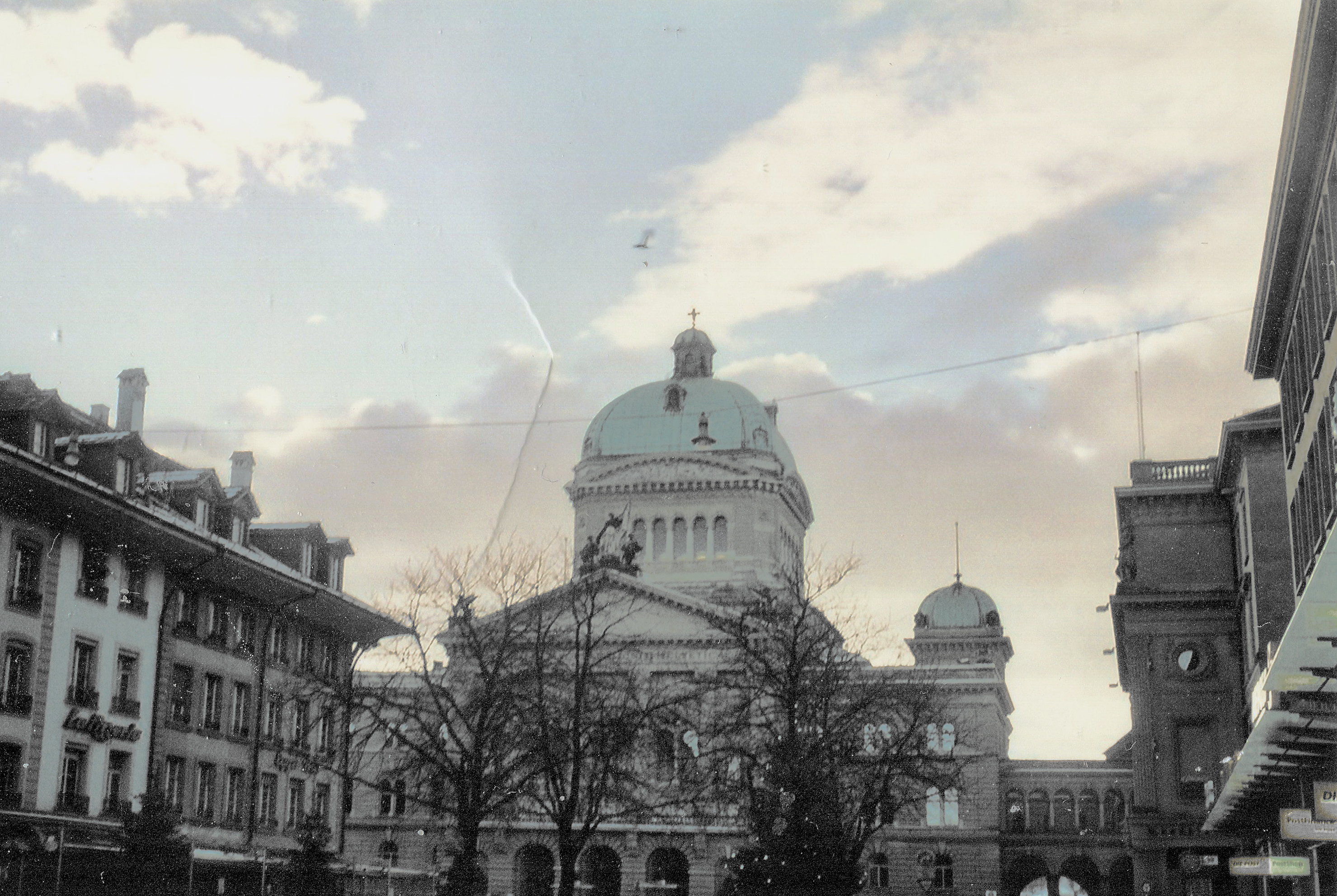
The Federal Palace in Bern is the visible setting of national political decision-making. But ministries, cantonal offices, banks, laboratories, transport operators and public-service workers are located across Switzerland.
The photograph accompanying this article shows the Federal Palace in 2019. It illustrates the institution and place, not the current individuals holding office or the operations of every Swiss service.
Is Switzerland in the EU or Schengen?
Switzerland is not an EU member. It has numerous bilateral agreements with the EU and participates in the Schengen area. These are separate relationships involving different areas of travel, trade and international cooperation. The country retains its own currency and federal political institutions.
Businesses importing and exporting products must comply with applicable rules even when agreements make transactions easier. A visitor’s entry rights, a worker’s residency status and a company’s product standards are three different questions.
Use the official About Switzerland portal for an overview of its international relationships. A general statement that Switzerland is ‘in Europe’ is not sufficient for legal, visa or employment decisions.
Does Switzerland use the euro?
No. The Swiss franc, abbreviated CHF, is the country’s official currency. Some shops in visitor areas may accept euros at a particular conversion rate, but that is a merchant service, not membership in the euro area. The Swiss National Bank helps maintain monetary and price stability.
A Swiss firm can invoice an overseas customer in euros while paying domestic wages in francs. Changes in currency markets can alter its revenue after conversion, even when the product and contract are unchanged. A traveller should also check currency-conversion fees.
Household prosperity is not determined by the franc’s international reputation. Real wages, rents, healthcare premiums, prices and access to employment all matter. The correct comparison uses purchasing power and actual services rather than a currency symbol alone.
What does the Swiss economy produce?
Switzerland’s economic activities include pharmaceuticals, biotechnology, chemicals, machinery, precision engineering, watches, finance, insurance, technology and tourism. Local trades, retailers, healthcare workers, farmers and public servants are important too. A high-income economy is built on many forms of work rather than only its internationally famous brands.
Imagine a precision medical instrument. Engineers design the product, technicians manufacture parts, quality inspectors check performance and logistics companies deliver it to a hospital. Research, training, public regulation, financing and reliable utilities support that transaction.
The How Switzerland Got So Rich guide owns the longer development history. Here the focus is how knowledge, factories, public infrastructure and businesses repeatedly create products and services that customers find useful.
What was Switzerland’s economic outlook for 2026?
The International Monetary Fund’s 2026 Article IV assessment expected slower growth because of weaker international demand and uncertainty. It projected about 0.8% growth in 2026 adjusted for major international sporting events associated with Swiss-based organisations, or about 1.1% unadjusted. Inflation was expected to remain subdued.
The IMF 2026 report explains these different measures. It also identifies housing, mortgage exposure, ageing, long-term fiscal pressures and international trade as issues requiring attention.
A projection is not the year’s final economic result. National GDP growth also cannot tell whether a particular family faces rising rent or a small business has enough customers. Good analysis follows jobs, public finance and the real prices people pay.
How does Swiss banking and insurance work?
Banks provide savings accounts, payments, lending and other financial services; insurers help people and businesses manage specified risks through policies. Switzerland has a large international financial sector, but each institution operates under laws, contracts and supervision rather than a universal guarantee that money is risk-free.
A family arranging a mortgage must understand interest, repayment, affordability and property obligations. A small exporter may need trade financing and payment settlement. Both depend on trustworthy records, financial regulation and accessible dispute procedures.
The IMF’s 2026 review notes the concentration of lending in mortgages and the need to watch financial stability. A reputable banking industry does not eliminate the need for consumer understanding or effective risk management.
How is Swiss healthcare organised?
Switzerland requires qualifying residents to obtain compulsory basic health insurance under the applicable legal framework. Private insurance providers deliver the statutory basic insurance product under regulated rules, while cantons have important responsibilities for hospitals and service organisation. Premiums, deductibles and cost sharing are practical issues for many households.
Having coverage does not itself guarantee the immediate availability of every medical procedure. A patient still needs a healthcare provider, appropriate referral, qualified staff, medicines, records and a workable journey. Services and local arrangements may vary by canton.
People making real decisions should check the current insurer, canton and provider, and distinguish compulsory basic insurance from supplementary products. A country explainer can show how the network operates but cannot replace personal eligibility guidance or qualified medical advice.
How do schools and apprenticeships connect to employment?
Swiss education is shaped strongly by canton-level responsibilities. Learners can pursue academic routes and vocational education and training, including apprenticeships that combine supervised workplace practice with formal learning. Qualifications and eligibility depend on the exact programme and applicable local rules.
Imagine an apprentice learning to maintain industrial equipment. The employer provides supervised practice, instructors develop technical knowledge and assessments check progress. Those experiences require good mathematics, literacy, safe equipment and a credible pathway into work.
Families needing school stages and admissions should read Education in Switzerland. The national story is how teachers, workplaces, transport, public finance and qualification systems prepare people for useful careers.
Why do Zurich, Geneva and Basel play different roles?
Zurich is a major centre of finance, technology and business services. Geneva hosts numerous international organisations and diplomatic activities. Basel has important life-sciences and pharmaceutical activity and connections across national borders. These centres complement Bern’s federal institutions rather than duplicating them.
A business may develop a product near Basel, find financing in Zurich and serve international customers through other hubs. Skilled staff and suppliers move within a system of roads, trains, research institutions and telecommunications.
Urban growth can also strain housing and transport affordability. The value of a city’s international reputation should be judged alongside the ability of residents to find suitable homes, travel safely and access necessary services.
How do Swiss railways, tunnels and Alpine roads connect cities?
The Swiss transport network includes railways, buses, local transit, highways and Alpine routes. Mountain terrain requires tunnels, bridges, careful maintenance and practical safety rules. Trains can connect busy centres, but a complete journey includes the initial walk and final local connection.
A mountain village may rely on a road that becomes unsafe during heavy snowfall. Even a fast railway tunnel cannot help if the passenger’s first link is closed. Freight similarly needs a road or terminal connection after its main journey.
Good planning measures reliability, accessibility and total travel time rather than merely kilometres of new construction. Operators should use current weather and infrastructure information, while travellers verify timetables through the appropriate service provider.
How does Switzerland produce electricity and distribute water?
Hydropower contributes significantly to Swiss electricity alongside nuclear generation and other sources, with solar and further technologies growing. The system also depends on power grids, balancing, storage, safety and maintenance. Electricity generated in one part of the country must reach homes and industrial customers when they need it.
Drinking water needs collection, treatment where necessary, monitoring and distribution. Mountain lakes and streams do not automatically create safe tap water without infrastructure and competent oversight.
An apartment building’s heating, a hospital’s equipment and a factory’s machines all depend on this connected network. Building new generation without maintaining local power lines cannot guarantee a reliable service to every user.
Why are German, French, Italian and Romansh important?
Switzerland has four national languages: German, French, Italian and Romansh. German, French and Italian are federal official languages, while Romansh has official status for communication with Romansh-speaking persons. Different cantons and municipalities have different linguistic arrangements.
The Languages Act, amended in 2026 explains the federal rules, and the Federal Chancellery describes Romansh’s special status. No one should assume a resident speaks all four languages or has the same preferred language as a neighbour.
Language shapes schooling, healthcare instructions, public forms and workplaces. Effective services give people understandable information and ways to clarify requirements. This is an operating necessity in a multilingual country, not merely an aspect of cultural tourism.
How do Alpine snow, glaciers and climate risk affect daily life?
Glaciers, mountains, valleys and alpine climate conditions shape transport, hydropower, tourism, housing and environmental management. Avalanches, floods, landslides and extreme weather create different levels of risk depending on the location and season.
A village’s access road, a ski operator and a water supply may all depend on the same mountain environment but face different technical problems. Safe planning relies on hazard information, suitable construction, warnings and realistic emergency routes.
Explore the avalanche bulletin vocabulary and ice-core analysis guide for specialist scientific terms. This overview connects those risks to public services and livelihoods.
A worked example: how does a Swiss watch reach its customer?
Imagine a small manufacturer receiving a request for a precision watch. Designers plan the product, suppliers provide components, specialists assemble and regulate the movement, and quality inspectors check that the finished item meets specifications. The product is packaged and arranged for delivery.
The shipment requires reliable transport, customs and tax compliance where relevant, insurance, contracts and payment settlement. The international customer sees a small watch but depends on dozens of decisions carried out by workers and organisations.
Suppose a specialised component is late. An otherwise healthy factory can miss a promised deadline. Suppose the finished item is delayed in transit. The customer may not receive it when expected despite faultless craftsmanship.
This is an illustrative supply-chain model, not a story about a named watch manufacturer. Specialist terminology belongs in our Switzerland watchmaking vocabulary article.
A second example: what makes a mountain school day work?
Imagine a student in a smaller Swiss valley community preparing for class. The learner needs a safe home, food, a suitable route and learning materials. Teachers require training and a functioning building with heating, water and electricity. The relevant canton or municipality must provide its assigned services.
Suppose heavy snow closes a road. No matter how good the teacher’s lesson plan, some pupils cannot attend safely. School leadership, transport providers and families need reliable communication and, where appropriate, a sensible plan for learning continuity.
After completing school, the student may become a technician who maintains transport, a nurse who supports healthcare or an engineer who develops safer buildings. These professions emerge from education and then sustain the infrastructure future learners need.
The example is hypothetical and teaches a feedback loop: society needs education to keep services working, while education relies on those same services every day.
How do taxes support Swiss public services?
Public spending is financed through taxes and other revenue under the federal, cantonal and municipal frameworks. Those layers have different revenue powers and expenditure duties. A household may encounter rules at more than one level, so a tax question always requires the exact canton, municipality and personal circumstances.
A school or railway project needs money not only for construction but also for years of staffing, cleaning, repairs and equipment replacement. Approval of a building does not guarantee the capacity to operate it safely.
Good public finance keeps spending transparent and matches commitments to realistic resources. A general national tax statistic is not a substitute for checking the actual obligation that applies to a particular person or business.
How do Swiss housing costs affect working families?
Housing affordability varies across Switzerland. Demand for homes near strong job markets, transport nodes and universities can differ from demand in smaller towns or mountain communities. Rents and purchase prices depend on supply, planning, finance and local conditions.
A worker may be offered a useful job but struggle to live near the workplace. A longer commute can make wages less valuable in practice, especially when childcare or medical needs also require travel. That is why housing and transport planning belong in the same discussion.
The IMF’s 2026 review highlights mortgage concentration and continued housing-price increases. These financial-system concerns ultimately connect to whether households can plan sustainably.
Why is neutrality different from isolation?
Swiss neutrality is a longstanding element of foreign and security policy, but it does not mean the country avoids international commerce or diplomacy. Switzerland participates in international organisations, hosts diplomatic activities and cooperates with its neighbours through numerous agreements.
Neutrality, EU membership, Schengen participation and the ability to sell products abroad are different concepts. A firm trading with European customers still follows applicable business rules, while humanitarian or diplomatic activity is governed by other arrangements.
The practical lesson is to identify the exact kind of international relationship rather than treating one familiar word as an answer to every foreign-policy, business or travel question.
How can readers verify a claim about Switzerland?
For federal executive arrangements use the Federal Council and its 2026 presidential page. For Parliament use the National Council and Council of States.
For languages, the Federal Chancellery and Languages Act are useful. For economic forecasts use the dated IMF analysis and preserve its distinction between adjusted and unadjusted growth.
Always identify the year, canton, municipality and responsible provider. Switzerland’s national system leaves meaningful differences in cantonal services. Useful country knowledge tells the reader which institution can actually answer the next practical question.
Frequently asked questions about Switzerland
How many cantons does Switzerland have?
26 cantons, each with distinct institutions within the federal framework.
Does Switzerland have a president?
Yes, a rotating one-year president among seven Federal Council members; Guy Parmelin is president in 2026.
How many members are in the Federal Council?
Seven.
How many seats does Switzerland’s Parliament have?
The National Council has 200 and the Council of States has 46.
What is direct democracy?
Citizens can vote on particular measures through referendums and popular initiatives in addition to elections.
Is Switzerland a member of the EU?
No, but it has extensive agreements with the EU and is part of Schengen.
Does Switzerland use the euro?
No. The Swiss franc (CHF) is its currency.
What city is the capital?
Bern is Switzerland’s federal city and the seat of major national political institutions.
Which languages are used?
German, French, Italian and Romansh are the national languages, with distinct federal official-language arrangements.
Who runs schools and hospitals?
Cantons and other legally assigned providers have major responsibilities; specific procedures vary.
Continue through Switzerland and connected country guides
Use the related specialist articles for education, culture, economics, heritage and geography rather than reading repeated versions of the national explanation.
- Education in Switzerland
- How Switzerland Got So Rich
- Swiss watchmaking vocabulary
- Swiss avalanche science vocabulary
- Swiss ice-core analysis vocabulary
- How Sweden Works
- How Tajikistan Works
- How Singapore Works
- How Countries Work
Editorial note, 20 October 2026: The presidency is a dated officeholder fact, and the IMF projections are forecasts. The watch and school examples are illustrative scenarios. Featured media is a 2019 CC BY-SA 4.0 photograph of Bern’s Federal Palace by Vitold Muratov, not a picture of current leaders. Refer to current cantonal and national guidance for legal, school and medical decisions.