
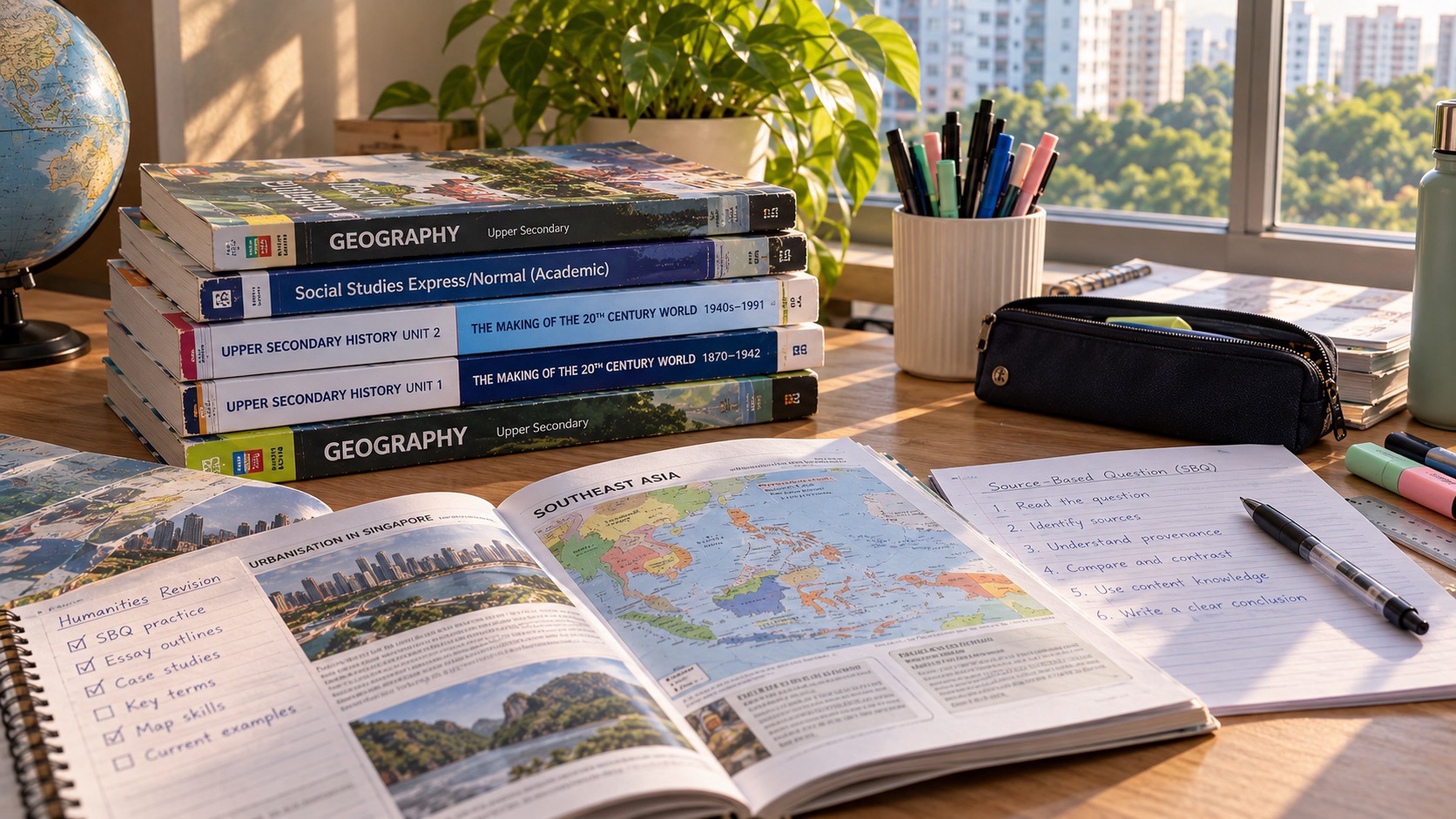
G2 Humanities in the 2027 SEC: what to do first. To survive G2 Humanities (Social Studies, Geography), learn to do three things in every answer: identify the issue, select evidence that actually supports a claim, and explain a reasoned judgement. You do not need to memorise endless essays before you understand the question. Start with one poster, map, graph or source and ask what it shows—and what it does not show.
In the 2027 SEC, G2 Humanities (Social Studies, Geography) is K229. Social Studies is 50% of the grade and tests source-based and structured responses. Geography contributes the other 50%, with Geography in Everyday Life compulsory and a choice between Climate and Tectonics in the second section. The Social Studies paper uses a printed question paper with responses typed into a digital answer booklet. Plan for that format well before the actual examination.
Humanities skills support urban planning, logistics, environmental management, tourism, public services, journalism, business and civic participation. Taking the subject at G2 is not a career label. Future opportunities depend on your overall SEC subjects, subsequent qualifications and how well you learn to use evidence in real decisions. There are constructive steps forward for learners with different interests and strengths.
Official SEAB K229 syllabus · 2027 G2 subject list · Singapore-Cambridge SEC qualification · MOE post-secondary admissions information.
G2 Humanities SEC 2027: paper-by-paper survival guides
The 2027 Social Studies component has the same Paper 1 format in K229, K230 and K231. Paper 2 differs by registered combination. Select the guide matching the student’s actual syllabus code and prepare the compulsory tasks and question choices correctly.
- Social Studies Paper 1 — 35-mark source case, 15-mark structured responses and digital answers
- K229 Geography Paper 2 — Geography in Everyday Life, Climate or Tectonics
Eight actions that immediately make revision easier
- Confirm that the subject is combined K229, not standalone G2 Geography K226.
- Record what each Social Studies source claims, which details support it, and its limitations.
- Practise one source-based inference or comparison on a short extract every study day.
- Write a clear structured-response paragraph using point, explanation, example and consequence.
- Learn the compulsory Geography in Everyday Life cluster and geographical methods.
- Practise both Climate and Tectonics questions before deciding how to handle the examination choice.
- Type timed short Social Studies responses using a simple plan before writing.
- Always make Geography judgements using specified criteria, evidence and a limitation.
Choose two useful actions for this week rather than turning the checklist into another source of pressure. The aim is to make errors visible and correctable. Record which questions you can now attempt without a model answer, because independent use is a better indicator of progress than the number of pages highlighted.
What G2 actually means for this subject and for your future
G2 means General 2 subject level under Full Subject-Based Banding. It should not be confused with Posting Group 2, which concerns the starting admission arrangement for secondary school. Students may take a mix of G1, G2 and G3 subjects depending on school rules, academic readiness and eligibility. A student taking Humanities (Social Studies, Geography) at G2 is studying a meaningful syllabus, not receiving a lifetime label.
From 2027, students sitting the national examinations receive a Singapore-Cambridge Secondary Education Certificate showing their subjects and subject levels. SEAB lists K229 as the relevant 2027 G2 syllabus for this subject. The shared name of the certificate does not make G1, G2 and G3 papers identical. Check the subject code, paper rules and content whenever selecting resources.
Under the 2028 Post-Secondary Admissions Exercise, eligible SEC holders can participate in applications to post-secondary courses, but eligibility for a particular course depends on the entire subject-level profile, grades and course rules. A profile with five G2 subjects can be relevant to Higher Nitec and Polytechnic Foundation Programme pathways subject to requirements; direct Polytechnic Year 1, JC and MI routes typically have requirements involving specified G3 subjects and other conditions. Some learners have mixed-level profiles that may open other options. Check MOE and individual institution criteria rather than assuming a one-line rule.
Practical careers deserve the same serious consideration as more academic routes. Engineering services, environmental work, community roles, media, business and technical occupations can each involve demanding skill and further learning. The sensible question is what someone will do on a normal working day and which qualifications and abilities are needed to do it well. There is no need to turn a G2 result into an excuse to look down on a learner or a particular industry.
Read this before buying a past-year paper: official examination requirements
Social Studies: printed sources and digital answers
The Social Studies component is a 1-hour-45-minute paper worth 50 marks and 50% of K229. Candidates receive the question paper in hard copy but type their answers in a supplied digital answer booklet. Familiarity with the response method matters because the examination tests interpretation and explanation, not typing surprises.
Social Studies Section A: source-based case study
The compulsory source-based case study is worth 35 marks. Questions 1–4 draw on specific sources and contribute 25 marks; Question 5 asks candidates to use multiple sources and carries 10 marks. The task can draw on any of the three issues in the syllabus, so memorising one case study is inadequate.
Social Studies Section B: structured responses
Two compulsory structured-response questions carry 15 marks combined. Students should apply knowledge to the issue, construct explanations and make informed judgements where the command requires them. Precise examples help, but copying stock paragraphs without addressing the question can fail.
Geography Paper 2: compulsory and optional clusters
The Geography component is also 1 hour 45 minutes and contributes 50 marks, or 50% of K229. Section A’s 25-mark Question 1 on Geography in Everyday Life is compulsory. In Section B, answer either the 25-mark Climate Question 2 or the 25-mark Tectonics Question 3. The chosen section includes a six-mark judgement and decision-making task. An approved calculator may be used.
Different information, one common reasoning habit
Social Studies includes perspectives, credibility, context and arguments. Geography uses locations, maps, data, fieldwork methods, physical and human processes, and evaluating actions. Both reward explanations that connect evidence to a precise question. Strong answers are neither a catalogue of facts nor unsupported opinion.
The scheme above is based on SEAB’s 2027 K229 official G2 syllabus. Earlier Normal (Academic) material can sometimes help with overlapping topics, but only after checking whether the assessment demands and content match. A practice paper’s answer key cannot correct the mistake of revising the wrong combination or subject level.
A strong revision plan works backwards from what is assessed. A candidate should be able to recognise the paper and timing, select the right response style, explain scientific or social evidence where demanded, and decide when to move on. Being familiar with a topic is only one component of being ready to demonstrate it under examination conditions.
The subject knowledge that makes the largest difference
1. The three Social Studies issues: build a conceptual map
The syllabus organises Social Studies around citizenship and governance, living in a diverse society, and being part of a globalised world. Begin by defining the ideas of participation, responsibility, identity, diversity, interdependence, benefit and cost. Understanding those concepts gives a student more flexibility than remembering one teacher’s model essay.
Consider an invented neighbourhood consultation about where to add shaded walkways. Residents might emphasise accessibility and comfort, while agencies consider public safety, budgets and maintenance. A reasoned explanation compares these roles without reducing the issue to ‘the authorities are always right’ or ‘the public is always right’.
Draw a two-column map for each issue: actors and concerns. Add examples from reliable sources, then vary the setting. A strong learner can recognise the same concept when a question concerns a public digital service instead of a walkway.
2. Source inference: a conclusion must be supported
A source can show an action, intention or viewpoint without proving everything about the wider society. First identify a specific clue, then explain a proportionate inference. The strongest answer often acknowledges the context rather than jumping to a dramatic conclusion.
Suppose a poster says, ‘Our estate needs more bicycle parking’ and depicts bicycles clustered near an entrance. It reasonably suggests a demand for additional parking or a problem with current storage. The poster alone does not prove that every resident rides a bicycle, or that theft is widespread. Those are unsupported expansions.
Use the pattern ‘This suggests…, because the source shows…, which matters because…’ while learning the skill. Gradually move beyond a rigid formula by selecting the most relevant evidence and explaining the context. Try an unfamiliar photo, chart or speech extract.
3. Comparison: identify the precise point of agreement
Two sources may address the same broad topic and still disagree on its effect, causes or recommended solution. Before writing, name the point of comparison. Do they share concern about congestion? Do they disagree about who should fund a service? Do they differ in how quickly a policy should be implemented?
Invented example: A shop owner supports later opening hours because business could improve; a resident opposes them because nearby noise might increase. Simply writing ‘both discuss opening hours’ is weak. Their central disagreement concerns trade-offs between commerce and residential quiet.
Use matched evidence: a phrase from each source for the same issue, followed by an explanation of the similarity or difference. Do not compare one source’s intended audience with another source’s factual statistic as though they were the same category.
4. Utility and reliability: source provenance is a clue, not a verdict
Consider the creator, intended audience, date, purpose, evidence and what the task actually asks you to judge. An organisation’s leaflet may be valuable evidence of its priorities even if it does not independently prove the real-world impact of a policy. An official statistic may be robust for a defined population while still unsuitable for a different question.
Imagine a resident says a crossing feels unsafe, while a traffic count shows few recorded collisions. The experience shows a perception that can matter for participation and accessibility; the count concerns recorded collisions. The sources may be measuring different things rather than one necessarily being false.
Ask whether the limitation changes the particular conclusion being drawn. The useful language is often ‘valuable for understanding X, but insufficient to establish Y’. Avoid automatic judgements based on a logo, formal tone or an emotional picture.
5. Structured Social Studies answers: explain the mechanism
A structured response should make the relationship between action and outcome visible. If asked how citizens can contribute to a shared goal, identify the contribution, show how it works, and explain a likely benefit or difficulty. A list of civic virtues does not substitute for a causal explanation.
Invented task: How could residents improve accessibility to a community service? One point is that they can report barriers using specific observations, such as unavailable ramps or unclear signage. Agencies can use that information to prioritise changes. A limitation is that some groups may be underrepresented unless feedback channels are accessible.
Practise one paragraph, then add a second perspective that genuinely changes the decision. End with a judgement that follows from both lines of reasoning, not a generic conclusion that ‘both sides are important’.
6. Geography in Everyday Life: think in locations and scales
The compulsory Geography cluster covers thinking geographically, sustainable development and geographical methods. Look at an everyday place—a transport interchange, shopping street, park connector or school route—and ask where activities happen, how patterns vary and which groups are affected. Scale matters: a neighbourhood finding is not necessarily a national trend.
Draw an invented sketch map with a title, orientation and useful legend. Add the places where people cross a road and the times observations were made. Describe the pattern before trying to explain it. Then check whether route access, land use or observation time could account for what was seen.
Good geography does not require every answer to be lengthy. It requires a clear location, the relevant feature, data when available and an explanation proportionate to the evidence. Practise distinguishing an observed pattern from a proposed cause.
7. Fieldwork and methods: ask whether the data answer the question
Geographical data can come from surveys, counts, measurements, photographs, maps and other sources. The method should suit the research question. Counting pedestrian movements at a single entrance may help describe that location at that time, but it cannot directly prove the satisfaction level of all commuters.
Invented task: A student wants to compare perceived comfort on two walking routes. A temperature reading may provide useful physical context, but a user survey with well-designed questions captures a different dimension. Using both may be stronger if the sampling approach is appropriate and limitations are discussed.
Identify what is measured, who or what was sampled, how many observations were taken and how data might be biased. When recommending a better method, say exactly what it would add. ‘Do more research’ is not a complete improvement.
8. Climate: distinguish weather, climate, mitigation and adaptation
Weather concerns atmospheric conditions at a particular time and place; climate describes patterns over a longer period. A rainy afternoon is not, by itself, proof of a change in a region’s long-term climate. In climate questions, identify the timescale and variable before drawing conclusions.
Climate mitigation aims to reduce drivers such as greenhouse gas emissions. Adaptation aims to reduce harm from impacts, for instance by planning for heat exposure or flooding. These approaches can work together, but the criteria for judging their effectiveness differ. Students should not use the two terms interchangeably.
Practise interpreting a climate graph with rainfall and temperature on separate, clearly labelled scales. Explain a pattern and qualify it using the data’s location and period. Then describe how a suitable response might help a community without promising that one measure solves every risk.
9. Tectonics: physical hazards meet human vulnerability
Plate tectonics helps explain earthquakes and volcanoes, but the effect of a hazard on people depends on exposure, vulnerability and preparedness. A powerful earthquake in an unpopulated area and a weaker event near poorly constructed buildings can create very different human outcomes. Explain the process and the human context separately.
On a simple diagram, use correctly labelled plate boundaries and arrows to explain movement. If a task asks about disaster risk management, assess early warning, building standards, public education or evacuation planning according to the hazard and local conditions.
An answer that only states ‘earthquakes are dangerous’ misses how physical hazard, population and capacity interact. Use at least one real criterion, such as cost, feasible implementation, safety or accessibility, when judging a proposed measure.
10. Judgement and decision-making: criteria make choices defensible
The Geography Section B question includes a six-mark judgement task. Start by stating the decision and the criteria by which options should be compared. Suitable criteria may include effectiveness, cost, fairness, timescale, environmental impact or maintenance, depending on the case. Use information from the question, not arbitrary preferences.
Imagine two approaches to an urban heat problem. A shade structure can offer immediate protection but needs installation and maintenance. Trees can provide longer-term ecosystem benefits but need time to grow, suitable root space and care. The stronger recommendation depends on the stated location, urgency and resources.
Practise changing one constraint at a time: limited space, a short implementation deadline or a low maintenance budget. A defensible answer may change as the evidence changes. This flexibility is more valuable than memorising which option is always ‘best’.
11. Link Social Studies and Geography without mixing paper demands
Both parts of K229 involve people, environment and decisions, but the assessments ask different questions. Social Studies evaluates perspectives and societal reasoning through sources and structured tasks. Geography develops spatial, environmental and methodological reasoning. Use the shared habit of evidence-based explanation while preserving the different vocabulary and formats.
A transport improvement may be a Social Studies question about residents, institutions and responsibilities, or a Geography question about spatial patterns, land use and accessibility. The subject of the case may be identical, but the valid answer must match the question’s lens.
Practise writing two separate three-sentence explanations about one invented public project, one from each disciplinary perspective. The student should notice when a social claim needs stakeholder evidence and when a geographical claim needs location or measurement data.
12. Digital answer booklet and examination choices
The Social Studies paper supplies a printed question paper while responses are typed. Students can practise reading on paper and structuring short digital answers under timed conditions, including careful paragraph separation. Accuracy and evidence are more important than typing long texts at great speed.
Geography demands a different exam decision. Compulsory Question 1 must be attempted, then one of Climate Question 2 or Tectonics Question 3. Students should understand both taught clusters and practise choosing based on the actual question. Attempting both optional questions is not the published requirement.
An exam plan should mark compulsory questions first and leave time to support a six-mark judgement. Rehearse the layout using school or officially aligned practice so that the choice becomes routine rather than a surprise.
Three original worked problems and what to learn from each
These problems are educational examples created to explain transferable methods. They are not reproductions of SEC examination papers and are not predictions of future topics. What matters is that a student can solve a changed version without prompting, explain the evidence, and recognise a limitation in the original answer.
1. Worked Social Studies source case: is one statistic enough?
Original practice scenario, not an SEC question: Source A is a leaflet saying, ‘Our new bicycle lane makes the area safer for everyone.’ Source B is a count showing more bicycles using the route after the lane opened. Does Source B prove Source A’s whole claim?
Source B supports the narrower finding that recorded cycle use increased, assuming the counts are comparable. It does not directly establish safety for every road user. That would require suitable additional evidence such as collision records, observations of conflict points and views from pedestrians as well as cyclists.
Source A’s persuasive purpose may affect its framing, but an advocacy source is not automatically false. Source B is numerical evidence, but the meaning depends on how and when the count was collected. Compare the evidence with the exact claim, rather than treating data as a universal guarantee.
Now imagine Source B is a survey of 20 regular cyclists reporting that they feel safer. The new source directly captures a perception of safety but still does not establish all road users’ actual risk. The evaluation should adapt to what the source measures.
2. Worked Geography choice: heat and shade
Original practice scenario: A town can install temporary shade panels along a high-use walkway or plant trees to provide longer-term shade. The local council wants a recommendation with one limitation. The task is invented for teaching and is not a current council proposal or a past SEC question.
Define the objective: reduce heat exposure while keeping the walkway accessible. Shade panels could protect people sooner but have installation and maintenance costs. Trees may improve the streetscape and offer ecological benefits, but their roots need suitable space and the canopy needs time to develop.
If relief is required before an imminent event, panels may be the stronger immediate option. If long-term conditions and planting space are favourable, trees may be valuable. A phased combination could also be reasonable if the task allows it and resources are available.
A high-quality answer names the criteria, relates each option to evidence or constraints, and reaches a proportionate decision. Change the constraint to ‘underground services leave no planting space’ and see how the decision changes. This is the essence of judgement rather than memorised conclusions.
3. Worked fieldwork: when a sample is not representative
Original classroom question: A class interviews 15 pedestrians outside a shopping centre at 4 pm and reports that 80% prefer the nearby park connector. Can the class conclude that 80% of all neighbourhood residents have this preference?
No. The result describes the sampled pedestrians under the stated selection method. People not at that location or time were not included, and the sample may overrepresent commuters or shoppers. The question is about representativeness, not whether the count of respondents was done correctly.
A better plan might include more observation times, different sampling locations and a clearly defined target population. Random or systematic sampling methods may reduce some biases if implemented appropriately. The response should explain exactly how the modification addresses the limitation.
Change the purpose: if the question only asks what the surveyed pedestrians said at 4 pm, the original data may be useful for that narrower conclusion. Scientific and geographical literacy both require matching a conclusion to the scope of evidence.
Ten mistakes to stop repeating
1. Using a source to assert a fact it cannot establish.
This is a diagnosis prompt, not a statement about a student’s character. Find one marked question that shows the mistake. Ask what the task actually required, identify the earliest wrong assumption, and explain the proper principle in ordinary language before attempting a fresh version. Where necessary, ask a teacher for a worked counterexample. A correction counts as learned only when it survives changed wording, numbers, sources or diagrams.
2. Treating an official logo as automatic proof of reliability.
This is a diagnosis prompt, not a statement about a student’s character. Find one marked question that shows the mistake. Ask what the task actually required, identify the earliest wrong assumption, and explain the proper principle in ordinary language before attempting a fresh version. Where necessary, ask a teacher for a worked counterexample. A correction counts as learned only when it survives changed wording, numbers, sources or diagrams.
3. Comparing two sources merely because they discuss the same broad topic.
This is a diagnosis prompt, not a statement about a student’s character. Find one marked question that shows the mistake. Ask what the task actually required, identify the earliest wrong assumption, and explain the proper principle in ordinary language before attempting a fresh version. Where necessary, ask a teacher for a worked counterexample. A correction counts as learned only when it survives changed wording, numbers, sources or diagrams.
4. Writing a Social Studies response with a memorised example but no explanation.
This is a diagnosis prompt, not a statement about a student’s character. Find one marked question that shows the mistake. Ask what the task actually required, identify the earliest wrong assumption, and explain the proper principle in ordinary language before attempting a fresh version. Where necessary, ask a teacher for a worked counterexample. A correction counts as learned only when it survives changed wording, numbers, sources or diagrams.
5. Forgetting the Social Studies digital answer booklet and leaving typing practice too late.
This is a diagnosis prompt, not a statement about a student’s character. Find one marked question that shows the mistake. Ask what the task actually required, identify the earliest wrong assumption, and explain the proper principle in ordinary language before attempting a fresh version. Where necessary, ask a teacher for a worked counterexample. A correction counts as learned only when it survives changed wording, numbers, sources or diagrams.
6. Treating one rainy day as evidence for an entire climate trend.
This is a diagnosis prompt, not a statement about a student’s character. Find one marked question that shows the mistake. Ask what the task actually required, identify the earliest wrong assumption, and explain the proper principle in ordinary language before attempting a fresh version. Where necessary, ask a teacher for a worked counterexample. A correction counts as learned only when it survives changed wording, numbers, sources or diagrams.
7. Confusing climate mitigation with adaptation.
This is a diagnosis prompt, not a statement about a student’s character. Find one marked question that shows the mistake. Ask what the task actually required, identify the earliest wrong assumption, and explain the proper principle in ordinary language before attempting a fresh version. Where necessary, ask a teacher for a worked counterexample. A correction counts as learned only when it survives changed wording, numbers, sources or diagrams.
8. Explaining earthquake damage only through hazard magnitude while ignoring exposure.
This is a diagnosis prompt, not a statement about a student’s character. Find one marked question that shows the mistake. Ask what the task actually required, identify the earliest wrong assumption, and explain the proper principle in ordinary language before attempting a fresh version. Where necessary, ask a teacher for a worked counterexample. A correction counts as learned only when it survives changed wording, numbers, sources or diagrams.
9. Answering both optional Geography Section B questions instead of selecting one.
This is a diagnosis prompt, not a statement about a student’s character. Find one marked question that shows the mistake. Ask what the task actually required, identify the earliest wrong assumption, and explain the proper principle in ordinary language before attempting a fresh version. Where necessary, ask a teacher for a worked counterexample. A correction counts as learned only when it survives changed wording, numbers, sources or diagrams.
10. Making a geographical judgement without a criterion or a limitation.
This is a diagnosis prompt, not a statement about a student’s character. Find one marked question that shows the mistake. Ask what the task actually required, identify the earliest wrong assumption, and explain the proper principle in ordinary language before attempting a fresh version. Where necessary, ask a teacher for a worked counterexample. A correction counts as learned only when it survives changed wording, numbers, sources or diagrams.
Four weeks to rebuild confidence and examination control
Week 1: diagnose rather than guess
Week 1: Create one-page concept maps for the three Social Studies issues and practise short source inferences. Each claim needs an actual detail and a qualified explanation. Compare two brief sources without assuming they must agree or disagree entirely.
Finish the first week by naming two strengths alongside the gaps. Being able to describe what is already secure is useful for motivation and planning. Avoid adding long hours without knowing whether the issue is knowledge, question reading, reasoning, time management or a mismatch between the school’s work and the chosen practice material.
Week 2: strengthen the method
Week 2: Practise source utility and comparison, then revisit Geography in Everyday Life. Interpret a simple sketch map, small table and fieldwork scenario. Ask whether a proposed method can really answer the chosen research question.
Use a regular pattern: try a question independently, compare the reasoning to accurate feedback, then solve a changed question without looking. Keep the change meaningful but manageable. A learner should neither copy ten similar answers nor be thrown straight from an introductory example into the hardest available challenge.
Week 3: use information in new settings
Week 3: Revise Climate and Tectonics with diagrams and evidence. Distinguish weather from climate, process from impact, and physical hazard from social vulnerability. Write one six-mark judgement using stated criteria and an acknowledged trade-off.
The key word this week is transfer. If an explanation works only with the diagram, source or wording seen in class, the understanding may still be fragile. Alter one variable or perspective and discuss how the conclusion changes. When the student can do this without prompting, the confidence becomes more dependable.
Week 4: simulate, review and update
Week 4: Type Social Studies responses against realistic time limits and complete a Geography paper segment containing compulsory Question 1 and a deliberate choice between Questions 2 and 3. Review omissions, weak evidence and poor time decisions separately.
Timed practice is an information-gathering exercise. Note which questions were omitted, where explanation was too short, where time was lost, and which choices were made under pressure. Compare those observations with Week 1. Preserve useful routines and replace those that were not improving actual independent performance.
What to expect in Secondary 1, 2, 3 and 4
Secondary 1: adjusting from primary learning
The subject may feel unfamiliar because its vocabulary, diagrams, sources and explanations become more precise than in primary school. A first weak weighted assessment should guide the repair plan rather than define the learner. Use current schoolwork to discover the particular prerequisite and show one concrete improvement at a time.
Parents can ask the student to teach back one small concept or method. If the explanation becomes vague, return to a picture, example or short reading and rebuild it. The aim is not a long performance but a stable connection between words and meaning. Keep pace with the school’s actual taught sequence.
Secondary 2: turning separate facts into connected understanding
Questions often become longer and expect students to combine knowledge with a new context. Work on interpreting evidence and recognising what the task is asking for before rehearsing an answer. When considering upper-secondary subject options, check available school offerings, readiness and interests instead of copying friends’ choices.
If a child performs well untimed but struggles under pressure, teach recognition, planning and checking. If a child cannot explain a principle even without a clock, teach the concept from a simpler example. These two learning problems may produce a similar test mark but require different interventions.
Secondary 3: building independent application
At upper-secondary level, earlier foundations are assumed more frequently. Students should practise a short retrieval task from a previous topic alongside the current chapter. Use a tracker for recurrent errors rather than rewriting every page of notes. A tutor’s job is to reduce support gradually until the learner can select the method independently.
Study workload needs limits. More practice is not always more progress when sleep and attention decline. When a topic causes persistent avoidance, inspect the teaching sequence and the student’s experience of success. A small achievable repair can restart engagement more effectively than a generic demand to work harder.
Secondary 4: preparing for the actual SEC rather than the idea of an exam
Use the correct K229 paper and the current syllabus. Simulate its real sections, time limits and permitted materials. Review a completed paper before assigning another. Mark the cause of an incorrect answer, practise the underlying skill and confirm the correction on a changed task.
Preliminary results are useful feedback but not a permanent forecast. If the largest gap is incomplete explanations, revise answer construction. If it is calculation setup or source interpretation, repair that earlier decision. Keep a sustainable calendar before the released SEC timetable and confirm official examination logistics as they are announced.
How to tell whether learning has actually improved
A useful performance measure is depth: can the student say why a rule or interpretation is justified, not merely state it? Another is load: can the student still follow the process when a question contains more detail and the clock is running? The third is transfer: can the same principle be used with unfamiliar information? These are complementary observations, not official SEAB grades.
For a brief self-check, ask for one explanation without notes, one independent practice task, and one changed scenario. If only the first is successful, practise applying the idea. If accuracy collapses under timed conditions, train planning and attention while preserving correct conceptual work. Do not call every mistake carelessness; describe the actual step where the reasoning became unstable.
Good feedback names what to do next. ‘Use the trend in the graph to support the claim’ or ‘Explain how this source’s purpose affects this specific conclusion’ gives direction; ‘revise more’ does not. Keep the number of weekly targets small so the student can observe whether the intervention is working.
A parent and tutor plan that respects the learner
At home, use calm questions that invite evidence: ‘What did you learn to explain today?’, ‘Where did this answer go wrong?’ and ‘What would you change in the next version?’ These questions allow students to ask for help without fear of being compared with somebody else’s grades. Praise should attach to a concrete correct method or meaningful correction.
If tuition is appropriate, choose support that diagnoses individual knowledge gaps, models reasoning and checks understanding in a new setting. In a small group, the teacher should still track each learner rather than deliver one generic worksheet to everybody. Ask for a short consultation based on recent school scripts and a realistic plan for the next few weeks.
Parents can support the environment: a workable study schedule, suitable breaks, access to school feedback and a way to discuss concerns early. A child who is overcommitted may need workload changes before additional lessons. Good teaching and reasonable expectations should help a student regain agency over learning.
Careers and post-secondary choices worth exploring
An interest in urban planning or public services can begin with maps, data collection, access for different users and understanding competing needs. A course may later require mathematics, language and other subjects in addition to Humanities. A young person can develop a small portfolio of careful local observations without claiming expertise beyond their experience.
An interest in environmental science, sustainability or logistics can begin with interpreting climatic risks, spatial patterns, transport routes and fieldwork data. Some roles emphasise applied technical training, while others require specialised degrees. Practical observation and a willingness to test a claim matter on both kinds of pathway.
An interest in tourism, journalism or community engagement can benefit from interviewing, comparing sources and explaining choices fairly. Humanities does not predetermine a job. The next decision is to examine actual course entry standards, training style and work tasks, using school counselling and current programme information.
The 2028 Post-Secondary Admissions Exercise is part of a new admission landscape for the first SEC cohort. It brings application routes together, but it does not mean every SEC candidate meets every course requirement. Check the subject mix, required level, aggregate rules and special selection conditions. A student interested in a direct diploma programme should confirm whether G3 qualifications are needed, while someone attracted to applied study should examine ITE Higher Nitec and PFP options where eligible.
A realistic planning exercise is to shortlist three courses or qualifications: one matching current evidence, one needing a defined academic improvement, and one practical progression route. Record what each institution says rather than relying on a social-media claim. Include travel, course activities, workplace exposure, progression opportunities and learning preferences alongside grades.
The long-term value of Humanities (Social Studies, Geography) includes evaluating information before acting. Whether a future worker monitors a laboratory process, checks the design of a neighbourhood plan, advises clients or reports on community issues, clear evidence and careful reasoning matter. Developing this skill now is a constructive goal even when a teenager has no fixed career in mind.
Frequently asked questions about G2 Humanities
Is K229 just G2 Geography?
No. K229 combines Social Studies and Geography. Standalone G2 Geography is K226; the assessment arrangements are different.
Do candidates handwrite Social Studies answers?
K229 provides a printed question paper and a digital answer booklet in which answers are typed. Confirm the latest e-exam instructions and practise the format.
Must I know Climate and Tectonics?
Follow the school and official syllabus coverage. On the examination, Question 1 is compulsory and candidates choose one of the Climate or Tectonics Section B questions.
How should I explain a source’s reliability?
Discuss its origin, evidence, purpose, context and suitability for the specific claim. Avoid automatically saying every official source is correct or every emotional source is false.
Can I use a calculator in Geography?
The K229 Geography scheme allows an approved calculator. Interpret location, units, charts and criteria correctly before relying on a computed answer.
What if I know the facts but still get weak response marks?
Check whether the command word required a comparison, judgement, explanation or evidence-based inference. A list of relevant facts may not form a complete answer.
Is there a career path from G2 Humanities?
Yes. The knowledge and evidence skills are useful in further study and work. Exact course access depends on the full SEC profile, entry criteria and subsequent qualifications.
How can parents support without debating every opinion?
Ask what evidence supports the point and what reasonable limitation remains. The goal is to teach reasoning, not require a child to agree with the adult’s preferred conclusion.
What if a learner’s grade is improving slowly?
Look at smaller indicators: fewer unsupported claims, more accurate units, better graphs, a correctly selected paper section or one independent explanation. A slowly rising mark may hide important improvement; equally, a lucky test score without stable reasoning should not lead to abandoning retrieval practice. Compare several attempts under similar conditions.
Do students need to revise with classmates?
Discussion can be useful when it involves teaching back a method, comparing evidence and checking an actual mark requirement. It is less useful when classmates exchange unverified answers or memorise each other’s mistakes. Use official material and school feedback to settle disagreements. Independent practice remains necessary.
How often should a learner do practice papers?
Begin with smaller topic and skill diagnostics. As the exam approaches, add paper sections and eventually full-paper simulations aligned to the real format. After each attempt, spend enough time repairing errors. Repeating complete papers without correction often reinforces the same failures.
Is the G2 level less valuable than taking G3?
The levels have different academic expectations and can lead to different immediate admissions eligibility; the difference should be understood accurately. That does not diminish the learner’s worth or the practical value of studying well at G2. Good guidance compares real options and requirements without mockery, pressure or unrealistic guarantees.
One-page readiness checklist before the next school assessment
- I know that my registered G2 subject is Humanities (Social Studies, Geography) and the relevant code is K229.
- I know what is compulsory and where an examination question may offer a choice.
- I can explain a central concept without staring at the textbook.
- I can use evidence, units, graphs or context accurately as the question demands.
- I know my most repeated two errors and the next repair exercise.
- I have completed one changed question independently after receiving feedback.
- I know which course or career interests I want to investigate and will check the official entry requirements.
- I have enough time for rest and school commitments alongside revision.
Related eduKate Singapore guides and official sources
- How to survive G2 English Language
- How to survive G2 Mathematics
- How to survive G2 Science (Physics, Chemistry)
- How to study from corrected mistakes
- Using evidence across SEC subjects
- G2 Science Physics/Chemistry parent guide
- G2 Humanities Social Studies/Geography parent guide
- Science practical and written-paper differences
- 2028 PSE and Higher Nitec options
- 2028 Polytechnic EAE and admission
- Secondary 1 Mathematics in 3-pax tutorials
- 2027 SEAB G2 school-candidate syllabuses
- Official syllabus K229
- Singapore-Cambridge SEC certification
- MOE 2028 PSE guidance
Reviewed against the 2027 SEAB K229 syllabus and MOE/SEAB information available in October 2026. The worked examples in this guide are invented teaching tasks, not past papers or forecasts. Verify course eligibility, examination instructions and syllabus updates with their official publishers.
Explore the connected G2 SEC 2027 guides: All 25 G2 subjects · Languages and Humanities: survival collection · Official SEAB 2027 syllabus list. Use the subject code registered by your school.