
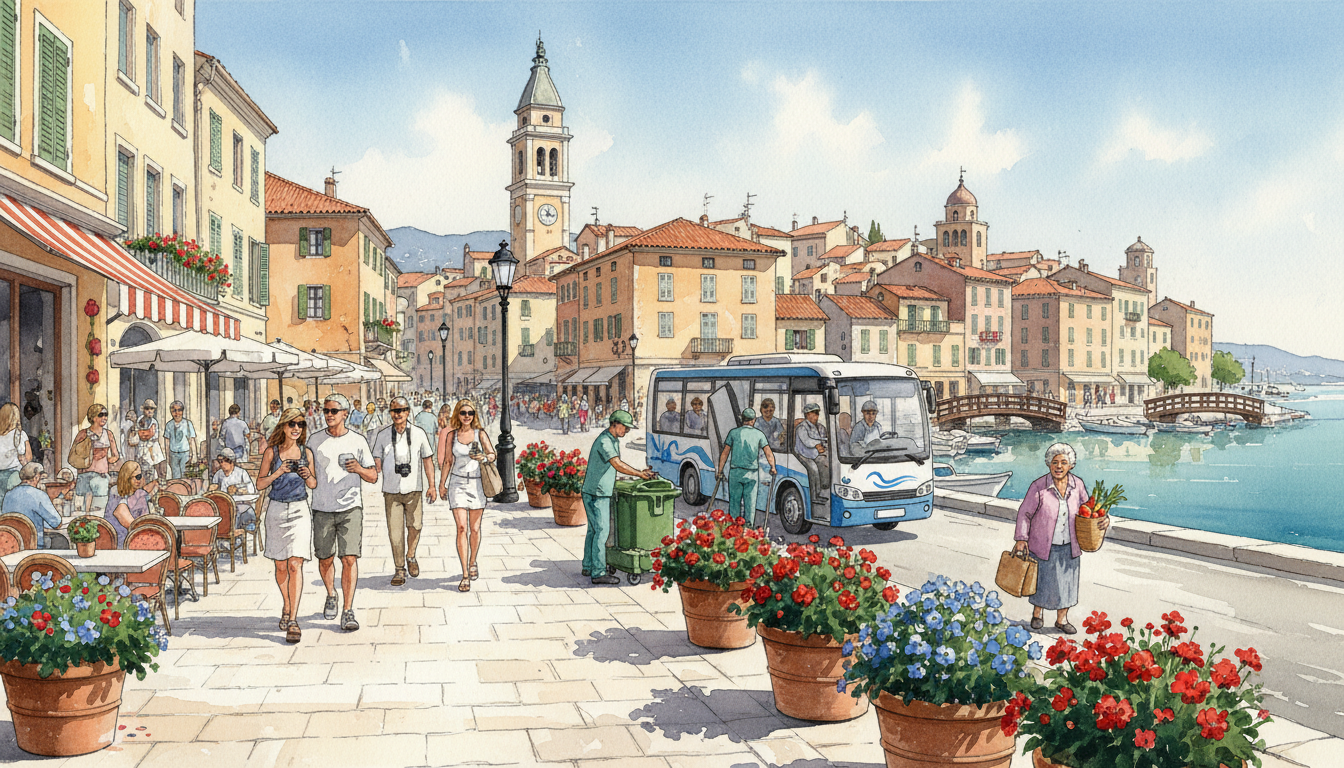
Did you know? A town can welcome more tourists than ever, fill its hotels and become famous online—while residents begin finding it harder to get a seat on the bus, reach everyday shops or enjoy their public spaces. The tourism figures look successful. Daily life may tell a more complicated story.
That is one way tourism stalls. It is not always a collapse in visitor numbers. Sometimes a destination grows so quickly or unevenly that its infrastructure, environment and host community struggle to share in the benefits. When that happens, the conditions supporting a good visitor experience can start to deteriorate too.
Quick answer: tourism can become unsustainable when visitors cluster in particular places or periods, public services cannot absorb extra demand, economic benefits leak away from local businesses or residents have little voice in decisions. Better destination management tracks who benefits, who carries costs and whether the place remains attractive and liveable over time.
More visitors and better outcomes are not the same measurement
Imagine a popular waterfront district. Annual arrivals are rising. But the increase is concentrated on a few weekend hours, when parking, public transport, toilets and walkways are already busy. Restaurants near one attraction do well, while businesses in surrounding areas see relatively little extra activity.
The visitor count alone does not establish whether tourism is delivering its intended value. A useful assessment also considers visitor spending, jobs and income opportunities, local access to services, environmental pressure and residents’ experiences.
The OECD Tourism Trends and Policies 2026 describes an important change in tourism policy: governments increasingly assess long-term economic value together with community wellbeing, environmental outcomes and resilience rather than only headline growth.
The report identifies concentrated visitor flows and infrastructure pressures as challenges in some destinations, while less-visited areas may miss out on opportunities. It does not claim that high visitor numbers are automatically harmful everywhere.
Six connections tourism needs to keep working
- Local infrastructure: transport, water, sanitation, waste management, public safety and access must serve residents as well as visitors.
- Local economic value: visitor spending needs suitable pathways into local employment, suppliers, businesses and community benefit.
- Natural and cultural assets: the qualities that attract visitors should not be progressively degraded by unmanaged use.
- Community participation: residents and workers need a meaningful role in understanding impacts and shaping decisions.
- Visitor experience: overcrowding, unreliable information or excessive waiting can make a popular destination less enjoyable.
- Long-term adaptation: seasonal demand, extreme weather and changing travel patterns require a way to revise the plan.
Tourism management connects public and private responsibilities. Hotels and tour operators make choices, while public agencies manage many shared facilities and regulatory duties. A destination may fail at the boundary if each organisation assumes another party will handle the growing pressures.
The problem of crowds in one place at one time
A destination’s annual visitor total may conceal the actual pressure. One million arrivals spread across many months, neighbourhoods and activities create a different operational problem from the same number concentrated at one viewpoint during a short festival.
It is therefore useful to examine peak-hour counts, public-transport demand, queue conditions, crowding at specific attractions and the amount of time people spend in the area. Averages alone may miss the moments that matter most.
The OECD’s 2026 analysis of tourism patterns documents strong spatial concentration of visitor stays across OECD regions. The point is not that all tourism should be dispersed indiscriminately, but that local conditions and the distribution of demand must be understood.
Moving tourists to a new site without checking its readiness can merely relocate crowding, environmental damage or pressure on residents. Alternative destinations need appropriate infrastructure and the support of the local community.
A fictional neighbourhood that becomes too successful
Illustrative scenario. A small waterfront community appears in several viral travel videos. Weekend visitors increase. Its one bus service becomes crowded, a formerly quiet residential lane turns into a parking area and litter increases around the waterfront.
Tourism businesses may gain new customers. Residents may appreciate some of the economic activity but object to noise, accessibility problems and insufficient waste collection. The local council has several choices: changing visitor routing, improving public transport, expanding appropriate services, managing peak access or working with businesses and residents on a more balanced approach.
There is no universal single solution. Some interventions would be expensive, and restrictions could also harm small operators. A credible decision names the trade-offs and tests which measure improves the actual experience.
Why destination management must include residents
Residents do more than provide a backdrop for tourists. They live with the destination every day, depend on public services and may help preserve its traditions, environment and identity.
The OECD’s chapter on enhancing tourism’s social benefits discusses both the economic opportunities and pressures linked to tourism. It describes how overcrowding, housing costs, stretched infrastructure and environmental degradation may affect communities in some destinations.
Participation should be meaningful rather than decorative. Ask which changes residents actually experience, what kinds of work and local benefits tourism supports, which groups are disproportionately affected and who has authority to adjust visitor management.
Not every resident will agree. A shop owner, bus commuter, accommodation worker and person living next to a popular attraction may have different priorities. A reasonable process makes those competing needs visible rather than pretending one average opinion represents everyone.
Visitor spending is not necessarily local income
A visitor may spend a substantial sum while only part of it remains in the local economy. Imported supplies, distant ownership, outside booking platforms and other arrangements can influence where revenue flows. On the other hand, tourism can support local restaurants, transport providers, craftspeople, guides and agricultural suppliers.
The correct evaluation requires data about employment quality, local purchasing, business participation and other economic connections. It is misleading to assume that every dollar spent is either a direct local benefit or completely lost.
The OECD’s 2026 tourism policy chapter emphasises support for local enterprises, value creation, community engagement and coordinated planning across government levels.
The point is to build tourism that creates durable opportunities where people live, rather than relying entirely on growth in arrivals.
Housing and services can become unexpected bottlenecks
In destinations with housing constraints, changes in visitor accommodation can interact with local availability and affordability. Other forces also affect housing prices, so tourism should not be blamed for every rent increase without local evidence.
A similar interaction appears in public services. Transport, waste collection, water, healthcare and emergency access may need to serve a much larger daytime or seasonal population than the number of permanent residents suggests.
For a related explanation, see How Countries Work | Who Pays for Public Services in Tourist Towns With Few Permanent Residents?. It highlights the gap between permanent population and actual service demand.
When reviewing tourism impacts, compare peak visitor demand with available capacity, existing residents’ needs and credible operating costs. A new tourism campaign may be inappropriate if the required services have no practical path to expansion or funding.
The nature and heritage that attract visitors are not unlimited
Trails, coastal areas, wildlife habitats and heritage sites can be sensitive to intensive use. The relevant pressures may include erosion, noise, disturbance, litter, inappropriate behaviour or wear on infrastructure.
A busy attraction is not necessarily damaged, and some locations can accommodate substantial numbers when appropriately managed. The important questions are which ecological or cultural features matter, how use affects them and what monitoring shows over time.
The UN Tourism Best Tourism Villages initiative frames tourism development around community involvement, cultural and natural resource conservation, local livelihoods and sustainable practices, rather than treating visitor volumes as the sole indicator of success.
Conservation does not always mean closing a site. It may involve visitor education, carefully chosen paths, booking arrangements, physical protection, seasonal management or other measures based on evidence.
The seasonality trap
A destination may be overwhelmed during one peak month and have limited demand for much of the year. Businesses still need to pay for premises and workers, while shared infrastructure has to accommodate occasional large surges.
A strategy might extend reasons to visit outside the busiest period, support different types of local activity, improve capacity where justified or strengthen economic opportunities that do not depend solely on tourists.
The right approach depends on the place and its residents. Encouraging travel during environmentally sensitive seasons, for example, could be harmful. The goal is not merely to spread visitor numbers on a chart but to match demand to the destination’s actual ability to host it.
How to measure tourism without flattering the dashboard
- Distribution: visitors by area, day and peak time rather than only an annual total.
- Local value: suitable indicators of jobs, income, local enterprise participation and visitor spending.
- Infrastructure: pressure on water, sanitation, transit, waste systems, accessible paths and essential public services.
- Resident experience: specific evidence of benefits, complaints, access barriers and changing conditions.
- Nature and heritage: relevant indicators of habitat condition, site wear or cultural stewardship.
- Visitor experience: realistic feedback on queues, quality, safety, accessibility and expectations.
Metrics should be proportionate and transparent. A beautiful chart cannot replace clear definitions, a defensible sampling method or consultation with affected people.
A practical destination-management reset
- Define the problem: is the difficulty crowding, insufficient local benefit, environmental pressure, seasonal demand or something else?
- Map the peak: identify where and when the problem actually occurs and which services are under strain.
- Listen broadly: consult residents, workers, local businesses, visitor services and relevant experts.
- Compare options: test whether infrastructure, booking, visitor routing, different activities or other approaches could help.
- Protect local needs: consider safety, accessibility, livelihoods, housing and essential services alongside tourist convenience.
- Measure the result: check whether the agreed outcomes improved and whether new harms appeared elsewhere.
- Review regularly: update decisions as travel behaviour, climate-related risk and community conditions change.
Tourism policy involves legal authority, costs and legitimate disagreements. A general checklist is not permission to impose crowd controls or commercial restrictions without proper process.
A Singapore connection: places with everyday users and visitors
In Singapore, parks, heritage areas, markets and neighbourhood retail streets may serve both residents and visitors. The same public path can be part of a child’s journey, a resident’s exercise route and a tourist’s itinerary.
A hypothetical review of a busy heritage street should therefore consider pedestrian safety, access to local businesses, residents’ needs, suitable waste facilities and clear visitor guidance—not only how many people appear in tourist photos.
The existing How Urban Planning Stalls examines how a place can contain desirable amenities yet fail to connect them into practical everyday access. Tourism adds the question of changing demand and its consequences for host communities.
Five warning signs of an unsustainable tourism pattern
- Visitor counts rise while everyday access to some essential local services becomes less reliable.
- Peak periods create repeated crowding or environmental impacts without a credible management response.
- Local residents and workers report concerns but have little role in how decisions are made.
- The economic case relies on aggregate visitor spending with little information about local benefits or costs.
- A destination launches growth campaigns without matching investment in infrastructure, maintenance or preparedness.
Any one signal should lead to investigation, not an automatic conclusion that tourism must be reduced. Some problems reflect wider urban or economic conditions, and effective solutions need local evidence.
Frequently asked questions
Is overtourism simply too many tourists?
It is more useful to examine whether tourism volume, concentration and management are causing significant pressure relative to a destination’s conditions. The same number of visitors can have different effects in different locations and seasons.
Does tourism always benefit local businesses?
No universal outcome is guaranteed. Tourism can create jobs and opportunities, but benefits depend on local business participation, value chains, labour conditions and infrastructure.
Can promoting quieter destinations solve crowding?
It can help when those places are prepared and willing to host visitors. Sending demand to locations with inadequate infrastructure or sensitive environments can merely relocate the problem.
How should a city decide whether tourism is successful?
Use several indicators together: sustainable local economic value, resident and visitor experience, public-service capacity and the condition of natural and cultural resources.
The final idea
Tourism stalls when visitor growth becomes detached from the health of the place receiving the visitors. A successful destination should remain useful, liveable and resilient for its community while offering worthwhile experiences to the people who visit.
Explore this batch of failure guides
- How Time Management Fails | When Schedules Ignore Priorities and Energy
- How Scientific Measurement Fails | When Calibration and Uncertainty Are Ignored
- How Tourism Stalls | When Visitor Growth Overwhelms Local Communities (this guide)
- How Insurance Claims Break | When Coverage and Evidence Do Not Match
Related systems thinking appears in How Strategy Fails, How Society Stalls and the unchanged Secondary 1 Mathematics Tutor Clementi | Small Groups Tutorials. These perspectives share a central idea: diagnose what is not connecting before selecting a remedy.
Sources and further reading
- OECD (2026): Tourism Trends and Policies
- OECD (2026): Enhancing Tourism’s Social Benefits
- OECD (2026): Tourism Policies, Priorities and Governance
- UN Tourism: Best Tourism Villages Initiative and Community Outcomes
- eduKateSG: Public Services in Tourist Towns
The examples in this guide are illustrative rather than claims about particular individuals, destinations or disputes. Actual outcomes and rules depend on the circumstances and the jurisdiction.