
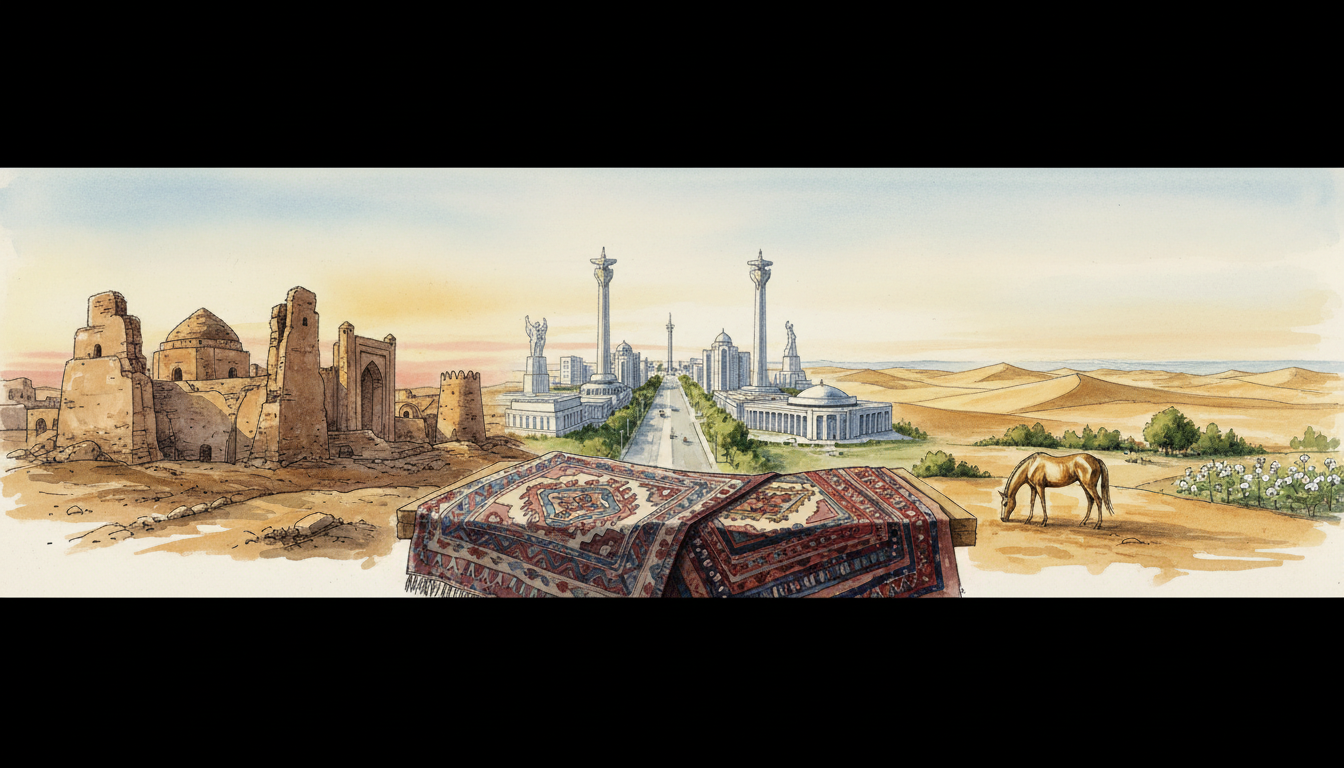
How does Turkmenistan work? Turkmenistan’s natural gas reserves, state-directed economy, five regions, Karakum Desert, irrigation infrastructure and Caspian transport routes shape how people work and access everyday services. The central question is how resource income becomes a sustainable public benefit.
This country guide is part of How Countries Work — the A–Z guide to 195 countries, with real-world examples and clear notes where independent data are limited.
Turkmenistan at a glance
Official name: Turkmenistan. Capital: Ashgabat. Region: Central Asia, bordered by the Caspian Sea, Kazakhstan, Uzbekistan, Afghanistan and Iran. Government: highly centralised presidential republic with a legislature called the Mejlis. Currency: Turkmen manat (TMT). Main systems: natural gas, state enterprises, agriculture, irrigation, road and rail trade, electricity, schools and public services.
Imagine a truck delivering greenhouse tomatoes across the desert to an overseas customer. The tomatoes need water, electricity, labour, refrigeration, a reliable road and permission to cross borders. The same basic links explain much of the country, even though the gas industry often dominates the headlines.
How does Turkmenistan work in one minute?
Turkmenistan is a landlocked Central Asian country with substantial natural gas resources and a largely state-directed economy. Revenues from energy exports help support public spending and investment. Agriculture, manufacturing, construction, retail and services also provide livelihoods.
One major challenge is using resource wealth to build a more varied, efficient and inclusive economy. A pipeline earns export revenue, but household wellbeing also depends on food prices, water access, skills, transport, public accountability and reliable services.
Who governs Turkmenistan?
Turkmenistan has a president, government ministries, a unicameral Mejlis and local administrative institutions. President Serdar Berdimuhamedow heads the state under a political system where power is highly concentrated. Political pluralism, independent media and access to public information are significantly restricted.
Do not assume that the existence of elections or a parliament means that opposition and scrutiny operate as in a competitive multi-party system. For analysis, distinguish what the constitution assigns to each institution from how independently it can act.
What is the role of the Mejlis?
The Mejlis is the national legislative body. It adopts laws and exercises the functions assigned by the constitutional framework. Public reporting about debates and oversight is not equivalent to broad, independent access to political information.
A useful way to study the system is to trace a policy from presidential or government announcement through the law, budget, responsible ministry and local delivery. Where independent information is incomplete, that limitation should be explicit rather than filled with invented detail.
How is Turkmenistan divided administratively?
Turkmenistan has five regions, known as welayats: Ahal, Balkan, Daşoguz, Lebap and Mary. Ashgabat has a separate capital-city administrative position, and Arkadag is also a planned and developed city with distinct administrative arrangements.
Regions have different economic profiles and distances from markets. A rural water network in Daşoguz faces different challenges from an urban service in Ashgabat or a logistics route on the Caspian coast. National promises must be measured by local performance.
Why is Turkmenistan so important for natural gas?
Turkmenistan has some of the world’s largest natural gas reserves and is a significant exporter. Gas production connects geology, drilling, processing plants, pipelines, equipment maintenance, contracts and foreign customers. Energy exports are a major source of income and foreign exchange.
But reserves underground are not the same as revenue received this year. Production costs, available pipeline capacity, export prices, contracts, maintenance and market demand determine actual earnings. A new pipeline proposal is not proof that the gas has already reached consumers.
Where does Turkmenistan export its gas?
Gas exports have been closely linked to pipeline routes and regional customers, including China. Reliance on a limited group of destinations can create vulnerability if demand or commercial terms change. Building alternative routes involves financing, coordination, engineering and political decisions.
A simple classroom example is a supplier with one main buyer. Even when the product is valuable, the supplier may face limited bargaining options. Economic diversification and transparent contractual management can help reduce some risks over time.
How do energy exports support the state budget?
Revenue from gas and other hydrocarbons can finance public spending, capital projects and state enterprises. But public investment must be evaluated by what it delivers, not solely by the size of construction budgets.
The World Bank notes that the economy remains strongly state-controlled and that transparency and fiscal management are major development issues. A capital project is more likely to help households when its operating costs, maintenance and performance are tracked openly.
Why is the private sector still important?
Entrepreneurs and smaller firms can provide services, food processing, trade and specialised employment outside the hydrocarbon sector. They need reliable banking, fair competition, clear rules, electricity, premises and accessible markets.
When state enterprises dominate key sectors, it can be hard for smaller firms to grow or for investment to flow to productive opportunities. A national diversification plan should therefore be judged by whether independent firms can actually hire, innovate and sell—not merely by the number of new business slogans.
What is the Karakum Desert?
The Karakum covers a large part of Turkmenistan’s territory. Its arid climate and geography shape transport, settlement, land use and water needs. Farming and cities rely on managed supplies rather than abundant rainfall across the whole country.
Aridity does not mean an absence of economic activity, and not all areas are identical. The important question is which infrastructure can sustainably move and protect water without damaging the land and ecosystems on which future livelihoods depend.
Why is the Karakum Canal important?
The Karakum Canal and connected irrigation infrastructure are central to moving water into agricultural and settlement areas. They enable production and domestic uses, while also raising questions about losses, water efficiency and the consequences of intensive withdrawals in an arid region.
Modernisation may include repairing channels, improving measurement, reducing leakage and using more efficient irrigation. A project announcement is only the beginning; water saved and crop yields achieved must be measured against the costs and environmental effects.
How does Turkmenistan’s water problem affect neighbours?
Rivers and water systems cross Central Asian borders. Agricultural withdrawals and upstream or downstream decisions can influence other places. Climate change, heat and salinity create further pressures, especially where water-intensive farming has been practised for decades.
Water cooperation works when countries share evidence and manage demand transparently. A single canal’s capacity cannot tell us whether every community has safe drinking water or whether soil remains healthy.
Why does cotton still matter?
Cotton has been a significant agricultural crop, linking irrigation, labour, processing, textiles and exports. Other farming includes cereals, vegetables and fruit. Changing the mix of crops is not only a matter of selecting seeds; it may affect farmer incentives, water needs, machinery and buyers.
Crop income should be assessed alongside water use, working conditions and soil health. Excess irrigation and poor drainage can contribute to salinity, which reduces future productivity. Long-term prosperity depends on efficient resources rather than maximising one harvest at any cost.
Can Turkmenistan export fresh tomatoes?
Fresh vegetable production and greenhouse farming offer examples of non-hydrocarbon export activity. The World Bank notes growing non-energy exports including processed goods and vegetables, especially tomatoes in recent reporting.
A greenhouse can extend growing conditions but requires heating or cooling, water, packaging and delivery arrangements. Making a profitable export depends on quality, border procedures, refrigerated logistics and predictable payment.
How does the Caspian Sea help trade?
Turkmenistan is landlocked in the sense that it has no ocean coastline, but it borders the inland Caspian Sea. The Turkmenbashi port area supports ferry and maritime logistics within the Caspian region, connecting to routes through other countries.
An exporter still needs onward rail or road links and border documents after crossing the sea. Calling Turkmenistan ‘landlocked’ should not be misread as saying it has no port at all. The relevant distinction is lack of direct access to the world’s oceans.
Why are railways and border corridors important?
Railways and roads move fuel-related equipment, agricultural products, consumer goods and other freight. Routes can connect Turkmenistan with neighbouring countries and, through further networks, more distant markets.
Freight reliability requires interoperable procedures, customs clearance, safety, vehicle maintenance and usable schedules. A new railway segment may be impressive, but delays at a border can still make the entire route costly.
What currency does Turkmenistan use?
The national currency is the Turkmen manat (TMT). Currency arrangements, official prices and access to foreign exchange can be important to traders and households. Published exchange rates are not necessarily enough to describe all practical transaction conditions.
Responsible writing distinguishes official rates, inflation estimates, actual prices and market access without inventing unofficial figures. The World Bank and IMF both advise care about data coverage and transparency.
How do electricity and gas reach households?
Domestic energy resources can help supply electricity and gas, but production must be connected to properly maintained pipes, generating stations and distribution networks. Heat, distance and equipment condition affect reliability.
A resident does not consume the country’s abstract gas-reserve total. They need dependable power and safe fuel delivery. An industrial city also needs skilled maintenance staff and protective rules to prevent disruptions and accidents.
How do schools connect to a diversified economy?
Schools and training institutions provide foundational learning and professional skills. Engineers and technicians can work in energy, while agriculture, logistics, healthcare and small businesses need other capabilities. Education is especially important if the economy is to become less reliant on one export commodity.
Independent information about learning outcomes and public institutions can be limited. Rather than making sweeping claims about every student, ask what reliable assessments show, whether training is accessible and how graduates enter useful work.
How does healthcare depend on water and transport?
Healthcare services require trained workers, medicine supply, safe water, infection control, electricity and patient transport. In rural or sparsely populated areas, travel distance can make access harder even if national health institutions exist.
A clinic supplied with new equipment may still struggle if spare parts are unavailable. The correct test is whether patients can receive timely, safe care over time, with available evidence about outcomes.
Worked example: a gas export payment becomes a school budget
Imagine an energy company selling natural gas overseas under a commercial contract. Revenue passes through company accounts, applicable taxes or state ownership channels and public financial arrangements. Government then proposes and spends a budget, while procurement teams build or maintain school facilities.
This is an illustrative mechanism, not a claim that a particular sale directly financed a particular classroom. It shows why export receipts, budget allocations, actual spending and improved learning are separate stages that require transparent evidence.
Worked example: a tomato reaches an overseas supermarket
Imagine a greenhouse in Turkmenistan growing tomatoes for an export buyer. Workers need water and energy, the business needs packaging and quality checks, and a truck must arrive at the border in time to preserve freshness. Any delay can reduce earnings.
This makes irrigation modernisation, reliable roads and practical trade rules part of one explanation. Non-oil exports can grow while still requiring careful water use and transparent financial conditions.
What do independent sources say about Turkmenistan’s data?
Reliable analysis uses source-dated information and explains its limits. The World Bank has highlighted the importance of stronger public data and fiscal transparency, while the IMF’s June 2026 mission distinguished its own growth estimates from official figures.
Readers should not average incompatible estimates or pretend every number is independently verified. Ask what was measured, who collected it, for which period, and whether independent checks were possible.
Frequently asked questions about Turkmenistan
What is Turkmenistan’s capital? Ashgabat.
Is it landlocked? Yes, without an ocean coast, although it has a Caspian Sea shoreline and port facilities.
What is its most important export? Natural gas is a major export and public-revenue source.
What currency is used? The Turkmen manat.
How many regions are there? Five welayats, alongside special city arrangements.
Who is president in October 2026? Serdar Berdimuhamedow.
Why is the Karakum Canal important? It supports water transport and irrigation but also raises water-efficiency concerns.
Does hydrocarbon wealth guarantee broad prosperity? No. Jobs, governance, services, diversification and environmental sustainability also matter.
Sources and further reading
See World Bank — Turkmenistan country overview and the IMF’s June 2026 mission statement for dated analysis of natural gas, agriculture, diversification and fiscal-data limitations.
Continue through How Countries Work A–Z, or compare this landlocked country’s transport with Tajikistan’s mountain and hydropower systems.