
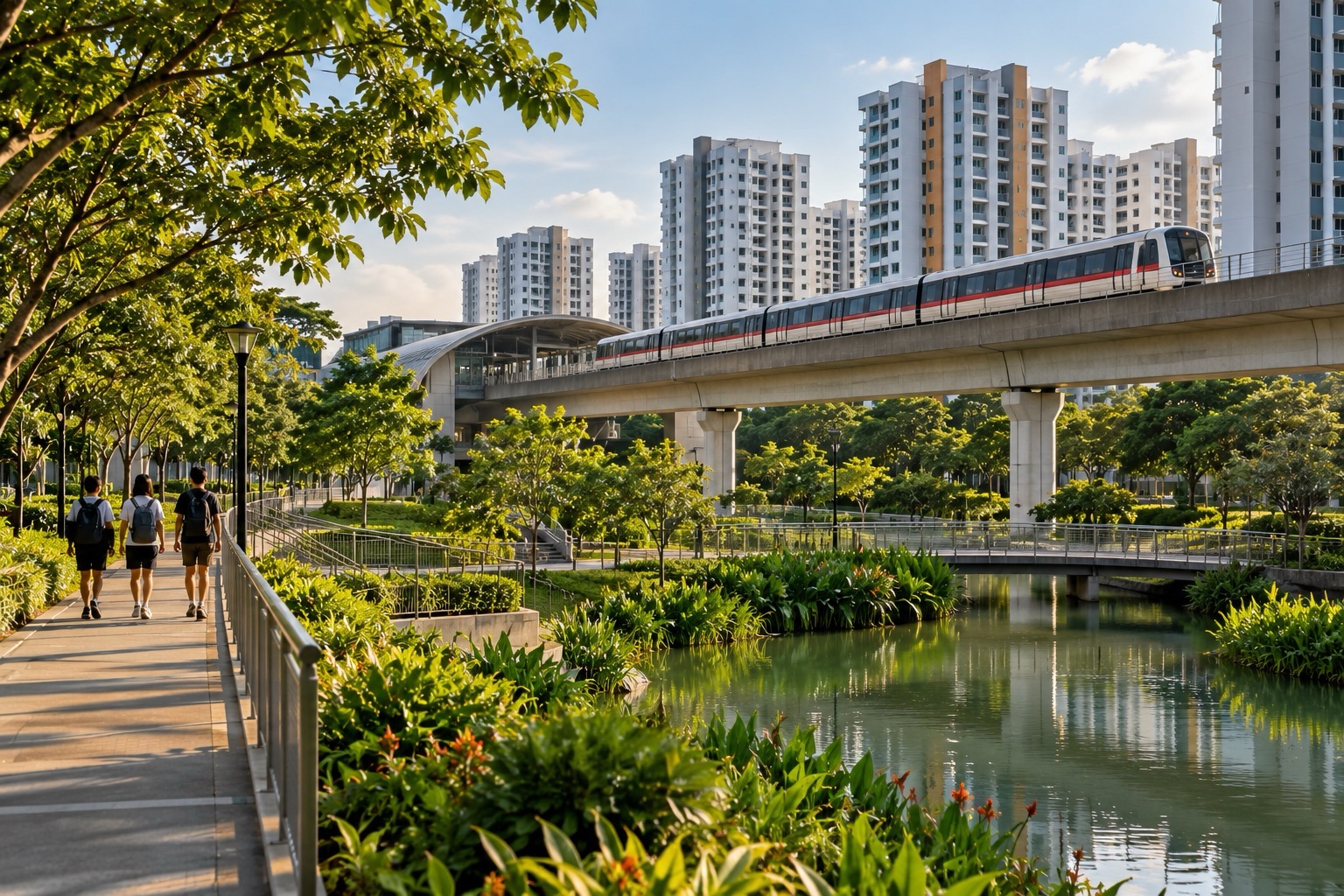
Did you know? Planting a tree is a one-day activity. Establishing an urban tree is a commitment that continues through changing weather, maintenance, construction and growing roots. That difference explains why good intentions sometimes produce disappointingly little shade.
Quick answer: Urban tree planting fails when species choice, root space, soil, drainage, watering, physical protection and maintenance ownership are treated as independent tasks. A programme can meet its planting-count target while failing to establish healthy trees that deliver lasting benefits.
This guide explains how urban tree planting fails through practical site decisions, fictional case studies and an establishment-first repair method. It draws on Singapore NParks/GardeningSG resources and Trees for Cities’ 2026 establishment guidance, separating general principles from any local watering schedule or regulatory requirement.
Choose your reading route
- Understand the whole planting chain — purpose, location, choice and aftercare
- Check the physical site — roots, soil, water and space
- Protect establishment — early care, mulch, maintenance and contractors
- Run a real diagnosis — a five-part review and care planning
- Quick questions — FAQs and sources
A planting ceremony is not the same as a living urban forest
Did you know a city can celebrate planting thousands of trees while quietly losing many of the youngest ones before they become useful shade? The ceremonial photograph records an activity completed on one particular day. Urban greening succeeds only if the planted tree is still healthy, safe and suitably located years later. A living tree has recurring needs that do not disappear when the volunteers go home. The difference between planting and establishment is the first distinction every project should explain.
Imagine a campaign that supplies saplings, publicity and a weekend workforce but no named person to inspect them during a dry spell. Its budget may look excellent when divided by the number of holes filled. Yet some saplings may never overcome damaged roots, poor drainage, lawnmower strikes or competition from nearby vegetation. This is not an argument against public planting. It is an argument for measuring the outcome people actually wanted: surviving, appropriate trees that contribute to a healthier neighbourhood.
The complete chain: purpose, site, plant, care, monitor, adapt
An effective planting programme begins by defining why a particular location needs trees. The aim could be shade on a pedestrian route, biodiversity, visual character, soil protection or a better outdoor learning environment. Next come site investigation, species choice, procurement, planting practice, establishment care, safety inspection and long-term management. Each stage is connected: a species that fits a nursery container may be entirely unsuitable beneath overhead wires or above buried utilities.
When the chain breaks, changing the next stage rarely fixes the earlier mistake. Extra watering cannot give an oversized root system adequate underground space indefinitely. More social media updates cannot restore roots damaged during construction. A good project therefore assigns an owner and a verifiable decision at each stage, then keeps the chain visible after planting. The first useful question is not “How many trees can we plant?” but “Which trees can this place support, and who will look after them?”
Why species selection must come before procurement
Urban trees differ in mature size, growth rate, rooting characteristics, habitat value, tolerance of local climate and suitability near roads or buildings. A tree may flourish in a nursery yet perform poorly in a tiny, compacted strip beside a hot carriageway. The species may also become hazardous or costly when it grows into overhead space that planners had forgotten to reserve. Buying whatever sapling is easiest to obtain reverses the correct decision order.
Choose species on site conditions and intended benefits, following local arboricultural guidance. Consider the above-ground canopy and below-ground root environment together, and investigate any known pest or disease risks. Native species can provide important ecological benefits, but “native” alone does not override a poor physical fit. The most defensible choice explains why the specific tree is suitable for the specific planting location. That evidence is more useful than the popularity of the species’ name.
The overlooked space beneath the pavement
An urban tree’s roots need a suitable environment for water, oxygen and growth. A narrow opening in an otherwise heavily compacted pedestrian pavement may admit the trunk but offer too little supportive rooting space. As the tree grows, conflicts may emerge with paving, drainage or adjacent structures. The resulting cycle can involve repeated repairs, aggressive interventions and declining tree health, none of which was visible in the planting-day photograph.
Site design should consider soil condition, root volume, drainage, compaction and underground services before the planting pit is approved. Appropriate engineering solutions depend on the site and should be designed by qualified people where necessary. The repair is not to promise that all roots will remain motionless or that every tree can be planted in any pavement. It is to make enough suitable space available, choose the tree appropriately and plan how both pedestrians and plants will remain supported.
Overhead space is part of the same calculation
Street trees often share a corridor with road signs, building façades, lighting, communications lines and utility infrastructure. A young sapling can seem comfortably distant from every obstacle. Its mature canopy may tell a different story. When future size is ignored, managers may be forced into repeated pruning or replacement, reducing shade and sometimes harming the desired form of the tree.
Estimate mature growth and identify the space that must remain clear for safe travel, lighting and essential services. Where a location cannot support a large canopy, a smaller appropriate species or a different site may be a more successful choice. Poor urban greening sometimes begins with the admirable wish to plant a large tree everywhere. Better planning recognises that the long-lived benefits depend on giving the right organism an environment it can occupy safely.
Soil compaction makes a planting pit misleading
A hole filled with loose soil can give the impression that the rooting environment is good. But if the surrounding ground is hard and compacted, roots may encounter a difficult boundary soon after leaving the original pit. Urban construction traffic, repeated foot traffic and poorly handled site preparation can affect soil structure. Water infiltration and aeration then differ substantially from the conditions the tree experienced before planting.
Ask whether soil investigation considered the area beyond the visible hole. Compare the planting plan with pedestrian routes, construction history and expected future pressure. Qualified landscape and arboricultural teams may need to improve the growing environment rather than simply making the initial hole deeper. A neat pit is a construction detail; an adequate rooting environment is a living requirement. Confusing the two can create a delayed failure that becomes expensive only after the project has been declared finished.
Drainage problems can defeat both good rainfall and good intentions
Trees need water, but they also need appropriate drainage and aeration. An unsuitable location can hold water around roots for too long, while another site sheds rain rapidly and dries between showers. A planting crew may assume that tropical rainfall makes all supplemental care unnecessary. The opposite assumption—that more water always helps—is no more reliable. Conditions must be assessed rather than guessed from the city’s average weather.
Inspect how water actually behaves at the site, including after rain and during a dry period. Look for persistent waterlogging, runoff concentration, blocked drainage or unexpectedly fast drying. Establishment plans should be responsive to observed conditions and the species involved. A single generic watering rule should not be copied across different soil types, climates and sites without explanation. The success condition is appropriate moisture and root function, not the largest possible volume of water applied.
Why the first growing seasons are different
Recently transplanted trees may have a limited effective root system compared with established trees. They need time to develop roots into their new environment and adjust to the particular combination of sun, wind, soil and drainage. Trees for Cities describes ongoing establishment care including watering, mulching, weeding and health monitoring, with its own UK programme extending through several growing seasons. That example shows the importance of planning aftercare, not a Singapore-wide watering schedule.
The exact maintenance frequency must reflect local rainfall, species, planting stock and site condition. The general lesson remains clear: do not transfer a tree from the nursery and then act as though it has the resilience of a mature specimen. A project budget should include inspection and responsive care after the ribbon-cutting event. Without that continuity, a low-cost planting programme may become an expensive replacement programme.
Watering is a decision, not a box to tick
A landscape worker can record that watering occurred without knowing whether moisture reached the relevant root zone. Water may run off compacted ground, collect unevenly, or be applied after the site is already wet. During hot, dry conditions a recently planted tree can need additional attention. However, excess watering or poor drainage can cause a different problem. Frequency alone does not describe adequacy.
Define responsibility for assessing conditions, applying appropriate water and checking the response. Inspection should consider the tree’s condition and the growing environment, with specialist advice where signs are uncertain. Avoid presenting an arbitrary number of litres or a universal weekly calendar as professional guidance for every urban tree. A useful aftercare record asks why the watering was appropriate and whether the tree is establishing, not simply whether a tap was opened.
Mulch helps only when it is applied appropriately
Mulching can reduce moisture loss, moderate soil-surface conditions and limit competition from some weeds. It may also protect the rooting area from certain maintenance activities. But the material, placement and ongoing maintenance matter. A poorly applied pile touching the trunk can conceal problems, while a thin, displaced layer may offer little continuing value. An attractive brown circle is not proof of correct mulching practice.
NParks and GardeningSG resources discuss mulching and sensible plant care in Singapore conditions. Operators should follow context-appropriate guidance rather than import every overseas dimension without checking. Monitor whether mulch remains effective, whether surrounding weeds are competing and whether the trunk base can be inspected. Establishment care is about maintaining suitable conditions, not repeating decorative installation steps every time a visitor is expected.
Weeds and grass can compete with a young tree
When a sapling is surrounded by vigorous ground vegetation, its limited developing roots may compete for water and nutrients. That competition can matter particularly during establishment and dry weather. At the same time, removing vegetation carelessly can disturb roots or leave exposed soil vulnerable to other problems. The solution is thoughtful management, not declaring all nearby plants enemies.
Decide what groundcover, mulch or vegetation pattern is suitable for the site and inspect it over time. Train maintenance workers to recognise the protected root zone and any planting specifications. If weed removal is outsourced, verify that staff understand which seedlings are intended to stay and where equipment should not be used. The quiet failure occurs when planting staff and grounds-maintenance staff have never shared a plan.
Lawnmowers and trimmers can undo months of growth
A sapling can survive the first transplant successfully and then suffer repeated mechanical damage from mowers or string trimmers working too close to the trunk. Wounds may be small but recurring. The landscaping contractor may be evaluated on a neatly cut verge without anyone reviewing the tree’s condition. Two separate performance targets—the tidy grass edge and the growing sapling—have come into conflict.
Protect the immediate rooting and trunk zone through appropriate site design, clear maintenance instructions and practical staff training. Where tree protection is installed, ensure it does not itself damage the plant. Review how equipment approaches the planting area and what staff should do when a problem is spotted. The point is not to blame the person mowing a verge; it is to stop organising maintenance in a way that repeatedly damages something the organisation paid to establish.
Stakes and ties can become long-term problems
Some newly planted trees need temporary support under specified conditions. The support should not be an unexamined permanent fixture. Poorly positioned ties may rub or constrict a growing stem, and loose or damaged supports may fail to serve their original purpose. A support arrangement that was useful at installation can become unsuitable as the tree develops.
A responsible maintenance plan records why support was used and when it should be reviewed or removed according to competent guidance. The exact specification depends on stock size, exposure and local planting practice. Inspect ties and supports during establishment visits rather than treating them as immutable parts of the tree. The broader lesson is that temporary controls need a lifecycle: installation, inspection, adjustment and deliberate removal when appropriate.
Poor planting stock carries hidden disadvantages
Two saplings with similar heights may differ in root development, health, defects and suitability for transplant. A procurement decision based only on unit price or visible foliage can select stock that struggles later. Stressed material may look acceptable on a delivery truck but perform poorly after planting, leading to repeated mortality that no amount of publicity can conceal.
Use suitable nursery-quality criteria, delivery checks and records appropriate to the species and project. Inspect for issues rather than assuming that a label guarantees quality. Rejecting unsuitable stock before planting may feel slower, but it prevents scarce maintenance resources from being used to rescue avoidable failures. The project should distinguish contractor delivery performance from biological establishment performance, because both are necessary to achieve the original goal.
Planting depth matters more than a dramatic ceremony
A planting event often focuses on getting the sapling upright quickly. Yet the relationship between the root system and finished soil level can influence establishment, and disturbed or poorly prepared soil can settle. A tree that appears vertical and elegant immediately after installation may still have been planted incorrectly for its species and stock condition.
Use trained supervisors and an approved planting specification. Check the correct placement of the root collar or relevant root features with qualified guidance, rather than letting untrained volunteers improvise. Community participation remains valuable when preparation and quality assurance are handled responsibly. The photographic goal is not for every volunteer to finish a hole quickly; it is for each tree to begin life in an appropriate growing environment.
Roadside planting introduces special safety responsibilities
Roadside areas are not empty lawns. Buried utilities, traffic visibility, pedestrian clearances and other services may constrain the work. NParks roadside-gardening guidance explicitly reminds participants to consider underground electrical and gas infrastructure. A seemingly harmless act of digging can therefore have consequences beyond the immediate plant.
Planting organisers must obtain appropriate permissions and coordinate with the responsible authorities or land managers. Qualified personnel should address location and excavation risks, and volunteers should not be directed to dig around unknown services. This article offers systems thinking rather than instructions for street excavation. The safest successful programme recognises that landscaping, utility management and public movement share the same physical space.
One attractive species can create ecological narrowness
A streetscape planted almost entirely with a single species may look coordinated. Yet over-reliance on a narrow range of plants can concentrate vulnerability to particular pests, diseases or site changes. Urban ecological value also depends on the wider habitat, surrounding vegetation and the needs of wildlife, not simply the quantity of green canopy visible from a drone.
Diversity should be planned deliberately with suitable local ecological advice. That does not mean mixing species at random or claiming a universal formula. Consider ecological interactions, site suitability, maintenance capacity and the intended character of the place. A programme can meet a headline tree-count target and still fail to build a resilient, useful planting network. Quality of the urban forest matters alongside quantity.
Shade targets can be lost through poor placement
Trees are often planted partly to make walking routes more comfortable, especially in warm cities. But a tree placed too far from a pedestrian path, in an unsuitable orientation or beside a structure that will prevent healthy canopy development may offer less useful shade than expected. Counting its existence on a map says little about what people experience on a routine journey.
Define the human benefit before choosing the location. Examine where pedestrians wait, how sun exposure changes during the day and whether the location can safely support the intended canopy. Shade benefits emerge over time and depend on actual growth. Do not promise immediate comfort from a tiny newly planted sapling, and do not ignore the maintenance years required to reach a useful canopy.
Biodiversity claims need more than a label
An urban planting scheme may advertise that it supports biodiversity without explaining which plants and animals will benefit or how the planting connects to other habitats. A decorative tree can still have value, but broad claims about ecological recovery should be supported by the chosen species, site management and relevant evidence.
Consider native biodiversity, habitat connections, food resources, canopy structure and the effects of management, while recognising that outcomes vary by site. Where ecological performance matters, choose appropriate indicators and advice. Avoid promising that a specific number of trees automatically creates a functioning ecosystem. Urban biodiversity is a living network, not a single tree-count column in a funding report.
Construction can interrupt an otherwise sound plan
A tree may be planted successfully, then lose root space or suffer damage when a nearby path is widened, utilities are installed or a building is renovated. If development plans and tree records are held by separate teams, the later contractor may not know which planting areas need protection. The tree then appears to fail mysteriously after months of healthy growth.
Integrate tree inventories and protection requirements with future works planning. Ensure relevant contractors receive the necessary information and involve competent arboricultural personnel where needed. A low-cost meeting before construction can prevent expensive remedial work. The real system is not just the planting programme; it includes every later activity that shares the space where the tree is expected to survive.
Community volunteers need a clear handover
Volunteers may have enthusiasm, local knowledge and a strong interest in a green neighbourhood. They may also have limited availability, no authority over contractors and different levels of horticultural experience. Asking them to assume indefinite aftercare after a one-day event, without agreement or tools, risks turning a valuable community activity into an unsupported obligation.
Define who is responsible for watering, inspections, reporting and urgent professional assessment after the event. Volunteers can make a genuine contribution through agreed, safe roles, but the land manager must not leave essential maintenance in an informal gap. Write down who receives concerns and how decisions are made. Long-term stewardship depends on reliable relationships as much as on enthusiasm.
The budget failure hidden in a cheap unit price
A project proposal may compare saplings according to purchase and installation cost alone. That makes the least expensive initial option appear superior, even if it requires more replacement, inspection or later remediation. A tree that dies and is replanted repeatedly can consume funds without ever delivering the intended shade or habitat.
Evaluate the lifecycle of the decision: investigation, planting, establishment care, routine maintenance, risk assessment, possible replacement and impacts on nearby infrastructure. Avoid assigning imaginary savings or a universal replacement rate. A budget that provides for aftercare is not wasteful overhead; it is part of the cost of producing a living outcome. Procurement should recognise the difference between installing a tree and establishing one.
When contractor incentives measure planting instead of survival
A contractor may be paid for the number of saplings installed, while another organisation is later responsible for maintenance. Neither contract may reward successful establishment. If trees die, the first contract has already been closed and the second contractor may claim the stock was unsuitable from the beginning. This makes accountability difficult even when everyone technically fulfilled their assigned task.
Create clear specifications for acceptance, establishment inspections, defect reporting and responsibilities during any maintenance period. Verify outcomes with appropriate professional review rather than turning contracts into arbitrary survival guarantees for circumstances outside a supplier’s control. Good governance identifies controllable causes and repairs the handoff between project delivery and continuing care.
A perfect planting map can contain outdated information
Geographic records can show that a tree was planted at a precise point. They do not necessarily show whether it is alive, which species is actually present, whether it was replaced or who last inspected it. A beautiful digital map can become an archive of intentions rather than a record of living assets.
Keep essential records current: location, species or stock identity where appropriate, planting date, establishment status, relevant defects and follow-up actions. Use the information to plan care, not merely to decorate a public dashboard. If a tree is removed or replaced, document the change honestly. A trustworthy tree inventory distinguishes an installation event from the continued existence and health of the planting.
Survival is necessary but not the whole measure
A sapling that remains barely alive in poor conditions may not develop the crown or ecological value expected. Survival can also obscure substantial defects, recurring water stress or conflicts with surrounding infrastructure. A programme that measures only whether trunks remain standing may therefore overstate success.
Assessment should consider growth and health in context, site suitability, safety and progress toward intended benefits. Measurements must be selected by qualified practitioners for the setting; this article does not prescribe a universal canopy or survival threshold. Where performance is uncertain, describe the uncertainty. Reporting a living, struggling tree honestly helps managers decide whether to improve conditions, adapt care or reconsider the site.
Why tree health and public safety must be considered together
Urban trees provide many benefits but also occupy places used by pedestrians, cyclists and vehicles. Poorly maintained or unsuitable trees can create conflicts, and aggressive responses to perceived risk can also damage healthy trees or remove valuable canopy unnecessarily. A public programme should not present every tree as risk-free or every visible defect as a reason for removal.
Competent inspections and proportionate management are essential. When signs of structural or health problems arise, refer them to the responsible land manager and suitably qualified arboricultural professionals. The public can report an observable concern without attempting climbing, cutting or improvised diagnosis. Good urban forestry protects both people and the continuing benefits of trees.
Fictional case: the sapling beside a sun-baked walkway
Illustrative case: a new neighbourhood plants twenty small trees alongside a pedestrian corridor. The opening ceremony is well attended. The maintenance schedule assumes mature trees and does not include targeted establishment checks. During a hot dry period, several saplings decline while the nearby grass remains green because its irrigation pattern misses the tree root areas.
A better approach would identify an aftercare owner before planting, check the actual rooting conditions and revise watering when evidence warrants it. The case is fictional, not a report about any named Singapore project. Its lesson is general: the success of a tree is not secured by the enthusiasm of the people who planted it, and visually green surroundings do not prove the sapling receives appropriate care.
Fictional case: the tree chosen for a tiny island
Illustrative case: a shopping area orders a large-canopy tree for a small paved traffic island because its mature photographs look appealing. Years later, the tree must compete with paving, utilities and lighting requirements. The owner spends money resolving conflicts that could have been identified in the initial site assessment.
The corrective lesson is to define the available canopy and rooting environment before procurement. If the site cannot support the desired mature tree, change the planting choice or improve the location through appropriate design. Avoid treating later maintenance teams as the only source of failure. Some operational problems are decisions made years before the symptoms appear.
Fictional case: a volunteer programme without a caretaker
Illustrative case: a community group plants saplings as part of an environmental campaign. The land manager assumes volunteers will continue watering. The volunteers assume professional maintenance begins the following week. Months later, nobody can identify who was meant to inspect the planting. Some specimens fail and both groups feel unfairly blamed.
A written handover with simple responsibilities could have prevented the gap. Participants should know which tasks are safe for volunteers, which require professional expertise, who receives reports and what the establishment period involves. A tree-planting programme is a collaboration across time, not just a gathering at a location.
A five-part site diagnostic
Start by asking five questions. First, what benefit is this location supposed to deliver? Second, can the chosen species and its mature roots and canopy fit the site? Third, is the planting method professionally appropriate? Fourth, who will provide and verify establishment care? Fifth, what evidence will show that the tree is still progressing toward its purpose?
Use the answers to identify the weakest handoff rather than assuming every poor outcome has the same cause. A tree suffering from damaged roots needs a different response from one affected by repeated trimmer strikes or a blocked drainage arrangement. A practical diagnosis should end with an owner, an action and a date for review. That turns environmental ambition into a service that can actually be managed.
A first-year care calendar must adapt to local conditions
A calendar can schedule initial checks after planting, then repeated assessments of moisture, health, supports, mulch, weeds and damage. The frequency should vary as conditions change, especially during unusual weather. The actual schedule must come from the site manager’s competent guidance, not an imported example treated as a mandatory rule.
Trees for Cities publishes an establishment programme for its UK operations, but its seasonal watering intervals should not be applied mechanically in equatorial Singapore. Use such examples to understand the principle of continuing aftercare, then develop a local plan around rainfall, exposure, soil and planting stock. A schedule is a reminder to inspect and decide, not a substitute for judgement about living plants.
What a four-week management review can achieve
Week one: inspect the site and compare the original planting objectives with actual space and condition. Week two: identify urgent maintenance gaps and clarify the responsibilities of contractors, volunteers and landowners. Week three: check records, accessible reporting routes and the budget for recurring work. Week four: agree on actions, inspect the first repairs and establish longer-term review points.
This is a suggested administrative sequence, not a promise that an unhealthy tree can be rescued in four weeks. Biological recovery can be slower, and serious safety matters need competent immediate attention. A good review makes it clear what changed in the management system and who will check again. The results should include both successful plantings and unresolved concerns, because silence is not the same as recovery.
How residents can help without harming the trees
Residents are often the first to notice a damaged stake, repeated construction impact or a young tree in visibly poor condition. Their observations are valuable, especially when maintenance teams cannot be present at every location. But residents should not assume they can safely prune, dig around roots, apply unknown fertilisers or alter public-land plantings.
Report specific observations through the relevant land manager or public feedback channel, including a safe-to-obtain location and description. Avoid entering work areas or sharing unnecessary personal details. Community interest can support stewardship through approved activities and conversations about what the planting is meant to achieve. The most helpful contribution is an accurate report connected to appropriate professional action.
What schools and tutors can teach through tree establishment
A small sapling offers a vivid example of systems thinking. Students can ask how soil, water, light, biology, maintenance budgets and public space interact over time. Mathematics lessons might compare planting counts with later inspections, while English lessons examine whether the statement “one hundred trees planted” proves that a programme improved neighbourhood shade.
Use photos, public information and supervised observations rather than asking children to excavate public plantings. Teach learners to distinguish an activity indicator from an outcome, and a correlation from a causal explanation. A good project ends with an honest uncertainty: what would we need to check next year to know whether the trees actually established? That question is more powerful than a competition to fill the most holes.
How to report the outcome honestly
A credible public update names the period covered and distinguishes trees planted, trees still present, trees assessed as establishing adequately, those needing intervention and any replaced or removed specimens. It also explains what the programme has learned about site suitability and care. Where records are incomplete, state that openly rather than publishing a false precise survival percentage.
Do not compare programmes based solely on a single numerator while ignoring species, weather, age and exposure. A newly planted roadside project and an established park planting may have different needs and risk profiles. What matters is whether the programme records meaningful results, responds to weak performance and uses evidence to make the next decisions better.
The final principle: protect the years after the photo
Urban greening fails when the public story ends at installation but the biology has only begun. A sapling does not know that the funding cycle is closed, the sponsor has left or the event has been celebrated. It continues needing suitable space, appropriate moisture, sound maintenance and people capable of responding to change.
Success is a tree that belongs in its location and is supported as it grows into the benefits promised. The most valuable green infrastructure is not the tree that looked impressive on planting day. It is the one that remains healthy and useful for the people, wildlife and neighbourhood years afterwards. Make the establishment plan part of the planting plan, or the two will never truly be the same project.
Frequently asked questions
Why do newly planted urban trees sometimes die?
Possible causes include unsuitable growing conditions, transplant stress, insufficient or excessive moisture, compacted soil, physical damage and inadequate establishment care. Actual diagnosis requires inspection rather than a guess based on the tree’s appearance alone.
Is watering the only aftercare young trees need?
No. Appropriate moisture is important, but establishment may also involve checking mulch, weeds, supports, soil and signs of damage. Work should suit the species, local conditions and competent professional guidance.
Should every Singapore sapling follow a three-year watering schedule?
No universal interval should be inferred from an overseas programme. The UK organisation Trees for Cities describes its own establishment approach; Singapore maintenance should respond to actual rainfall, soil, species and site conditions.
Why is tree survival not enough to prove success?
A surviving specimen may still be struggling or unable to deliver the intended canopy and environmental benefits. Evaluate health, growth, suitability, safety and progress toward the original purpose.
Can residents prune a tree that looks unhealthy?
Do not attempt unauthorised cutting or unsafe work on public trees. Report the condition to the relevant land manager and seek qualified arboricultural assessment where appropriate.
What is the most important budget line after planting?
There is no one universal line, but genuine establishment care and monitoring must not be omitted. Adequate site preparation, appropriate stock and clear responsibility for follow-up are also essential.
How can a school evaluate a planting initiative fairly?
Record the original goal, site constraints, planting dates, appropriate follow-up observations and unresolved problems. Teach students the difference between counting activities and measuring sustained outcomes.
Evidence and further reading
- Trees for Cities (2026): Tree Establishment — Helping Urban Trees Thrive — examples of mulch, watering, weeding and monitoring after planting
- GardeningSG/NParks: Housekeeping (updated 2026) — upkeep, local conditions and recurring plant care
- NParks: Caring for Plants — local guidance for plant needs and maintenance
- The Gold Standard of Urban Tree Establishment Care — service and verification perspective
- The Gold Standard of Urban Tree Planting Site Selection — site-first decisions
- Why Public Parks Fail | Access, Maintenance and Urban Nature
- Why Heatwave Protection Plans Fail | Alerts, Exposure and Cooling Access
- How Community Gardens Stall | When Volunteer Energy Cannot Sustain Maintenance
- How X Works — related explanations
- Secondary 1 Mathematics Tutor Clementi | Small Groups Tutorials — unchanged teaching standard
Evidence boundary: The examples are educational and fictional. Site requirements depend on species, setting, qualified professional evaluation and local authority. UK establishment schedules are described as examples, not transplanted as Singapore regulations. Seek expert arboricultural advice for tree health, structural concerns or works around buried services.