
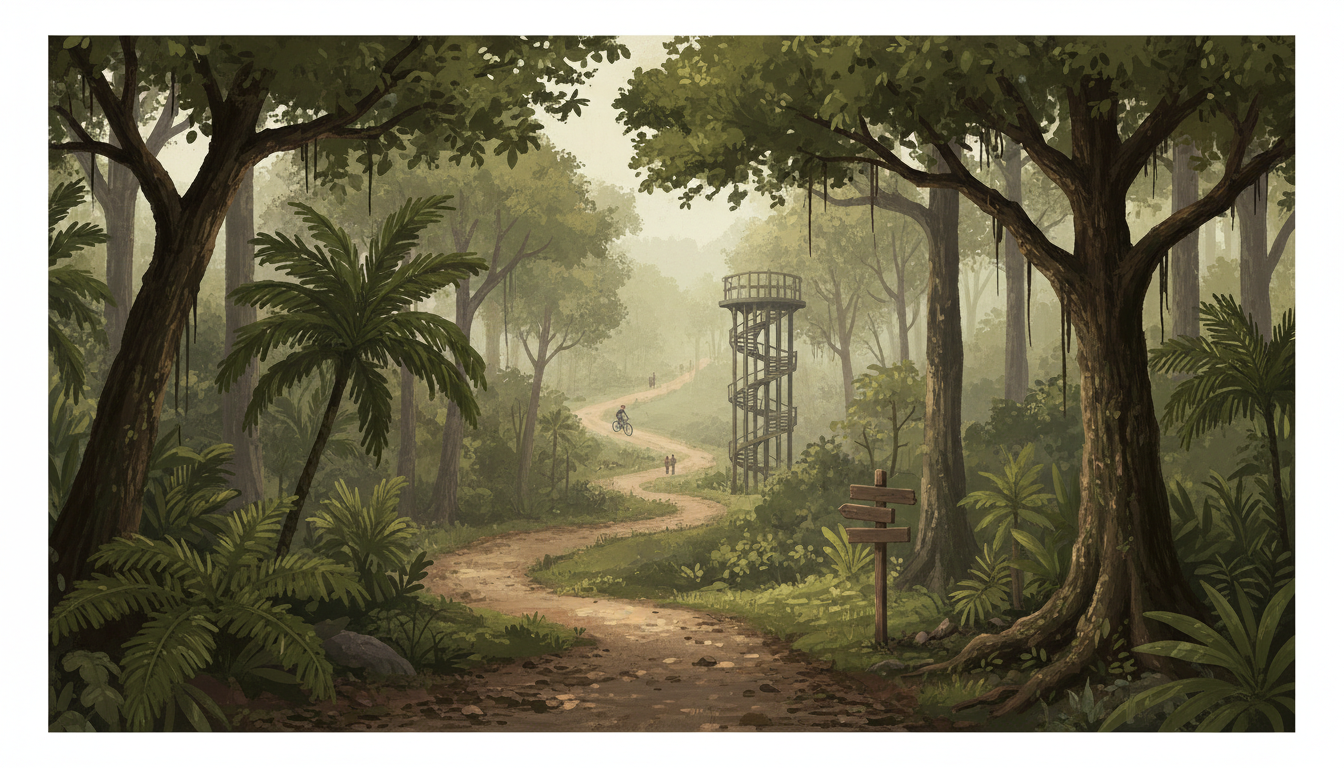
Did you know? A neighbourhood can have a beautiful park on a city map that many residents cannot reach safely. Green land is an asset; usable and welcoming green space is a public service.
Quick answer: Public parks fail when poor access, inadequate maintenance, unsafe routes, missing shade or misunderstood ecological needs prevent people and communities from benefiting. The reasons can often be repaired when the right failure is identified.
This guide explains parks as connected urban systems and uses WHO’s January 2026 children’s public-space guidance, UN-Habitat principles and Singapore’s NParks resources. It separates documented principles from fictional examples.
The chain: land → safe routes → inclusive design → nature and comfort → maintained facilities → daily use → feedback and improvement.
Choose your reading route
- 1. What does it mean when a public park fails?
- 2. The full chain from green land to public benefit
- 3. Land area is not the same as practical access
- 4. A map can hide the dangerous crossing
- 5. Why children need more than an equipment catalogue
- 6. The hidden cost of too little shade
- 7. Trees require care beyond planting ceremonies
- 8. Why a tidy park is not always ecologically healthy
- 9. Maintenance backlogs can erase accessibility
- 10. Paths and boardwalks need different kinds of care
- 11. Toilets and water points are access features
- 12. A park can feel unsafe without having high crime
- 13. Why universal access requires real users
- 14. Overcrowding is a design and operations question
- 15. Cyclists, walkers and runners share space differently
- 16. Biodiversity requires connectivity, not just patches of green
- 17. Flooding can be a symptom of the wider catchment
- 18. Why facilities must be maintained through their full life
- 19. Events can help parks but also displace routine users
- 20. How public trust erodes after unclear closures
- 21. Why the neighbourhood’s voice matters
- 22. A park’s green area can increase while access falls
- 23. Fictional case: the park across the six-lane road
- 24. Fictional case: the playground that aged quickly
- 25. What a useful park scorecard includes
- 26. A practical repair plan for failing public parks
- 27. Five questions when a park is called a failure
- Frequently asked questions
- Primary sources and further reading
What does it mean when a public park fails?
Did you know? A city can report plenty of public green space, yet a child in one neighbourhood may have no safe route to a usable playground. The park exists on the map, but not as a practical place in that child’s life.,Quick answer: Public parks fail when land, access, safety, maintenance, ecology and community needs do not combine into welcoming, dependable public spaces. A park can fall short because it is difficult to reach, poorly maintained, inaccessible, uncomfortably hot or designed without understanding its users.,One flooded path or a temporary maintenance closure is not proof that the whole park system has collapsed. Diagnose which benefit failed, for whom and over what period.
The full chain from green land to public benefit
A public park works through land and planning → neighbourhood access → safe design → shade and ecology → amenities → reliable upkeep → inclusive use → feedback and improvement.,A large field without shade may deter midday users. A beautiful landscaped garden may be inaccessible to a person with limited mobility. A neighbourhood path may stop at a dangerous crossing, making an otherwise excellent park hard for children to reach.,The important question is not whether the city bought land or planted trees; it is whether the intended public can actually use and benefit from the space.
Land area is not the same as practical access
Two cities might report similar park area per resident yet distribute it differently. One has small parks within walking distance of homes; the other puts most green land far from dense neighbourhoods.,The WHO, UNICEF and UN-Habitat guide released in January 2026 reported that only 44% of urban residents worldwide lived near an open public space, falling to 30% in low- and middle-income countries. These are global estimates, not Singapore neighbourhood statistics.,Access planning should examine real walking routes, crossings, barriers and neighbourhood populations rather than assume that every home within a straight-line radius has an easy journey.
A map can hide the dangerous crossing
A park across a wide road may be very close by distance but difficult for young children, older residents or people using mobility aids to reach safely.,WHO’s 2026 public-spaces guidance emphasises safe routes, crossings, traffic calming and inclusive access. A park project should therefore be evaluated with the streets and paths around it.,Improving a crossing may be more valuable than adding one more activity feature behind an inaccessible entrance. The journey to the park is part of the park’s public purpose.
Why children need more than an equipment catalogue
A playground may be full of attractive structures but offer little age-appropriate space for exploration, imaginative play or varying capabilities. One design can privilege confident older children while giving toddlers and children with disabilities few useful options.,The SPACES framework released by WHO, UNICEF and UN-Habitat in 2026 highlights Safety, Play, Access, Child Health, Equity and Sustainability. These six principles connect children’s experience with wider urban design.,Good design includes active play, quiet activities, safe supervision possibilities and opportunities for different age groups. A new slide is not automatically a meaningful play improvement.
The hidden cost of too little shade
Shade influences whether residents can comfortably walk, sit, exercise and use outdoor spaces, particularly in hot climates. Trees, shelters and thoughtful orientation can help reduce heat exposure in selected areas.,WHO identifies inadequate green space and heat-island effects among urban-health challenges. A tree canopy should be evaluated for real locations and conditions rather than used as a promise that every park will be cool all day.,Plan shade where people wait, play and walk. Remember that young trees may take years to grow and that planting creates long-term maintenance responsibilities.
Trees require care beyond planting ceremonies
A newly planted tree creates potential future ecological and comfort benefits, but it also needs suitable growing conditions and appropriate maintenance. Soil space, watering, species selection, root conditions and surrounding development all influence performance.,A city that counts saplings planted without tracking their survival can overstate the enduring green-space benefit. Repeated replacement can become costly if the original site conditions are never corrected.,Tree programmes should measure survival, canopy development, ecological suitability and responsible maintenance over time—not simply opening-day photographs.
Why a tidy park is not always ecologically healthy
Some landscaped parks emphasise short grass and ornamental surfaces while providing little habitat complexity. Others support trees, wetlands, understory plants or natural areas that need different care.,Ecological management has to match the intended site. Not every less-mown area is neglect, and not every manicured surface is automatically harmful. Visitor safety, biodiversity and use patterns all matter.,Explain management choices to residents. A habitat restoration area can look unfamiliar while providing genuine ecological benefits, provided the plan is grounded and its risks are managed.
Maintenance backlogs can erase accessibility
Broken lighting, damaged paths, clogged drainage, faulty seating and unusable toilets can turn an initially popular park into a place people avoid. Minor defects accumulate when nobody owns their repair.,Routine inspection must lead to prioritised corrective work. An online form that accepts defect reports is useful, but performance depends on whether the responsible team verifies and resolves significant issues.,Track actual availability of amenities and repairs by severity and time. The number of complaints closed in software is not a reliable substitute for the condition of the park.
Paths and boardwalks need different kinds of care
An accessible paved path, a trail through a natural area and a wetland boardwalk face different wear, drainage and ecological constraints. Their safety and maintenance plans should reflect those differences.,A route can be open while certain segments remain difficult because of slope, surface, obstructions or poor wayfinding. Users should not have to discover a blocked exit at the far end of a long trail.,Publish clear and current notices, suitable alternatives and realistic accessibility information. Park paths should be treated as a network, not as isolated short segments.
Toilets and water points are access features
Facilities for drinking, hygiene and rest affect how long families, older visitors and people with health or mobility needs can comfortably use a park. An otherwise attractive space may be impractical without dependable basic amenities.,Facilities require staffing, cleaning, maintenance and accessible design where relevant. Their operating schedules should match the nature of public use and available resources.,Evaluate the park through complete visitor journeys. A beautifully designed entrance does not compensate for a critical facility that is habitually unusable.
A park can feel unsafe without having high crime
Poor lighting, isolated routes, unclear sight lines and confusing entrances can influence whether residents feel comfortable, especially when travelling alone or with children.,Perceived safety and recorded crime are not identical. Management should listen to concerns without labelling a community dangerous based on stereotypes. Environmental design, maintenance and appropriate community presence can improve usability.,Balance security with openness. Excessive barriers, hostile design or intrusive surveillance may make a public space less inclusive while doing little to address the actual risk.
Why universal access requires real users
Steps, narrow paths, uneven surfaces, inaccessible toilets and complicated information can exclude people with disabilities. Older visitors and families with prams may face related difficulties.,Universal design and accessible information should be considered from planning through maintenance. Not every protected nature trail can be altered in identical ways, but alternatives and clear descriptions help people make informed decisions.,Test paths with people who use mobility aids and with visitors who have different sensory needs. Compliance drawings alone do not describe the full experience.
Overcrowding is a design and operations question
A popular park can face congestion on narrow paths, shortages of seating or conflicts between activities. More visitors can be a success signal while revealing limitations in the original capacity plan.,Consider trail widths, alternative routes, maintenance, booking systems where appropriate and the distribution of nearby spaces. Different uses may need agreed zones or clear etiquette rather than blanket restrictions.,One busy weekend is not proof of persistent failure. Use evidence by day, hour and user group before changing a park’s design.
Cyclists, walkers and runners share space differently
Park connectors and shared paths can support active travel as well as recreation. Their users move at different speeds and need predictable interfaces at intersections and narrow points.,Clear wayfinding, considerate behaviour and suitable physical design can help. Where activities consistently conflict, authorities should examine the path width, sight lines, volume and user expectations.,A network is successful when it allows safe, usable movement—not when a map simply shows that two parks are connected by a coloured line.
Biodiversity requires connectivity, not just patches of green
Small habitat areas can provide valuable benefits, but isolation, fragmentation and unsuitable management can limit movement and ecological functioning for particular species.,Green corridors and ecologically considerate urban planning can connect selected habitats, but different organisms need different conditions. A pedestrian park connector is not automatically a wildlife corridor for every species.,Measure habitat condition and relevant ecological indicators alongside visitor counts. Public park planning can support recreation and nature without pretending they are always the same task.
Flooding can be a symptom of the wider catchment
A low-lying park may collect rainwater after heavy storms, especially where drainage, soil conditions and upstream development affect runoff. Some designed wetlands intentionally hold water as part of stormwater management.,Readers must distinguish a planned stormwater feature from an unsafe, unexpected inundation. Flood risk needs site-specific investigation, warning and appropriate closure procedures.,Park management should coordinate with drainage and urban planning bodies. Changing one path surface will not necessarily fix water arriving from a much larger catchment.
Why facilities must be maintained through their full life
Play equipment, decks, bridges, seating, fitness stations and lighting all deteriorate with use and exposure. The capital budget for installation is only the first part of the financial obligation.,UN-Habitat’s Global Public Space Programme includes management and maintenance frameworks, not just design and new construction. Sustainable operations are central to long-term public value.,A maintenance budget should match what was built, and authorities should plan replacements and closures honestly rather than leave unsafe assets in service.
Events can help parks but also displace routine users
Festivals, organised sport and public programmes can make parks lively community spaces. But repeated closures, noise or damaged surfaces can restrict people who depend on everyday access.,Balanced management considers the event’s benefits, environmental impacts, cleaning and restoration costs and fairness to regular visitors. Public spaces need not be event-free, but ordinary users should understand temporary changes.,Evaluate programmes by their stated purpose and effects, not by attendance alone. A large crowd does not establish that the wider park remained accessible.
How public trust erodes after unclear closures
Maintenance closures can be entirely responsible when a trail, bridge or tree requires urgent work. Problems emerge when notices are unavailable, dates are inaccurate or no alternative is explained.,Singapore’s NParks and Park Connector Network maintain official information about parks and current path notices. These information channels can help visitors plan around closures, subject to real-time changes.,Clear communication should state what is closed, why where appropriate, what route remains available and when an update is expected. Users may accept inconvenience more readily when they know the system is working.
Why the neighbourhood’s voice matters
Residents can describe when they visit, which entrances feel inaccessible, where lighting is weak and what kinds of spaces are missing. Different groups often need different things.,UN-Habitat’s public-space work emphasises participation, safety, inclusion and long-term management. Consultation should include people who rarely use the park because it is currently unsuitable for them.,Do not ask only current visitors. A park may seem successful to people already able to reach it while excluding families, older adults and disabled residents living nearby.
A park’s green area can increase while access falls
A city may designate new protected green land while closing previously accessible paths for redevelopment or while population growth increases demand in some neighbourhoods.,Area totals and access statistics answer different questions. Biodiversity protection may legitimately limit entry to sensitive sites; at the same time, people still need usable everyday green and recreational spaces.,Publish who can use each space, its purpose and the conditions of access. Claiming more square kilometres of green area is not sufficient evidence that recreation options improved for everyone.
Fictional case: the park across the six-lane road
Imagine fictional Maple District celebrating a new urban park. It includes an attractive lake, shaded seating and a modern playground. Yet the nearest families must cross a fast, multilane road with no convenient safe crossing.,Visitor counts are initially low. Rather than blaming residents for lack of interest, planners examine actual walking routes and improve safe access with the responsible road authority.,The park did not need more ornamental structures first. It needed a workable connection to the people it was designed to serve.
Fictional case: the playground that aged quickly
In fictional Riverside Green, a new play area opens to enthusiastic families. Within two years, surfacing wears unevenly, drainage clogs and damaged features remain out of service while staff process repetitive maintenance tickets.,The council introduces risk-based inspection, funded replacement planning and a public notice that explains available alternatives. It tracks verified repairs instead of merely counting service requests received.,This is a fictional case, not a report about any actual Singapore park.
What a useful park scorecard includes
Track safe walking access, condition of paths and amenities, shade and comfort, ecological outcomes, inclusive participation, maintenance resolution, incident reporting and realistic user satisfaction.,Compare population served and accessibility rather than rank every park by raw visits. Some natural areas serve conservation functions, while neighbourhood parks support frequent everyday recreation.,UN-Habitat’s 2025 Global Public Space Programme report connects public space with climate resilience, social inclusion and livelihoods. These are complementary outcomes that need appropriate measures, not a single decorative success score.
A practical repair plan for failing public parks
First examine who cannot reach or use the space. Second review route and on-site safety. Third identify critical maintenance and amenity problems. Fourth assess ecological health and growing conditions. Fifth coordinate drainage and access with neighbouring infrastructure. Sixth involve overlooked users. Seventh test whether improvements actually change use and wellbeing.,Prioritise severe safety risks and accessibility barriers. Longer-term projects can address canopy growth, habitat restoration and expansion, with clear objectives and funding.,A successful repair is not always another grand redevelopment. Sometimes reliable upkeep, a safe crossing and a little more shade make a larger difference.
Five questions when a park is called a failure
Is the issue location, public access, safety, maintenance, biodiversity or a temporary closure? Which group is affected? Over what time period? Are the problems supported by observations or official records? What action is within the responsible agency’s control?,Distinguish design shortcomings from deliberate conservation restrictions. A nature-sensitive area may require limited access without being badly managed.,The aim is parks that remain welcoming, safe and ecologically valuable—not a cityscape that looks green only from the air.
Frequently asked questions
Does more park land always mean better access?
No. Neighbourhood distribution, walking routes, crossings, operating conditions and the needs of users matter.
Can a temporary park closure be good management?
Yes. Safety or conservation maintenance may justify closures if they are handled and communicated responsibly.
Are children’s playgrounds and nature reserves evaluated alike?
No. Their primary uses and ecological objectives differ, though safety and informed access matter in both.
Does a high park visitor count prove success?
Not alone. It may hide poor accessibility, overcrowding or ecological stress.
Why should a city plan shade?
Comfort and heat conditions can affect whether people can use public parks safely and comfortably, particularly in hot settings.
What should residents do about broken paths or equipment?
Use the current official park management or maintenance reporting channel, especially for hazards that require urgent attention.
Are public park connectors only recreational?
No. They may support walking and cycling connections between neighbourhoods and green spaces, depending on the network.
Primary sources and further reading
International public-space frameworks are guidance, not a substitute for local safety rules. Singapore park and connector notices can change. Check the relevant official resource before relying on an access route.
- WHO, UNICEF and UN-Habitat — Child-Friendly Public Spaces Guidance, 21 January 2026
- UN-Habitat — Global Public Space Programme (programme overview)
- UN-Habitat — Global Public Space Programme Annual Report Published 2025
- WHO — Urban Health and Environmental Conditions
- Singapore NParks — Find a Park or Park Connector
- Singapore Park Connector Network — Current Notices
- Singapore Park Connector Network — Explore Connectors
Explore connected systems
- Why Cities Fail | Infrastructure, Housing and Public Services
- Why Waste Management Fails | Collection, Recycling and Pollution
- Why Transport Networks Fail | Congestion, Maintenance and Disruption
- Why Coastal Flood Defences Fail | Overtopping and Adaptation
Final thought: A public park succeeds when people can safely reach it, enjoy it and return tomorrow to a space that is still cared for—and when urban nature remains healthy enough to last.