
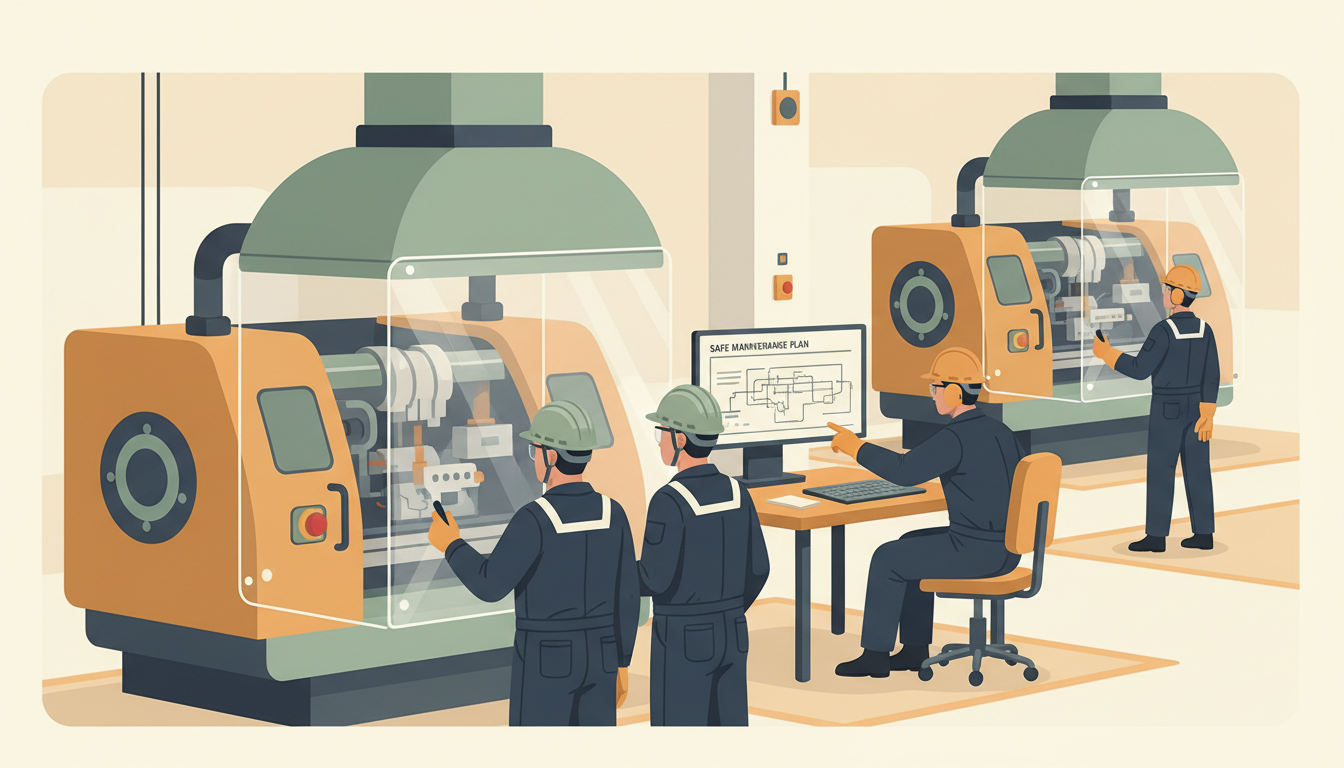
Did you know? A factory can have a safety poster at every entrance, completed risk-assessment forms in a folder and a daily meeting about safe work—yet still expose a worker to a serious hazard if the actual machine, procedure or site has not been made adequately safe.
That is how workplace safety fails. A signed checklist can provide useful evidence that someone considered a risk. It does not, on its own, physically remove the hazard, protect the worker or demonstrate that the chosen control is effective during real work.
One-minute answer: workplace safety breaks down when organisations confuse paperwork with control, overlook non-routine work, rely exclusively on warnings or personal protective equipment, do not check whether controls function, or ignore changes to equipment and people. A stronger process identifies hazards, evaluates risks, selects effective measures using the hierarchy of control, verifies those measures and revises the assessment when conditions change.
A completed safety form is not a controlled hazard
Imagine an industrial machine with moving parts. Workers attend a briefing that reminds everyone to keep clear of the danger area. A checklist shows that the briefing was delivered.
But suppose an accessible moving part still presents a foreseeable risk during the intended task. The warning is helpful information, not proof that the physical hazard was adequately controlled.
The relevant questions are more practical: Can the hazardous exposure be eliminated? Could the method or substance be substituted? Can a suitable engineered safeguard protect the worker? What further operating and protective measures are necessary?
Singapore’s Ministry of Manpower’s Workplace Safety and Health risk-management guide describes the three basic stages of risk assessment as hazard identification, risk evaluation and risk control. MOM says assessments should cover routine and non-routine work, including preparatory, troubleshooting, repair and maintenance tasks.
The purpose of these steps is to protect people in the real process, not simply produce a document that looks complete.
The seven points where workplace safety can break
- The hazard is not recognised: the work team evaluates an old process and overlooks a new machine, chemical, location or task.
- Non-routine work is ignored: cleaning, troubleshooting or maintenance creates exposures not present during ordinary operations.
- The wrong control is selected: warnings or PPE are used where a more reliable upstream control should have been considered.
- Responsibilities are unclear: the owner of a control, inspection or correction is not identified.
- Training is mistaken for competence: attendance at a briefing becomes a substitute for observing whether work can be performed safely.
- Controls are not verified: a guard, ventilation system or procedure is assumed effective without suitable checks.
- Changes are not reviewed: production demands, equipment changes or incidents alter the risks while the risk assessment remains unchanged.
These weaknesses often reinforce one another. A repair team enters a work area not covered by the ordinary assessment; a supervisor assumes the usual instruction is sufficient; the protective arrangement that matters to the new task has not been reviewed. The gap appears between approved paperwork and actual conditions.
What the hierarchy of control really means
A workplace has several ways to reduce exposure to a hazard. The hierarchy of control ranks approaches broadly according to their effectiveness and reliability.
The US National Institute for Occupational Safety and Health hierarchy and Singapore MOM upstream risk-control guidance describe the general order:
- Elimination: remove the hazard or the need for exposure where reasonably practicable.
- Substitution: replace a hazardous material, equipment arrangement or process with a suitable less hazardous alternative.
- Engineering controls: isolate people from a hazard through suitably designed physical or technical protections.
- Administrative controls: establish appropriate instructions, procedures, work schedules, supervision and training.
- Personal protective equipment: use correctly selected, maintained and fitted protection where appropriate.
These measures are not always mutually exclusive. Real tasks may require several controls together. The mistake is to jump straight to a poster, warning or pair of gloves without considering whether the hazardous exposure can be prevented more reliably at its source.
Singapore’s Workplace Safety and Health Council risk-assessment guidance recommends considering higher-level controls first, notes that several measures may need to work together, and cautions against starting work while risks remain high.
Why PPE is not a universal solution
Personal protective equipment can be necessary and effective for particular residual risks. But its actual protection depends on whether it is appropriate to the hazard, properly fitted, maintained and used consistently.
A safety helmet does not make an unsafe work-at-height system acceptable on its own. Respiratory protection is not automatically equivalent to eliminating or suitably containing an airborne exposure. Gloves selected for the wrong chemical may not perform as intended.
The correct combination requires competent assessment of the hazard and applicable requirements. A general educational article cannot choose protective equipment for a real site without examining the work.
The important question is whether the organisation has considered source reduction, engineering protections and other controls, not merely whether everyone is visibly wearing PPE.
A machine-guard example: the checklist is green, but the risk is real
Illustrative scenario, not an account of an actual workplace incident. A manufacturing plant reports that employees attended a safety briefing and completed a daily machine-condition checklist. During a production change, a different component is installed and the operating arrangement changes.
The briefing remains in the folder, but the team has not verified whether the existing physical controls remain suitable for the new setup.
A stronger management process stops and appropriately reassesses the changed condition through authorised competent personnel. It identifies the hazard, evaluates the revised task, selects suitable controls and confirms that the equipment can be operated safely under its applicable procedures before the work resumes.
It would be unsafe for an ordinary reader to experiment with guards, interlocks or live machinery based on a blog article. The educational point is that a change in the real system needs a change in the risk-management process.
Maintenance and troubleshooting are not ordinary operations
Equipment that is routinely operated from a protected position may require different safety procedures when maintenance personnel must investigate a fault or reach other areas.
This is why MOM explicitly requires attention to non-routine operations in risk assessments. The need for a repair does not remove the need to manage the new hazards it introduces.
Suppose a conveyor is stopped because of an unexpected fault. The safe way for authorised workers to investigate will depend on the equipment, applicable isolation procedures, relevant sources of energy and worksite controls.
The public should not improvise these procedures. Qualified staff must apply their approved safe-work instructions and legal requirements.
The general systems lesson is that maintenance is not simply ‘normal operation with a technician present.’ It deserves its own assessment where the risks differ.
Why a risk assessment must be understood by the people doing the work
A risk-assessment document can be technically detailed and still ineffective if its crucial controls are not communicated in a form the relevant workers can understand and apply.
Language, training, job roles, supervision and practical access to instructions may matter. Workers also need a legitimate way to raise a discrepancy when the actual task does not match the assessment.
The MOM risk-management guidance calls for a multidisciplinary risk-assessment team that includes relevant managers, supervisors and other employees familiar with the work. The aim is to include practical knowledge about actual operations.
A document written without hearing from people who perform the task may overlook hazards that are obvious during day-to-day work but invisible in a meeting room.
The difference between training attended and competence demonstrated
An organisation can accurately report that all workers received training. But did the instruction cover their actual task and equipment? Can the relevant worker identify when conditions have changed and what approved action they must take?
For some roles, competence may require formal certification or specialised training. For others, it may involve supervised demonstration and workplace-specific instruction.
The response depends on applicable WSH rules and the hazard. Merely ticking the attendance box cannot establish every required capability.
This is related to How Workplace Training Stalls | When Courses Do Not Become Skills. The same gap appears when a course has been completed but the learner has not yet demonstrated the intended work behaviour.
A safety meeting can become an empty ritual
A short toolbox briefing can be valuable when it covers real changes, current hazards and the work actually taking place. It is less valuable if people repeat a standard message while ignoring the day’s different conditions.
For example, a work area may have new contractors, unusual material deliveries or changed access. The briefing should not conceal those differences by repeating yesterday’s text unchanged.
A useful discussion connects the actual work plan to the applicable risk assessment. People need to know who to ask when instructions conflict and which authorised person may decide whether the activity can proceed.
The goal is clear, actionable safety communication. The number of meetings held is only an output measure.
What does ‘risk’ actually mean here?
Risk involves both the likelihood and consequence of a hazardous event under relevant conditions, with the exact assessment approach depending on the organisation and prescribed method.
A high-severity hazard deserves careful attention even if exposure seems infrequent. A common lower-severity event may also warrant substantial controls because it occurs repeatedly.
A risk-rating number can support prioritisation, but it should not become an excuse to ignore the actual mechanism or legal duties. A low score derived from unrealistic assumptions can be misleading.
Similarly, a completed risk register is not evidence that the controls were installed, maintained and effective.
The most useful questions are which hazard exists, who can be exposed, what effective measures are in place and how the organisation knows those measures work.
Incident-free days do not prove all risks are controlled
An organisation may go many days without a recorded injury. That is encouraging, but it does not guarantee every dangerous condition has been removed.
Some hazards have low event frequencies but serious possible consequences. Other problems may not be reported. A long interval without an accident can coexist with weaknesses that deserve correction.
Good WSH management therefore looks at proactive evidence: inspections, effective control measures, reported concerns, correction of defects and suitable supervision—not just the absence of injuries in an aggregate report.
This does not imply every near miss proves a coming disaster. It means that risk reduction requires observation of the system as well as its eventual outcomes.
Workplace culture is revealed when someone reports a concern
Imagine an employee notices that a procedure no longer matches the operating arrangement. If the employee fears punishment merely for raising a legitimate concern, the organisation may lose the information needed to prevent a harmful event.
A better culture provides appropriate routes to report concerns, ensures competent review and supports authorised action when work cannot proceed safely.
The report should be examined fairly. Not every concern will reveal a serious defect, but dismissing a credible observation solely because it inconveniences a production target is poor risk management.
Managers also need to address actual problems rather than celebrating the number of submitted reports without closing the loop.
The contractor handover problem
A worksite may involve an employer, a principal, vendors, maintenance contractors and temporary personnel. Each may know part of the process while assuming another party has reviewed a shared hazard.
A reliable arrangement clarifies who controls the area, who is permitted to perform the task, which risk assessments apply, and how changes and incidents are communicated across organisational boundaries.
This matters during non-routine jobs, where workers may be unfamiliar with the site or need to interact with equipment maintained by someone else.
Contractual paperwork and safety briefings should reflect real responsibilities. The need for coordination does not disappear because two separate companies have each completed their own forms.
When productivity pressure conflicts with a control
A supervisor may face a delayed order and ask for faster work. Productivity matters to employment and business survival, but the pressure must not undermine legally required safeguards.
If an appropriate control takes time to establish, the organisation must account for it in the plan. Bypassing the control because a schedule was unrealistic creates a new risk rather than repairing the schedule.
In some cases the correct response is to revise the method, resources or deadline through authorised decisions.
See How Project Management Breaks for the related failure of schedules that ignore critical dependencies.
A practical eight-question workplace safety review
1. What is the actual task? Include setup, routine operation, cleaning, troubleshooting, maintenance and other relevant work phases.
2. What hazards exist? Identify sources of harm using competent observations, equipment information and worker experience.
3. Who is exposed? Consider employees, contractors, visitors and other relevant persons.
4. Which controls are most effective? Examine elimination, substitution and engineering controls before relying on administrative measures and PPE.
5. Who owns each control? Identify authorised people responsible for implementation, inspections and correction.
6. How is effectiveness verified? Use suitable evidence from real conditions rather than assuming a signed checklist proves the measure works.
7. What changed? Review new equipment, tasks, personnel, materials, incidents and conditions that affect the assessment.
8. What happens when a control is inadequate? Clarify escalation, temporary protections and conditions under which authorised work must not proceed.
These questions explain safe management principles but do not authorise anyone to modify equipment, bypass isolation arrangements or perform hazardous tasks without competent oversight.
A student-friendly analogy: Science practical safety
A school science experiment may have written instructions and a checklist. But if the materials or setup change, students must not assume the old procedure remains safe merely because it is familiar.
The teacher or laboratory supervisor needs to assess the current activity and apply the approved precautions. Students should report discrepancies rather than improvising.
This illustrates an important lesson about systems: a plan describes conditions. When conditions change, the relevant risk and controls may need to be reassessed.
The analogy helps students understand why workplace safety involves critical thinking and responsible communication rather than just memorising safety slogans.
Five warning signs that a checklist has replaced actual safety
- Risk assessments have not been updated even though the work method or equipment has changed.
- Workers cannot explain the main hazards or the controls relevant to their own task.
- Posters and PPE are highlighted while more effective feasible upstream controls have not been properly considered.
- Repeated concerns are documented but remain unresolved without an accountable response.
- Safety performance is judged only by completed forms and periods without reported incidents.
These signs call for appropriate review, not a conclusion that a particular employer broke the law without evidence. Specific compliance questions require the relevant legal requirements and professional assessment.
Frequently asked questions
Are workplace safety checklists useless?
No. They can support consistent reviews, documentation and communication. The failure occurs when completing the form substitutes for identifying hazards and verifying effective controls.
What is Singapore’s three-step risk-assessment process?
MOM describes hazard identification, risk evaluation and risk control. These steps need to cover relevant routine and non-routine operations.
Why are engineering controls generally preferred to relying only on PPE?
An appropriately designed engineering control can reduce exposure at the source or isolate people from the hazard without depending as heavily on consistent individual behaviour. PPE remains important where needed for residual risks.
Does a safety course certificate prove a worker can do every job safely?
No. Training and competence must match the actual tasks and applicable legal or professional requirements, with suitable supervision where necessary.
Does a long accident-free period prove there are no hazards?
No. It provides information about recorded outcomes but cannot replace inspection, hazard assessment and verification of controls.
Should someone continue work if a serious risk remains inadequately controlled?
Singapore WSH Council guidance says work should not start while the risk remains high. Workers and supervisors should use the relevant approved escalation and safe-work procedures, rather than improvising.
The final idea
Workplace safety fails when the record of a control is mistaken for the control itself. A sound system identifies real hazards, chooses measures that genuinely reduce exposure, communicates clearly and checks how the safeguards perform after the paperwork is complete. The goal is people doing necessary work safely—not simply a folder full of green ticks.
Sources and further reading
- Singapore MOM: Risk Management and Risk Assessment
- Singapore WSH Council: Conducting Risk Assessments
- Singapore MOM: Adoption of Upstream Risk Controls
- US NIOSH: Hierarchy of Controls
- eduKateSG: The Gold Standard of Industrial Safety
- eduKateSG: How Manufacturing Stalls
Educational workplace-safety guide, not operational or legal advice for any particular worksite. Follow current Singapore WSH requirements and authorised competent professional directions.
Explore the next How Things Fail guides
- How Workplace Safety Fails | When Checklists Replace Hazard Control (current guide)
- How Digital Accessibility Fails | When Websites Exclude Real Users
- How Scam Prevention Fails | When Urgency Overrides Verification
- How Building Maintenance Stalls | When Small Defects Become Major Repairs
For further systems thinking, see How Manufacturing Stalls and How Public Policy Fails. Our unchanged Secondary 1 Mathematics Tutor Clementi | Small Groups Tutorials is an educational reference for distinguishing a completed activity from real ability.