
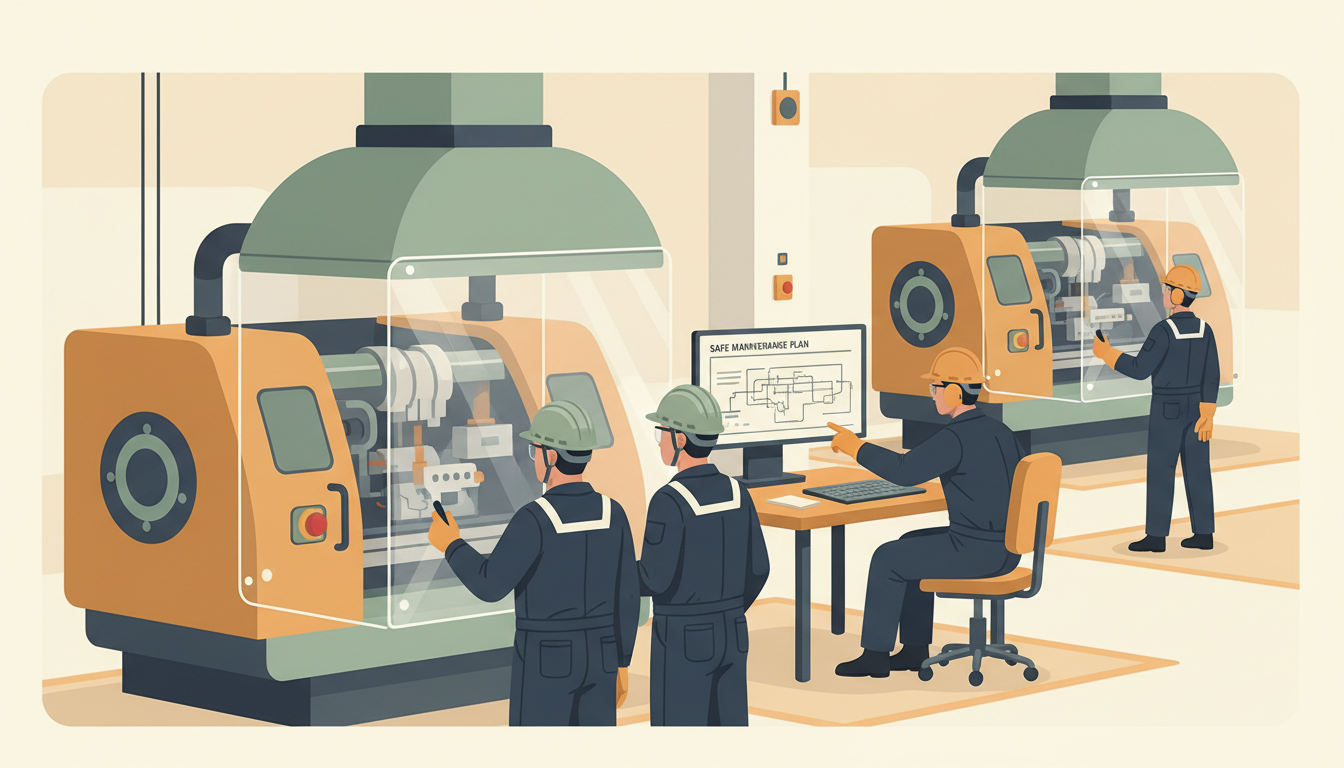
Industrial safety protects people by controlling hazards in the way work is designed, operated, maintained and changed. Its gold standard is an effective system of prevention—not a poster, a training count or an apparently accident-free period.
This guide explains the hierarchy of controls, risk assessment, workers’ observations and safety evidence through original fictional workplace comparisons. It focuses on safe reasoning and organisational decisions, not instructions for operating dangerous machinery.
Chapter index
Hazards, prevention and layers of controls · Chapters 1–9
- Safety is a property of work, not a poster
- Hazard and risk answer different questions
- Observe normal work and non-routine tasks
- The hierarchy of controls changes the starting question
- Elimination removes the source when feasible
- Substitution needs a second assessment
- Engineering controls separate people from hazards
- Administrative controls work through people and systems
- Personal protective equipment is a protective layer, not a cure
Measurement, workforce and changing operations · Chapters 10–18
- Worker participation improves hazard discovery
- A risk matrix is a conversation aid, not a scientific oracle
- Worked example: incident counts versus exposure hours
- Leading and lagging indicators tell different stories
- Design and commissioning must test controls
- Maintenance introduces distinct safety states
- Human factors and ergonomics deserve attention
- Guards, barriers and interlocks need ongoing integrity
- Contractors and shift handovers change the information available
Exposure, emergency systems and learning · Chapters 19–25
- Noise, dust and chemical exposures may be less visible
- Emergency arrangements must be more than a document
- Safety data should not punish the act of reporting
- Incident review should learn rather than invent certainty
- Changed-context transfer: the same task on a different shift
- Frequently asked questions and independent practice
- Continue through the relevant safety and engineering roots
1. Safety is a property of work, not a poster
Industrial safety concerns the prevention of injury, illness and harmful exposure during work involving equipment, substances, energy, people and changing environments. A workplace cannot demonstrate that it is safe simply by displaying a policy or reporting that no accident happened yesterday. It needs to identify credible hazards and control them in ways that work during ordinary tasks and foreseeable disruptions.
The central unit of analysis is the work as it is actually performed. A conveyor may operate normally during production but create different hazards when cleaning or maintenance occurs. A warehouse can have good traffic signs yet expose people to dangerous crossing movements if the physical layout forces pedestrians and vehicles together. The gold standard links observable controls to the actual situations where harm could occur.
The NIOSH hierarchy of controls sets out a widely used approach to reducing exposures. Safety is a continuous engineering and management responsibility, not a personal character judgement about whether workers are sufficiently careful.
2. Hazard and risk answer different questions
A hazard is a source or situation with the potential to cause harm, such as moving machinery, harmful noise, an unsuitable work surface or a hazardous substance. Risk concerns the possibility and consequences of harm in a particular exposure context. The presence of a hazard does not mean every worker experiences the same risk, and an apparently low incident count does not establish that the hazard has been removed.
Risk assessment requires a description of the task, who may be exposed, possible pathways of harm and existing controls. Some hazards are obvious to visitors, while others emerge from repeated exposure or unusual work conditions. A bright warning label may identify a hazard without changing the likelihood of contact.
A useful record distinguishes the condition observed from the uncertainty in its possible consequences. Where the assessment is consequential, qualified safety professionals and the applicable legal requirements must govern the work. The general Risk Management root adds methods for evaluating uncertain outcomes.
3. Observe normal work and non-routine tasks
Production tasks are only one part of an industrial process. Cleaning, maintenance, deliveries, fault diagnosis, shift handovers and emergency response can expose people to conditions not visible during a standard demonstration. A well-organised assessment asks how the system changes across these operating states rather than copying one checklist across all activities.
Workers and supervisors often know where workarounds occur, which controls are difficult to use and when time pressure changes behaviour. This knowledge should be gathered respectfully and checked against the physical system. A worker report may identify a problem that an incident register misses, but it does not remove the need for competent technical evaluation.
The OSHA guidance on hazard prevention and control recommends worker involvement, consultation with specialists and selection of effective controls. A good investigation avoids encouraging workers to experiment with dangerous equipment in order to prove a suspected fault.
4. The hierarchy of controls changes the starting question
NIOSH presents a preferred order for controlling hazards: elimination, substitution, engineering controls, administrative controls and personal protective equipment. Controls nearer the top generally prevent exposure more reliably because their success depends less on continuous individual action. This is a design priority, not a guarantee that one control alone solves every workplace problem.
Elimination asks whether the hazardous task or source is necessary at all. Substitution considers a less hazardous alternative. Engineering controls separate people from a source through the system’s design. Administrative controls change work practices and exposure time; personal protective equipment reduces exposure at the individual. Real workplaces may need several layers.
A poor response starts and ends with telling workers to be more vigilant. The NIOSH hierarchy of controls explains why personal protective equipment should not displace feasible higher-order controls. The appropriate solution still depends on the particular hazard, task and competent assessment.
5. Elimination removes the source when feasible
Elimination means changing the process so that the hazardous source or exposure pathway no longer exists in the intended work. It can be easier to achieve during design than after a factory is operating. A process that no longer requires manual movement through a vehicle route, for example, may remove an exposure rather than ask workers to cross carefully.
Removing one hazard can introduce a different task, so the redesigned process must be assessed as a whole. Eliminating manual handling through mechanisation might introduce maintenance, electrical or collision hazards. The claim should identify exactly which exposure has been removed and which new risks remain.
Good engineering decisions look at the complete lifecycle, including cleaning, servicing and eventual removal. An eliminated hazard is a stronger protection than a sign asking people to avoid it, but only when the new system has genuinely removed the relevant exposure.
6. Substitution needs a second assessment
Substitution replaces a hazardous material, process or piece of equipment with a less hazardous alternative. A lower-emission material or quieter equipment might reduce a particular exposure, but ‘safer’ is a comparative conclusion that requires evidence about the replacement’s own hazards.
An alternative can affect quality, compatibility, waste management, maintenance and other worker groups. A solvent replacement, for instance, should not be described as safe solely because it smells milder. Exposure routes and toxicological properties require reliable information and professional evaluation.
The NIOSH hierarchy of controls explicitly advises comparing potential new risks when substituting materials or processes. A defensible recommendation states what hazard is reduced, how the comparison was made and which safeguards remain necessary.
7. Engineering controls separate people from hazards
Engineering controls are physical or technical features intended to reduce or prevent exposure, such as correctly designed guards, suitable local ventilation or barriers that separate pedestrians from moving vehicles. Their advantage is that protection need not rely solely on every individual remembering a rule every moment.
The existence of a guard or extraction device does not prove it operates effectively. Controls must be selected, installed, maintained and evaluated under the actual work conditions by qualified personnel. A ventilation system that simply transfers contaminated air into another occupied area could create a new risk.
The OSHA guidance on hazard prevention and control and NIOSH describe engineering controls as important protection layers. This article addresses their purpose and evaluation principles, not instructions for constructing, bypassing or operating industrial safety equipment.
8. Administrative controls work through people and systems
Administrative controls include training, supervision, planned schedules, restricted access, job rotation and documented safe systems of work. They may be necessary but depend on attention, resources and implementation over time. A procedure that is technically correct but impossible to follow during peak production may provide weak real-world protection.
Training should match the actual tasks and worker needs. It must be supported by the equipment, time and authority needed to act safely. A manager who measures only training attendance cannot assume workers can recognise hazards or stop work appropriately when a condition changes.
Administrative controls can complement stronger engineering protection, but they should not become a substitute for eliminating hazards that can feasibly be removed. Worker feedback and observations are essential to testing whether a policy functions in practice.
9. Personal protective equipment is a protective layer, not a cure
Personal protective equipment may protect against certain residual hazards when it is correctly selected, fitted, used and maintained. Different hazards require different equipment, and an item appropriate for one task can be unsuitable for another. A safety notice showing a helmet cannot be treated as proof that all workplace risks are controlled.
Fit, wear, compatibility and limitations matter. PPE may not protect workers who do not have access to it or who must remove it to perform a task. Organisations need appropriate programmes, training and review under their governing standards. Some PPE can also make communication or movement more difficult if the selection is poor.
The NIOSH hierarchy of controls advises against relying on PPE alone when stronger control measures are feasible. The gold standard evaluates the whole layered safety arrangement, not the number of items a worker is wearing.
10. Worker participation improves hazard discovery
Workers often encounter conditions that designers and auditors do not see: blocked sight lines, unstable materials, difficult lifting motions or tasks carried out differently during breakdowns. Their observations can reveal hazards before they cause recorded injuries. A useful reporting culture encourages specific, non-punitive descriptions of conditions rather than slogans about being responsible.
An organisation should separate observations from blame. A report that a guard is difficult to use requires qualified evaluation of the system, not a demand that the employee prove the problem through a dangerous demonstration. Workers need credible routes for raising concerns and feedback on what changed after their report.
Participation should include contractors, temporary workers and less experienced employees whose exposure can differ. The OSHA guidance on hazard prevention and control identifies worker input as part of finding effective controls.
11. A risk matrix is a conversation aid, not a scientific oracle
Some workplaces use matrices that combine categories for likelihood and severity. They can help teams discuss priority, but their scores depend on subjective definitions and should not be treated as calibrated probabilities unless actual evidence supports that interpretation. Multiplying ordinal categories also does not create an objective measurement of expected harm.
Suppose a fictional team assigns likelihood category 3 and severity category 4, producing score 12. Another reviewer assigns likelihood 2 and the same severity 4, producing score 8. The change may reflect judgement rather than a change in the physical hazard. Both assessments need underlying observations and controls.
Critical hazards require action under relevant rules even if an arbitrary matrix yields a modest number. A qualitative risk rating should point to a decision and evidence review, not replace professional judgement or legal obligations.
12. Worked example: incident counts versus exposure hours
Imagine two fictional shifts. Shift A records three reportable incidents over 2,000 worker-hours; Shift B records two over 500 worker-hours. The raw count is greater on A, but the simple reported rates are 3 ÷ 2,000 × 1,000 = 1.5 per 1,000 hours and 2 ÷ 500 × 1,000 = 4 per 1,000 hours. The smaller count belongs to the higher rate.
The example does not prove Shift B is intrinsically less safe. The incidents may differ in severity; reporting practices, jobs and exposure conditions may differ. Small numbers fluctuate substantially and require caution in generalisation. Neither rate by itself measures all unreported hazards or longer-term exposure outcomes.
The gold-standard report states the incident definition, observation period, denominator and limits. Rates help compare differently sized exposures, but responsible decisions still require examining the underlying work.
| Shift | Incidents | Worker-hours | Reported incidents per 1,000 hours |
|---|---|---|---|
| A | 3 | 2,000 | 1.5 |
| B | 2 | 500 | 4 |
Rates do not measure every hazard or establish causation. These are fictional arithmetic examples.
13. Leading and lagging indicators tell different stories
Injury and illness records are lagging indicators of outcomes already reported. Other measures, such as timely control inspections, verified repairs or worker hazard reports, may help identify whether protective arrangements are functioning before a serious event. Yet a high number of inspections does not automatically show that hazards were removed.
Choose indicators linked to an actual safety mechanism. A count of completed training sessions is weaker than evidence that workers can carry out the intended task under safe conditions. Conversely, a rise in near-miss reporting may indicate better reporting culture rather than a deterioration in the underlying exposure rate.
Interpret indicators together and examine incentives. Organisations that punish reports may appear excellent under a low-incident metric while failing to learn about hazards. Good measurement supports prevention rather than appearances.
14. Design and commissioning must test controls
Safety decisions made before equipment is commissioned can prevent difficult retrofits later. Designers should consider access, maintenance, visibility, noise and foreseeable misuse alongside normal production. During commissioning, qualified teams test whether controls meet the required criteria under the intended conditions.
A design drawing is a hypothesis about future performance. Real operating conditions can reveal different movement patterns, workloads and environmental influences. Controls should be checked before reliance is placed on them and reviewed after significant process changes.
The Engineering and Manufacturing roots show how design decisions create operational consequences. This guide deliberately avoids procedures for testing hazardous machinery; such work must follow site-specific qualified safety systems.
15. Maintenance introduces distinct safety states
Maintenance can expose people to stored energy, moving parts, unexpected startup or other hazards different from normal operation. Effective prevention includes appropriate isolation, planning, qualified personnel and verification under the applicable rules. A general educational article cannot supply the correct step-by-step method for a particular installation.
Service planning should define who is authorised, what safeguards are needed and how workers communicate changes in equipment status. Contractors and operators may have different assumptions about whether equipment is available. The resulting mismatch can itself be a hazard.
The underlying lesson is a systems one: maintenance safety must be designed into equipment and management arrangements rather than improvised during an emergency. Refer to local legal requirements and competent procedures for real tasks.
16. Human factors and ergonomics deserve attention
Workplace design affects posture, reach, repetitive activity, fatigue, attention and coordination. A process that requires awkward force or sustained concentration beyond human limits can generate risk even when its written instructions are followed. Human factors are not excuses for poor performance; they are design considerations about how people actually interact with a system.
Assessments may consider workstation geometry, task variation, pace and the ability to recover from errors. Administrative reminders can help, but engineering changes to tools and material handling may reduce exposure more reliably. Introducing a new machine can also change tasks and create new demands.
NIOSH’s ergonomics programme guidance emphasises higher-order controls for reducing work-related musculoskeletal risk factors. Any assessment of health outcomes needs suitable specialist evidence.
17. Guards, barriers and interlocks need ongoing integrity
Physical safeguards can limit contact with hazardous movement or separate people from active equipment. Their effectiveness depends on design, installation, maintenance and the way tasks are performed. A device that is routinely defeated because the work cannot otherwise proceed should trigger system review, not merely another warning to staff.
Inspection should be carried out by authorised competent personnel using appropriate procedures. Improvised modifications can have unforeseen effects on protection. Employees should not test a suspected failure by exposing themselves to the hazard.
The main principle is prevention through design, with operating arrangements that make safe practice achievable. This article does not describe how to defeat, alter or build machine protection systems.
18. Contractors and shift handovers change the information available
A site can have strong internal training while visiting contractors lack the same knowledge of local hazards. Shift handovers can also fail when a task’s status, temporary restrictions or equipment condition is not communicated. Safety information must be accurate for the people who actually need it and consistent across responsible organisations.
A useful handover identifies unfinished work, controlled areas, changed conditions and the person responsible for updating the status. The necessary detail depends on the operation and must follow site-approved procedures. Long generic checklists are not substitutes for clear responsibility and verified understanding.
Organisations should review not only whether a form was signed but whether critical information reached the next worker or team. The Communication root reinforces the role of precise information in preventing errors.
19. Noise, dust and chemical exposures may be less visible
Some industrial hazards are obvious at a glance, but others involve airborne materials, sound levels or substances that require measurement to evaluate. The absence of immediate discomfort does not establish that an exposure is safe. Long-term health consequences may depend on intensity, duration, substance and individual circumstances.
Qualified hygienists or other competent specialists may need sampling plans, instruments and appropriate reference criteria. One measurement in one location may not represent the entire workforce or operating cycle. Results should be interpreted against the relevant exposure definition and uncertainty.
Controls may involve process changes, suitable containment, ventilation and other measures selected through the hierarchy. Do not infer exposure compliance from a simple smell, an uncalibrated consumer device or an unverified average.
20. Emergency arrangements must be more than a document
Industrial emergencies can involve injury, fire, loss of utilities or other disruptions. Preparation requires appropriate roles, safe communications, professional response arrangements and drills suited to the foreseeable situation. An emergency plan’s value depends on whether people can use it under actual conditions, including language and accessibility needs.
Drills can identify unclear responsibilities and routes, but they should not create real hazardous exposures simply to make the exercise dramatic. Review what participants could and could not do and correct the system rather than focusing solely on attendance counts.
Real emergency actions are governed by applicable local plans and competent authorities. This guide develops planning logic, not operational firefighting, hazardous-material handling or emergency medical instructions.
21. Safety data should not punish the act of reporting
Data about incidents, symptoms and hazards can help identify patterns, but they are sensitive and affected by reporting incentives. A low number of reports may reflect under-reporting. Publishing individual details unnecessarily can damage privacy and discourage future participation.
A responsible dataset uses clear definitions, appropriate access and careful comparisons. Aggregation can protect identities in some contexts but may still reveal individuals in small groups. An organisation should examine whether the way it measures performance discourages the very information needed for prevention.
The Information Ethics and Statistics roots explain why evidence quality and fair treatment matter together. A safe organisation needs people to trust that hazard reports will lead to appropriate review.
22. Incident review should learn rather than invent certainty
An incident investigation should distinguish what is known, what remains uncertain and which system conditions contributed. A single proximate action may be visible, while underlying design, workload, supervision or maintenance factors receive less attention. Focusing exclusively on personal blame can conceal preventable hazards.
Investigators need appropriate competence, records and respectful treatment of those affected. Proposed corrective actions should be tested for effectiveness where feasible. A completed report is not itself proof that the problem has been fixed.
Learning includes checking whether the selected controls reduce the specific exposure and whether they introduce new risks. The approach connects Research with practical prevention.
23. Changed-context transfer: the same task on a different shift
Consider a fictional workshop that has effective daytime pedestrian controls. At night, a temporary delivery schedule changes which doors are used and reduces visibility. The daytime safety record remains relevant but cannot be copied as proof that the changed operation is equally safe.
Map the changed routes and activities, involve the affected workers and identify which existing controls still function. The right response may involve redesign, revised delivery arrangements or additional qualified assessment; this exercise does not prescribe a site-specific engineering solution.
The transferable skill is to keep the hierarchy-of-controls logic while reassessing the actual exposure. A safety procedure is only dependable for the conditions under which it remains suitable.
24. Frequently asked questions and independent practice
Is industrial safety the same as wearing protective equipment? No. PPE is one layer within a hierarchy that prioritises removing or reducing hazards at their source. Does an accident-free month prove a workplace has no serious hazards? No. Events may be rare, exposures may be chronic and reporting may be incomplete.
Can a risk matrix prove the probability of harm? Not when its categories are subjective and lack validated calibration. Is a higher incident count always worse? Raw counts should be interpreted with exposure, severity, reporting quality and work conditions. Should workers test a suspected faulty guard themselves? No; report concerns and follow qualified procedures.
Check the fictional incident rates: three incidents over 2,000 hours is 1.5 per thousand hours; two over 500 is four per thousand. Explain why this numerical comparison alone cannot identify the cause. This is a lesson in safe reasoning, not a verdict on a real employer.
25. Continue through the relevant safety and engineering roots
For principles and risk interpretation, use Safety, Risk Management, Measurement and Statistics. To understand work processes, connect Engineering, Manufacturing and Ethics.
Primary guidance includes the NIOSH hierarchy of controls and OSHA guidance on hazard prevention and control. They explain the control hierarchy and practical responsibilities without replacing the actual law or competent site-specific safety arrangements. The worked figures in this article are fictional learning data, not measured safety outcomes.
The wider educational method appears in The Gold Standard of Education: Learning Transfers into Life. Define the real hazard, test the control, examine evidence and adapt when work conditions change.