
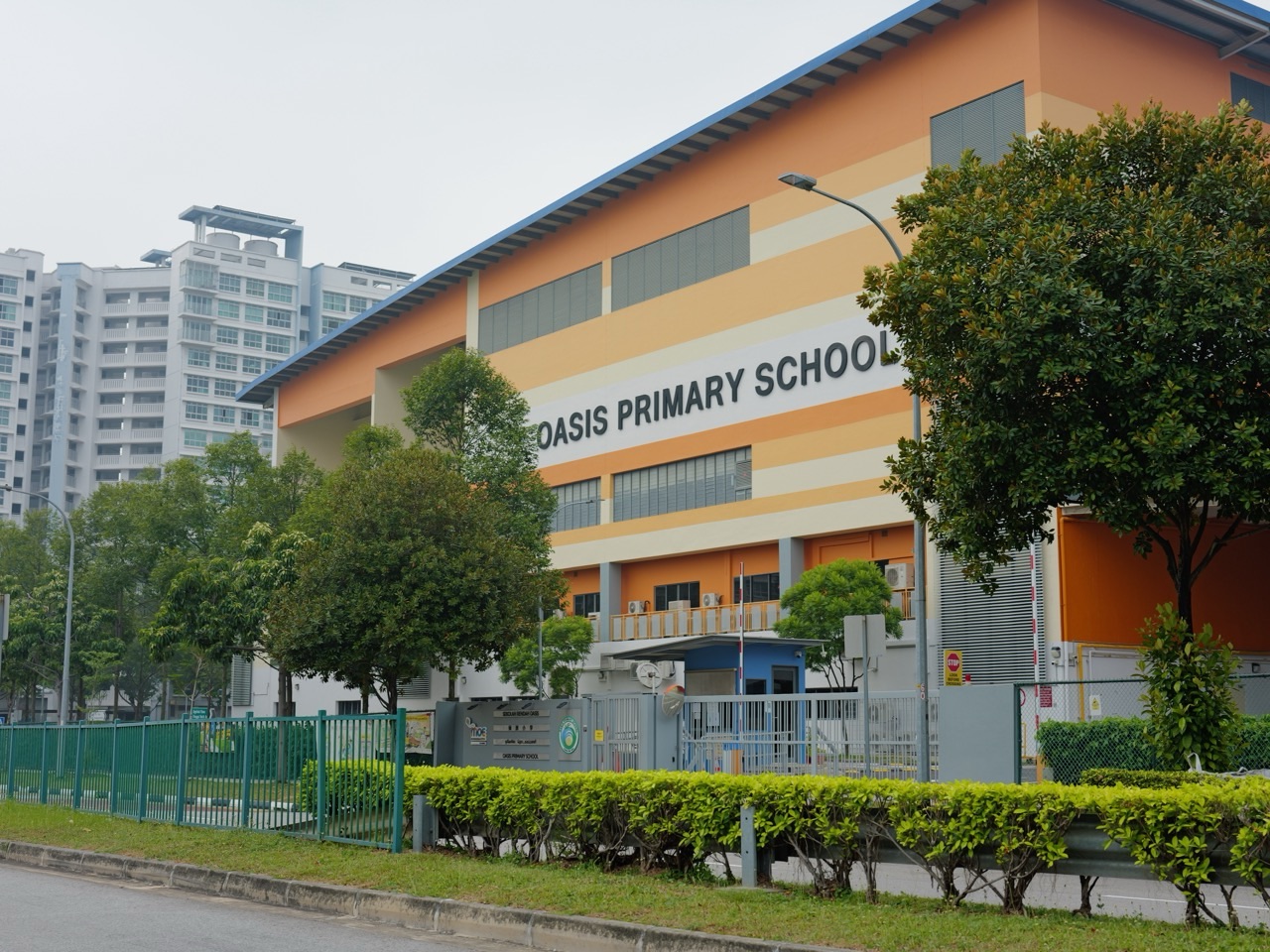
Is Oasis Primary School a good school? Yes — it has an especially thoughtful case for a child who enjoys stories, communication, creative learning and gradually taking responsibility. Oasis Primary School in Punggol identifies Nurturing Language Artisans through an Interdisciplinary Approach as its Applied Learning Programme, and Lead with a Heart, Changemakers for the Future as its Learning for Life Programme. Its published English and character-learning activities bring those ideas to life: children read literature, explore perspectives and learn self-leadership through The Leader in Me framework. For the right child, this is an inviting combination of language and character, rather than a generic school ranking.
Parents searching for an Oasis Primary School review, Oasis Primary School ALP, Lead With a Heart Oasis LLP, Primary 1 registration Punggol or Oasis Primary School student care and MOE Kindergarten can begin with clear facts. The campus is at 71 Edgefield Plains, Singapore 828716. Its official English curriculum describes P3 and P4 Literature is Alive experiences and P5 media literacy, while its 2026 leadership page separates self-leadership for everyone from additional training for class leaders and prefects. The presence of an MOE Kindergarten and care arrangements is a practical matter to verify independently of a P1 place.
Did you know? At Oasis, the P3 literature programme uses Charlie and the Chocolate Factory to explore ideas and make objects such as imaginative chocolate wrappers, while the P4 literature programme uses Wonder to discuss empathy and accepting differences. These are school-published learning examples, not proof that every future cohort follows identical texts. Their value is the connection between reading, discussing another person’s experience and creating something that shows understanding.
Oasis Primary School: two companion guides for families
Why go Oasis Primary School? — explore the fuller school story. Is Oasis Primary School a good school? — this independent, fact-checked fit review. Parents & Pathways Hub — continue through Singapore education routes.
Oasis Primary School: the details to check first
| School location | 71 Edgefield Plains, Singapore 828716 |
|---|---|
| ALP identity | Nurturing Language Artisans through an Interdisciplinary Approach, confirmed in 2026 Principal’s Message |
| LLP identity | Lead with a Heart, Changemakers for the Future |
| English curriculum aim | Empathetic Communicators, Discerning Readers and Creative Inquirers |
| P3 English experience | Literature is Alive: Charlie and the Chocolate Factory, reflection and making in the school description |
| P4 English experience | Literature is Alive: Wonder, perspective-taking and discussion of inclusion |
| P5 English experience | OLE Week media-literacy learning and evaluating information |
| P1–P2 PAL | Sports and Games, Outdoor Education, Performing Arts and Visual Arts, with place-based experiences |
| LLP participation | Tier 1 The Leader in Me for every pupil; Tier 2 classroom leaders and Tier 3 prefects have separate training |
| Facilities and services | MOE Kindergarten and school-related care provision are listed; confirm enrolment and available places separately |
| Official sources | 2026 Principal’s Message · English curriculum · LLP |
Why this school’s language direction has substance
A child can read a story fluently without fully understanding why a character makes a difficult decision. Oasis’ language direction tries to make the reading experience richer by connecting words with perspective, expression and purposeful inquiry.
The school calls its ALP Nurturing Language Artisans through an Interdisciplinary Approach. Its Principal’s Message confirms that identity, while the English department describes learners as empathetic communicators, discerning readers and creative inquirers. These are related educational aims; they do not prove that every English enrichment activity is itself a separate ALP module.
The real decision question is how a child’s language learning changes through the curriculum. Can the pupil explain what was read? Can they distinguish a fact from an assumption? Can they listen to another interpretation without losing confidence? A good language programme gives learners a reason to practise these skills over time.
Did you know? P3 literature can involve making chocolate wrappers
The official English page describes Primary 3 pupils reading Charlie and the Chocolate Factory and using hands-on making activities to explore its themes. The pupils work in groups on imaginative chocolate bars or wrappers while discussing challenges and reflecting on their own experiences.
This is not simply a craft class. The useful instructional question is why the physical task helps students understand characters, vocabulary or the author’s choices. Does the pupil explain an idea from the text, or merely decorate an object? Good teaching should make the link between creative activity and reading comprehension visible.
Parents should remember that the page includes examples from particular cohorts, including older event photographs. It is evidence that the school has taught literature this way, not a guarantee that the identical book or task will recur every year. Ask what the current P3 reading sequence is.
P4’s Wonder offers a route into empathy
For Primary 4, Oasis’ official English curriculum describes using Wonder to explore characters who look, think or act differently. Students discuss acceptance, diversity and respectful treatment of others; the school also illustrates creative responses in the form of board games and classroom projects.
Such a book can lead to a sensitive and age-appropriate discussion of whose perspective has been overlooked and why. A young learner may initially judge a character too quickly and then revise that view after another passage. That is a valuable example of thinking with evidence.
A discussion about inclusion should not be used to pretend that all social difficulties disappear. Ask how teachers handle real incidents, bullying or misunderstanding, and how they support pupils who are personally affected. A literature lesson is a place to practise empathy, not a replacement for adult safeguarding.
At P5, media literacy becomes part of reading
The English department identifies Primary 5 Media Literacy in OLE Week. Students learn to interpret information from different media, think about how messages are created and consider whether claims can be trusted.
That is a particularly relevant skill for the 21st century. A child may encounter an attractive video or confident online statement before having the tools to question the source. Teaching media literacy can help them ask who made it, what is actually shown and what information might be missing.
At a school visit, ask whether pupils practise checking dates, distinguishing opinion from evidence and comparing sources. Those habits are different from memorising facts, and they matter well beyond one examination paper.
The English department’s three learner identities are worth unpacking
Oasis’ English page describes Empathetic Communicators, Discerning Readers and Creative Inquirers. The distinction matters. Communication involves listening and conveying meaning; discernment involves evaluating information; inquiry involves using questions and evidence to investigate something unfamiliar.
A child who can retell a story but struggles to evaluate a claim might need different teaching from one who reads accurately but cannot explain an implication. A family should look for lessons that diagnose these parts rather than simply label a student weak in English.
The school mentions pen-pal and international communication experiences as examples of using language for authentic purposes. Ask which activities reach the current level, how children are prepared and what guidance helps less confident writers or speakers contribute.
What does PAL provide in the first two primary years?
Before upper-primary literature and leadership projects become complex, Primary 1 and 2 pupils receive a Programme for Active Learning. Oasis’ July 2026 PAL page calls its approach All Around Us and describes four areas: Sports and Games, Outdoor Education, Performing Arts and Visual Arts.
The school explains that these are taught through age-appropriate weekly experiences. Place-based learning uses the school environment and parts of the Punggol neighbourhood, including the waterway, to help pupils connect learning with familiar surroundings.
This could suit a child who learns best by moving, observing and talking before sitting down to explain an abstract idea. Ask how teachers build safety and cooperation during activity, and how a quiet or anxious pupil can settle into unfamiliar lessons.
Place-based learning is more than taking a walk
A neighbourhood is full of things a child can notice: a public space, a waterway, a piece of public art or a change in the way people move. Oasis’ PAL description suggests using those environments to connect learning with the community.
The educational value is not determined by the distance travelled. It depends on what children are asked to observe, compare, record and reflect on. A walk along the waterway can become a conversation about safety, environmental care or why different groups use the same space in different ways.
Parents should ask how learning journeys are supervised, which levels participate, and how pupils with mobility or sensory needs are included. A broad place-based identity is useful only when it becomes safe, purposeful learning for the child.
Leadership at Oasis begins with managing the self
The school’s Learning for Life Programme is named Lead with a Heart, Changemakers for the Future. It draws on The Leader in Me and the 7 Habits framework, including goal-setting, responsibility and working constructively with other people.
This can begin very simply. A child learns to organise school materials, complete a manageable task and understand why turning up prepared helps a classmate. These are small examples of self-leadership that do not require a formal title.
A parent might ask how the school makes an abstract habit age-appropriate. What does a P1 pupil actually do when they forget something? Is the child helped to create a routine, or simply corrected? A supportive response is more valuable than a poster about responsibility.
Start It Right and End It Well: the school-year structure
The school’s LLP page describes annual Start It Right activities linked to self-management, relationships, classroom norms and personal goals. It also documents End It Well activities involving reflection, literacy tasks and revisiting the habits taught earlier.
The interesting educational principle is continuity. A pupil does not learn a habit permanently after hearing about it once. It needs to be practised, reviewed and adapted when the child grows older or encounters a different situation.
The school webpage includes examples from several years. They demonstrate how the approach has been used, not an identical list of required assignments for every future child. Ask which activities run during the actual enrolment year.
One important distinction: Tier 1, Tier 2 and Tier 3
Oasis publishes a leadership structure that separates Tier 1 self-leadership experiences for all pupils from role-specific Tier 2 training for classroom leaders, and more advanced Tier 3 training for prefects.
Tier 1 includes lessons and P1–P2 place-based activities around the 7 Habits. Tier 2 gives class leaders help understanding their responsibilities. Tier 3 includes leadership skills, conflict resolution and change-making projects.
That distinction is essential for parents. A pupil who does not become a prefect can still learn responsibility, planning and empathy. A child who wants a senior role must ask about eligibility and selection rather than assume it follows automatically from attending the school.
The 2023 prefect projects should stay dated
The LLP page documents projects organised by older prefect cohorts, including upcycling used clothing and educating peers about misinformation online. These are attractive examples of pupils identifying an issue and communicating possible improvements.
Because the activities were created by specific pupils in specific years, they should be treated as historical illustrations. It would be misleading to tell a new P1 family that every child will run the same upcycling event, make the same online game or earn the same award.
The reusable question is how children in the current year develop an idea. What evidence identifies the problem? Who has to be consulted? How will pupils know whether their response helps? Teaching these steps matters more than repeating one prize-winning project.
Does this school have a kindergarten on campus?
Oasis has an MOE Kindergarten associated with the primary-school campus, and the school’s website includes a separate MK@Oasis area. For families with preschool-age children, this may make educational continuity and logistics worth investigating.
However, kindergarten enrolment and a future Primary 1 place are separate administrative questions governed by the applicable MOE admission rules. A family should never assume that having a sibling at a nearby care facility, or attending an MOE Kindergarten, guarantees a seat in the primary school.
Ask the kindergarten and primary school how transition is supported, what information teachers share, and what the actual P1 registration eligibility is for the intended year. The familiarity of an environment can help, but the admission route must still be checked officially.
Student care and transport: the practical family test
Parents considering Oasis often need to know what happens between school dismissal and the end of the working day. The school has published student-care and other service arrangements, but a school placement does not imply a guaranteed student-care vacancy.
Ask for current operating hours, application timing, pick-up rules, holiday arrangements, any fees and the handover process when a child has a CCA or enrichment activity. The child should know which adult is responsible for them at each stage.
If your household relies on a car or public transport, test the route to 71 Edgefield Plains at school start and finish time. The correct gate, crossings and rainy-weather shelter may matter more to a seven-year-old than a distance estimate.
What about Mathematics, Science, Mother Tongue and PSLE?
A distinctive language ALP does not mean every other subject takes care of itself. A pupil may love stories but find fractions confusing. Another might be an excellent logical thinker yet struggle with written explanation or Mother Tongue vocabulary.
Ask how the school identifies the particular gap, gives an explanation the child understands and checks whether the idea becomes stable. A single score compresses many different skills into one number and can hide why the child is struggling.
The ideal primary-school experience preserves learning continuity across years: understanding concepts, practising sufficiently, noticing errors and transferring knowledge to new settings. A focus on literary expression is most helpful when it complements secure foundations in the rest of the curriculum.
Who should shortlist Oasis — and who should compare?
Oasis is particularly worth exploring for a child who loves stories, creative discussion and different perspectives, or for a family seeking a clearly articulated self-leadership and empathy programme. Its place-based and PAL activities may also appeal to children who enjoy learning outside a conventional worksheet.
Another school may be more suitable if transport is exhausting, student care is unavailable when needed, a specific support arrangement has not been confirmed or the family is primarily chasing a selected leadership post.
The question is whether this child will be able to participate in the ordinary classroom, make friends, receive help after a misunderstanding and still have time for rest and play. That is a better school-choice standard than a reputation contest.
Four questions for Oasis Primary
- What language learning is included for all P1–P2 pupils, and how are quieter or less fluent students helped to speak?
- Which P3–P5 literature and media-literacy examples remain current for our child’s intended cohort?
- What does Tier 1 The Leader in Me teach every pupil, and which further leadership experiences involve class appointments or prefect selection?
- What are the actual admission, MOE Kindergarten transition and student-care application arrangements for our family?
Primary 1 registration: a good school still needs an available place
Use MOE’s official registration phases and dates to determine the eligible route, citizenship and address rules. Historical vacancies and balloting from the correct year are context, not a quality score or an admission guarantee.
For future entry cohorts, confirm the applicable framework at MOE’s updated registration page. Do not assume that an old ballot result or preschool attendance alone settles a later exercise. Ask separately about transfer availability for an older child.
The Oasis Primary School verdict
Yes — Oasis Primary School can be an excellent fit for a child who enjoys language, reflective reading and learning to contribute to others. Its literature examples and graduated leadership framework give parents substantive reasons to investigate.
A good school is a good-fitting school when the child can understand the work, speak up for help, revise a misunderstanding and feel increasingly capable. A family can make that decision more confidently by separating documented programmes, selective opportunities and the realities of everyday life.
Quick answers for parents
Where is Oasis Primary School? 71 Edgefield Plains, Singapore 828716.
What is its ALP? Nurturing Language Artisans through an Interdisciplinary Approach, as identified in the school’s 2026 Principal’s Message.
What is its LLP? Lead with a Heart, Changemakers for the Future, with a 7 Habits framework and different levels of student leadership.
Fact-check sources and editorial boundaries
Reviewed on 10 October 2026 against official 2026 school information. The school identifies its ALP in the Principal’s Message; its English department provides concrete literacy activities rather than a separately dated ALP module list. Historical book examples, prefect projects and prizes are not promises for future cohorts. This is independent eduKate editorial guidance, not an MOE ranking or school endorsement.
- Oasis official Principal’s Message, identifying ALP and LLP
- Oasis official English Language curriculum, updated 17 July 2026
- Oasis official Learning for Life Programme, updated 25 August 2026
- Oasis official P1–P2 Programme for Active Learning
- Oasis official school address and contact
- MOE P1 registration guidance