
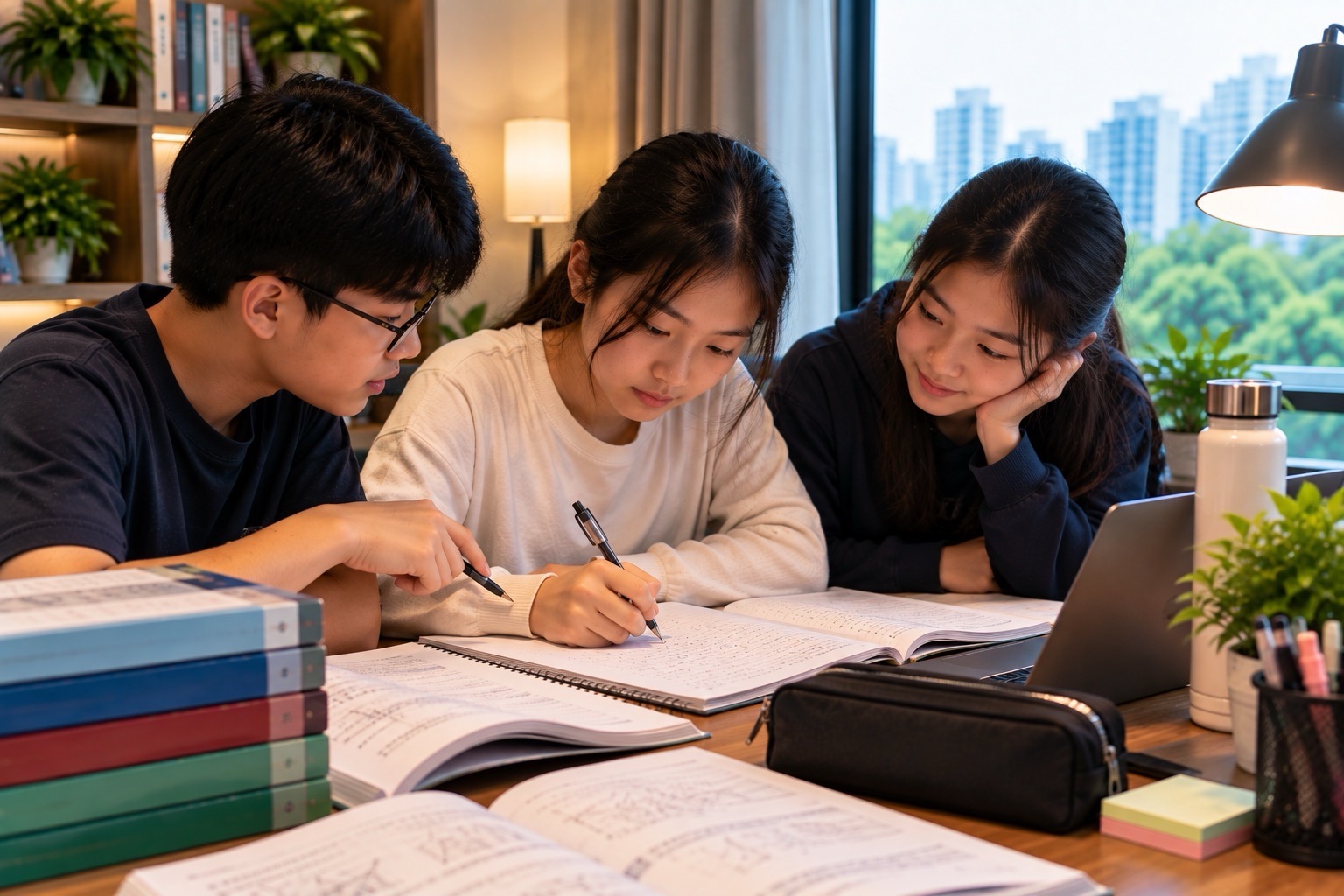
Do you know what the G3 Chinese Language examination really expects Singapore secondary-school students to do? It is not simply an exercise in memorising model compositions, collecting impressive 成语, or recognising a long list of characters. The MOE Chinese syllabus asks learners to listen, speak, read, write and interact with other people. Good performance involves understanding unfamiliar material, deciding which facts matter, using vocabulary precisely, organising an email or essay for its intended reader and discussing a topic thoughtfully. A learner can be fluent at family conversation yet need practice interpreting an unfamiliar article or speaking with reasons in a national video-based examination.
For the 2027 Singapore–Cambridge Secondary Education Certificate (SEC), this is G3 Chinese Language K320, previously code 1160. The official national assessment has Paper 1 Writing: two hours, 60 marks, 30%; Paper 2 Language Use and Reading Comprehension: 1 hour 30 minutes, 70 marks, 35%; and Paper 3 Oral and Listening: 35% together. Oral takes approximately fifteen minutes after ten minutes of preparation, worth 50 marks or 25%; Listening takes approximately thirty minutes, with ten multiple-choice questions worth 20 marks or 10%. Thus there are three numbered papers but four assessed skill components. The distinction helps families understand how to divide practice.
Writing requires a practical email of at least 150 Chinese characters chosen from two tasks and a composition of at least 300 characters chosen from three prompts. The reading paper assesses contextual word use, replacement of misused vocabulary and both practical and longer texts. Oral requires reading aloud and discussing a video with examiners; listening uses short spoken passages and longer recordings. This guide explains the skills, rubric and revision decisions in accessible parent-friendly detail, without substituting outdated O-Level facts for the correct 2027 K320 specification.
Do you know why this is specifically G3 Chinese K320?
Under Full Subject-Based Banding, G3 identifies the demand of a subject offered by the student, not a fixed label for the child’s overall ability. The official 2027 code is K320; G1 Chinese K120 and G2 Chinese K220 have their own learning and examination arrangements.
Families should verify the registered code before purchasing practice materials. A G2 Chinese exercise can sometimes reinforce comprehension, but it does not establish K320’s character minimums, paper marks or marking expectations.
Ask the school which level and examination year apply and what evidence would support a change in level, where the school’s policies permit one. A thoughtful decision recognises strengths across reading, writing, oral and listening rather than just one total mark.
Do you know why MOE and SEAB materials answer different questions?
MOE’s curriculum aims concern the growth of language competence throughout schooling. SEAB publishes the national paper specifications, item types, rubrics and examination instructions for a particular year.
A class may study a local news story through discussion and a written response. The national paper may use an entirely different text, so the useful preparation is learning to identify purpose, main ideas and relevant evidence rather than predicting the headline.
Use the teacher’s course plan for present learning and K320’s official 2027 document for the assessment structure. Parents should not assume that a generic Chinese-language revision guide covers every component accurately.
Do you know why a strong spoken Chinese foundation may not be enough?
Everyday speech is often supported by familiar topics, gestures and shared context. Academic reading requires understanding an unfamiliar passage independently; examination writing requires a clear structure and accurate written characters.
A student may discuss food or hobbies fluently yet struggle to distinguish an author’s main idea from an example. Another student may write carefully but become hesitant when an examiner asks an unanticipated question.
Use actual samples from all four assessed components. A diagnosis based only on family conversation is incomplete. The goal is flexible communication suited to several audiences and situations.
Do you know exactly how the 30–35–25–10 percentages work?
Writing contributes 30%, language use and reading 35%, oral 25%, and listening 10%. The oral and listening examinations are both included under numbered Paper 3 in the K320 syllabus’s blueprint, but they have distinct tasks and marks.
A family that focuses entirely on 作文 leaves 70% of the national weighting unaddressed. Conversely, a student who reads very well still needs to produce extended writing and spoken interaction.
Balance the weekly schedule with the actual score profile. One learner may need reading inference work, another better video conversation; preserving practice across the components avoids an unintentional gap.
Do you know what Paper 1 Writing includes?
The two-hour, 60-mark paper has two compulsory sections. 实用文 practical writing offers two emails from which one is chosen, carrying 20 marks or 10% overall. 作文 offers three questions from which one is answered, carrying 40 marks or 20% overall.
Both responses are required. The syllabus permits a SEAB-approved dictionary during this writing paper under the stated conditions. It does not say students can consult unrestricted translation apps or personal notes.
Students should read every relevant instruction before beginning, select topics they can address faithfully, and reserve time to check missing information and language accuracy. Writing more is not automatically the same as writing better.
Do you know why the practical email has a character minimum?
The 2027 K320 response must be at least 150 Chinese characters. This minimum establishes the expected scale, but a long email can still omit required points or use the wrong register.
An email to a school organiser about an activity should identify the purpose, explain relevant facts and make the request or suggestion understandable. A beautifully written passage about the general importance of education may not answer the organiser’s specific question.
Teach the learner to underline recipient, purpose and required information, then plan what each paragraph will accomplish. Once the task is complete, check accuracy and length rather than padding an irrelevant response.
Do you know how a reply email differs from a new email?
K320 permits a response to a provided email or a new email based on supplied material. In a reply, the recipient has already raised a question or issue; the response needs to acknowledge it and address the important points. A new email must establish the context clearly.
Imagine a school committee asks whether a proposed event meets students’ needs. A useful reply responds to its concerns and provides concrete suggestions. Beginning an unrelated narrative about last year’s event does not automatically help.
Practise identifying what the reader already knows and what remains to be explained. The same theme can produce different openings and levels of detail depending on which kind of email is required.
Do you know why audience determines tone?
A message to a teacher, a community organiser and a close peer may need different forms of address and language. A formal email should be respectful and direct; a peer response may allow more conversational phrasing.
Students sometimes use complicated stock openings to appear sophisticated while hiding the reason for writing. Effective register means choosing wording suited to the relationship and action required, not permanently sounding ceremonial.
Rewrite the same factual message for two audiences. Ask which phrases changed and why, and whether both versions remain complete. This develops genuine language control.
Do you know how Paper 1 email marks are awarded?
The practical-writing rubric divides its twenty marks between content and language/structure, ten each. Content concerns relevance, sufficient development and organisation; language/structure concerns character use, vocabulary, grammar, punctuation and coherent expression.
A candidate who covers every required point but writes unclearly may lose language marks. A polished email missing the actual purpose may lose content marks. The two dimensions should be diagnosed separately.
When reviewing a marked draft, highlight the required facts and the language used to connect them. A precise correction is more useful than a generic instruction to add 成语 everywhere.
Do you know why a 300-character 作文 needs structure?
The composition requires at least 300 Chinese characters and one response chosen from three questions. The assessed forms include narrative 记叙文, explanatory 说明文 and argumentative 议论文 writing.
A narrative should show meaningful change; an explanatory text should develop a topic through clear relationships; an argument needs a position and reasoning. Writing three paragraphs of loosely related ideas does not automatically satisfy the genre.
Plan a main direction and two or three distinct developments before drafting. Characters should be used to communicate relevant thought, not accumulated for their own sake.
Do you know how to choose among three composition prompts?
Candidates should read the full wording and identify what each prompt actually asks. A familiar keyword may appear in a question demanding a different form from the learner’s rehearsed essay.
For instance, a topic about responsibility may ask for a particular experience rather than a general argument about good habits. Reproducing an old argumentative essay in a narrative slot risks missing the assignment.
A short planning test helps: identify the writing form, central claim or event, relevant evidence and ending. Choose the option with clear material rather than the one that sounds most impressive.
Do you know why a narrative needs more than chronology?
A story becomes meaningful when a decision, encounter or discovery changes the direction of events. Listing what a student did throughout a day can be readable but may not build tension or insight.
In an imagined story, a student finds a lost envelope and must decide what to do with it. The important passage might concern the choice and its consequences, not lengthy descriptions of every street on the way home.
Ask where the problem begins, what turns the story and how the ending follows. Description should support that progression rather than hide an absent plot.
Do you know why explanations require a meaningful link?
说明文 helps a reader understand a process, issue or phenomenon. It may define a concept, distinguish categories or explain causes and effects. A list of facts without connecting logic offers little guidance.
For a school recycling example, a writer could explain why sorting matters, how a system works and which limitations should be addressed. A generic slogan to protect the environment is not an explanation of the process.
Students should ask how and why after every main point, then add a relevant example. Coherence comes before elaborate vocabulary.
Do you know why an argument can acknowledge a limitation?
议论文 aims to persuade through defensible reasoning. A writer can state a clear position, explain evidence and consider a relevant alternative without becoming uncertain about everything.
An essay about school activities could weigh learning opportunities against time pressures and explain conditions that make participation useful. Declaring every activity always beneficial would ignore plausible constraints.
Teach a claim–reason–example–evaluation sequence, but let the question determine the precise structure. A conclusion should return to what the argument actually established.
Do you know what a well-chosen example adds?
Examples make an idea concrete, but the writer must still explain why the example supports the point. A long description of an enjoyable school programme does not automatically demonstrate that it developed teamwork.
A stronger paragraph identifies how students divided tasks, resolved a disagreement or adapted when a plan changed. The example’s significance becomes visible through its connection to the claim.
After writing, underline the sentence that explains the connection. If none exists, adding more descriptive adjectives is unlikely to repair the reasoning.
Do you know why a memorised opening can weaken an essay?
Students sometimes begin every composition with sweeping claims about modern society or a famous saying. An impressive opening is only useful when it prepares the reader for the actual topic.
A precise introduction to a difficult personal decision may be stronger than a long paragraph on how technology has changed the world. The opening should create a relevant expectation for the paragraphs that follow.
Practise writing two short introductions for the same question and compare how directly they establish the central direction. Formulaic language should serve the idea, not replace it.
Do you know when 成语 and proverbs are useful?
Idioms and established expressions can make writing concise and evocative when their meanings and register fit the context. Misusing a 成语 may distort a sentence or create a tone unsuitable for a practical email.
A student should be able to explain what the expression conveys and how it strengthens the paragraph. Memorising ten rare expressions provides limited value if they appear only as decorations.
Build a smaller set of authentic examples, including contexts where the expression would not fit. This produces better judgment and more accurate vocabulary use.
Do you know why characters and punctuation must be checked?
The Paper 1 rubrics include accuracy of written Chinese characters and punctuation alongside grammar and vocabulary. A character error can change meaning, while poor sentence boundaries can obscure a well-developed idea.
Students may recognise a character in reading but fail to retrieve it accurately during independent writing. This is a different skill from understanding its pronunciation.
Practise short sentences using frequently confused forms, then revisit them in an unfamiliar email or essay. A spelling list alone does not guarantee writing accuracy.
Do you know why Paper 2 has 30 questions?
The 90-minute Language Use and Reading Comprehension paper carries 70 marks or 35%. Its blueprint includes five contextual gap-filling items, five word-replacement items, ten selected-response questions on practical texts and ten free-response comprehension questions on two longer passages.
The raw marks are distributed as 5 for gap filling, 10 for word replacement, 20 for practical reading and 35 for longer comprehension. The highest raw allocation therefore lies in reading that requires the student to construct answers.
Practise selecting and explaining text evidence, not merely choosing from multiple-choice options. Accurate language use remains important, but reading comprehension is a substantial part of the subject.
Do you know what 综合填空 asks?
The contextual cloze gives a passage with gaps and requires the best-fitting words from the available options. The learner should consider sentence grammar and the meaning of the surrounding paragraph rather than focus only on a word next to the blank.
A phrase that appears similar to a familiar expression might contradict the author’s intended cause or contrast. The correct option must work within the full argument or narrative.
During correction, ask which contextual clue supports the chosen word and why an attractive alternative is unsuitable. That builds flexible Chinese understanding.
Do you know what 词语替换 tests?
Word replacement asks candidates to replace words that are inappropriate in the context of a supplied passage. A learner may recognise the general topic yet select a substitute with the wrong nuance or grammatical function.
Two Chinese expressions can have overlapping meanings but differ in connotation, collocation or register. A suitable replacement preserves the author’s intended message in that particular sentence.
Study near-synonyms with real contexts rather than isolated bilingual translations. After making a correction, read the whole sentence aloud and ask whether its meaning now fits the paragraph.
Do you know why practical texts are examined?
The reading section includes two or three practical materials or short texts, such as advertisements, leaflets or news reports, with ten selected-response questions. It tests the ability to locate information and interpret its purpose.
A poster may contain a prominent invitation but also a smaller deadline or condition. Recognising the event name does not answer a question about eligibility or the actual action required.
Teach students to read the title, intended audience, relevant details and any restrictions. A response should be based on what the material says, not assumptions about how similar events usually work.
Do you know why visual reading can be misleading?
Visual materials organise meaning through wording, layout and emphasis. A large headline may create an impression while the smaller content qualifies it. Students should examine the whole message before inferring the author’s purpose.
A promotion advertising a price may include conditions about timing or specific products. Choosing an answer based on the largest number alone could misrepresent the practical offer.
Practise distinguishing fact, emphasis and inference. A careful reader asks what the material establishes and what would need further information.
Do you know how 阅读理解二 differs?
The longer comprehension section includes two written passages and ten constructed responses, carrying 35 raw marks. Questions can require accurate detail, inference, vocabulary meaning or explanations of relationships within the text.
A student who finds the keyword in the question may copy a sentence that describes what happened when the question asks why. The relevant operation must be understood before selecting the evidence.
Ask the learner to paraphrase the question’s demand, identify the supporting part of the passage and then answer clearly. A shorter relevant explanation often communicates better than an unrelated copied paragraph.
Do you know what inference means in a Chinese passage?
Inference draws a reasonable conclusion from evidence rather than inventing a fact. A character may hesitate before speaking, suggesting uncertainty in context, but that action alone cannot establish a complicated unseen family history.
A good response identifies what happened, what it suggests and which surrounding details make the interpretation plausible. The writer’s use of perspective or contrast may help distinguish possibilities.
Practise separating explicitly stated facts from implications and speculation. This habit makes reading answers more disciplined.
Do you know why cause and effect are frequently confused?
A passage may report that an event moved indoors because rain was predicted. Rain is the stated reason; relocation is the response. Reversing this relationship changes the meaning even when the same words are copied.
Connectors and time expressions can reveal whether a clause expresses cause, consequence, contrast or sequence. Their interpretation must be guided by the actual sentence.
A useful short exercise draws two boxes labelled cause and consequence, then writes a clear Chinese sentence linking them. Transfer the habit to new reading material.
Do you know why contextual vocabulary is different from a dictionary definition?
A familiar character or word may have a context-specific meaning, figurative use or emotional connotation. The first meaning found in a glossary is not always what the writer intends.
An expression about a physical road can sometimes be used metaphorically for a life journey. The surrounding passage, not the learner’s favourite translation, determines the appropriate interpretation.
Compare two short passages using the same expression differently, then explain the clues. This builds adaptable language understanding.
Do you know why no separate summary section appears in K320?
The official 2027 K320 Paper 2 lists contextual cloze, word replacement, selected-response reading and free-response comprehension. It does not list a separately weighted summary task among its thirty questions.
Summarising a passage in a few sentences remains a useful revision technique, but parents should not impose another subject’s official 60-word or 80-word summary rule on K320.
Match examination practice to the correct code. The goal is developing comprehension that can support the actual question types.
Do you know how the oral examination is organised?
The K320 oral component takes approximately fifteen minutes after ten minutes to read the given passage silently and view a video. The student then reads the passage aloud and takes part in a conversation linked to the video stimulus.
Reading aloud is worth ten raw marks or 5% overall, while video-based conversation carries forty marks or 20%. Together the oral component represents 25% of the subject.
Candidates should practise both accurate delivery and flexible discussion. A fluent reading does not replace a thoughtful response when the examiner asks for an opinion.
Do you know what oral reading aloud measures?
Reading aloud examines pronunciation, clarity, pacing, intonation and fluency. A student must communicate a connected text so listeners can follow its meaning, not simply recognise every character visually.
A learner may pronounce individual words correctly yet pause at unnatural places because the sentence’s structure is not understood. Reading for meaning can help phrasing and emphasis.
Practice with unfamiliar short passages, explain the central point and read aloud at a measured pace. Mechanical speed without clarity is not the purpose.
Do you know how to use the ten-minute oral preparation?
The preparation time allows candidates to read the provided text and view the video more than once within the rules. It should help them understand the theme, notable details and possible questions rather than attempt to memorise every word.
A small mental outline might include what the clip shows, which issue it raises and two supported personal views. The learner can prepare useful vocabulary without scripting an entire conversation.
Practice with new clips under realistic timing. Recognition of the method, not prediction of a topic, creates flexibility.
Do you know why describing the video is not a complete conversation?
The examiner may ask for views, reasons, consequences and proposed actions related to the stimulus. Recounting every visible action can be a useful starting point but does not necessarily answer an opinion question.
If a clip depicts a school community activity, a student might discuss who benefits and what could make participation more inclusive. The answer should connect an observation to reasoning.
After practice, ask what the actual question sought and whether the response answered it directly. A polished description may still be off-task.
Do you know how to extend an oral opinion?
A strong spoken answer can state a viewpoint, explain why it makes sense and offer a concrete example. It can also acknowledge a meaningful limitation if the examiner explores another perspective.
Suppose a student believes schools should offer more outdoor learning. The explanation could link an activity to observation and teamwork, while considering weather or accessibility. The answer should be proportional to the question.
Practice a direct first sentence and one developed reason before adding several examples. Relevance matters more than speaking continuously without thought.
Do you know why follow-up questions cannot be memorised?
A follow-up may ask about an exception, an alternative or a change to the situation. Repeating the first answer shows fluency with rehearsal but not necessarily the ability to interact.
After a response about student volunteering, the examiner might ask how to involve classmates with limited time. The learner needs a new, relevant suggestion rather than another list of volunteer benefits.
Practice short unrehearsed follow-ups so the child can listen, clarify when appropriate and respond in their own Chinese.
Do you know why pauses during oral are not always failures?
A brief pause may help the learner understand a new question and organise a coherent response. It is different from refusing to engage. Rushing can lead to irrelevant or grammatically confused speech.
If a technical term is temporarily unavailable, the student may explain the idea in simpler Chinese, provided the meaning stays clear. Elaborate memorised expressions are not always necessary.
During review, focus on one issue that repeatedly limits communication, such as incomplete answers or weak examples, rather than interrupt every minor hesitation.
Do you know what Listening assesses?
The 2027 Listening component lasts approximately thirty minutes, with ten multiple-choice questions worth twenty raw marks and 10% overall. It includes three short conversations or spoken extracts and three longer comprehension passages.
The contexts can include everyday dialogue, advertisements, explanation, stories and news. The learner needs to identify relevant information from speech, sometimes distinguishing an original plan from a changed one.
Reading a transcript afterwards can help explain mistakes, but first-time listening to unfamiliar audio must be practised directly.
Do you know why listening for final decisions matters?
A dialogue may contain two possible dates or places before the speakers reach an agreement. A student who recognises the first one and stops listening can choose an incorrect answer.
Imagine one speaker proposing a Saturday event before another mentions a conflict and suggests Sunday. A question about the confirmed plan requires the final decision.
Practise recording the original suggestion, reason for change and eventual agreement. Use a new topic after correction to test whether the listening habit transfers.
Do you know how reading and listening vocabulary differ?
A student may recognise a word in printed Chinese yet fail to identify it in connected speech. Another may understand a familiar spoken phrase but hesitate when asked to write its characters.
These skills depend on overlapping knowledge through different input channels. Revising written vocabulary alone does not automatically solve every listening problem.
Pair a short audio passage with written text only after the listening attempt, then identify whether the difficulty came from recognising sound, understanding the word or interpreting its context.
Do you know why home Chinese exposure can help but not replace practice?
Family communication provides valuable cultural and linguistic experience. Yet home language use may focus on a limited set of familiar topics and may not require formal email writing, interpretation of news or evidence-based oral argument.
The learner may be fluent in conversation while needing careful work on written vocabulary. Another student may read accurately but find spontaneous discussion demanding. Neither profile should be reduced to a label such as good or bad at Chinese.
Use component-specific feedback to choose learning tasks. Encourage natural language use alongside the distinct assessed skills.
Do you know how Secondary 1 Chinese can prepare for K320?
Earlier secondary work should consolidate character recognition, reading fluency, sentence relationships, purposeful communication and confidence discussing unfamiliar themes. A short article can provide material for reading questions, a practical email and oral opinion.
Students need not begin by completing two-hour full papers every week. The foundations of understanding what a text claims and building connected ideas are more important initially.
Ask which operation first becomes difficult and repair it with manageable examples before increasing task length.
Do you know what Secondary 2 should develop?
As learners progress, they can work with longer texts, interpret implied views and practise choosing writing structures that suit audience and purpose. Oral practice can introduce questions that require reasoning beyond one sentence.
One school issue can be written as an email to a teacher and discussed as a personal opinion. The content may overlap, but the expected register and organisation differ.
Review teacher feedback for repeating mistakes: near-synonym choice, grammar, inference, paragraph development or failure to respond to the task. Each needs its own corrective exercise.
Do you know how to prepare effectively during Secondary 3 and 4?
Upper-secondary preparation integrates all components. Students should alternate paper-specific tasks with mixed practice that requires recognising what method fits the new question. Timed papers become useful once the underlying skills are dependable.
A learner weak at 词语替换 may need contextual comparison before another entire Paper 2. A student whose essay lacks structure should plan several new questions before completing another long composition.
The study plan should adapt to the school schedule and maintain reading, writing, listening and spoken interaction throughout.
Do you know how to diagnose a weak Writing score?
Separate task fulfilment from language quality. Did the email answer the recipient’s actual points? Did the composition have meaningful progression? Did the student write characters, vocabulary and sentences accurately?
A missing request needs a content correction; a narrative with no turning point needs structure; repeated character errors may need targeted retrieval. Assigning the same generic writing worksheet to every problem is inefficient.
Choose one priority, practise deliberately and check it in a new prompt. A copied improved model answer does not demonstrate independence.
Do you know how to diagnose a weak Reading score?
Different Paper 2 errors reveal different gaps. Cloze errors may reflect contextual grammar; word replacement may involve lexical nuance; practical-text errors may come from missed conditions; long responses may lack evidence or explanation.
Examine the first wrong step in one answer and compare it with a second example. A student who selects an unsupported inference needs different work from one who understands the passage but writes an unclear answer.
An error notebook with the original misconception and one fresh application task can make feedback actionable.
Do you know how to diagnose Oral and Listening separately?
A student might speak accurately but give few reasons, or produce thoughtful views while hesitating over unfamiliar vocabulary. Listening problems might involve missing negation, the final plan or an important speaker change.
These are not identical communication barriers. Reviewing a video conversation should assess relevance and responsiveness; reviewing listening should ask which audio detail was not recognised or understood.
A short, focused intervention is often more useful than simply repeating a prepared oral speech or replaying the same recording indefinitely.
Do you know what a sustainable weekly Chinese routine looks like?
A balanced week could include one practical text, a longer comprehension passage, contextual language-use questions, a writing task or revision, and a brief listening and video discussion. The exact balance should respond to the learner’s weak components.
One theme such as community activities can support all four skills. Shared content reduces vocabulary burden while requiring different operations: identify facts, write a request, discuss a viewpoint and understand spoken information.
Time for correction and rest matters. More unreviewed work does not automatically mean better learning.
Do you know when extra Chinese instruction might help?
Additional teaching may help when specific difficulties remain after school feedback, such as contextual vocabulary, character writing, comprehension inference or video-based conversation. A useful teacher should identify the first unstable skill and test it on unfamiliar material.
The Clementi small-group tutorial reference illustrates the general principle: diagnose, explain, practise and check independence. Chinese requires its own language-specific methods, even when the teaching logic is transferable.
Extra hours cannot guarantee an examination result. A targeted reading routine and teacher consultation may sometimes be the most effective first steps.
Do you know the answers to frequent G3 Chinese questions?
What is the 2027 code? K320. How much is Writing? 30%, comprising a 150-character-minimum email and 300-character-minimum composition. Is Paper 2 a 70-mark, ninety-minute paper? Yes, worth 35%. Does the paper contain separate summary marks? No distinct summary task is listed.
How much is oral? 25%, including reading aloud and video conversation, with ten minutes’ preparation. How much is listening? 10%, around thirty minutes with ten MCQs. Can a dictionary be used? A SEAB-approved dictionary is permitted for Paper 1 under its rules.
Is Higher Chinese the same as G3 Chinese? No. K355 is a separate syllabus with different demands and examination arrangements.
Do you know what to ask the Chinese teacher?
Confirm K320 and the examination cohort, then request component feedback. Ask whether the child is limited by reading evidence, contextual vocabulary, email purpose, composition organisation, reading aloud or discussion.
If a subject-level change or Higher Chinese entry is being considered, ask about the school’s criteria and bridging expectations rather than assume it follows automatically from one strong test.
Agree on one priority practice and an unfamiliar task that will show whether the skill has improved. This turns a parent–teacher conversation into a learning plan.
Do you know what a twelve-week improvement cycle could look like?
The first fortnight can identify strengths and gaps in Writing, Reading/Language, Oral and Listening. Choose one or two recurring problems. Weeks three to six focus on short, explained practice while keeping other components active.
Weeks seven to ten introduce new texts, prompts and recordings; the final fortnight can add examination timings and compare current answers with the original weaknesses.
The schedule is illustrative, not a guarantee of grades. Adjust it to the school calendar and the child’s wellbeing. Improvement should survive an unfamiliar question.
Do you know what genuine G3 Chinese progress looks like?
A progressing student can understand an unfamiliar notice, interpret a longer Chinese passage, replace a misused word in context, write a complete email for the intended reader and develop an organised composition.
The learner can also read aloud intelligibly, discuss a video with reasons and follow spoken information when the topic changes. These skills support communication beyond the SEC.
The dependable path is to use K320, study authentic feedback and repair the first recurring weakness until the corrected method becomes independent.
Official 2027 K320 sources and connected guides
Read SEAB’s 2027 G3 Chinese Language K320 syllabus and the G3 national subject list. For level comparisons, see SEC G1 Chinese and SEC G2 Chinese. For the separately examined advanced course, see SEC Higher Chinese. The Clementi diagnostic-learning example provides a general approach to repairing weak prerequisites. The child’s school should confirm registration and current instruction.