
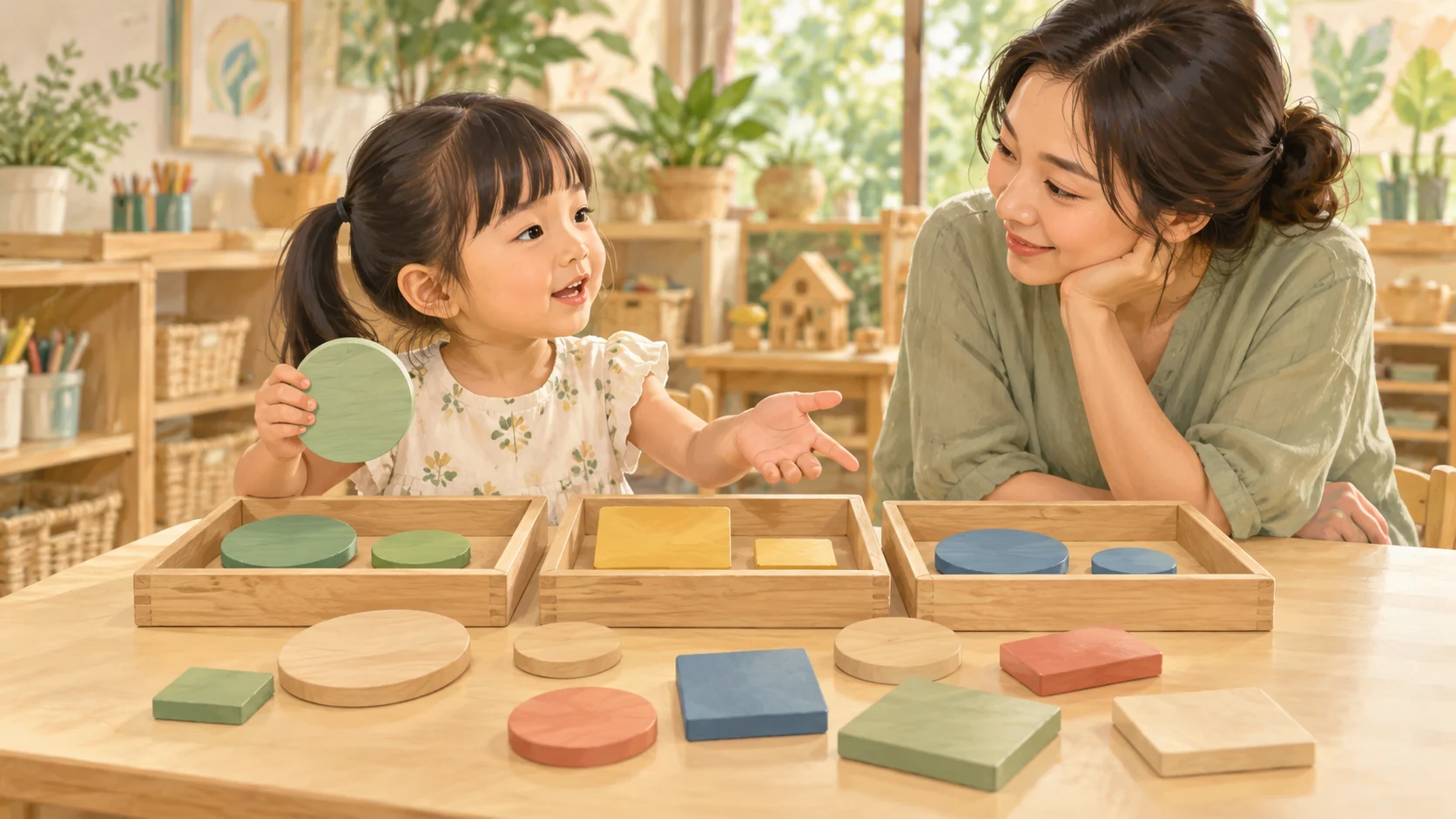
Learning vocabulary for children age 4 means moving beyond naming objects towards describing them, telling simple stories, comparing ideas and explaining what happened. If you searched for ‘vocabulary words for 4 year olds’, ‘Pre-K vocabulary activities’, ‘preschool language development games’ or ‘how to improve vocabulary in preschoolers’, the fastest useful starting point is a short conversation about something your child can see, do or remember.
An age-four child can learn new meanings through stories, pretend play, sorting, outdoor observation and everyday decisions. Instead of teaching ‘enormous’ as a word on a card, compare an enormous picture of an elephant with a tiny toy. Instead of reciting ‘behind’, place a figure behind a block. Then help the child use the word in a new situation. Meaning first, practice second, retrieval later.
This guide provides a clearly organised set of 100 word ideas, detailed parent scripts, gentle daily practice and reliable developmental references. It is not a developmental test or a claim that every four-year-old should use every word here. Some terms are deliberately richer words for adult modelling; a child may only need to understand them in context at first.
Quick answers: what vocabulary learning should look like at age 4
- Choose useful meaning: teach words for where, when, why, feelings, comparisons and storytelling.
- Make a visible example: show an action, picture or object while naming a new term.
- Use contrasts: rough versus smooth, heavy versus light, before versus after.
- Build a three-part story: ‘first’, ‘then’, ‘finally’ with family photos or toys.
- Invite explanations: ‘Why did the boat float?’ and offer language even when the answer is uncertain.
- Read interactively: pause for predictions and talk about the illustration, not just printed letters.
- Revisit across settings: a word used during craft can reappear at the market or playground.
- Keep expectations flexible: adjust activities and seek professional advice when communication concerns persist.
Definition lock: vocabulary is not the same as reading or spelling
Vocabulary is the knowledge of words and meanings. Receptive vocabulary refers to words a child understands when they hear them; expressive vocabulary refers to words they can use to share meaning. A child may understand ‘fragile’ while handling a paper model long before independently using that adjective in a sentence.
Oral language is the system used to understand and express spoken ideas, including sentences, questions, narratives and conversation. Phonological awareness concerns noticing sounds in language, such as rhyme. Print awareness concerns what books, letters and written words do. All may support later literacy, but a child does not become a stronger vocabulary user simply by spelling longer words.
Word knowledge also has depth: a child may know that ‘slippery’ relates to difficulty keeping a grip, distinguish a slippery wet tile from a rough mat, and later describe a slippery rock in a story. This is more valuable than correctly pointing at a single picture and never encountering the word again.
Which communication milestones are relevant at age 4?
The CDC’s age-four communication milestones include using sentences of four or more words, saying parts of a song or story, talking about something that happened during the day, and answering simple questions about what objects are used for. These are examples of what most children can do by that age, not an examination list that can diagnose a child.
ASHA’s age-three-to-four guidance discusses comparisons, more location words, storytelling and language-rich play. The four-to-five range adds more connected stories, time and position words, grammar and early sound awareness. Adults may model a word in the next range, but should not treat a future milestone as a requirement on a child’s fourth birthday.
For Singapore families, the Ministry of Education’s Nurturing Early Learners Framework 2022 guides holistic preschool learning for ages four to six and includes language and literacy among several learning areas. It is not an instruction to push formal examinations earlier. Real conversations, exploration, play and positive relationships remain useful across different national school systems.
The age-four approach: grow from a familiar word to a precise one
1. Start with the child’s meaning, not a dictionary definition
When a child points to a large lorry, begin with ‘big’. Then show how ‘enormous’ means very big. Ask them to find another object in a picture that deserves that description. A precise word becomes understandable when the child already has a familiar idea to attach it to.
2. Let the child compare real objects
Place a soft towel and a rough cleaning sponge side by side. ‘Both are things we touch. This is soft; that is rough.’ If the child can explain the difference using their own words, the vocabulary is doing its job. Avoid dangerous materials or demonstrations just to create a dramatic contrast.
3. Build cause and sequence from what actually happened
After rain, you might say, ‘The playground is wet because it rained. We will play indoors instead.’ This gives a reason and an alternative. At bedtime, ask what happened first on the outing, what happened next and how it ended. Help supply words rather than expecting a polished adult narrative.
4. Encourage a complete thought without demanding a perfect sentence
If a child says ‘bird loud’, answer, ‘Yes, the bird is making a loud sound.’ If they say ‘she goed home’, reply, ‘She went home after the rain.’ Modelling the natural form helps the child hear richer syntax while still feeling that their original message was heard.
5. Keep stories interactive
A picture book can teach ‘between’, ‘surprised’, ‘escape’ and ‘finally’ in a single coherent event. Ask what the child notices, respond to their description and leave space for imaginative predictions. The What Works Clearinghouse has found positive effects of dialogic reading on oral language; the value is not simply reading words aloud but talking with a child about them.
6. Invite new words in play and relationships
During pretend restaurant play, ‘order’, ‘prepare’, ‘serve’ and ‘customer’ appear because they make the game more realistic. While planning a block bridge, ‘sturdy’, ‘heavy’ and ‘balance’ help explain what happened. Words become useful instruments for play rather than decorations on a worksheet.
7. Remember the child’s languages and interests
A child who loves buses may know specialist vehicle words and still be learning emotion vocabulary. A child who uses Mandarin with grandparents and English in preschool may express the same idea differently across contexts. Continue rich language experiences across the family’s languages, and ask professionals for guidance if there is concern about development across everyday life.
100 useful vocabulary words for 4-year-olds, in 20 practical themes
These are 100 distinct headwords for parent modelling and discussion, organised so that you can find a relevant theme quickly. They are not official milestones, a compulsory Pre-K spelling list or a test. Use two or three meaningful words in a real situation; come back to them in conversation, reading and play before adding more.
Size and physical description
More precise adjectives make it easier to distinguish two objects that are both called ‘big’ or ‘strong’.
- enormous — extremely large.
- miniature — very small version.
- delicate — easily damaged or requiring care.
- sturdy — strong and stable.
- fragile — easy to break.
Try this with your child: Compare a large cardboard box with a miniature toy. Describe why a paper decoration is fragile and a wooden block feels sturdy.
Extension or safety note: Model the meaning naturally rather than telling a child to memorise five synonyms.
Words for complicated feelings
Feelings are more nuanced than simply happy and sad, especially in stories about expectations.
- curious — wanting to find out.
- grateful — appreciative of help.
- uneasy — not completely comfortable.
- relieved — feeling better after worry.
- delighted — very pleased.
Try this with your child: Discuss a character who loses a toy then finds it: ‘She was uneasy, then relieved.’
Extension or safety note: Invite different interpretations; a child’s own feeling is never a right-or-wrong answer.
Ways people and objects move
Specific verbs can bring life to a description and clarify the manner of an action.
- tumble — fall or roll unexpectedly.
- glide — move smoothly.
- stumble — trip or lose balance.
- rush — move in a hurry.
- creep — move slowly and quietly.
Try this with your child: Move toy figures down a ramp, then talk about which one glides and which one tumbles.
Extension or safety note: Use safe toy demonstrations, not risky physical stunts.
Comparisons that explain differences
Comparative language gives children a way to organise and discuss what they notice.
- similar — sharing important features.
- different — not the same.
- equal — the same amount or value.
- heavier — having greater weight.
- lighter — having less weight.
Try this with your child: Compare two bags containing different safe objects, and ask which one seems heavier.
Extension or safety note: ‘Equal’ can be modelled with a visible matching set, not a demand for arithmetic mastery.
Where something sits in relation to another thing
Location terms clarify pictures, directions and play scenes.
- opposite — on the other side.
- nearby — at a short distance.
- inside — within a space.
- outside — not inside.
- around — on several sides or in a circle.
Try this with your child: Use toy animals around a box and change one animal’s position as you narrate.
Extension or safety note: A location should be visible in the demonstration; avoid long multi-step instructions at first.
Time and story order
Time words help children connect events into a sequence rather than a collection of facts.
- earlier — at a time before.
- later — at a time after.
- meanwhile — at the same time.
- eventually — after some time.
- finally — at the end.
Try this with your child: Recall a family outing: ‘Earlier we were at the park; later we ate lunch.’
Extension or safety note: ‘Meanwhile’ is a stretch word; model it with two actions in parallel using toys.
Joining reasons and ideas
Conjunctions allow a child to show why events connect, while some are advanced for adult modelling.
- because — gives a reason.
- therefore — shows a result.
- although — introduces contrast.
- unless — introduces an exception or condition.
- so — connects an action to a result.
Try this with your child: Say ‘The plant is dry, so we water it’ while observing a plant safely.
Extension or safety note: Do not require a four-year-old to use every connector; understanding may come first.
Parts of a story
Story vocabulary supports discussion about beginning, change, characters and endings.
- narrator — voice telling the story.
- illustration — picture that accompanies text.
- beginning — first part of an account.
- middle — part between start and end.
- ending — final part of an account.
Try this with your child: Arrange three picture cards and describe what happens at the beginning, middle and ending.
Extension or safety note: An informal retell is enough; ‘narrator’ is useful adult language, not a test item.
What a speaker is trying to do
These verbs name communication actions that adults can demonstrate while talking.
- describe — tell what something is like.
- compare — look for similarities or differences.
- retell — say a story again.
- predict — suggest what might happen.
- explain — make an idea understandable.
Try this with your child: Point to two pictures, compare them and then predict what will happen in the next picture.
Extension or safety note: Praise a meaningful idea, even if the child uses a short answer.
Plants and the living world
Plant words become memorable when children can observe something growing over time.
- sprout — young new growth.
- petal — part of a flower.
- stem — main supporting stalk of a plant.
- habitat — natural home of an organism.
- shade — area with reduced direct sunlight.
Try this with your child: Grow a safe seed or observe a potted plant; notice its stem and where shade falls.
Extension or safety note: Avoid handling unknown plants or claiming every seed will sprout on a timetable.
Weather and the environment
Weather descriptions help children discuss plans and the world outside.
- humid — containing much moisture in the air.
- thunder — rumbling sound in a storm.
- lightning — bright electrical flash in a storm.
- mist — tiny water droplets in air.
- drought — long period of unusually little rain.
Try this with your child: On a rainy day, discuss thunder from safely indoors and how weather changes plans.
Extension or safety note: ‘Drought’ is a stretch concept best introduced through a picture or simple story, not fear.
Sounds, voices and silence
Different voice and sound words show that volume and manner convey meaning.
- whisper — speak very quietly.
- murmur — speak in a soft low voice.
- shout — speak very loudly.
- echo — reflected sound heard again.
- silence — absence of sound.
Try this with your child: Use a gentle whispered line in a story, then read another line at normal voice.
Extension or safety note: Protect hearing and avoid shouting directly into anyone’s ear.
Properties of materials
Material words help children describe why objects work for different purposes.
- absorbent — able to soak up liquid.
- waterproof — not easily letting water through.
- flexible — able to bend.
- rigid — not easily bent.
- transparent — allowing light to pass through so objects are visible.
Try this with your child: Compare clean cloth with a clear plastic cover using a tiny, controlled water drop on a tray.
Extension or safety note: Use safe materials and supervision; the objective is language and observation, not a laboratory test.
Sorting and finding patterns
Names for categories and features help explain why things belong together.
- category — group of things sharing a feature.
- feature — a noticeable characteristic.
- pattern — regular repeated arrangement.
- group — collection treated together.
- exception — thing that does not fit a rule.
Try this with your child: Sort leaves or picture cards by colour or shape and explain why one item differs.
Extension or safety note: Allow more than one valid sorting rule when a child can justify it.
People in the community
Community vocabulary lets children describe practical roles they see in daily life.
- firefighter — worker trained to fight fires.
- pharmacist — health professional concerned with medicines.
- librarian — person working with library resources.
- baker — person who makes bread or pastries.
- cleaner — person who cleans places.
Try this with your child: During a walk, notice an occupation or read a book about community helpers.
Extension or safety note: Talk respectfully about every kind of work and do not assume a person’s job from appearance.
Directions in space
Direction words make following and describing a route more precise.
- forward — towards the front.
- backward — towards the back.
- clockwise — in the direction of clock hands.
- straight — without turning.
- left — direction opposite right.
Try this with your child: Guide a toy car straight, then forward and backward around a marked track.
Extension or safety note: ‘Clockwise’ can be modelled with a toy clock; precision comes gradually.
Talking about the day
Day-part words provide a vocabulary for recalling and planning simple family routines.
- yesterday — day before today.
- tomorrow — day after today.
- morning — early part of the day.
- afternoon — part after midday.
- evening — later part of the day.
Try this with your child: Use family photos to contrast yesterday’s outing with tomorrow’s plan.
Extension or safety note: Time concepts develop gradually; support with a visual calendar and familiar routines.
Working and playing together
Cooperative language can help children describe fair solutions during shared play.
- negotiate — discuss a solution.
- collaborate — work together.
- compromise — each side adjusts.
- volunteer — offer to help.
- encourage — give someone confidence or support.
Try this with your child: During block play, say ‘We collaborated to build the bridge’ and explain what each person did.
Extension or safety note: These are modelling words, not expectations that a child can resolve every disagreement.
Health and everyday care
Health-related vocabulary can explain family choices without moralising about food or bodies.
- nutritious — providing useful nutrients.
- hygiene — practices that help keep clean.
- rest — time spent recovering energy.
- exercise — physical activity.
- hydration — having enough fluids.
Try this with your child: Talk during handwashing, mealtime or a rest break about what the family is doing.
Extension or safety note: Avoid restrictive food labels or frightening descriptions of germs and illness.
Curiosity and simple investigations
Inquiry words let children describe noticing, asking, trying and checking.
- investigate — look carefully to learn more.
- observe — watch or notice.
- evidence — information supporting an idea.
- conclude — decide from observations.
- question — thing someone asks to find out.
Try this with your child: Investigate which safe object rolls down a low ramp and say what you observed.
Extension or safety note: Model uncertainty: one observation is not always enough to reach a firm conclusion.
Eight detailed parent-child examples for four-year-old vocabulary
The elephant and the tiny toy
Open a picture book to a very large elephant. Say, ‘The elephant is enormous. That means very big.’ Hold a small toy next to the book: ‘This toy is miniature compared with the elephant.’ Ask the child to show something enormous and something tiny. If they point, respond to the idea. If they use ‘big’, you can model the new word again without insisting on repetition.
Bring the word into another situation: On another day, look at a building and compare it with a little box. The contrast now transfers beyond animal pictures.
A three-picture rescue story
Place three pictures in order: a kitten on a branch, a neighbour finding a safe way to help, and the kitten resting at home. Tell the story slowly using ‘beginning’, ‘middle’ and ‘ending’. Ask the child to explain what happened first. If the child says ‘cat tree’, answer, ‘At the beginning, the kitten was in a tree.’ Let them change the ending if they want.
Bring the word into another situation: The purpose is a meaningful sequence, not perfect past-tense grammar or the adult’s preferred story.
The mysterious wet towel
Put a dry towel and a damp towel on a tray. ‘This one is dry. This one has absorbed water, so it is wet.’ Introduce ‘absorbent’ when the difference becomes visible. Ask which material might dry a small spill and why. Accept an observation in simple language; respond with a short fuller sentence.
Bring the word into another situation: Use only clean water and safe household materials. Compare with a waterproof surface another day if the child is interested.
A bridge that keeps falling
A toy bridge falls when a block is added. Ask, ‘What happened?’ Listen. Then model, ‘It became unstable because the support was too narrow.’ Offer a simpler phrase: ‘It was not sturdy.’ Invite the child to design another bridge. When it stays up, say, ‘This support is stronger.’ Three words explain the same physical event.
Bring the word into another situation: Let the child test safe ideas without rushing to announce a single correct construction.
Finding a toy in the living room
A toy is opposite a cushion or inside a box. Say, ‘I can see the bear near the box. Is it inside or outside?’ Move it and ask the child to describe the change. If ‘opposite’ seems too abstract, use two chairs facing each other and point out what is opposite.
Bring the word into another situation: The strongest moment is when the child later uses a location word to help someone find an actual object.
The rainy-day plan
Rain changes an outdoor plan. Say, ‘We wanted to go to the park, although it is raining. So we will read instead.’ Ask what your child would prefer to do indoors. If the child says ‘paint’, reply, ‘You would prefer to paint instead.’ You have introduced a reason, contrast and choice in a genuine family decision.
Bring the word into another situation: Complex connectors like ‘although’ may remain words to hear and understand for some time before independent use.
A story character’s surprise
Show a picture of a character opening a present. Ask, ‘How might she feel?’ The child says ‘happy’. Reply, ‘She looks delighted—very happy.’ Next, show a picture of the character losing the gift: ‘Perhaps she is disappointed now.’ Invite the child to explain which clue in the picture helped them decide.
Bring the word into another situation: If the child disagrees, ask what they noticed. Learning emotional vocabulary is not about winning a quiz.
Observing a seedling
Look at a small seedling growing safely in a pot. Say, ‘I can see a tiny sprout. The stem holds the leaves up.’ Ask what the child notices today compared with yesterday. If nothing has changed, say so. The vocabulary of observe and evidence becomes honest when adults do not invent dramatic growth.
Bring the word into another situation: Draw a small picture of the plant and revisit it later. Real change may take several days.
A gentle two-week practice routine for a four-year-old
The route below gives each day a different communication purpose while keeping familiar words in play. It is meant to fit into ordinary family life, not replace rest, preschool, outdoor activity or social time. Skip or rearrange anything that does not suit your child.
- Day 1 — Contrasts: Compare two safe objects and talk about what is similar or different. Model one new adjective.
- Day 2 — Story order: Use three photos or drawings and describe beginning, middle and ending together.
- Day 3 — Materials: Compare an absorbent cloth with a waterproof surface under adult supervision.
- Day 4 — Feelings: Read a picture with a surprising event and explore why a character may feel relieved or disappointed.
- Day 5 — Locations: Hide a large toy in a safe spot and describe where it is using precise location words.
- Day 6 — Community: Discuss a real helper seen during a walk or in a book, including what that person does.
- Day 7 — Review: Bring two favourite words into a new conversation. Ask for a meaning only if the child enjoys it.
- Day 8 — Weather: Observe today’s conditions, connect them with a practical decision and compare with yesterday.
- Day 9 — Garden: Notice a stem, petal or seed. Draw what you actually see rather than an imagined result.
- Day 10 — Working together: Build something with a partner and model ‘collaborate’ or the simpler ‘work together’.
- Day 11 — Sounds: Compare a whisper and normal conversation in a story, keeping volume comfortable.
- Day 12 — Investigate: Roll safe shapes on a low ramp and use ‘predict’, ‘observe’ and ‘compare’ conversationally.
- Day 13 — Retell: Invite the child to describe one part of their day with a picture or gesture as support.
- Day 14 — Celebration: Let your child choose an activity and notice the words used naturally, without scoring a test.
What progress looks like without a vocabulary exam
The most valuable evidence is the child’s ability to use a word in a fresh context. Perhaps ‘rough’ was introduced with a textured card and later used to describe a pavement. Perhaps ‘because’ appeared in a story and later helped the child explain why a toy broke. Record real examples if they are useful; avoid pressuring the child to perform for an audience.
A child may understand words while speaking only short phrases, or use richer words in one home language than another. Both are reasons to observe more carefully rather than to jump to a conclusion. When comprehension, speech, hearing or general communication concerns persist, arrange professional advice rather than trying to fix the issue with a longer list.
Make space for questions you cannot answer immediately. If your child asks why the sky looks different after rain, ‘I am not sure; let’s look carefully’ models curiosity and intellectual honesty. Vocabulary should help the child explore reality, not train them to repeat unsupported explanations.
Mistakes that make preschool vocabulary practice less helpful
- Making big words the goal: teach a precise meaning only when it is useful in a scene.
- Too many prompts at once: one observation, one pause and one gentle question are often sufficient.
- Correcting every sentence: restate the idea naturally instead of interrupting the child’s story.
- Rushing early reading: print awareness and oral vocabulary can grow together without formal spelling drills.
- Ignoring child’s own interests: a favourite bus or flower can be a stronger teaching object than an expensive workbook.
- Presenting advanced words as compulsory: some words here are intended for adult modelling and listening first.
- Using only English with a multilingual child: continue rich discussion in languages the family knows well.
- Treating activities as diagnosis: speak to a clinician if hearing or communication raises concern.
Frequently asked questions: vocabulary for four-year-olds
What words should a 4-year-old know?
There is no single universal 100-word list. Children benefit from practical words for descriptions, location, feelings, storytelling, comparisons and reasons. Choose meanings the child can encounter, explain or use in family life rather than assuming every advanced headword on this page is expected at age four.
How many words should a 4-year-old know?
A large internet word count cannot diagnose a child’s language development. The CDC describes age-four milestones involving four-or-more-word sentences, stories about the day and understanding what objects are used for. Persistent concerns are best discussed with healthcare or speech-language professionals.
Are synonyms helpful at this age?
They are helpful when the child can see the distinction. ‘Big’ and ‘enormous’ are connected, but ‘delighted’ is not simply another interchangeable word for every kind of happiness. Use a real contrast and an example sentence rather than a memorised synonym bank.
Should my child be reading by age 4?
Children acquire print awareness, sound awareness, oral language and reading skills at different paces and under different educational systems. The purpose of this age-four vocabulary guide is meaningful language, not a claim that formal reading is mandatory at four.
How do I teach difficult words like ‘because’ and ‘although’?
Start with one visible reason: ‘We use an umbrella because it is raining.’ Then offer a contrast: ‘It is raining, although we can still play indoors.’ The child can listen, point or respond with a short idea before independently using longer grammar.
What if my child prefers pretend play to books?
Use the pretend-play story. A toy shop, café or farm creates roles, descriptive words, requests and explanations. You can later connect the play to a book on the same theme, but neither activity needs to be forced.
Is a multilingual home confusing for preschool vocabulary?
No. Families can continue using their strongest languages. Children may use different words with different people and in different settings. A genuine developmental concern should be evaluated with the child’s languages and contexts in view.
How long should vocabulary practice last?
There is no required daily quota. Several short, responsive conversations within daily life may be more workable than a long formal session. Stop or change the activity when the child is tired, upset or uninterested.
What does early vocabulary help with later?
Understanding and using words supports listening, stories, sharing ideas and later reading comprehension. Research on shared reading and vocabulary emphasises context, interaction and repeated exposure rather than isolated memorisation as the only method.
When should I seek help rather than try more worksheets?
If your child’s understanding, spoken communication, hearing or overall language progress concerns you, contact a paediatrician or speech-language professional. Seek timely advice for loss of previously acquired communication skills. A web article cannot assess the child’s needs.
Sources and next steps for four-year-old vocabulary
- CDC: Milestones by 4 Years — age-four communication and development guidance.
- ASHA: Communication Milestones, 3–4 Years — stories, comparisons, position terms and parent activities.
- ASHA: Communication Milestones, 4–5 Years — the following development range, not a mandatory current-year checklist.
- Singapore MOE: NEL Framework 2022 — holistic preschool learning for ages four to six.
- What Works Clearinghouse: Dialogic Reading — evidence on interactive shared reading.
Follow the eduKate vocabulary pathway
Continue with Reading Aloud: A 10-Minute Parent Routine and Describing Words for Kids: 60 Adjectives for more focused practice.
For age progression, read Learning Vocabulary for Children Age 3 if simpler back-and-forth conversation is the current priority, or visit the eduKateSG Vocabulary Library for the broader vocabulary system.