
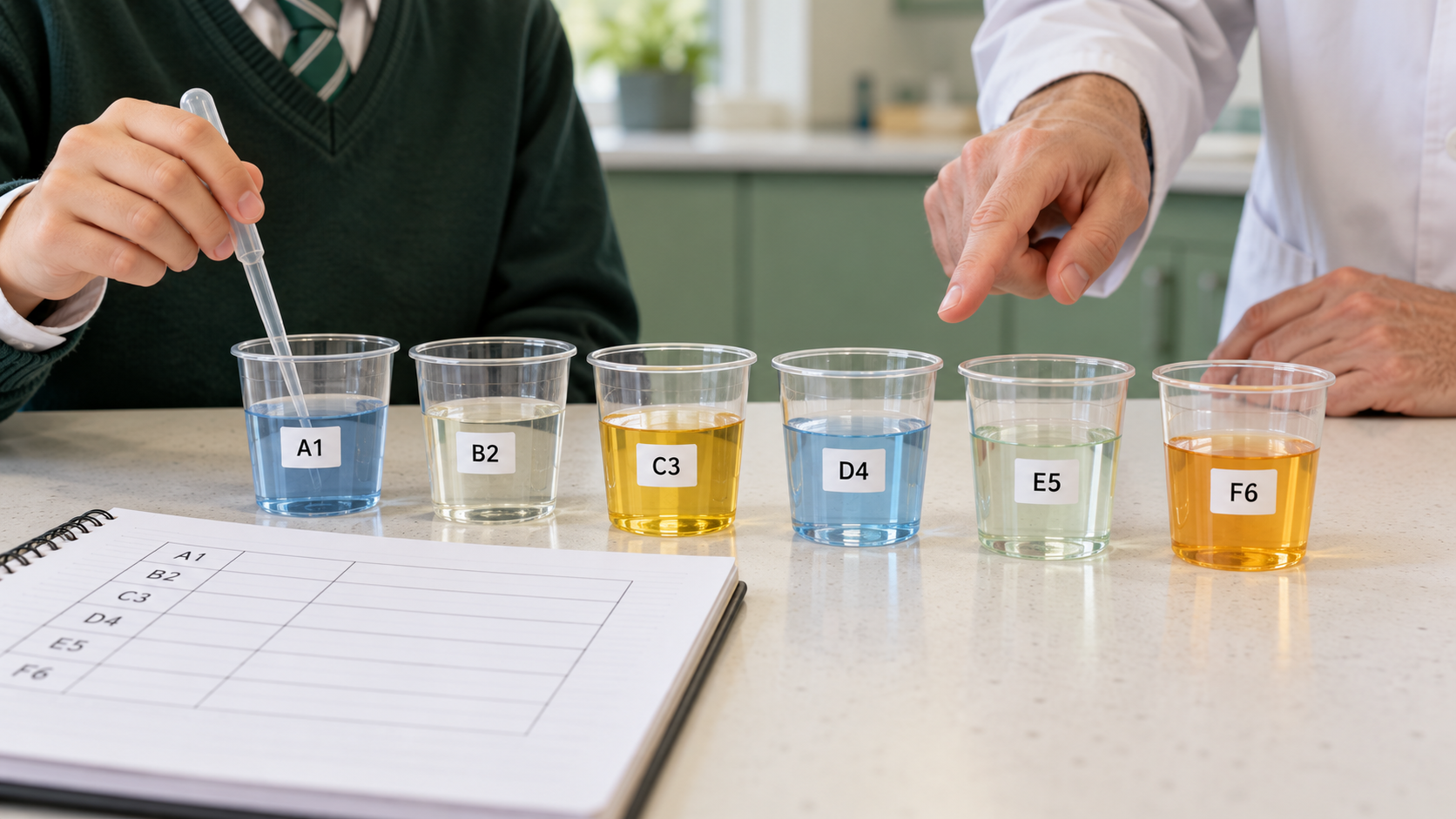
Why can an insoluble salt be obtained from two clear solutions, while a soluble salt may require a completely different preparation method? The choice comes from whether the desired product dissolves in water. If mixing suitable aqueous ions produces an insoluble solid, precipitation and separation are the relevant concepts. If the intended salt remains dissolved, the plan must instead account for removing excess reactants and recovering a pure soluble product.
This independent eduKateSG Ministry of Education V3.0 Reference 397 teaches Topic 5.2 Salts from the official 2027 Singapore–Cambridge SEC G3 Chemistry K324 syllabus. It covers solubility rules for nitrates, Group 1 and ammonium salts, chlorides, sulfates, carbonates and hydroxides; selecting precipitation, acid-with-insoluble-base or carbonate, metal-acid and titration routes; and choosing filtration, crystallisation or evaporation conceptually. Twenty-six original worked cases and a twelve-stage diagnostic method show how to move from target salt to justified starting materials.
This is paper-based instructional chemistry, not a protocol for mixing hazardous solutions outside an authorised laboratory. Some salts and reagents including lead, barium and silver compounds require professional controls and must not be handled or disposed of casually. The article develops a narrower decision skill than the previously published broad Reference 272 and follows the immutable Clementi three-pupil teaching benchmark without modifying it. It is independent of MOE and SEAB.
1. The exact K324 Topic 5.2 syllabus scope
The 2027 syllabus requires describing preparation, separation and purification of salts using precipitation and titration as well as reactions of acids with metals, insoluble bases and insoluble carbonates. It also requires general solubility rules for nitrates, chlorides including silver and lead, sulfates including barium, calcium and lead, carbonates, hydroxides, Group 1 salts and ammonium salts. Candidates must suggest methods using appropriate starting materials. The strongest answer begins by identifying the intended salt’s solubility, then selects a route whose products and purification steps are chemically compatible. Memorising one laboratory recipe without checking solubility does not satisfy the decision task.
2. A salt contains cations and anions in charge balance
In the school framework, salts are ionic compounds whose cations and anions combine to give an electrically neutral formula. Sodium chloride has Na⁺ and Cl⁻ in a one-to-one ratio; calcium chloride has Ca²⁺ and two Cl⁻, giving CaCl₂. A student must formulate the target salt correctly before planning a reaction. If the intended product is copper(II) sulfate, its ions are Cu²⁺ and SO₄²⁻, giving CuSO₄, not Cu₂SO₄. The ion charges determine the formula, and the formula determines which soluble starting materials can supply those ions.
3. Solubility is not the same as reaction speed
A salt’s solubility concerns how much dissolves under stated conditions, while reaction rate concerns how rapidly substances transform. An insoluble precipitate can form rapidly or gradually, and a soluble salt can be made by a fast or slow reaction. The term precipitate describes a solid forming out of solution under appropriate ionic conditions. A student who equates ‘insoluble’ with ‘chemically unreactive’ may reject a perfectly valid precipitation method. First ask whether the product remains in water or can form a solid; time and speed are separate considerations.
4. Nitrates are generally soluble
The standard school solubility rules treat nitrate salts as soluble in water. This makes a nitrate solution a useful conceptual source of a metal cation in certain precipitation equations, though actual reagent hazards must be respected. When a pupil sees nitrate ions NO₃⁻ in an aqueous mixture, they should not automatically claim an insoluble nitrate precipitate. Identify which other ions might form the target insoluble product. The rule is a chemical pattern for ordinary school aqueous conditions, not a guarantee about every concentration or all exotic compounds.
5. Group 1 and ammonium salts are usually soluble
Salts of lithium, sodium and potassium in the familiar Group 1 classification, and ammonium salts containing NH₄⁺, are generally water-soluble under the school rules. Thus sodium chloride and ammonium carbonate are treated as soluble, even though many other metal carbonates do not dissolve readily. A learner who memorises ‘all carbonates insoluble’ without the Group 1 and ammonium exceptions will misclassify important solutions. Use the cation as well as the anion when applying solubility patterns, and state the relevant exceptions where the syllabus specifies them.
6. Chlorides have important silver and lead exceptions
Many chlorides are soluble, but silver chloride AgCl and lead(II) chloride PbCl₂ are named exceptions in the school solubility rules, with lead chloride’s solubility depending on temperature. These exceptions make certain conceptual precipitation reactions possible. A pupil who says ‘chlorides are all soluble’ will predict the wrong observation when Ag⁺ meets Cl⁻. The correct net ionic equation Ag⁺(aq)+Cl⁻(aq)→AgCl(s) shows a solid forming. The accompanying spectator ions generally remain in solution. Silver and lead compounds are not suitable for unsupervised preparation.
7. Sulfate exceptions include barium, lead and calcium
Most common sulfates are soluble, but barium sulfate and lead(II) sulfate are insoluble in the familiar school rule, while calcium sulfate is sparingly soluble and often treated as an exception. A strong answer names the specific salt and recognises that solubility is not always binary in more detailed chemistry. Barium sulfate can be represented by Ba²⁺(aq)+SO₄²⁻(aq)→BaSO₄(s). This net ionic equation expresses precipitation, not an operational instruction to handle potentially hazardous barium reagents. Always follow the actual syllabus rule rather than saying every sulfate dissolves.
8. Carbonates have Group 1 and ammonium exceptions
Most common metal carbonates are insoluble, including calcium carbonate and copper(II) carbonate in familiar examples. Group 1 carbonates and ammonium carbonate are generally soluble. This explains why one may supply carbonate ions from sodium carbonate solution in a paper precipitation calculation while the chosen target carbonate forms a solid. A pupil who proposes a precipitate of sodium carbonate from ordinary aqueous sodium and carbonate ions has ignored the soluble exception. Solubility rules are applied to the whole cation–anion combination, not to an ion name in isolation.
9. Hydroxides have several practical exceptions
Many metal hydroxides are poorly soluble in water. Group 1 hydroxides are soluble alkalis; calcium hydroxide is only sparingly soluble but can give an alkaline solution and appears in school discussions. Aqueous sodium hydroxide can therefore supply OH⁻ ions for precipitation of various metal hydroxides in conceptual qualitative analysis. A student should not assume every hydroxide forms a solid or that all metal hydroxides dissolve freely. The relevant cation and the stated school solubility information determine the prediction. Detailed industrial separation is outside this course.
10. Precipitation begins with soluble ion sources
To obtain an insoluble salt conceptually, select two suitable aqueous solutions whose ions can combine to form the intended solid. The net ionic equation isolates the ions actually producing the precipitate; remaining spectator ions remain in the liquid. The method differs from making a soluble salt, because the desired product can be separated as a solid. A student should identify the target cation and anion before choosing their source solutions, then check that the unwanted remaining ions stay dissolved rather than forming a second competing precipitate. The goal is selectivity, not arbitrary mixing.
11. A net ionic equation identifies what forms the solid
For AgCl precipitation, the net ionic equation is Ag⁺+Cl⁻→AgCl(s). The total charge is zero on both sides, and silver and chlorine atom counts are conserved. For BaSO₄, it is Ba²⁺+SO₄²⁻→BaSO₄(s). Such equations explain what forms the solid without writing every spectator ion in the reaction vessel. A student should not include Na⁺ or NO₃⁻ in the precipitate simply because they are present in the starting solutions. Distinguish reacted ions from unchanged dissolved ions.
12. Filtration separates an insoluble solid from its liquid
When a precipitate forms in a conceptual school method, filtration can separate the solid residue from the liquid filtrate. The desired insoluble salt remains with the residue in the usual simple case. This is different from using filtration to recover a soluble salt that passed through with the liquid; that dissolved product would need a different recovery method. The terms residue and filtrate should be attached to where the target product actually is. Real procedures, especially with hazardous compounds, require laboratory supervision and appropriate disposal.
13. Soluble salts often need crystallisation rather than filtration
When the intended salt is dissolved in the reaction mixture, ordinary filtration does not collect it as residue. Instead, a conceptual recovery plan may concentrate an appropriate solution and allow the salt to crystallise under controlled conditions, followed by suitable separation and drying. A pupil should choose the method based on whether the product is in solution and whether a suitable crystallisation process is possible. Heating until completely dry is not universally safe or suitable, because certain substances can decompose or be affected by excessive heat. The examination asks for method selection, not unsafe replication.
14. An excess insoluble base can be separated
To prepare a soluble salt from an acid and an insoluble base such as a suitable metal oxide, the conceptual school method can use an excess of the insoluble solid so that remaining acid is consumed. Any unreacted solid can then be separated from the salt solution by filtration, followed by suitable crystallisation of the dissolved product. The excess is useful because it is physically separable. This logic differs from adding excess soluble alkali, whose dissolved hydroxide cannot simply be filtered out. A student should explain why excess reactant choice affects purity and separation.
15. Insoluble carbonates can provide soluble salts
A suitable insoluble metal carbonate reacts with an acid to produce a salt, carbon dioxide and water. In the classroom example CaCO₃+2HCl→CaCl₂+CO₂+H₂O, calcium chloride is soluble in the school rule. The conceptual plan must account for gas evolution, separation of any unreacted solid and recovery of dissolved product. It is not appropriate to assume every carbonate-containing mixture will yield a precipitate as the product; the carbonate is a reactant being consumed here. Identify the intended salt and its solubility after the reaction.
16. Acid with a suitable metal is another recognised route
Certain reactive metals can react with dilute acids to form soluble salts and hydrogen under suitable conditions, for example Mg+2HCl→MgCl₂+H₂ in a paper equation. Whether a particular metal is suitable depends on its reactivity and the acid involved. A student should not choose copper with dilute hydrochloric acid as though it behaves exactly like magnesium, and should not ignore the flammable gas produced in a real reaction. The syllabus wants a justified route and product, not an experimental recipe for generating hydrogen. Unsupervised metal-acid reactions are inappropriate.
17. A soluble alkali requires a different purity strategy
A soluble acid and a soluble alkali can both remain in solution, so an excess of either cannot simply be removed by filtering. In the school model, titration determines the relevant reacting amounts under an authorised laboratory procedure, allowing a suitable neutral salt solution without an uncontrolled excess. For HCl and NaOH, the balanced equation is HCl+NaOH→NaCl+H₂O. The resulting salt is soluble, so an appropriate controlled crystallisation concept follows. This route is different from recovering an insoluble precipitate. Specific practical volumes, strengths and handling belong to a supervised laboratory.
18. Indicators and titration endpoint are different from crystals
An indicator can help reveal an acid-base endpoint in a titration, but the indicator itself is not the desired salt and can contaminate a final sample. In some school preparations, a known reacting volume relationship can be used to repeat a neutralisation under appropriate conditions without an indicator for the final pure solution. This is a conceptual purity distinction, not instructions for performing titration without supervision. A pupil should understand why the method determines amounts, why filtration of a fully dissolved salt does not recover it, and why a coloured solution may not be the purest final material.
19. Choosing the acid determines the salt’s anion
Hydrochloric acid provides chloride ions in simple salt preparations, sulfuric acid sulfate ions, and nitric acid nitrate ions. The metal ion or ammonium component determines the cation. Therefore a question asking for copper(II) sulfate should not begin with hydrochloric acid and expect sulfate to appear spontaneously. A student should construct the target ionic formula, identify the needed anion, and choose appropriate starting materials that supply both ions through a valid reaction. The matching is chemical bookkeeping before any experiment or separation technique is considered.
20. Solubility exceptions should be checked before precipitation claims
A student may correctly write a balanced ionic combination yet predict a solid that remains soluble. For instance, sodium chloride is soluble and does not precipitate merely because Na⁺ and Cl⁻ coexist in ordinary aqueous solution. Silver chloride, by contrast, is an insoluble exception and may form a precipitate under suitable conditions. Likewise barium sulfate is insoluble while sodium sulfate is soluble. A real prediction requires the complete salt identity and the relevant rule, not the simplistic idea that joining any two ions creates a visible solid.
21. Crystal recovery is distinct from chemical reaction
Chemical synthesis produces the target salt ions; crystallisation is a physical technique to obtain a solid from a suitable solution. The salt’s chemical formula need not change when crystals form, though hydration or decomposition can matter in particular real salts. A pupil who labels crystallisation as the reaction that produces chloride ions has confused reaction with separation. School questions may present both stages together, but a good answer separates the chemistry of forming the dissolved salt from the physical process of recovering and purifying it. This distinction makes method comparisons intelligible.
22. A pure insoluble precipitate needs separation of spectators
Precipitation creates a solid in a liquid that can also contain dissolved spectator ions. Filtering separates most liquid from the solid, and suitable washing under controlled laboratory conditions may help reduce soluble impurities. The key chemistry is that the desired insoluble salt stays solid while unwanted soluble ions remain in the liquid. A student should not claim precipitation alone guarantees analytical purity or that any recovered solid is safe to touch. The precise purification method and waste handling depend on the actual materials and supervision.
23. Method choice is a decision tree based on target solubility
For a target insoluble salt, choose suitable soluble ion sources and precipitation, then separate the solid. For a target soluble salt, consider an appropriate acid-plus-insoluble-reactant route if a separable excess is possible, or a titration method when both acid and alkali are soluble. Check whether the chosen metal actually reacts with the acid and whether carbonate or oxide supplies the desired cation. Finally choose a recovery technique based on where the target salt is after the reaction. There is no universal recipe for all salts; each branch follows from chemical properties.
24. Transfer means defending a new choice of starting materials
After predicting AgCl precipitation, a learner should be able to choose a different method for a soluble nitrate or sulfate, and explain why filtration or titration is appropriate or inappropriate in each. They should name target cation and anion, consult solubility exceptions, select a suitable reaction family, identify whether product is solid or dissolved, and decide on conceptual separation and purification. This transfers the syllabus skill to unfamiliar salts without memorising a list of isolated procedures. The tutor should correct the first mistaken decision in the chain rather than only the final method name.
25. Twelve-stage Target–Solubility–Recovery method
Stage 1 — Write the target salt formula
Balance its cation and anion charges before choosing reagents.
Stage 2 — Apply general solubility rules
Check nitrates, Group 1, ammonium, chloride, sulfate, carbonate and hydroxide exceptions.
Stage 3 — Decide soluble versus insoluble target
This first choice controls whether precipitation or solution recovery is likely.
Stage 4 — Choose a suitable reaction family
Precipitation, metal-acid, insoluble base/acid, carbonate/acid or titration.
Stage 5 — Identify both ion sources
Ensure the intended salt’s cation and anion actually occur among starting materials.
Stage 6 — Check reacting suitability and products
Avoid assuming every metal reacts with every acid or all ions precipitate.
Stage 7 — Balance the chemical or net ionic equation
Keep atom counts and electrical charge consistent.
Stage 8 — Identify the product’s physical location
An insoluble precipitate is solid; a soluble salt remains in the liquid.
Stage 9 — Select the separation technique
Filter a solid residue or retain a soluble salt solution appropriately.
Stage 10 — Choose the conceptual recovery step
Crystallisation may recover a soluble salt; precipitation may need solid purification.
Stage 11 — Identify hazards and purity limits
Chemical preparation and waste handling require authorised laboratory supervision.
Stage 12 — Transfer the decision to an unseen salt
Defend the complete route using the target and solubility evidence.
26. Fictional three-pupil salt-selection tutorial
Three imaginary G3 Chemistry students work from a printed list of target salts rather than conducting chemical experiments. Pupil A uses ion charges to write the intended formulas and marks soluble exceptions. Pupil B chooses a precipitation route for an insoluble product and writes the net ionic equation. Pupil C explains why a soluble sodium salt cannot be recovered as a precipitate and when a titration or acid-plus-insoluble-base route might be considered conceptually. Roles rotate, then each pupil independently designs a paper-only route to a different salt and states where its product would be after reaction. The tutor diagnoses whether the first error was formula, solubility, starting ions, reaction type or product recovery.
27. Twenty-six original worked examples
Worked Example 1 — Formula of calcium chloride
Ca²⁺ combines with two Cl⁻ to give neutral CaCl₂. The salt formula is not CaCl or Ca₂Cl, because charge balance determines the ratio before any preparation route is selected.
Worked Example 2 — Formula of copper(II) sulfate
Cu²⁺ and SO₄²⁻ balance in a one-to-one ratio, producing CuSO₄. This identifies the copper cation and sulfate anion that suitable starting materials must provide.
Worked Example 3 — Sodium nitrate is soluble
NaNO₃ is treated as water-soluble because it is a nitrate and also a Group 1 salt. Predicting it as an ordinary precipitate from aqueous sodium and nitrate is inconsistent with both general rules.
Worked Example 4 — Ammonium carbonate is soluble
The familiar school rule treats ammonium salts as soluble. Thus (NH₄)₂CO₃ is a soluble exception to the broad observation that many metal carbonates are insoluble.
Worked Example 5 — Silver chloride precipitation
Ag⁺(aq)+Cl⁻(aq)→AgCl(s) describes an insoluble silver chloride solid forming. Silver chloride is an exception to the general chloride-solubility rule; spectator ions are omitted.
Worked Example 6 — Lead chloride exception
PbCl₂ is a named low-solubility chloride in the course comparison, with appreciable temperature dependence. It is not classified by the unrestricted statement that all chlorides are readily soluble.
Worked Example 7 — Barium sulfate precipitation
Ba²⁺(aq)+SO₄²⁻(aq)→BaSO₄(s) is the net ionic relationship for a barium sulfate solid. Real barium reagents are hazardous; this is an equation interpretation, not an experiment.
Worked Example 8 — Lead sulfate exception
PbSO₄ is treated as an insoluble sulfate in the school rules. A hypothetical aqueous mixture containing compatible Pb²⁺ and sulfate ions can form a precipitate under suitable conditions.
Worked Example 9 — Calcium sulfate’s limited solubility
CaSO₄ is less soluble than many common sulfates and appears as an exception in the syllabus. A student should not predict its behaviour using the oversimplified slogan all sulfates dissolve.
Worked Example 10 — Sodium sulfate remains dissolved
Na₂SO₄ is treated as soluble because sodium is a Group 1 cation. Mixing ordinary aqueous sodium and sulfate sources does not create an insoluble sodium sulfate precipitate.
Worked Example 11 — Calcium carbonate as insoluble salt
CaCO₃ is a familiar insoluble carbonate, contrasting with soluble sodium and ammonium carbonates. It can be represented as Ca²⁺+CO₃²⁻→CaCO₃(s) in a conceptual precipitation equation.
Worked Example 12 — Copper carbonate as insoluble
The general school rule treats CuCO₃ as an insoluble carbonate. It is not a soluble salt simply because its cation and anion can be written in a balanced formula.
Worked Example 13 — Sodium carbonate exception
Na₂CO₃ is soluble in the school rule because the cation belongs to Group 1. A student who expects sodium carbonate solid upon mixing aqueous Na⁺ and CO₃²⁻ has ignored the exception.
Worked Example 14 — Copper hydroxide precipitate
Cu²⁺+2OH⁻→Cu(OH)₂(s) shows a common insoluble hydroxide precipitate. The two hydroxide ions are necessary to balance charge against Cu²⁺.
Worked Example 15 — Sodium hydroxide remains soluble
NaOH is a soluble Group 1 hydroxide and an alkali. Its dissolved OH⁻ can react with suitable metal ions to form other insoluble hydroxides, but NaOH itself is not generally the intended precipitate.
Worked Example 16 — Ammonium salt solubility
NH₄Cl is soluble in the named ammonium-salt rule, even though AgCl is not. The cation must be checked before concluding all chlorides or ammonium salts behave the same.
Worked Example 17 — Acid plus magnesium example
Mg+2HCl→MgCl₂+H₂ is a balanced paper equation for a suitable reactive metal and acid. MgCl₂ is soluble, so product recovery is not as an insoluble salt residue.
Worked Example 18 — Acid plus copper oxide example
CuO+H₂SO₄→CuSO₄+H₂O describes a basic oxide and acid producing soluble copper(II) sulfate. Conceptually, an excess insoluble oxide can be separated from the salt solution before appropriate crystallisation.
Worked Example 19 — Acid plus a carbonate
CaCO₃+2HCl→CaCl₂+CO₂+H₂O produces soluble calcium chloride, water and carbon dioxide. This is not the same as precipitating calcium carbonate from aqueous ions.
Worked Example 20 — Acid plus insoluble oxide route
ZnO+2HNO₃→Zn(NO₃)₂+H₂O is a conceptual acid–basic oxide equation for zinc nitrate, which is soluble under the nitrate rule. Hazardous reagent handling is not part of the exercise.
Worked Example 21 — Soluble alkali and acid
HCl+NaOH→NaCl+H₂O shows a neutralisation route to soluble sodium chloride. A titration-type approach can establish reacting amounts when both reactants are dissolved; filtration alone does not recover NaCl.
Worked Example 22 — Sulfuric acid and potassium hydroxide
H₂SO₄+2KOH→K₂SO₄+2H₂O is a balanced conceptual route to soluble potassium sulfate. The coefficients follow the acid’s two relevant hydrogens and two hydroxide ions.
Worked Example 23 — A nitrate’s salt-anion source
For a target nitrate, a suitable nitrate-providing acid is nitric acid in the school acid–salt naming framework. A hydrochloric-acid choice would supply chloride rather than the desired nitrate.
Worked Example 24 — Residue versus filtrate
An insoluble precipitate recovered by conceptual filtration is the residue, while dissolved spectator ions remain in the filtrate. If the target is soluble, the target may instead pass through into the filtrate.
Worked Example 25 — Crystallisation after soluble product formation
If the desired salt remains dissolved after reaction, appropriate controlled crystallisation can recover solid salt from solution. Simply collecting the filter residue would miss the dissolved product.
Worked Example 26 — Independent unknown-salt transfer
Given a target insoluble BaSO₄, identify Ba²⁺ and SO₄²⁻, choose suitable soluble sources, write Ba²⁺+SO₄²⁻→BaSO₄(s), and explain conceptually why separation of the solid is appropriate.
28. Ten common errors and precise repairs
1. Choosing a method before determining target solubility
Start with the intended salt formula and its rule. An insoluble target suggests precipitation, while a soluble target generally needs a solution-formation and recovery strategy. The order of decisions matters.
2. Treating all nitrates as insoluble
Nitrates are generally soluble under the school rules. A nitrate should not be predicted as a routine precipitate without specific contrary evidence.
3. Forgetting Group 1 and ammonium exceptions
Many carbonates and hydroxides are insoluble, but Group 1 and ammonium salts have important solubility exceptions. Check the cation as well as the anion.
4. Calling every chloride and sulfate soluble
Silver and lead chlorides and barium, lead and calcium sulfates require special attention under the named syllabus exceptions. Use the correct material.
5. Forgetting to balance ionic formula charges
A salt is electrically neutral. For Ca²⁺ and Cl⁻, the formula is CaCl₂. Correct formula-writing is prerequisite to balanced chemical equations.
6. Filtering to collect a dissolved salt
A dissolved soluble product normally travels with the filtrate rather than remain as solid residue. Choose crystallisation concepts when appropriate instead of treating filtration as universal recovery.
7. Using excess soluble alkali as though it can be filtered
Excess dissolved hydroxide cannot simply be separated like unreacted insoluble oxide. Titration addresses reacting quantities when acid and alkali are both soluble.
8. Calling bile or any unrelated reagent a salt ion source
Each chosen reactant must supply the target salt’s cation or anion through the stated chemical reaction. Naming unrelated substances cannot produce missing ions.
9. Claiming precipitation guarantees perfect purity
A precipitate may retain dissolved impurities or solvent, so controlled separation and appropriate purification matter. The syllabus requires more than naming the reaction.
10. Treating a paper reaction as permission for unsafe preparation
Lead, barium, silver, concentrated acids and reactive metals have hazards. The reference explains academic method selection, not home chemical mixing or waste disposal.
29. Ninety-minute three-pupil learning sequence
Begin by identifying ion charges and writing target-salt formulas. Give pupils a mixed list of nitrates, chlorides, sulfates, carbonates and hydroxides, and ask which are soluble with stated exceptions. Use a comparison between an insoluble silver salt and a soluble sodium salt so students must choose different methods. Rotate the roles of solubility checker, equation writer and recovery-method reviewer. Add acid-with-insoluble-base and acid-with-carbonate conceptual problems, then a titration scenario to show why dissolved excess cannot simply be filtered away. Finish with an unfamiliar salt choice and require each pupil to defend a complete paper-only preparation plan. Feedback targets the first wrong decision in target identity, solubility, reacting ions or purification.
30. Depth–Load–Transfer diagnostic
Depth means knowing why solubility controls preparation and why the target salt’s ions must come from the starting materials. Load asks a student to coordinate formula charges, solubility exceptions, reaction family, product phase, possible excess reactant and physical recovery. Transfer requires a new target salt and no prompt specifying precipitation or titration. A learner who can justify the whole chain—not only give one method name—has mastered the 2027 Topic 5.2 decision skill. The tutor should explain what a chosen method removes or retains, then retest with a different soluble or insoluble target.
31. Independent practice and answer checks
Classify the solubility of NaNO₃, NH₄Cl, AgCl, BaSO₄, CaCO₃, Na₂CO₃ and Cu(OH)₂. Write balanced formulas and net ionic equations for silver chloride, barium sulfate and copper(II) hydroxide precipitation. Explain why a sodium salt typically remains dissolved when suitable aqueous sources are mixed, and why acid reacting with an excess insoluble oxide can allow separation of the unreacted solid. Finally compare the conceptual route for a soluble salt from acid plus alkali against the route for an insoluble salt from soluble ions. Each answer should name the target phase and subsequent recovery method rather than recite a laboratory recipe.
32. Frequently asked questions
What is the first decision in preparing a salt?
Determine the target salt’s formula and solubility under the stated conditions.
How is an insoluble salt usually considered?
A suitable precipitation route from soluble ion sources, followed by separation and appropriate purification.
How is a soluble salt considered?
A valid salt-forming reaction with suitable excess management, followed by appropriate recovery such as crystallisation.
Why is titration useful?
It establishes reacting quantities when both acid and alkali are soluble, avoiding uncontrolled soluble excess in the final product.
Are all nitrates soluble?
Yes, nitrates are treated as generally soluble in the school solubility rules.
Which chlorides are notable exceptions?
Silver and lead chlorides, with solubility details that depend on conditions.
Which sulfates are exceptions?
Barium and lead sulfates are insoluble, and calcium sulfate is only sparingly soluble.
Are all carbonates insoluble?
No. Group 1 and ammonium carbonates are generally soluble exceptions.
What does filtrate mean?
The liquid that passes through a filter, potentially carrying dissolved salts and spectator ions.
Is this a home laboratory procedure?
No. It is paper-based chemistry; authorised laboratory safety and supervision are needed for any real preparation.
33. Closing principle
A successful salt-preparation answer works backward from the target. Form the correct ionic formula, check solubility, choose a reaction that supplies both ions, balance the equation, locate the product and choose a separation method that actually recovers it. Precipitation, filtration, titration and crystallisation are not interchangeable techniques. Their correct use follows directly from the product’s chemical and physical properties. This reasoning is transferable to new salts and remains consistent with the exact 2027 syllabus.
Official 2027 syllabus and connected eduKateSG references
Official SEAB 2027 G3 Chemistry K324 Topic 5.2 Salts · Reference 272 — Broad Salt Preparation Overview · Reference 385 — Acids and Bases · MOE V3.0 Reference Library · Immutable Clementi three-pupil standard.