
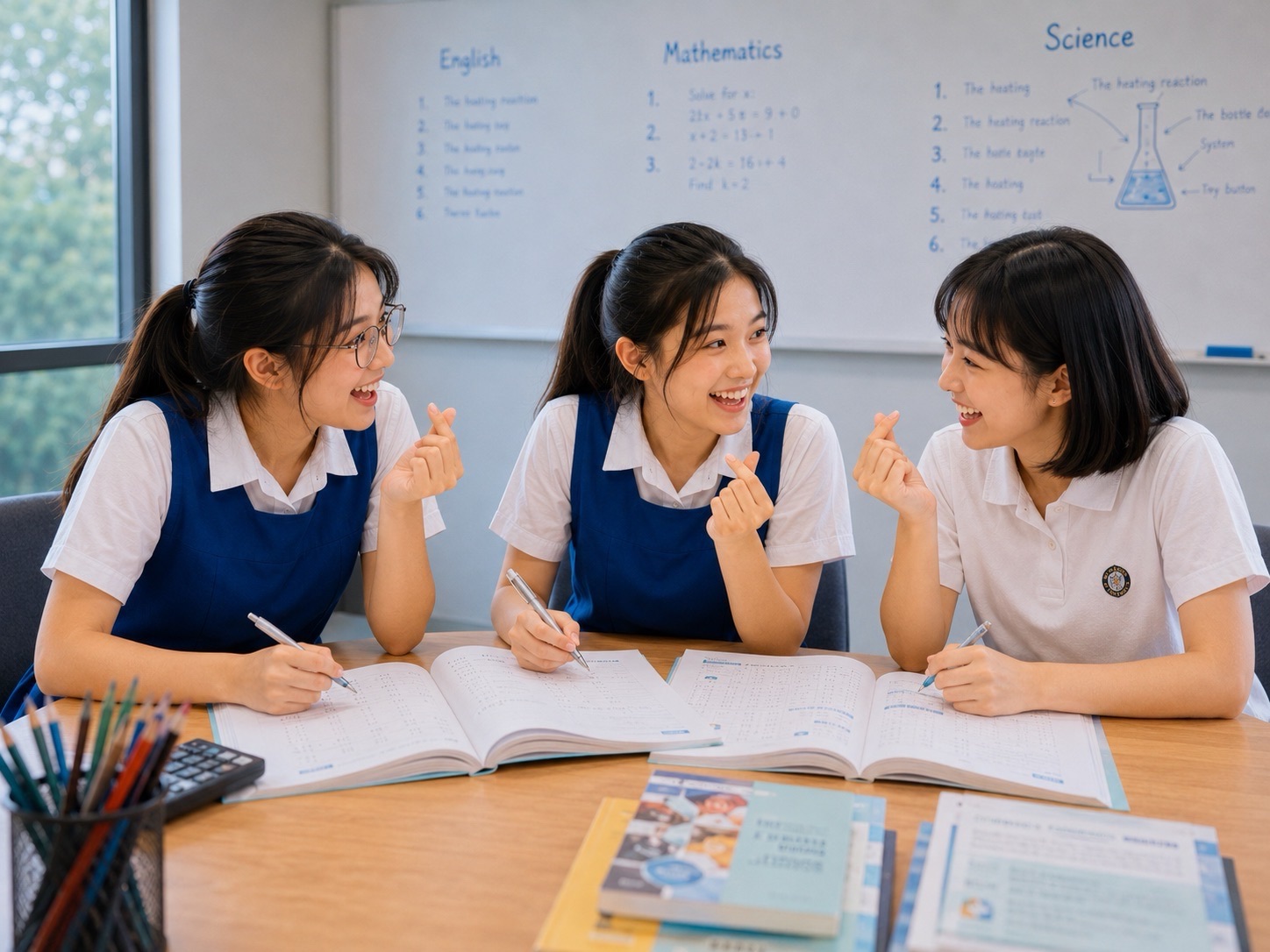
Mathematics Tuition in Bukit Timah is more than extra practice. The eduKateSG framework connects mathematical language, branches, modelling, teaching and studying to explain how tuition repairs gaps, strengthens understanding and keeps future learning routes open. Discover the absolute purpose of Mathematics Tuition in Bukit Timah: diagnose learning gaps, restore mathematical continuity and prepare students for future pathways.
The Complete Mathematics Tuition Picture
From Mathematics itself to the reason a student may need tuition
To understand Mathematics Tuition properly, we must first understand the structure being taught. Mathematics is a connected system for representing quantity, structure, space, change and uncertainty. Its ideas accumulate. Its language becomes more compressed. Its later corridors depend on earlier foundations.
Tuition becomes useful when a learner’s access to this structure is incomplete, unstable or insufficiently challenging. Its role is to diagnose the actual state, restore or extend the route, and gradually return control to the student.
01 / The Subject
Mathematics is one connected system, not a pile of calculations.
Calculation is important, but it is only one operation inside Mathematics. Students also learn to recognise patterns, represent relationships, move between words and symbols, justify conclusions, model changing systems, interpret uncertainty and test whether an answer remains reasonable.
The linked eduKateSG series builds the whole picture. It moves from what Mathematics studies and how its language works, through its major branches and the relationship between pure and applied Mathematics, into mathematical modelling, teaching, studying and the larger Civilisational Conversation.
02 / The Corridor
Mathematical chapters are separate on the page, but connected inside the learner.
Whole numbers support fractions. Fractions support ratio and percentage. Arithmetic supports algebra. Algebra supports equations, functions and graphs. Geometry supports trigonometry. These structures later enter calculus, modelling, science, computing, engineering, economics and data analysis.
An earlier weakness therefore travels. The visible problem may appear in Secondary 3 while the actual break began years earlier. This is why helping only with the latest assignment can miss the real beginning of the difficulty.
03 / The Absolute Reason
Mathematics Tuition protects learning continuity.
Continuity does not mean that a student never struggles. Productive struggle is part of learning. Continuity means the student has enough prior structure to understand the difficulty, expose the error, receive correction and continue into the next relationship.
When continuity breaks, the learner begins depending on familiar question shapes, excessive prompts and memorised movements. Mathematics becomes unpredictable because the student can no longer see a reliable route from the information given to the relationship required.
04 / Diagnosis
More work is not always the answer. First identify how the route broke.
A student may complete many questions using an unstable internal model. Practice then increases speed without increasing understanding. The weakness returns when the examination changes the representation, combines topics or asks the learner to explain the reasoning.
Each failure requires a different response. Reconstruction is different from variation. Translation support is different from examination pacing. Good tuition identifies the failure type instead of treating every wrong answer as the same problem.
05 / Beneath the Mark
A score reports performance. Tuition must reopen the learning system beneath it.
Two students can receive the same mark for different reasons. One may have a single severe gap. Another may have many small weaknesses. A third may understand the Mathematics but lose control under timed conditions. A fourth may score well through familiar routines while remaining vulnerable to unfamiliar questions.
The score is useful, but compressed. Diagnosis asks where the marks were lost, which errors are connected, what remains secure, what depends on support and which weakness will become more consequential at the next level.
06 / Safe Acceleration
Mathematics Tuition can shorten unnecessary distance without removing prerequisites.
Students already enter a civilisational corridor: they learn in years what humanity required centuries to develop. Tuition creates a local version of this compression. A tutor can identify the earliest weak link, reorganise the sequence, remove avoidable confusion and select examples that reveal the relationship more clearly.
But safe acceleration carries the prerequisites forward. Moving a child into harder material without the supporting structure is not progress. It is displacement: the student appears further ahead while becoming more fragile.
07 / The Student Route
There are three legitimate reasons to enter Mathematics Tuition.
These routes should not be mixed carelessly. The repair student should not be overwhelmed by premature acceleration. The strengthening student should not remain trapped in repetitive basic practice. The stretch student should not simply receive more of the same work.
08 / Level Pathway
Each Mathematics level changes the structure the student must carry.
Read below
Read below
Read below
Read below
Read below
Read below
09 / Bukit Timah
Bukit Timah students do not all need more pressure. They need a clearer map.
Students in Bukit Timah move through different schools, programmes and pathways. Some are recovering. Some are preparing for Full Subject-Based Banding transitions, SEC years, Integrated Programme demands, IB or IGCSE work. Some are performing strongly but becoming less stable as Mathematics grows more abstract.
In a high-expectation environment, uncertainty can remain hidden. A student copies the method, completes the assigned work and maintains a reasonable score while the internal route becomes less clear. The problem often becomes visible only when Mathematics changes phase.
10 / Teaching and Studying
Teaching opens the route. Studying must stabilise it.
A complete tuition system connects explanation with independent attempt, visible error, accurate correction, retry, changed context, later retrieval and transfer. The student should not merely understand while the tutor is present. The learning must survive after support is removed.
The final movement is from coached performance to mathematical agency: from asking which formula to use towards identifying the relationship; from waiting for confirmation towards checking whether the answer is reasonable.
11 / Connected eduKateSG Series
Read the complete Mathematics picture.
These articles form one connected route. Together, they explain the subject being inherited, the language through which it travels, the ways it is applied, and the teaching and study systems required to reconstruct it inside a learner.
12 / Continue Deeper
The introduction gives the map. The full article examines the route.
The long article below now follows the same architecture in greater depth: Mathematics as a corridor, the absolute reason of continuity, the nine ways a route can break, the score as compression, tuition as a safe wormhole, the role of school, the needs of capable students, future optionality, every school level and the final movement towards independence.
Choose One Next Step
Enter the route closest to your child.
Use the full article for the deeper explanation, or begin with the section that matches the learning state you are seeing now.
Mathematics tuition is often explained too simply.
A child is weak in Mathematics, so the family finds a tutor.
The marks improve.
The problem appears to be solved.
But this explanation does not reach the real reason Mathematics tuition exists.
Mathematics is cumulative. Every new idea depends on structures learned earlier. When one of those structures is missing, weak or incorrectly connected, later learning becomes unstable.
The student may still attend school.
They may still complete homework.
They may even pass examinations.
But inside the learning system, the route is beginning to fracture.
Mathematics tuition exists to find that fracture, restore continuity and rebuild the student’s ability to move forward.
That is its absolute purpose.
Mathematics tuition exists to preserve a student’s access to the mathematical corridor.
It is not merely extra teaching.
It is not simply more practice.
It is not a parallel school.
It is a carefully designed intervention that helps a student recover, strengthen or extend the structures required for the next stage of learning.
In Bukit Timah, where many students move through academically demanding schools, accelerated programmes, Full Subject-Based Banding pathways, Integrated Programme environments and increasingly complex Secondary Mathematics, this distinction matters.
The question is not only whether the student can complete today’s worksheet.
The deeper question is whether the student’s mathematical system is strong enough to carry what comes next.
This is the Bukit Timah Mathematics philosophy and parent-decision flagship. It explains why tuition can be useful, how to distinguish repair from strengthening or extension, and why more worksheets are not automatically the answer. It is not the year-level class owner. Use the Bukit Timah Secondary Mathematics and A-Math directory to choose the student’s year and subject route.
For students already in Additional Mathematics, the commercial spine begins at Additional Mathematics Tutorials in Bukit Timah. For Secondary 1 Mathematics, the transition route begins with The Phase Shift from PSLE to Algebra.
Mathematics Is a Corridor, Not a Collection of Chapters
A school textbook presents Mathematics as a sequence of topics.
Whole numbers.
Fractions.
Ratio.
Percentage.
Algebra.
Geometry.
Graphs.
Functions.
Trigonometry.
Calculus.
Students may experience these as separate chapters. But the chapters are not truly separate.
They form a connected corridor.
Fractions affect ratio.
Ratio affects percentage.
Percentage affects rate and financial Mathematics.
Arithmetic affects algebra.
Algebra affects equations.
Equations affect functions.
Functions affect graphs.
Graphs affect calculus and modelling.
Geometry supports trigonometry.
Trigonometry supports vectors, mechanics and advanced Mathematics.
A weakness in an earlier topic does not remain politely inside that chapter.
It travels.
A student who never developed a stable sense of fractions may later struggle with algebraic fractions.
A student who memorised ratio procedures without understanding proportional relationships may later struggle with gradients, rates and similar figures.
A student who can manipulate equations mechanically but does not understand equivalence may collapse when the question is presented in an unfamiliar form.
The visible difficulty may appear in Secondary 3.
The actual break may have begun in Primary 5.
This is why Mathematics tuition cannot be reduced to helping with the latest school assignment.
The latest assignment is often only where the earlier weakness becomes visible.
The tutor must find the real beginning of the problem.
The Absolute Reason: To Protect Learning Continuity
The deepest reason for Mathematics tuition is learning continuity.
A student must be able to move from one mathematical structure into the next without repeatedly falling through hidden gaps.
Continuity does not mean that the child never struggles.
Struggle is part of learning.
Continuity means the student has enough prior structure to understand the struggle, correct the error and continue moving.
When continuity breaks, several things happen.
The student begins relying on memory instead of understanding.
They wait for familiar question shapes.
They become anxious when the wording changes.
They need more prompts.
They make errors that appear careless but are actually structural.
They may understand the teacher during the lesson but cannot reproduce the method independently later.
Eventually, Mathematics starts to feel unpredictable.
The child may say:
“I understood this yesterday.”
“This question looks different.”
“I do not know where to start.”
“I studied, but the marks still changed.”
These are not always signs that the child needs more effort.
They may indicate that the route through the subject is no longer continuous.
Good Mathematics tuition restores that route.
Mathematics Tuition Is Not Repetition
A weak tuition model repeats school.
The school teaches a topic.
The tuition centre teaches the same topic again.
The student receives another worksheet.
If the student still struggles, more questions are added.
This may help when the problem is simply insufficient practice.
But many mathematical problems are not practice-volume problems.
They are structural problems.
A student may complete fifty questions using the wrong internal model.
They may become faster at a method they do not understand.
They may memorise more question types while becoming less capable of handling unfamiliar ones.
Repetition without diagnosis can make a fragile system look stable.
The student improves while the questions remain familiar.
The weakness returns when the examination changes the representation, combines several topics or requires an explanation.
The purpose of Mathematics tuition is therefore not to repeat the classroom louder or more slowly.
It is to determine what kind of intervention is actually required.
Does the student lack knowledge?
Do they understand the concept but fail to recognise when it applies?
Can they solve the question but not explain their reasoning?
Is the difficulty mathematical, linguistic or regulatory?
Is the student rushing?
Are they overloaded?
Is there one missing idea or an entire broken sequence?
Until these questions are answered, more worksheets may create activity without creating progress.
The Nine Ways a Mathematical Route Can Break
A wrong answer is only the visible output.
Underneath it, the learning system may have failed in different ways.
1. Missing-Node Gap
A concept was never properly learned.
The student may have missed a lesson, forgotten an earlier topic or memorised a procedure without forming the concept underneath it.
For example, a student may know how to cross-multiply but not understand equivalent fractions.
2. Broken-Edge Gap
The student knows two ideas but cannot see how they connect.
They may understand ratio and understand algebra separately, but fail when ratio must be represented algebraically.
3. Weak-Link Gap
The relationship exists, but it is unreliable.
The student can sometimes apply the method correctly, but small changes in wording or difficulty cause it to collapse.
4. Wrong-Edge Gap
The student has formed an incorrect connection.
They may believe that every percentage increase should be added directly, or that moving a term across an equation automatically changes its sign without understanding the operation being performed.
5. Routing Gap
The student possesses the necessary knowledge but cannot decide where to begin.
This is common in multi-step questions.
6. Translation Gap
The student cannot convert words, diagrams, tables or real-world contexts into mathematical form.
The Mathematics may be within reach, but the representation blocks access.
7. Transfer Gap
The student can solve familiar examples but cannot apply the idea to a new question.
This often appears when assessment questions become less predictable.
8. Calibration Gap
The student does not accurately judge difficulty, accuracy or completeness.
They may spend too long on a simple question, rush a difficult one or fail to check an answer that is obviously unreasonable.
9. Regulation Gap
The student understands the Mathematics but loses control under time pressure, frustration or cognitive overload.
These failures require different responses.
A child with a missing concept needs reconstruction.
A child with a routing problem needs decision frameworks.
A child with a transfer problem needs variation.
A child with a regulation problem may need pacing, sequencing and confidence restoration.
Good Mathematics tuition does not merely mark answers right or wrong.
It identifies the failure type.
Mathematics Tuition Reopens the Score
Schools must compress performance into marks, grades and achievement levels.
This is necessary for reporting and progression.
But a score is not the learning system itself.
A score is lossy compression.
A student who receives 68 marks may have one severe weakness and otherwise strong understanding.
Another student with the same score may have many small gaps.
A third may understand almost everything but lose marks through examination timing.
A fourth may have memorised enough familiar procedures to score well while remaining highly vulnerable to unfamiliar questions.
The number is the same.
The students are not.
Mathematics tuition should reopen the score.
It should ask:
- Where were the marks lost?
- Which errors are connected?
- Which errors are accidental?
- Which errors will repeat?
- What does the student understand securely?
- What can the student perform only with support?
- Where does the student stop recognising the route?
- What will become dangerous in the next academic year?
This is why diagnosis comes before acceleration.
Without diagnosis, tuition may raise a score temporarily while leaving the internal weakness untouched.
Mathematics Tuition Is a Safe Wormhole
Human civilisation took thousands of years to build modern Mathematics.
Students receive a compressed version of this development through education.
They learn in a few years what earlier societies required centuries to organise.
This is already a civilisational wormhole.
The student does not reinvent place value, algebra, geometry or calculus.
They enter a prepared corridor.
Mathematics tuition creates a more local wormhole.
It helps a particular student move from their present state to a more advanced state without waiting for every difficulty to resolve itself through time.
The tutor may:
- identify the earliest weak link;
- remove unnecessary confusion;
- reorganise the sequence;
- provide a clearer representation;
- select examples that reveal the relationship;
- create controlled variation;
- correct misconceptions before they spread;
- and prepare the student for the next layer.
This compresses time.
A student who might otherwise spend two years struggling through disconnected methods may recover the underlying structure much earlier.
But a safe wormhole does not simply transport the student to harder work.
It carries the prerequisites with them.
Acceleration without structure is not progress.
It is displacement.
A student may appear further ahead while becoming more fragile.
The purpose of tuition is not to push the child through the corridor faster than they can safely travel.
It is to shorten unnecessary distance while preserving understanding.
Why School Alone May Not Be Enough
This is not because schools are failing.
A school has a different responsibility.
A teacher must move an entire class through a curriculum within a defined period. Students enter with different foundations, speeds, confidence levels and learning histories.
A teacher may explain the concept clearly.
But one child needs one more representation.
Another needs the topic linked to an earlier concept.
Another needs their misconception interrupted immediately.
Another needs to practise making the first decision independently.
In a large classroom, these differences cannot always receive prolonged individual attention.
The lesson must continue.
Mathematics tuition creates a smaller correction environment.
In a carefully managed three-student group, the tutor can watch how each student begins, not merely whether they eventually arrive at the correct answer.
That beginning is important.
A correct answer may have been produced through:
- genuine understanding;
- memorised pattern recognition;
- imitation;
- guessing;
- excessive prompting;
- or an unnoticed error cancelled by another error.
The page may look correct.
The thinking may still be unstable.
Close tuition makes the invisible route more visible.
Why Capable Students Need Mathematics Tuition
Mathematics tuition is often treated as remedial support.
That is only one of its functions.
Strong students also encounter mathematical limits.
Their problem may not be basic understanding.
It may be depth, transfer, precision or strategic range.
A capable student may:
- solve routine questions quickly but struggle with unfamiliar structures;
- obtain high marks while relying on narrow methods;
- make too many small errors for distinction-level performance;
- lack elegant or efficient solution routes;
- understand concepts but communicate them poorly;
- avoid difficult questions because schoolwork has become too comfortable;
- or possess speed without sufficient checking discipline.
For these students, tuition should not create more routine practice.
It should expand the mathematical field.
The tutor introduces variation.
The student compares methods.
They examine why one route is more efficient.
They learn to detect hidden structure.
They practise changing representations.
They become less dependent on the appearance of the question.
This is not repair.
It is extension.
The absolute purpose remains the same: to preserve access to the next mathematical corridor.
For one student, that means rebuilding fractions.
For another, it means preparing for Secondary Additional Mathematics.
For another, it means moving from a strong school score to genuine mathematical independence.
Mathematics Tuition Protects Future Optionality
Mathematics affects more than the next examination.
It influences future routes.
Strong mathematical foundations may support access to:
- Additional Mathematics;
- advanced sciences;
- computing;
- engineering;
- economics;
- data analysis;
- finance;
- architecture;
- artificial intelligence;
- and other quantitatively demanding fields.
This does not mean every student must enter these areas.
The purpose is not to force one future upon the child.
It is to prevent weak foundations from closing future doors prematurely.
A twelve-year-old may not yet know whether they will eventually enjoy physics, economics, computing or design.
They should not lose those options because an earlier difficulty in fractions or algebra was allowed to harden into a permanent barrier.
Mathematics tuition protects optionality.
It keeps routes available long enough for the student to make a more mature decision later.
That is a deeper purpose than chasing one additional examination mark.
Mathematics Tuition and the Bukit Timah Student
Bukit Timah contains a wide range of students.
Some are academically advanced.
Some are recovering after a difficult school year.
Some attend highly competitive schools.
Some are entering the Integrated Programme.
Some are moving through Posting Groups and G1, G2 or G3 subject levels under Full Subject-Based Banding.
Some are approaching the Singapore-Cambridge Secondary Education Certificate years.
Some are deciding whether Additional Mathematics is appropriate.
Some appear to be doing well, but their results are becoming less stable as the work becomes more abstract.
The local difficulty is not always lack of opportunity.
It may be excess pressure, speed and comparison.
When many students appear strong, a child can hide uncertainty for longer.
They copy the class method.
They complete assigned work.
They maintain a reasonable score.
But internally, they may be losing clarity.
The problem becomes visible only when Mathematics changes phase.
This often happens:
- when Primary Mathematics becomes more multi-step;
- when algebra enters Secondary 1;
- when Secondary 2 Mathematics begins affecting upper-secondary pathways;
- when Secondary 3 introduces a heavier symbolic load;
- when Additional Mathematics begins;
- or when Secondary 4 requires speed, integration and examination judgement.
Mathematics tuition in Bukit Timah should therefore not be built around pressure alone.
It should provide calm, accurate diagnosis.
The student does not need louder instruction.
They need a clearer map.
Primary Mathematics Tuition: Building the First Corridor
Primary Mathematics is sometimes underestimated because the numbers appear simple.
But many of the structures required later are being formed here.
The student is learning:
- place value;
- number relationships;
- multiplication and division;
- fractions;
- decimals;
- ratio;
- percentage;
- measurement;
- geometry;
- problem representation;
- and multi-step reasoning.
These topics become the substrate of Secondary Mathematics.
A Primary student who relies too heavily on question templates may still score well for a period.
But when the context changes, the method becomes difficult to retrieve.
Good Primary Mathematics tuition develops more than answer production.
The child learns to ask:
- What is known?
- What is unknown?
- What relationship connects them?
- Which representation makes the relationship clearer?
- Does the answer make sense?
- Can I solve it another way?
The purpose is to build a mind that can enter Secondary Mathematics with stable number sense, flexible representation and confidence in unfamiliar problems.
Secondary 1 Mathematics Tuition: Managing the Phase Change
Secondary 1 is not merely a harder version of Primary 6.
It is a phase change.
The student moves further from concrete quantities into symbolic relationships.
Letters represent numbers.
Operations must be understood structurally.
Negative numbers become more active.
Equations require balance.
Graphs represent changing relationships.
The student must coordinate several layers of meaning at once.
A child who succeeded through arithmetic intuition may suddenly feel slower.
This does not necessarily mean their ability has declined.
The representational system has changed.
Secondary 1 Mathematics tuition helps the student translate between:
- words;
- numbers;
- algebraic expressions;
- equations;
- tables;
- graphs;
- and diagrams.
The central task is to stabilise algebra before it becomes the language through which later Mathematics is taught.
Secondary 2 Mathematics Tuition: Protecting the Short Runway
Secondary 2 is a consequential year.
The student is strengthening algebra, geometry, graphs, ratio, proportion and increasingly connected problem-solving.
At the same time, later subject pathways are becoming more visible.
For some students, the runway towards Additional Mathematics is short.
A student may be passing, yet still be insufficiently prepared for the symbolic density of upper-secondary work.
The question is not only:
Can the student complete Secondary 2 Mathematics?
It is:
What kind of Secondary 3 student is this system producing?
Secondary 2 Mathematics tuition should therefore diagnose readiness early.
It strengthens the foundations required for:
- upper-secondary E-Mathematics;
- Additional Mathematics where appropriate;
- science subjects;
- and later quantitative study.
This is a preparation year, not merely a waiting year.
Secondary 3 Mathematics Tuition: Surviving the Upper-Secondary Jump
Secondary 3 increases abstraction, volume and consequence.
E-Mathematics becomes more serious.
For students taking Additional Mathematics, a second mathematical corridor begins.
The workload is not simply doubled.
The relationships become more compressed.
Students must manipulate expressions, coordinate multiple steps and retain greater accuracy across longer solutions.
A small weakness that was manageable in Secondary 2 may now produce repeated failure.
Secondary 3 Mathematics tuition must separate two problems:
- Is the student struggling with the new topic?
- Or is the new topic exposing an older weakness?
These require different interventions.
Teaching more Secondary 3 material will not repair unstable Secondary 1 algebra.
The student may need to move backwards briefly so that they can move forward properly.
This is not regression.
It is route repair.
Secondary 4 Mathematics Tuition: Converting Knowledge Into Performance
By Secondary 4, many students know more Mathematics than their examination results reveal.
The remaining problem may involve:
- speed;
- retrieval;
- question selection;
- integration across topics;
- working accuracy;
- presentation;
- checking;
- or emotional regulation under time pressure.
At this stage, tuition must become increasingly precise.
The student does not need every topic retaught from the beginning.
They need to know:
- which errors continue to repeat;
- where marks are being lost;
- which questions consume too much time;
- what must become automatic;
- what requires deeper understanding;
- and how to protect accuracy under examination conditions.
The goal is not frantic revision.
It is controlled conversion.
Knowledge must become usable performance.
Additional Mathematics Tuition: Entering a Faster Corridor
Additional Mathematics is not valuable merely because it is difficult.
It matters because it gives students earlier access to a more powerful mathematical language.
Functions, advanced algebra, trigonometry, logarithms, differentiation and integration allow students to represent change and structure at a higher level.
This can create a wormhole into later scientific, engineering, economic and computational study.
But the corridor is narrow.
Weak algebra creates immediate instability.
Memorisation becomes expensive because methods interact.
A student may understand each topic separately but struggle when several ideas appear in one question.
Additional Mathematics tuition should therefore build:
- algebraic fluency;
- structural recognition;
- method selection;
- symbolic discipline;
- and the ability to connect topics.
The purpose is not simply to survive A-Mathematics.
It is to become capable of thinking inside its language.
Mathematics Tuition Should Reduce Stress, Not Manufacture It
Tuition is often associated with additional pressure.
More homework.
More deadlines.
More comparison.
More fear of falling behind.
But properly designed Mathematics tuition should reduce unnecessary stress.
Uncertainty is stressful.
Not knowing why the marks change is stressful.
Repeatedly getting stuck at the first step is stressful.
Being told to practise more without understanding what is wrong is stressful.
Watching classmates move forward while one’s own foundation becomes less stable is stressful.
Diagnosis reduces uncertainty.
A clear route reduces cognitive load.
Small corrections prevent larger failures.
Stable foundations make later learning less exhausting.
The student still has to work.
But the work becomes intelligible.
They know what they are repairing and why it matters.
Good tuition does not remove productive difficulty.
It removes avoidable confusion.
The Tutor Is an Engineer of the Learning Route
Within the eduKateSG Civilisation ecosystem, the Mathematics tutor performs the function of The Engineer.
The tutor does not merely deliver information.
They inspect the container.
They look for leaks.
They identify instability.
They preserve what is already working.
They repair the earliest weak connection.
They decide whether the student needs a different representation, a slower route, more variation or a higher level of challenge.
The tutor repeatedly compares the model with reality.
The model may say that the student has completed the topic.
Reality may show that they cannot use it independently.
The model may say that the student is weak.
Reality may show that one narrow misconception is disrupting an otherwise strong system.
The model may say that high marks mean readiness.
Reality may show that the student succeeds only with familiar question forms.
The tutor’s role is to see beneath the visible output.
This requires close attention.
In a three-student group, the tutor can observe:
- how the student reads;
- where they pause;
- which route they choose;
- when they guess;
- whether they check;
- how they respond to correction;
- and whether the learning survives after support is removed.
This is not mass delivery.
It is precision teaching.
The Three Legitimate Reasons for Mathematics Tuition
Most students enter Mathematics tuition through one of three routes.
1. Repair
The student is falling behind, losing confidence or carrying an earlier weakness.
The immediate purpose is to stop the decline, locate the break and restore a usable foundation.
2. Strengthen
The student is passing or performing reasonably well, but the results are unstable.
The purpose is to improve consistency, transfer, accuracy and readiness for the next stage.
3. Stretch
The student is already strong.
The purpose is to deepen reasoning, increase strategic range and prevent high marks from becoming a ceiling.
These students require different lessons.
The repair student should not be overwhelmed by premature acceleration.
The strengthening student should not remain trapped in repetitive basic practice.
The stretch student should not be given more of the same work merely because they can complete it quickly.
The route must match the student’s actual state.
What Mathematics Tuition Must Never Become
Mathematics tuition fails when it becomes:
- a second school moving at the same speed;
- a worksheet factory;
- a place where answers are supplied too quickly;
- a system that rewards dependence on the tutor;
- an examination shortcut without conceptual support;
- an acceleration programme that ignores weak foundations;
- or a pressure environment that makes the child afraid to reveal confusion.
A student who cannot make a mistake safely cannot be diagnosed accurately.
They learn to conceal uncertainty.
They wait for hints.
They copy polished solutions.
The tutor sees completed work but not the broken route underneath it.
A strong tuition environment makes thinking visible.
Errors are examined rather than punished.
The student learns that correction is not evidence of failure.
Correction is the mechanism through which mathematical capability grows.
The Absolute Outcome Is Independence
The final purpose of Mathematics tuition is not permanent reliance on tuition.
It is greater independence.
The student should gradually become better able to:
- recognise what a question is asking;
- retrieve relevant knowledge;
- choose a route;
- monitor their work;
- detect unreasonable answers;
- correct errors;
- and transfer understanding into new contexts.
The tutor initially supplies structure from the outside.
Over time, the student internalises it.
The questions change from:
“What formula do I use?”
to:
“What relationship is present?”
From:
“Have I seen this question before?”
to:
“What do I already know that applies here?”
From:
“Is this answer correct?”
to:
“How can I verify it?”
This is the movement from coached performance to mathematical agency.
Why Mathematics Tuition?
The absolute reason for Mathematics tuition is not that school is insufficient.
It is not that every child must achieve the highest possible grade.
It is not that Mathematics should dominate childhood.
It is not that more work automatically creates a better student.
Mathematics tuition exists because mathematical learning is cumulative, and cumulative systems are vulnerable to hidden fractures.
A small gap can travel.
A misconception can spread.
A student can remain functional for years while the route underneath becomes increasingly fragile.
Tuition creates a place where the route can be inspected.
It allows earlier weaknesses to be repaired before they close later corridors.
It gives capable students access to deeper structures.
It makes examination performance more stable by strengthening the learning system underneath it.
It compresses time without removing prerequisites.
It protects future optionality.
It helps students inherit more of the mathematical capability civilisation has already built.
That is the absolute reason.
Mathematics tuition keeps the corridor open.
Mathematics Tuition in Bukit Timah
At eduKate’s Mathematics Tuition in Bukit Timah, the work begins with the student’s present learning state.
Not the level printed on the textbook.
Not the reputation of the school.
Not the score in isolation.
The real starting point is the structure underneath the score.
What is stable?
What is missing?
What is connected incorrectly?
Where does the student lose the route?
What must be repaired now?
What must be prepared for next?
From there, the programme follows a quieter and more exact sequence:
Diagnose before accelerating.
Repair before pushing.
Understand before compressing.
Practise before performing.
Transfer before declaring mastery.
In a three-student small group, each learner receives close correction without losing the useful energy of learning beside others.
The atmosphere is calm, but the work is serious.
The aim is not simply to complete more Mathematics.
It is to build a student who can continue.
The Final Position
Mathematics is one of civilisation’s most powerful inheritance systems.
It preserves relationships discovered across generations and gives each new student a starting point far beyond where humanity originally began.
But the inheritance is not automatically received.
It must be reconstructed inside each learner.
When the reconstruction is incomplete, later Mathematics becomes unstable.
When the route is repaired, the student regains access.
This is why Mathematics tuition exists.
It is not merely an academic service added beside school.
At its best, it is a continuity intervention.
It restores the student’s connection to the mathematical structure already built by civilisation.
It helps the learner move through that structure safely, accurately and independently.
And it ensures that one temporary difficulty does not become a permanent boundary around the child’s future.
Mathematics Tuition in Bukit Timah: The Complete eduKateSG Mathematics Framework
Mathematics Tuition in Bukit Timah should not be understood as additional worksheets placed beside school Mathematics.
Its deeper purpose is to help a student enter, remain within and progress through the connected structure of mathematical learning.
Mathematics is not merely calculation. It is a system for studying quantity, structure, space, change, uncertainty and relationships. It uses numbers, symbols, equations, diagrams, graphs and models to make these relationships visible, testable and transferable.
Students do not learn this entire system at once.
They enter it gradually.
Counting develops into arithmetic.
Arithmetic develops into fractions, ratio and percentage.
These support algebra.
Algebra supports equations, graphs and functions.
Geometry develops into trigonometry and spatial reasoning.
Probability develops into statistics and the interpretation of uncertainty.
Functions and rates of change later support calculus, modelling, science, engineering, economics, computing and other advanced fields.
Every stage depends upon structures formed earlier.
This is why Mathematics Tuition matters.
The absolute purpose of Mathematics Tuition is to preserve and strengthen the student’s access to the mathematical corridor.
A child may need Mathematics Tuition because an earlier concept is missing.
Another may understand the concepts but struggle to translate word problems into equations.
Another may know the methods but fail to select the correct one.
Another may perform well in familiar exercises but lose stability when the question changes.
A strong student may need greater depth, precision and unfamiliar applications.
The visible mark may be similar.
The required intervention is not.
At eduKateSG, Mathematics Tuition begins by identifying the student’s actual learning condition before deciding whether to repair, strengthen or stretch.
Why Mathematics Is More Than Calculation
Calculation is one part of Mathematics.
It allows students to perform operations accurately and efficiently. However, a student can calculate correctly without understanding the relationship represented by the calculation.
Mathematical learning also requires the ability to:
- recognise patterns;
- compare quantities;
- identify relationships;
- translate between representations;
- choose an appropriate method;
- justify a conclusion;
- interpret an answer;
- detect unreasonable results;
- and apply knowledge in an unfamiliar setting.
This is why repeated calculation alone does not always produce mathematical independence.
A student must learn what the operation means, why the method works and when it should be used.
Read the wider explanation:
Why Mathematics Is More Than Calculation
What Mathematics Actually Studies
Mathematics is not restricted to numbers.
It studies several connected dimensions of reality and abstract thought.
Quantity
How much, how many, how large and how quantities compare.
Structure
How objects, operations and relationships are organised.
Space
Shape, position, distance, direction, dimension and geometric relationships.
Change
How quantities increase, decrease, move or respond over time.
Uncertainty
How probability, variation, risk and incomplete information can be represented.
A student studying Mathematics is therefore not simply learning to obtain answers.
The student is learning to recognise and work with different kinds of relationships.
Read:
What Does Mathematics Actually Study? Quantity, Structure, Space, Change and Uncertainty
The Language of Mathematics
Mathematics requires a precise language because many of its objects and relationships are abstract.
Numbers represent quantities.
Symbols represent operations, variables, constants and relationships.
Equations state that two expressions have equal value.
Graphs make change and comparison visible.
Diagrams reveal spatial or structural relationships.
Tables organise repeated values.
Mathematical models represent selected parts of real systems.
A student may recognise these forms without reading them fluently.
For example, a learner may know how to manipulate an equation but be unable to explain what the equation means. Another may understand a word problem but be unable to translate it into symbols. A third may read a graph but be unable to construct the corresponding equation.
These are not always calculation failures.
They are translation and representation failures.
Effective Mathematics Tuition helps students move in both directions:
Words → Mathematical representation → Working → Answer → Interpretation
Read:
The Language of Mathematics: Numbers, Symbols, Equations and Representations
The Branches of Mathematics Form One Connected System
Mathematics contains many branches, but they do not operate as isolated subjects.
Arithmetic develops control over numbers and operations.
Algebra generalises relationships using symbols.
Geometry studies space, shape and position.
Trigonometry studies relationships involving angles and lengths.
Calculus studies change and accumulation.
Probability represents uncertainty.
Statistics interprets variation and data.
Logic examines valid reasoning.
Number theory investigates the properties of numbers.
Discrete Mathematics studies countable structures, networks and combinations.
Each branch provides a different instrument for examining relationships.
School Mathematics introduces students to the foundational layers of this much larger system. Strong foundations allow them to enter more advanced mathematical, scientific and technological corridors later.
Read:
The Branches of Mathematics: From Arithmetic and Algebra to Calculus, Statistics and Logic
Pure Mathematics and Applied Mathematics
Pure Mathematics investigates mathematical structures, relationships and consequences, sometimes without requiring an immediate real-world application.
Applied Mathematics uses mathematical structures to represent, analyse and solve problems outside Mathematics itself.
The distinction is useful, but the two sides continually support each other.
An abstract idea developed within pure Mathematics may later become important in computing, cryptography, physics, engineering or data analysis.
A practical problem may also produce a new mathematical question that develops into a wider theory.
For students, this relationship explains why some topics initially appear abstract.
Algebraic manipulation, functions, proof and symbolic reasoning are not always tied to one immediate application. They develop structures that can later be transferred into many different settings.
Read:
Pure Mathematics and Applied Mathematics: What Is the Difference?
Mathematical Modelling Returns Mathematics to the World
Mathematical modelling begins when a real situation is represented using quantities, variables, equations, diagrams, graphs, probabilities or other mathematical structures.
A model may help us understand:
- distance, speed and time;
- the load carried by a structure;
- population growth;
- business costs and revenue;
- traffic movement;
- disease transmission;
- financial risk;
- weather patterns;
- or the use of limited resources.
A mathematical model is not the whole of reality.
It is a purposeful simplification created to answer a particular question.
The modelling cycle generally involves:
Identify the problem
→ Select the important relationships
→ State assumptions
→ Represent the system mathematically
→ Calculate or simulate
→ Interpret the result
→ Compare it with reality
→ Revise where necessary
This is an important destination of Mathematics education.
The student moves beyond performing a known method and begins using Mathematics to examine a system.
Read:
What Is Mathematical Modelling? How Mathematics Represents and Predicts the Real World
Mathematics Within the Civilisational Conversation
Mathematics allows human experience to be converted into transferable structure.
A relationship discovered by one person can be:
- represented;
- tested;
- recorded;
- checked;
- taught;
- applied elsewhere;
- and extended by later generations.
A formula can preserve the outcome of earlier observation and reasoning.
A proof can preserve why a conclusion follows.
An algorithm can preserve a repeatable procedure.
A model can preserve an interpretation of how a system behaves.
Through education, students receive mathematical structures that took civilisation centuries to develop. They do not need to reinvent numeral systems, algebra, geometry or calculus independently.
They enter a prepared corridor.
Mathematics therefore does more than help civilisation calculate.
It helps civilisation preserve valid relationships and move knowledge forward through time.
Read the foundation of the series:
What Is Mathematics? The Civilisational Conversation
Teaching Reconstructs the Mathematical Route
Mathematical knowledge may exist in a textbook, but it is not yet active inside the learner.
Teaching must reconstruct the route.
A complete teaching loop does more than explain a procedure once. It must help the student:
- encounter the idea;
- connect it to prior knowledge;
- understand the relationship;
- observe a worked method;
- attempt the method independently;
- expose errors;
- receive accurate correction;
- retry the problem;
- apply the idea in a changed context;
- retrieve it later;
- and use it without assistance.
When one part of this loop is omitted, the student may appear to understand during the lesson but fail to retain or transfer the learning.
Effective Mathematics Tuition closes the loop.
Read:
How Teaching Works: The Complete Loop
Studying Converts Teaching Into Independent Capability
Teaching creates access.
Studying helps stabilise what has been taught.
However, studying is not simply spending more time with Mathematics.
A student may work for many hours while relying on ineffective methods such as:
- rereading completed examples;
- copying solutions;
- memorising answer shapes;
- looking at hints too quickly;
- practising only familiar questions;
- or correcting an error without attempting the question again.
Productive mathematical study follows a more complete route:
Understand
→ Attempt
→ Expose the error
→ Diagnose
→ Correct
→ Retry
→ Change the context
→ Retrieve later
→ Perform independently
The aim is not to make the student permanently dependent on the tutor.
The aim is to help the student acquire a study system that continues working beyond the lesson.
Read:
How Studying Works: Progressing to the Next Level
How the Complete Mathematics Tuition System Fits Together
The complete eduKateSG Mathematics framework can be expressed as one connected route:
Mathematics identifies and represents relationships.
Its language makes those relationships precise and transferable.
Its branches provide different tools for studying quantity, structure, space, change and uncertainty.
Pure Mathematics develops structures.
Applied Mathematics connects those structures to practical problems.
Mathematical modelling uses them to represent and examine the real world.
Teaching reconstructs the route inside the student.
Studying stabilises the route through practice, correction, retrieval and transfer.
Mathematics Tuition diagnoses where that route has broken, weakened or reached its present limit.
This is the complete picture.
Mathematics Tuition is not separate from Mathematics.
It is the human-learning system that helps the student gain reliable access to Mathematics.
Why Mathematics Tuition Becomes Necessary
School Mathematics must continue moving.
The syllabus advances.
New topics arrive.
Assessments approach.
The next academic year does not wait for every earlier weakness to repair itself.
A student may therefore continue attending lessons while gradually losing contact with the mathematical route.
They may begin:
- memorising without understanding;
- copying without reconstructing;
- calculating without interpreting;
- passing without stability;
- practising without correcting;
- and entering new topics with old gaps.
This is where Mathematics Tuition becomes necessary.
Not every student needs the same intervention.
Repair
The student has a missing concept, misconception or broken connection that is disrupting current work.
Strengthen
The student understands much of the syllabus but needs greater consistency, accuracy, transfer and examination control.
Stretch
The student is already performing strongly and needs deeper problems, wider methods and unfamiliar applications.
The purpose is not to apply more pressure indiscriminately.
It is to provide the correct form of support for the student’s present condition.
Why Mathematics Tuition in Bukit Timah?
Bukit Timah students learn across different schools, programmes and academic routes.
Some are adjusting to the transition from Primary to Secondary Mathematics.
Some are managing the increasing abstraction of algebra.
Some are preparing for upper-secondary E-Mathematics.
Some are considering or already taking Additional Mathematics.
Some are moving through Integrated Programme, Full Subject-Based Banding, SEC, IB or IGCSE pathways.
Others are achieving strong marks but need greater precision and depth.
The correct starting point is therefore not the school’s reputation or the score in isolation.
It is the student’s actual mathematical state.
We ask:
- What is already secure?
- Which prerequisite is missing?
- Where does the student lose the route?
- Can the student translate between words, symbols, diagrams and graphs?
- Does the method survive when the question changes?
- Is the difficulty conceptual, procedural, representational or examination-related?
- What must be prepared before the next stage begins?
This creates a more useful form of Mathematics Tuition in Bukit Timah.
It begins with diagnosis rather than assumption.
It repairs before accelerating.
It develops understanding before relying on compression.
It practises for transfer rather than familiarity alone.
It aims for independence rather than permanent tuition dependence.
The Absolute Reason for Mathematics Tuition
The absolute reason for Mathematics Tuition is not simply to raise the next test score.
It is to prevent a temporary mathematical difficulty from becoming a permanent restriction on the student’s future.
Mathematics is cumulative.
A small weakness can travel forward.
An unstable understanding of fractions can later affect ratio, algebra and equations.
Weak algebra can affect graphs, functions, trigonometry, science and Additional Mathematics.
Poor translation can prevent a student from using Mathematics they already know.
A lack of checking and calibration can make strong knowledge produce inconsistent examination results.
Mathematics Tuition gives the route somewhere to be inspected, repaired and strengthened.
It protects the student’s ability to:
- catch up where necessary;
- keep pace with school;
- prepare for the next level;
- enter advanced Mathematics where appropriate;
- and retain access to future scientific, technological, economic and quantitative pathways.
Mathematics Tuition keeps the mathematical corridor open.
That is its absolute reason.
Mathematics Tuition in Bukit Timah at eduKateSG
At eduKateSG, Mathematics Tuition in Bukit Timah is designed around the learner beneath the score.
In a three-student small group, tutors can observe how each student reads, represents, begins, calculates, checks and responds to correction.
This makes it possible to identify whether the student needs:
- foundational repair;
- clearer explanation;
- better mathematical language;
- stronger methods;
- greater question variation;
- improved examination control;
- or deeper challenge.
The atmosphere is calm.
The correction is close.
The direction is deliberate.
The aim is not simply to complete more Mathematics.
It is to develop a student who can understand relationships, choose routes, correct errors and continue learning with increasing independence.
Less noise. More structure. Better results.
Mathematics Tuition in Bukit Timah
Less noise. More structure. Better results.
Three-student small groups. Close correction. Calm pacing. A clear route from the student’s present state towards stronger Mathematics and wider future choices.
Bukit Timah Mathematics Network
This article keeps its distinct reference or learning job. Use Mathematics Tuition Bukit Timah for the main local route, the Primary Mathematics and PSLE Directory for P1–P6, and the Secondary Mathematics and A-Math Directory for Secondary and Additional Mathematics.
Small-Group Class Details
Format: Premium 3-pax small-group tutorials
Duration: 1.5 hours weekly
Location: eduKateSG, 8 Fourth Avenue, Singapore 268674
Nearest MRT: Sixth Avenue MRT
Attendance: By appointment and suitable class placement
Properly taught kids shine a bright light into the future.