
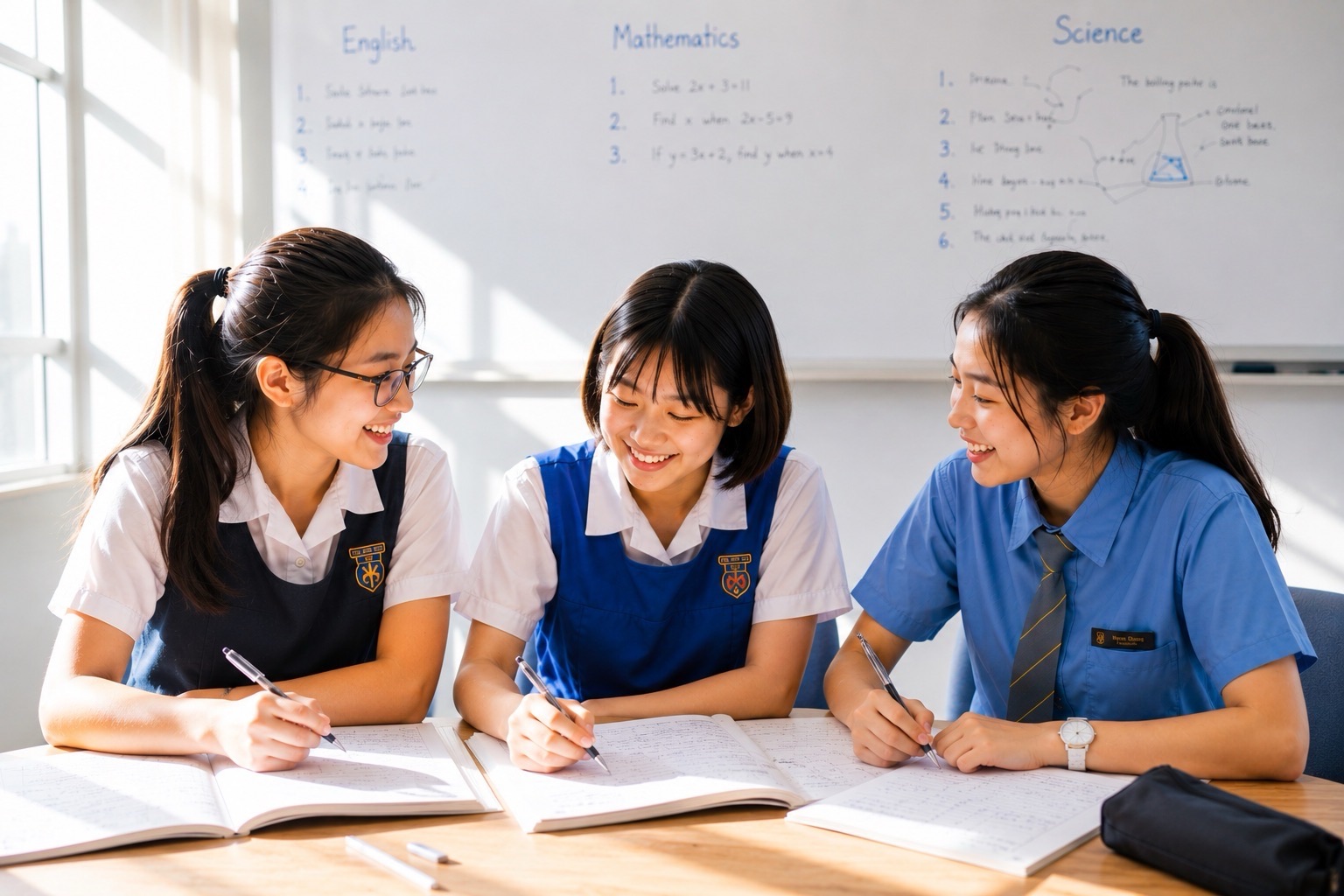
Mathematics Tuition for Sengkang students in small groups of up to three. Build strong foundations, problem-solving skills and exam confidence for Primary, PSLE, Secondary, E-Math and A-Math.
Mathematics Tuition Sengkang | Small Groups of 3 Students
Parents searching for Mathematics Tuition in Sengkang are often trying to solve more than one visible problem.
Their child may understand a concept during the lesson but be unable to complete questions independently. The student may know the formula but not recognise when to use it. Some students perform well in familiar exercises but become uncertain when the question is presented in a different form.
Others have accumulated small gaps over several years. These gaps may remain hidden until Mathematics becomes more abstract, multi-step and time-sensitive.
eduKateSG provides Primary and Secondary Mathematics tuition in small groups of up to three students for families from Sengkang and the surrounding northeast region.
We begin by identifying where the student’s mathematical system is becoming unstable.
This may involve:
- number sense;
- arithmetic accuracy;
- fractions, decimals and percentages;
- ratios and proportions;
- algebra;
- geometry;
- measurement;
- problem interpretation;
- model drawing;
- formula selection;
- working steps;
- mathematical language;
- time management;
- examination execution.
Teaching is then organised around the student’s actual learning bottleneck rather than another general sequence of worksheets.
Who We Help
Our Mathematics Tuition programme supports:
- Primary 1 to Primary 6 Mathematics students;
- students preparing for the PSLE Mathematics examination;
- Secondary 1 and Secondary 2 Mathematics students;
- Secondary 3 and Secondary 4 E-Mathematics students;
- Secondary 3 and Secondary 4 Additional Mathematics students;
- students preparing for school examinations;
- students preparing for the GCE O-Level examinations;
- students who need to rebuild mathematical foundations;
- students with inconsistent results;
- students who require greater challenge.
Lessons may cover:
- number operations;
- fractions;
- decimals;
- percentages;
- ratio;
- rate;
- algebra;
- geometry;
- measurement;
- statistics;
- graphs;
- equations;
- functions;
- trigonometry;
- differentiation;
- integration;
- examination techniques.
The exact emphasis depends on the student’s level, school requirements and current learning needs.
Building Strong Foundations Through Mathematics Tuition in Sengkang
Mathematics is cumulative.
A student does not begin every topic from zero. New learning is built on earlier concepts, procedures and representations.
For example:
- fractions support ratio and percentage;
- number sense supports algebra;
- algebra supports functions;
- equations support coordinate geometry;
- indices support exponential relationships;
- graphical understanding supports differentiation;
- differentiation supports optimisation and rates of change.
When an earlier dependency is weak, later topics become harder than they need to be.
This is why a student may appear to struggle with a new topic when the real difficulty began several years earlier.
Our Mathematics tutors look beneath the current chapter and identify the earliest weak link affecting progress.
The purpose is not simply to help the student finish today’s question.
It is to strengthen the mathematical structure that future questions will depend on.
How We Manage Your Child’s Mathematics Learning
Reliable Mathematics performance depends on several capabilities working together.
Reliable Mathematics Performance = Conceptual Understanding × Procedural Fluency × Problem Recognition × Execution
Conceptual Understanding
The student needs to understand what a mathematical idea represents and why the method works.
Procedural Fluency
The student must be able to carry out calculations and algebraic steps accurately and efficiently.
Problem Recognition
The student must recognise which concept or method applies when the question is unfamiliar.
Execution
The student must organise the working, manage time, check the answer and complete the solution under examination conditions.
A weakness in any one area can reduce the quality of the final result.
A student may understand the concept but make procedural errors. Another may calculate accurately but select the wrong method. A third may know the method but fail to complete the question within the available time.
Our tutors identify which part of the system is restricting the student and organise the lesson accordingly.
Accurate Diagnosis Before More Practice
More practice does not automatically produce better Mathematics results.
If the student repeatedly uses an incorrect model, misunderstands a relationship or follows a method without understanding it, more repetition may strengthen the wrong habit.
Progress becomes more dependable when five elements work together:
Progress = Accurate Diagnosis × Correct Sequence × Guided Practice × Feedback × Transfer
Our tutors therefore examine more than whether the final answer is correct.
We look at how the student approached the question.
Common patterns include:
- misreading the question;
- selecting the wrong operation;
- relying on keywords without understanding the situation;
- skipping essential working steps;
- using a formula without understanding its variables;
- making repeated sign errors;
- confusing ratio with fraction;
- struggling with unit conversion;
- losing track during multi-step problems;
- depending heavily on worked examples;
- failing to check whether the answer is reasonable.
Once the pattern is identified, teaching can begin at the correct point.
Three Routes for Mathematics Progress
Students do not all require the same kind of Mathematics lesson.
Depending on the diagnosis, we may place greater emphasis on repair, stabilisation or extension.
Repairing Foundations
Some students have missing prerequisite skills that affect several later topics.
A Primary student may struggle with percentage because fractions and place value are unstable. A Secondary student may find algebra difficult because negative numbers and arithmetic operations are not secure. An Additional Mathematics student may struggle with differentiation because algebraic manipulation remains weak.
In such cases, moving directly to harder examination questions usually creates more confusion.
We return to the missing dependency, explain it clearly and rebuild it through carefully selected examples.
The student learns:
- what the concept represents;
- why the method works;
- how each step connects;
- when the method should be used;
- how to recognise the concept in a question.
Stabilising Performance
Some students understand the topic but perform inconsistently.
They may complete questions correctly during guided practice but make avoidable mistakes when working independently. They may know a formula but substitute values incorrectly. They may perform well in topical work but struggle in mixed examinations.
Here, the goal is dependable execution.
Students practise the same underlying concept through varied question forms until the method becomes more stable.
Extending Capability
Students with secure foundations may be ready for more demanding work.
They may develop:
- multi-step problem solving;
- unfamiliar applications;
- efficient solution methods;
- deeper algebraic reasoning;
- stronger mathematical communication;
- greater speed and accuracy;
- advanced examination strategies.
Extension is not simply the addition of harder worksheets.
It develops mathematical judgement.
Primary Mathematics Tuition Sengkang
Our Primary Mathematics programme supports students from Primary 1 to Primary 6.
Lessons may include:
- whole numbers;
- place value;
- four operations;
- fractions;
- decimals;
- percentages;
- ratio;
- rate;
- measurement;
- geometry;
- area and perimeter;
- volume;
- time;
- money;
- data analysis;
- graphs;
- word problems;
- model drawing;
- heuristics.
At the lower Primary levels, students build strong number foundations.
They learn to:
- understand place value;
- compare quantities;
- recognise number relationships;
- perform calculations accurately;
- explain simple mathematical thinking;
- interpret basic word problems.
At the upper Primary levels, Mathematics becomes more connected and demanding.
Students must:
- coordinate several operations;
- work with fractions, decimals and percentages;
- interpret multi-step situations;
- recognise ratios and rates;
- organise information;
- select suitable methods;
- communicate working clearly.
Our teaching helps students move from calculation towards mathematical reasoning.
PSLE Mathematics Tuition
PSLE Mathematics requires students to apply familiar concepts in unfamiliar combinations.
A student may know every individual operation but still struggle because the question requires several ideas to be connected.
PSLE Mathematics performance can be understood as:
PSLE Performance = Knowledge × Selection × Sequencing × Accuracy
The student must know the relevant concepts, select the correct approach, arrange the steps in a workable sequence and complete the calculations accurately.
Our PSLE Mathematics lessons may focus on:
- number operations;
- fractions;
- decimals;
- percentages;
- ratio;
- rate;
- average;
- speed;
- geometry;
- area and volume;
- data interpretation;
- model drawing;
- pattern recognition;
- multi-step word problems;
- examination time management.
Students learn to break difficult questions into manageable parts.
They are taught to identify:
- what is known;
- what is unknown;
- which quantities are related;
- how the relationship can be represented;
- which step should be completed first;
- whether the final answer is reasonable.
Understanding Word Problems
Many students describe themselves as weak in word problems.
However, the difficulty may not be Mathematics alone.
A word problem requires the student to translate language into a mathematical structure.
The process is:
Language → Relationship → Representation → Operation → Answer
A student may understand the words individually but fail to identify how the quantities are connected.
We teach students to ask:
- What is changing?
- What remains the same?
- Which quantities are being compared?
- Is this a part-whole relationship?
- Is there a repeated unit?
- Is the question asking for a difference, total, rate or proportion?
- Can the information be represented with a model, table or equation?
This reduces dependence on superficial keywords.
Model Drawing
Model drawing helps Primary students make relationships visible.
It can be useful for:
- part-whole problems;
- comparison problems;
- fractions;
- ratio;
- percentage;
- before-and-after situations;
- repeated quantities;
- excess and shortage problems.
The purpose of a model is not to decorate the solution.
It should reveal the mathematical relationship.
Students learn how to:
- identify the quantities;
- represent equal and unequal parts;
- label known information;
- locate the unknown;
- determine the required operations.
As students become more advanced, model drawing can also support the transition towards algebraic thinking.
Mathematical Heuristics
Some problems cannot be solved through direct calculation alone.
Students may use heuristics such as:
- draw a model;
- make a systematic list;
- work backwards;
- look for a pattern;
- guess and check;
- simplify the problem;
- act it out;
- construct a table;
- form an equation;
- eliminate impossible cases.
We teach students to select heuristics based on the structure of the problem rather than memorising a fixed list.
The student learns not only how a heuristic works, but when it is useful.
Fractions, Decimals and Percentages
Fractions, decimals and percentages are different representations of related quantities.
Students often struggle because these topics are taught as separate procedures.
We connect them through common meaning.
For example:
[
\frac{1}{4}=0.25=25%
]
Each representation describes the same proportion.
Students learn to move between these forms and understand their relationships.
Lessons may include:
- equivalent fractions;
- simplifying fractions;
- comparing fractions;
- four operations with fractions;
- decimal place value;
- percentage of a quantity;
- percentage increase and decrease;
- reverse percentage;
- conversion between forms;
- application in word problems.
Strong understanding in this area supports ratio, rate, probability, algebra and financial Mathematics later.
Ratio and Rate
Ratio compares quantities.
Rate compares quantities with different units.
Students may confuse ratio with fraction or apply ratio methods without identifying what the parts represent.
We teach students to distinguish:
- part-to-part relationships;
- part-to-whole relationships;
- equal units;
- unequal units;
- ratios before and after a change;
- rates involving time, distance, cost or quantity.
Students learn to identify the value of one unit before scaling to the required quantity.
This unit-based thinking becomes useful throughout Secondary Mathematics.
Secondary Mathematics Tuition Sengkang
Secondary Mathematics introduces greater abstraction.
Students move from concrete quantities and visual models towards symbols, equations, functions and formal reasoning.
Our Secondary Mathematics programme may include:
- number systems;
- negative numbers;
- approximation;
- standard form;
- ratio and proportion;
- percentage;
- algebraic expressions;
- linear equations;
- simultaneous equations;
- inequalities;
- graphs;
- coordinate geometry;
- geometry;
- mensuration;
- trigonometry;
- statistics;
- probability.
The transition from Primary to Secondary Mathematics can be challenging because students are expected to manipulate symbols as well as numbers.
A student who could solve a Primary word problem using a model may now need to express the same relationship algebraically.
Our tutors help students make this transition carefully.
Algebra as a Mathematical Language
Algebra is not simply Mathematics with letters.
It is a language used to express relationships generally.
For example:
[
3+5=8
]
describes one numerical situation.
[
x+5=8
]
asks for an unknown value.
[
y=x+5
]
describes a relationship that can generate many values.
Students learn how algebra changes the way Mathematics can represent patterns, unknown quantities and functions.
Lessons may include:
- collecting like terms;
- expanding brackets;
- factorisation;
- algebraic fractions;
- substitution;
- linear equations;
- simultaneous equations;
- inequalities;
- changing the subject of a formula.
Strong algebra supports almost every later Secondary and Additional Mathematics topic.
The Negative Number Gap
Negative numbers are one of the earliest major transitions in Secondary Mathematics.
Students may understand that negative numbers exist but still struggle to operate with them reliably.
Common difficulties include:
- subtracting negative numbers;
- multiplying signed numbers;
- applying negative signs across brackets;
- interpreting negative gradients;
- working with negative indices;
- distinguishing (-x^2) from ((-x)^2).
These errors can spread into algebra, coordinate geometry, trigonometry and calculus.
We treat negative-number control as a foundational capability rather than a minor chapter.
Equations and Problem Solving
An equation states that two expressions are equal.
Solving an equation means finding the value that preserves that equality.
Students learn to understand each transformation rather than moving terms mechanically.
For example:
[
3x+5=20
]
The purpose is not simply to “move 5 across.”
The student subtracts 5 from both sides to preserve balance:
[
3x=15
]
Then divides both sides by 3:
[
x=5
]
This balance-based understanding reduces errors and prepares students for more complex equations.
Graphs and Functions
Graphs make mathematical relationships visible.
Students may work with:
- linear graphs;
- quadratic graphs;
- distance-time graphs;
- speed-time graphs;
- exponential graphs;
- reciprocal graphs;
- trigonometric graphs.
They learn to connect:
- equations;
- tables;
- coordinates;
- gradients;
- intercepts;
- shapes;
- rates of change.
A graph is not an isolated drawing exercise.
It is another representation of a mathematical relationship.
Geometry and Mensuration
Geometry requires students to reason with shape, space, measurement and relationships.
Topics may include:
- angles;
- polygons;
- congruence;
- similarity;
- symmetry;
- transformations;
- Pythagoras’ theorem;
- trigonometry;
- circles;
- area;
- surface area;
- volume.
Students learn to distinguish between information that is given, information that can be deduced and information that must be calculated.
Clear diagrams and organised reasoning are essential.
Statistics and Probability
Statistics helps students organise, interpret and evaluate information.
Probability helps students reason about uncertainty.
Students may work with:
- tables;
- bar graphs;
- histograms;
- cumulative frequency;
- box-and-whisker plots;
- mean;
- median;
- mode;
- range;
- standard deviation;
- simple probability;
- combined events.
The goal is not only to perform calculations.
Students must also understand what the result means in context.
E-Mathematics Tuition Sengkang
Elementary Mathematics requires broad control across algebra, geometry, statistics, graphs and applications.
Students must recognise which method applies and move efficiently between different topics.
Our E-Mathematics lessons may focus on:
- strengthening foundational algebra;
- improving calculation accuracy;
- interpreting graphs;
- organising geometry proofs;
- applying trigonometry;
- handling real-world applications;
- managing multi-topic examination papers;
- checking answers efficiently.
Students learn to build complete solutions rather than relying on isolated final answers.
Additional Mathematics Tuition Sengkang
Additional Mathematics requires stronger abstraction and algebraic control.
Topics may include:
- quadratic functions;
- equations and inequalities;
- surds;
- indices;
- logarithms;
- polynomials;
- partial fractions;
- coordinate geometry;
- trigonometric functions;
- differentiation;
- integration;
- kinematics.
Students often describe A-Math as difficult because several skills are compressed into each question.
For example, a differentiation question may require the student to:
- manipulate algebra;
- apply an index law;
- differentiate correctly;
- solve an equation;
- interpret a stationary point;
- present the answer in context.
A weakness in any supporting skill can interrupt the entire solution.
Our tutors identify these dependencies and repair them systematically.
From Algebra to Calculus
Calculus is easier to understand when students see how it grows from earlier Mathematics.
A useful progression is:
Algebra → Functions → Graphs → Rate of Change → Differentiation → Integration
Algebra expresses relationships.
Functions describe how quantities depend on one another.
Graphs show these relationships visually.
Differentiation studies how quickly a quantity changes.
Integration studies accumulation and the reverse process of differentiation.
This connected view prevents students from treating calculus as a disconnected collection of formulas.
First-Principles Mathematics Teaching
Our tutors begin with the underlying mathematical idea before moving towards examination complexity.
The progression is:
Concept → Representation → Method → Application → Transfer
The student first understands the concept.
The idea may then be represented using:
- objects;
- diagrams;
- models;
- number lines;
- tables;
- graphs;
- equations;
- real-world situations.
The student learns the method and applies it to guided questions.
Finally, the same concept is tested in a less familiar form.
This helps students recognise the mathematical structure beneath changing question surfaces.
Concrete, Representational and Abstract Learning
Mathematics often moves through three levels.
Concrete
The student works with physical quantities, objects or familiar situations.
Representational
The idea is expressed using diagrams, models, tables, graphs or number lines.
Abstract
The student works with symbols, equations and general relationships.
A student may understand a ratio using objects but struggle when the same relationship appears algebraically.
Our tutors connect these levels deliberately so that the student can move from seeing the idea to representing it and finally manipulating it independently.
Mathematical Vocabulary
Mathematics has its own language.
Students must understand words such as:
- difference;
- product;
- quotient;
- factor;
- multiple;
- proportion;
- gradient;
- intercept;
- perpendicular;
- congruent;
- similar;
- maximum;
- minimum;
- constant.
A student may calculate correctly but misunderstand the question because a term has been interpreted inaccurately.
We teach mathematical vocabulary within working examples so that the language becomes operational rather than memorised.
Showing Clear Working
Clear working is part of mathematical communication.
It helps the student:
- organise thinking;
- identify mistakes;
- receive method marks;
- check calculations;
- explain the solution;
- continue a multi-step problem accurately.
Students learn to show enough working without filling the page with unnecessary steps.
A complete solution should allow another reader to follow the mathematical logic.
Correcting Mathematical Misconceptions
Some Mathematics errors come from incorrect internal models.
Common misconceptions include:
- multiplication always makes numbers larger;
- division always makes numbers smaller;
- a larger denominator means a larger fraction;
- the equals sign means “write the answer next”;
- a negative number is always smaller in magnitude;
- the square root of a sum can be separated;
- cancelling means deleting matching symbols;
- a graph is only a picture rather than a relationship.
These misconceptions must be identified and corrected directly.
Showing the correct answer once may not be enough.
The tutor must demonstrate why the original reasoning fails and replace it with a more accurate model.
Why Small Groups of Up to Three Students Matter
Mathematics errors are often hidden inside working steps.
Two students may reach the same wrong answer for completely different reasons.
One may misunderstand the concept. Another may select the correct method but make an arithmetic error. A third may lose track during algebraic manipulation.
With a maximum of three students, the tutor can inspect each student’s:
- calculations;
- diagrams;
- equations;
- working sequence;
- method selection;
- use of mathematical language;
- checking habits.
Correction can happen at the point where the reasoning first breaks down.
Small-group learning also allows students to compare alternative methods while remaining individually accountable for their work.
What Happens During a Mathematics Tuition Lesson?
The exact lesson structure depends on the student’s level, school topics and current gaps.
However, a productive lesson usually follows a clear cycle.
1. Retrieve
Students recall relevant facts, formulas or methods from previous lessons.
2. Diagnose
The tutor checks whether the underlying concepts remain stable.
3. Explain
The central mathematical idea is taught from first principles.
4. Represent
The concept is shown through models, diagrams, graphs, equations or examples.
5. Practise
Students complete guided questions with immediate feedback.
6. Correct
Errors are addressed before they become repeated habits.
7. Transfer
The student applies the same concept to a different question form.
8. Test
Where suitable, the student completes an independent or timed task.
This sequence helps move learning from explanation to usable capability.
A Typical Four-Week Starting Cycle
Every student is different, but the first few weeks may follow a structure such as this.
Week 1: Diagnostic Review
We identify topic gaps, procedural errors and the student’s present level of independence.
Week 2: Foundation Repair
We address selected prerequisites and strengthen the central concept.
Week 3: Application
Students apply the repaired skills to school and examination-style questions.
Week 4: Review and Recalibration
We assess what has become stable, what still requires support and what should be addressed next.
This creates a clearer learning route than moving through unrelated worksheets.
Retention and Revision
Students may understand a method during the lesson but forget it when the topic reappears several weeks later.
Long-term learning requires planned retrieval.
Our Mathematics Tuition programme may include:
- short retrieval questions;
- cumulative quizzes;
- spaced review;
- mixed-topic practice;
- error journals;
- correction exercises;
- timed mini-tests;
- examination-paper analysis.
Spaced Review
Important concepts are revisited after increasing intervals.
Retrieval Practice
Students recall formulas and methods without immediately referring to notes.
Interleaving
Different topics are mixed so that students must identify the correct approach independently.
Error Analysis
Students record recurring mistakes and explain the corrected reasoning.
Together, these processes help learning remain available during examinations.
Converting Mathematical Knowledge into Marks
Students sometimes say:
“I knew how to do it, but I made a mistake.”
This reveals a difference between knowledge and examination performance.
Marks Earned = Knowledge Available × Conversion Accuracy
A student may understand the topic but still lose marks through:
- careless arithmetic;
- incomplete working;
- incorrect substitution;
- missing units;
- misreading the question;
- selecting an inefficient method;
- poor time management;
- failing to check the answer.
Our tutors train this conversion process directly.
Students learn to recognise what the question requires, select an appropriate method, organise the solution and check whether the result is reasonable.
Examination technique does not replace mathematical understanding.
It allows that understanding to become visible.
Examination Time Management
A student may be capable of solving a question but spend too long on it.
We teach students to manage:
- question selection;
- mark allocation;
- working speed;
- difficult questions;
- checking time;
- calculator use;
- presentation.
Students learn not to allow one difficult problem to consume the time needed for several accessible questions.
Accuracy remains important, but efficiency must also be developed.
Checking Mathematical Answers
Checking is more than repeating the same calculation.
Students learn different checking methods, including:
- estimating the likely range;
- substituting the answer back into the equation;
- using an alternative method;
- checking units;
- comparing with the diagram;
- reviewing signs and decimal places;
- testing whether the answer fits the context.
A useful check asks:
Does this answer make mathematical and real-world sense?
Developing Independent Mathematics Learners
At the beginning, some students require substantial guidance.
The tutor may need to:
- organise the method;
- identify relevant information;
- suggest a representation;
- prompt the next step;
- point out an error;
- remind the student to check the answer.
As capability grows, this management is gradually transferred to the student.
The progression is:
Tutor-Managed → Co-Managed → Self-Managed
A self-managed Mathematics student can:
- interpret the question;
- identify the relevant concept;
- select a method;
- organise working clearly;
- monitor progress;
- identify possible errors;
- check the final answer;
- attempt unfamiliar questions with greater confidence.
This is the deeper purpose of tuition.
The student should become increasingly capable of managing Mathematics independently.
Progress Parents May Observe
Improvement does not always begin with an immediate jump in marks.
Earlier signs may include:
- clearer working steps;
- fewer repeated arithmetic errors;
- better explanation of methods;
- stronger number sense;
- greater confidence with unfamiliar questions;
- improved algebraic control;
- more accurate formula use;
- better time management;
- fewer prompts required from the tutor;
- more stable school performance.
Marks remain important, but they are the visible output of a deeper learning system.
When that system becomes stronger, results become more dependable.
Mathematics Tuition for Sengkang Students
Our classes are suitable for families living in:
- Sengkang;
- Compassvale;
- Rivervale;
- Fernvale;
- Anchorvale;
- Punggol;
- Hougang;
- nearby northeast neighbourhoods.
Students receive small-group Mathematics tuition with close tutor attention and a structured learning direction.
Who May Benefit from Mathematics Tuition?
Our programme may be suitable for a student who:
- understands lessons but performs inconsistently;
- has gaps from earlier Mathematics topics;
- struggles with word problems;
- makes repeated calculation errors;
- finds algebra confusing;
- knows formulas but cannot apply them;
- loses track during multi-step questions;
- depends heavily on worked examples;
- lacks confidence during examinations;
- completes practice without clear improvement;
- requires more individual feedback;
- needs greater mathematical challenge.
The starting point is not simply whether the student is “strong” or “weak.”
The starting point is the specific condition preventing further progress.
Why Choose eduKateSG Mathematics Tuition?
Our approach combines:
- small groups of up to three students;
- more than 20 years of tuition experience;
- Primary and Secondary Mathematics support;
- PSLE, E-Mathematics and Additional Mathematics preparation;
- diagnostic gap identification;
- first-principles explanation;
- structured problem-solving;
- misconception correction;
- examination techniques;
- progressive movement towards independence.
We aim to provide a clear learning direction rather than another pile of worksheets.
Arrange a Parent–Student Consultation
For families considering Mathematics Tuition in Sengkang, the first step is to understand the student’s current learning position.
Parents may share:
- the student’s school level;
- recent examination results;
- school worksheets or test papers;
- current areas of difficulty;
- learning habits;
- upcoming assessment requirements.
Where suitable, we can identify the student’s main bottlenecks and recommend an appropriate starting route.
eduKateSG provides Primary, PSLE, Secondary, E-Mathematics and Additional Mathematics tuition in small groups of up to three students for families from Sengkang and the surrounding northeast region.
Contact eduKateSG to arrange a consultation and discuss how we can help your child develop stronger mathematical foundations, clearer problem-solving methods and more reliable examination performance.
Frequently Asked Questions
Does eduKateSG provide Mathematics Tuition in Sengkang?
Yes. eduKateSG provides Primary and Secondary Mathematics tuition for students from Sengkang and neighbouring northeast areas.
How many students are in each Mathematics tuition class?
Classes are conducted in small groups of up to three students. This allows the tutor to inspect each student’s calculations, working steps and problem-solving methods closely.
Which Primary Mathematics levels do you teach?
We support Primary 1 to Primary 6 students, including students preparing for the PSLE Mathematics examination.
Do you teach Secondary Mathematics?
Yes. We support Secondary 1 to Secondary 4 Mathematics, including E-Mathematics and Additional Mathematics.
How do you help students with word problems?
Students learn to translate the language of the question into mathematical relationships using models, diagrams, tables, equations and suitable heuristics.
Can tuition help a student who makes careless mistakes?
Yes. Careless mistakes may come from weak checking habits, rushed working, unstable procedures or cognitive overload. We identify the pattern and teach a more reliable working process.
How do you identify a student’s Mathematics gaps?
We review the student’s work, observe how questions are approached and identify recurring patterns in understanding, calculation, method selection and examination execution.
Is the programme suitable for stronger Mathematics students?
Yes. Stronger students may work on unfamiliar applications, advanced problem solving, efficient methods, deeper reasoning and higher-level examination questions.
Does Mathematics tuition focus only on examinations?
Examination performance is important, but it depends on deeper capabilities. Lessons also develop conceptual understanding, procedural fluency, reasoning, problem solving and independent learning.
How do you help students remember formulas and methods?
Students use spaced review, retrieval practice, mixed-topic work and repeated application. We also teach how formulas are connected to concepts so that they are understood rather than memorised in isolation.
When should a child begin Mathematics tuition?
Tuition may be useful when recurring gaps, weak confidence or inconsistent performance begin to affect progress. Starting earlier allows more time to repair foundations before later topics become increasingly dependent on them.