
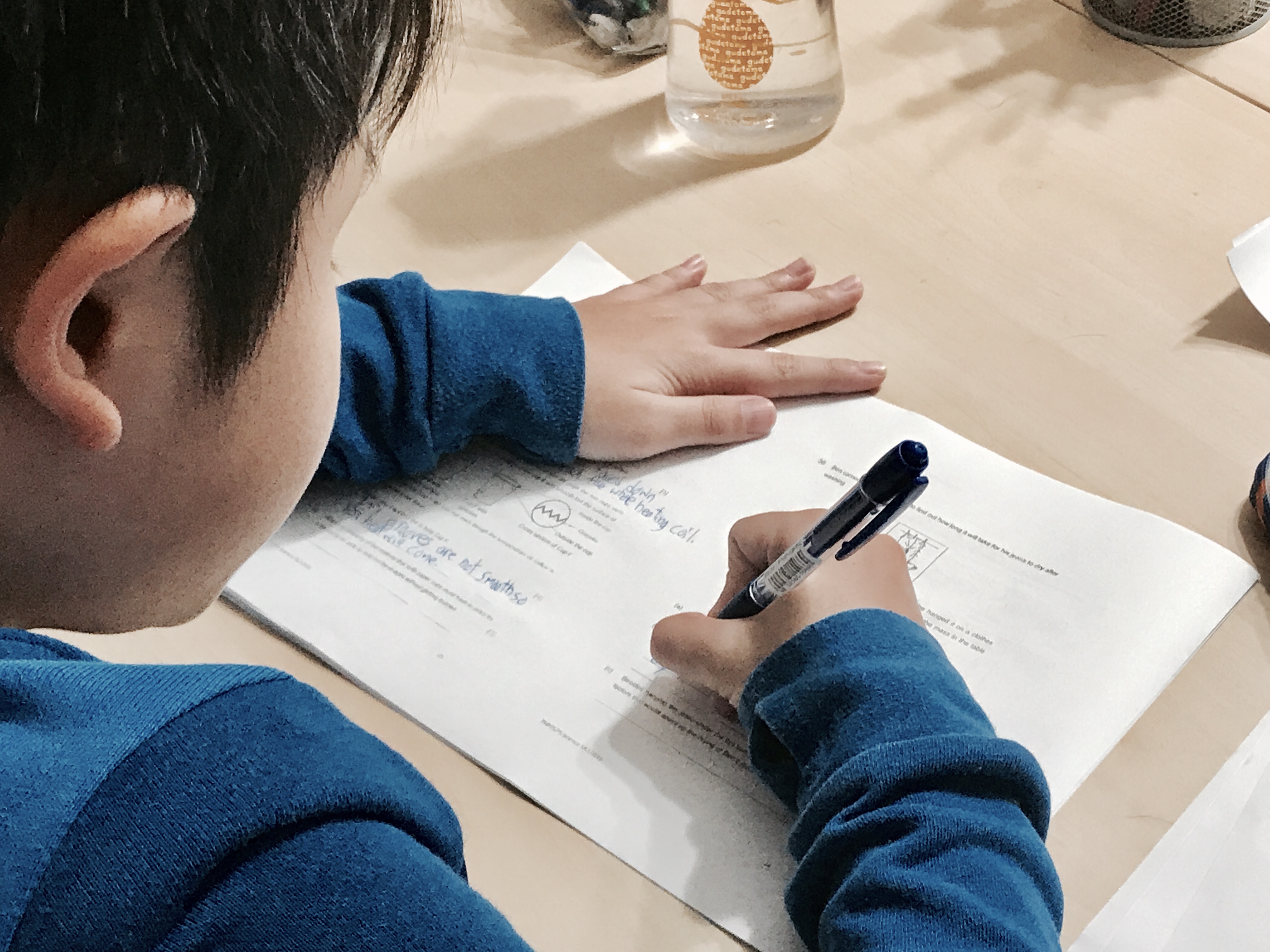
Pressure is not another name for force. Two objects may apply the same force and cause different effects because their contact areas differ. A liquid can press on a surface even when no solid object is directly pushing it; a pressure gauge may show a difference between two places rather than a simple absolute value. Understanding the boundaries between force, area, density and height is the beginning of reliable Physics.
This independent eduKateSG Ministry of Education V3.0 Reference 252 connects everyday experiences to the 2027 Singapore–Cambridge SEC G3 Physics syllabus K323, Section 5, Pressure. It explains calculations, hydraulics, liquid columns and pressure measurements through original hypothetical examples and a worked diagnostic pathway. It is not an official MOE textbook or a substitute for supervised practical instruction.
Fast answer: for a uniformly distributed perpendicular force, pressure equals force divided by area, p = F/A. For a stationary liquid of constant density, the pressure difference due to a vertical column is Δp = ρgh. Density is ρ = m/V. Ask which equation matches the physical mechanism before inserting numbers.
Reader route: from picture to physical model
- First identify what exerts the force and exactly where it acts.
- Decide whether the question describes contact pressure, fluid depth, density or a hydraulic system.
- Draw the system boundary, record the given units and state assumptions.
- Calculate with the correct area or vertical height, then explain the physical result.
- Check whether the question asks for pressure due to liquid, pressure difference or total absolute pressure.
- Attempt the unseen transfer questions without looking at the worked model.
1. Read the official syllabus without merging distinct topics
SEAB’s 2027 G3 Physics K323 lists pressure as force per area, transmission of pressure in hydraulic systems, density, pressure due to a liquid column, atmospheric pressure measurement through column height and pressure differences with a manometer. The nearby Turning Effects of Forces topic concerns moments, which uses perpendicular distance to a pivot: it is a different relationship.
This guide stays within those learning outcomes when describing examination expectations. It occasionally introduces gauge versus absolute pressure as explanatory context, clearly identified as an extension. Schools may teach the sequence differently; candidates should always use the examination-year syllabus issued for their course.
2. Force and pressure have different units and meanings
Force is measured in newtons (N), and pressure in pascals (Pa), where 1 Pa means 1 N of perpendicular force per square metre. The area must be the actual area of contact, not the surface area of the entire object. Two legs supporting a table share load, but the force on each foot and its effective contact area determine local pressure.
A force can be directed upward, downward or sideways. On a surface, distinguish its component perpendicular to the area from a force acting parallel to it. In simple school problems the given force is usually normal to the area; do not generalise that every force produces the same pressure regardless of its direction.
3. Why smaller area can mean greater pressure
The same 120 N applied over 0.02 m² produces 6,000 Pa, while 120 N over 0.06 m² produces 2,000 Pa. Tripling the contact area, with force unchanged, reduces the average pressure to one-third. That is why a wide shoe sole and a narrow spike can behave differently under comparable loads.
This does not imply that all material damage can be predicted from average pressure alone. Real contact surfaces deform, materials have varying strength and forces may be uneven. A classroom calculation is a simplified model, not a safety certification.
4. Convert centimetres squared and millimetres squared before calculating
A common trap is treating 50 cm² as 0.5 m². Since 1 m = 100 cm, 1 m² = 10,000 cm². Therefore 50 cm² = 0.005 m². For length in millimetres, 1 mm = 0.001 m, but 1 mm² = 0.000001 m². The conversion factor must be squared when area is being converted.
Write units on every given quantity before substituting. The apparently neat answer ‘4 Pa’ may conceal a conversion error worth four orders of magnitude. Explain the unit conversion in one line so that a tutor can see the exact step that needs repair.
5. Density describes material quantity per unit volume
Density is mass divided by volume, ρ = m/V. Its SI unit is kg/m³. Mass is in kilograms, whereas weight is a gravitational force in newtons. For example, a block with mass 0.8 kg and volume 0.001 m³ has a density of 800 kg/m³. The weight may be calculated from W = mg if the problem supplies gravitational field strength.
A substance is not necessarily ‘heavy’ just because its density is high. A very small piece of a dense substance may have less mass than a very large piece of a less dense substance. Density compares equal volumes, not arbitrary objects.
6. A liquid column creates a depth-dependent pressure difference
For a stationary liquid of uniform density, Δp = ρgh, where h is the vertical depth below a reference level and g is gravitational field strength. Double the depth with all else fixed and the pressure due to the liquid doubles. Double the density at the same depth and that contribution doubles too.
The formula uses vertical height, not the length of a sloping pipe or the width of a container. A narrow tube and a broad tank holding the same liquid to the same vertical depth can have the same hydrostatic pressure difference at that depth, provided the simplifying assumptions hold.
7. Understand what the water surface contributes
At an open water surface the liquid is exposed to atmospheric pressure. The pressure due to the water column is an additional pressure relative to that surface: ρgh. If a problem specifically asks for absolute pressure, it may require adding atmospheric pressure. If it asks ‘pressure due to the liquid’, do not add atmospheric pressure merely because you remember its approximate value.
A pressure gauge reading 0 does not necessarily mean the absolute pressure is zero. It may mean the measured pressure equals the local reference pressure. Read the stated reference before comparing a gauge, open container and sealed system.
8. Hydraulics transmits pressure, not free energy
In an ideal connected hydraulic system, a pressure change applied to a confined liquid can be transmitted through the fluid. If the input piston has area A₁ and the output piston area A₂, ideal pressure equality gives F₁/A₁ = F₂/A₂. A larger output area can therefore produce a larger output force.
That greater force comes with a trade-off in displacement. In a simplified incompressible system, A₁d₁ = A₂d₂; the wide output piston moves a shorter distance when the smaller input piston moves farther. Real systems also have friction, leakage and inefficiencies. No force multiplication creates energy from nothing.
9. The manometer measures pressure difference
A simple U-tube manometer compares pressure using the height difference between the liquid levels. For a suitably simplified arrangement, Δp = ρgΔh. Students must identify which side has the higher pressure and use the vertical difference in level, not both heights added together automatically.
A pressure measurement is an inference based on a known liquid density, the gravitational field and the observed column difference. Calibrated instruments and controlled laboratory conditions matter in practice; do not improvise pressure vessels or gas apparatus at home.
10. Atmospheric pressure and the liquid-column idea
A barometer uses the relationship between atmospheric pressure and the supported height of a liquid column, under the assumptions appropriate to the instrument. The same pressure principle explains why liquids settle at unequal heights in a U-tube when opposing pressures differ.
Do not transplant a mercury-column height into a water-column calculation without accounting for different densities. The answer must follow the substance specified by the question. Pressure does not equal ‘height’ alone.
11. A twelve-step pressure-audit method for unfamiliar questions
The method deliberately slows the first attempt so that the final calculation becomes faster and safer through understanding.
- 1 — Sketch the contact surface, piston or liquid column.
- 2 — Identify the question target: force, pressure, area, mass, volume, density or depth.
- 3 — Mark the region or surface on which the force acts.
- 4 — Decide whether the quantities describe a solid contact, static liquid or connected hydraulic system.
- 5 — State whether the pressure is relative or absolute when relevant.
- 6 — Write every given value with its original unit.
- 7 — Convert cm² and cm³ to appropriate SI units carefully.
- 8 — Choose p = F/A, ρ = m/V, Δp = ρgh or an ideal hydraulic relation.
- 9 — Substitute the numbers, keeping brackets for ratios.
- 10 — Compute the unit as well as the numerical answer.
- 11 — Test the direction of change: bigger area means smaller contact pressure.
- 12 — Explain in a sentence why the physical outcome makes sense.
12. Original fictional case: the school science fair’s water exhibit
A hypothetical supervised science fair presents a closed demonstration tank with a broad base, a depth indicator and a model hydraulic press. The demonstration uses fictional measurements for conceptual exercises. No reader is asked to build, pressurise or operate equipment. The purpose is to compare quantities and check the scientific claims printed beside the display.
A. Contact pressure on a stage platform
A 240 N demonstration load is distributed uniformly over 0.08 m².
Worked reasoning: p = 240/0.08 = 3,000 Pa.
Verification: 3000 Pa × 0.08 m² = 240 N.
Transfer question: If the area halves with unchanged force, what happens to pressure?
B. The centimetre-square trap
The same 240 N rests on an imagined 800 cm² pad.
Worked reasoning: 800 cm² = 0.08 m²; p = 240/0.08 = 3,000 Pa.
Verification: The two descriptions are equivalent areas; answers should match.
Transfer question: What error follows from converting 800 cm² to 8 m²?
C. Density from a small block
A sealed fictional block has mass 1.2 kg and volume 0.0015 m³.
Worked reasoning: ρ = 1.2/0.0015 = 800 kg/m³.
Verification: 800 × 0.0015 = 1.2 kg.
Transfer question: Does the block’s mass change if it is taken to another planet?
D. Pressure due to water depth
Use ρ = 1,000 kg/m³, g = 10 N/kg and a depth of 0.60 m.
Worked reasoning: Δp = 1000 × 10 × 0.60 = 6,000 Pa.
Verification: The units simplify to N/m²; this is the liquid contribution.
Transfer question: What depth would produce 9,000 Pa with the same assumptions?
E. Comparing two depths
The fictional tank has observation ports 0.20 m and 0.80 m below the open surface.
Worked reasoning: Water contributions are 2,000 Pa and 8,000 Pa; the difference is 6,000 Pa.
Verification: Only the depth difference of 0.60 m affects the pressure difference.
Transfer question: Does making the tank wider change these hydrostatic results?
F. Hydraulic force comparison
The input piston area is 0.002 m² with 100 N applied; an ideal output piston has area 0.010 m².
Worked reasoning: Input pressure 50,000 Pa. Output force = 50,000 × 0.010 = 500 N.
Verification: An ideal force ratio of five matches the area ratio of five.
Transfer question: How far does the output piston move if the input moves 10 cm?
G. Displacement trade-off
Use the previous pistons and suppose the small piston moves 10 cm.
Worked reasoning: Volume conservation: 0.002 × 0.10 = 0.010 × d₂, hence d₂ = 0.02 m = 2 cm.
Verification: Ideal input work 100 N × 0.10 m = 10 J; output work 500 N × 0.02 m = 10 J.
Transfer question: Which real inefficiencies could reduce useful output work?
H. A liquid manometer
An idealised manometer has fluid density 800 kg/m³, level difference 0.15 m and g = 10 N/kg.
Worked reasoning: Pressure difference = 800 × 10 × 0.15 = 1,200 Pa.
Verification: A larger height difference under the same fluid conditions represents a larger pressure difference.
Transfer question: How would the height difference change if a denser manometer liquid measured the same pressure difference?
13. One result can be numerically correct and physically wrong
Imagine a learner divides 500 N by 5 cm² and writes 100 Pa. The division is numerically 100, but the result ignores the units. Converting 5 cm² to 0.0005 m² gives 1,000,000 Pa in the simplified model. The reason for the discrepancy is not arithmetic ability; it is a failure to preserve the physical meaning of the area.
A good correction asks the learner to explain what one square metre means, mark the actual contact patch and estimate whether a very small area should increase or decrease pressure. Fix the mental model before drilling ten similar questions.
14. The deeper distinction: equal pressure does not mean equal force
Two pistons connected by an ideal fluid can experience the same applied pressure while exerting different forces because their areas differ. Conversely, two objects can exert the same force over different areas and therefore produce different pressures. Pressure is a ratio connecting two quantities; it cannot be treated as a synonym for either one.
This distinction becomes important in real engineering descriptions. A sentence such as ‘the large piston has more pressure because it lifts more’ is not automatically correct. The conditions of the apparatus decide whether pressure is equal, how much force is transmitted and how far each piston moves.
15. The pressure–density–height triangle
The three relationships used in this topic solve different types of question. p = F/A explains force spread across a surface. ρ = m/V quantifies mass per volume. Δp = ρgh explains the hydrostatic pressure difference across a vertical liquid column. The relationships may be combined, but only after each step has been justified.
For a column of liquid, imagine a vertical prism of area A and height h. Its mass is ρAh, its weight is ρAhg and weight per base area is ρgh. This argument explains why the area cancels. It is a simplified derivation that helps students remember the formula for the right reason.
16. What pressure calculations cannot tell you
A pressure value alone does not determine whether a wall will fail, whether a vessel is safe or how fluid flow behaves. Material properties, stress concentrations, geometry, dynamic motion and safety factors matter. The K323 section teaches foundational pressure physics, not professional hydraulic design certification.
A school experiment should be supervised using approved equipment and procedures. Avoid pressurised containers, compressed gases, improvised hydraulic presses and unfamiliar chemical manometer fluids as home activities.
17. Frequent errors and their repairs
Pressure questions are excellent at exposing a learner’s tendency to calculate before reading. Inspect the first wrong step, not only the final answer.
- Confusing mass with weight: 2 kg is mass; its weight depends on gravitational field strength.
- Using the whole box surface area instead of the contact patch: draw a shaded contact region.
- Converting cm² as if it were cm: square the conversion.
- Using sloping length instead of vertical liquid height: sketch a level reference.
- Adding atmospheric pressure when only pressure due to water is asked: underline the target.
- Using p = ρgh for a solid contact: first classify the physical system.
- Calling output force ‘greater pressure’ in hydraulics: calculate both quantities separately.
- Assuming force multiplication creates energy: compare piston displacement and work.
- Comparing densities using unequal volumes without accounting for volume: use m/V.
- Leaving final units as N or kg: recalculate the dimensional expression.
18. A practical three-pass teaching sequence
Pass one, concrete: compare two padded model footprints under the same hypothetical weight and explain which distributes force over a wider area. Pass two, representational: draw the contact patch, vertical fluid column or two pistons with arrows. Pass three, abstract: manipulate one relevant equation and defend the result with a unit and a direction check.
Only after the first pass is secure should extra conditions be layered in: mixed units, two depths, different fluid densities, and a combined density-plus-pressure question. This mirrors eduKateSG’s Fencing Method: protect the simple relationship before increasing load.
19. Retrieval and interleaving that actually tests transfer
Instead of completing 20 questions under a page heading ‘Pressure’, alternate a solid contact question with a density problem, a liquid-column question and an unfamiliar hydraulic diagram. The student must recognise the situation rather than imitate the immediately preceding formula.
Return to the same ideas a day later and again after a week. An accurate worked solution that a student remembers for five minutes is not the same as an idea the student can retrieve independently.
20. Assessment command words and answer discipline
For ‘state’, give the precise relationship. For ‘calculate’, show the chosen formula, substitution, working and unit. For ‘explain’, connect the variable change to the physical outcome in words. For ‘suggest’, identify a plausible mechanism grounded in the given apparatus and avoid presenting guesswork as certainty.
A good response to ‘Explain why the wider pad produces a lower average pressure’ is: at unchanged force, increasing the contact area lowers force per unit area. Merely writing ‘because the pad is bigger’ does not state the cause.
21. Quick self-test: try these before reading the answers
Questions: (1) A 60 N force acts over 0.015 m². Calculate pressure. (2) A fluid has mass 0.75 kg in 0.0005 m³. Find its density. (3) Why does a container’s width not appear in ρgh for static pressure at depth? (4) An ideal press has input area 2 cm² and output area 20 cm². What ideal force ratio follows? (5) Why should the area conversion be checked before using p = F/A?
Answers: (1) 4,000 Pa. (2) 1,500 kg/m³. (3) For the ideal liquid-column derivation, weight and base area increase together, so area cancels. (4) Output-to-input force ratio ten, assuming pressure equality. (5) Because an area conversion error is squared and can drastically distort the pressure.
22. Extended transfer: the apparently contradictory tanks
Two imaginary tanks contain the same stationary liquid at the same depth. Tank A is narrow; Tank B is broad. A pupil says Tank B must have the greater pressure at the bottom because there is more water. Ask the student to distinguish total weight of water, total force on the bottom and pressure per unit area. The water volume and bottom area may both be larger in B; hydrostatic pressure at equal depth need not be.
The important question is not ‘Which tank looks bigger?’ but ‘Which quantity are we comparing?’. That language discipline connects Physics to mathematical ratios, Geography flood analysis and responsible interpretation of graphs.
23. For parents and educators: what the working tells you
A student who calculates accurately but uses the wrong formula has a classification problem. A student who chooses p = F/A correctly but slips on 800 cm² has a unit-conversion problem. A student who obtains an answer but cannot explain why increasing depth raises pressure has a conceptual problem. They require different follow-up tasks.
A useful five-minute conversation asks the child to draw one diagram, explain why the formula applies, convert one unit and predict a direction of change without calculation. That reveals more than asking whether the homework was finished.
24. Depth–Load–Transfer evidence
Depth: can the learner explain why area cancels from hydrostatic pressure, and why force may increase in an ideal hydraulic press without violating conservation? Load: can the learner manage two pistons, mixed area units and an additional pressure reading in one chain without losing the reference level? Transfer: can the learner solve an unlabelled scenario with a new sketch and justify which pressure relationship applies?
Record which dimension is weak. A student who can solve repeated numerical questions but fails at an unfamiliar tank has not yet demonstrated transfer. The plan should repair recognition, not merely assign more algebra.
25. Frequent questions from Singapore students and families
The following answers help distinguish what the model can establish from what a practical decision requires.
Does greater weight always mean greater pressure?
Not when the contact area changes as well. Pressure depends on force divided by area. Compare both before deciding.
Is the pressure at the same depth equal in every liquid?
Only if the liquids also have the same density and the other assumptions match. A denser liquid produces a larger hydrostatic contribution at equal depth.
Is the height the same as the pipe length?
No. For a static liquid column, the relevant height is vertical, not the distance along a sloped or winding pipe.
Does a large hydraulic piston make energy?
No. In the ideal model, a larger output force is balanced by smaller output displacement; real systems also lose energy.
Are manometer readings absolute pressure?
A differential manometer primarily expresses pressure differences between connected regions. The reference arrangement must be known before interpreting absolute pressure.
Will memorising three equations be enough?
It is a start, but the marks lost in unfamiliar questions usually involve classification, diagram interpretation, units and explanation rather than the absence of a remembered symbol.
26. Sources, reading sequence and editorial boundary
The primary official reference is the 2027 SEC G3 Physics K323 syllabus, Section 5 Pressure; check the examination year and level on the cover. For the broader programme, see SEAB’s 2027 G3 school-candidate directory.
Read the earlier Reference 251 — Sustainable and Resilient Singapore to apply careful evidence and trade-off reasoning to urban water questions. Continue into Reference 253 — Qualitative Analysis, Reference 254 — Human Homeostasis, and Reference 255 — Exponential and Logarithmic Functions. Browse the MOE V3.0 Reference Library or the eduKateSG first-principles teaching standard.
Checked 22 October 2026 (Singapore time). All stage-display details and numbers are original hypothetical teaching illustrations. The lesson’s central habit is simple: identify what is acting, where it acts and how it is measured before choosing an equation. A pressure answer is dependable only when the mechanism, units, assumptions and physical explanation agree.
MOE V3.0 Reference Sequence Navigation
Continue: Reference 251 · Reference 253 · MOE V3.0 Reference Library. Read the adjacent concept and complete an unfamiliar question independently.