
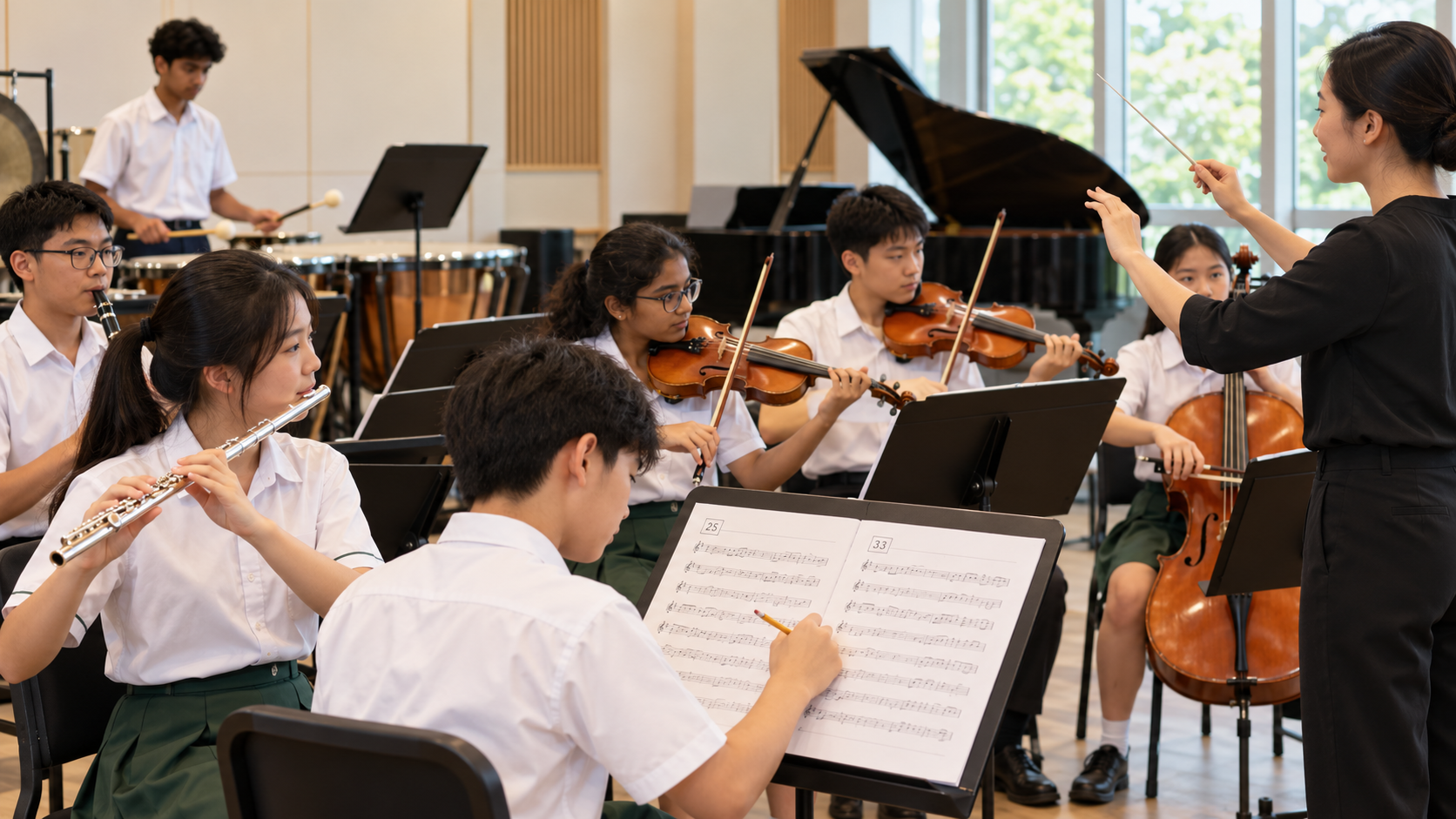
Did you know that saying a piece of music ‘sounds nostalgic’ is the beginning of an interesting listening question, not the conclusion of a research essay? The word describes a listener’s response. A defensible musical argument must move further: what actually changes in the sound, which sources establish the context, and how do the examples support—or fail to support—the interpretation? Higher Music research turns impressions into questions that can be investigated, challenged and revised.
This independent eduKateSG Ministry of Education V3.0 Reference 358 explains evidence-led inquiry for the 2027 Singapore–Cambridge Secondary Education Certificate G3 Higher Music K351 Research Essay elective. It connects listening analysis, musical features, responsible historical and cultural context, source quality, research design, originality, concise musical explanation and ethical attribution. It provides a twelve-stage Question–Evidence–Evaluate method, twenty-six invented teaching examples, a three-student tutorial, independent exercises and parent-and-tutor guidance without supplying a candidate’s assessed essay.
The 2027 K351 common Music core includes Music Studies, Creating and Performing, while Higher Music candidates choose one separate elective: Research Essay, Higher Creating or Higher Performing. This article concentrates on how to learn the research reasoning that supports an independent essay; it is not a completed submission, model essay to copy, or an official SEAB publication. All miniature compositions, listening descriptions, interviews and researcher names here are fictional. Candidates must read the official syllabus, follow school instructions, use lawful sources and produce authentic work of their own.
Study route for busy learners
- Confirm the official 2027 G3 Higher Music K351 core-and-elective assessment structure.
- Choose a narrow musical question and identify exactly what a listener could observe.
- Separate musical facts, contextual source information and interpretive claims.
- Compare legitimate recordings or original classroom materials fairly, with provenance and limitations.
- Keep candidate assessed writing authentic and practise transfer with unfamiliar listening material.
1. Know the actual 2027 Higher Music assessment structure
SEAB’s 2027 G3 Higher Music K351 syllabus requires the three common core papers, Music Studies, Creating and Performing. Candidates then choose one separate elective: Paper 12 Research Essay, Paper 22 Higher Creating or Paper 32 Higher Performing. The three common core papers determine the SEC subject grade, while the elective is assessed separately for the Higher Music award under the published rules. Therefore an essay is not simply a fourth compulsory section of the Music Studies paper. Confirm with the school which elective is registered and apply the exact syllabus instructions for the examination year.
2. Paper 12 is a research task, not a long personal review
The Research Essay elective asks for purposeful musical investigation. The writer must assemble a question that has an answerable scope, engage directly with musical material, use contextual evidence appropriately and explain conclusions in their own voice. A general biography of a composer, a timeline of genres or a stream of personal preferences lacks the focus of a testable inquiry. The strongest independent work shows how chosen evidence bears on an actual claim, while recognising where the source cannot settle the interpretation.
3. Differentiate the elective routes before choosing a method
Research Essay, Higher Creating and Higher Performing ask students to demonstrate different forms of musical capability. A pupil who enjoys close listening, comparing sources and sustained argument may find research appealing; another may prefer a higher-level compositional or performance route. All require preparation, musicianship, sustained revision and authentic authorship. The choice should not be based on a claim that research is ‘easier’ because it uses words, or that performance must be superior because it is public. Discuss the student’s genuine strengths and school requirements without promising grades.
4. Turn a broad topic into an investigable question
‘Music and emotion’ is too broad for a useful small investigation. ‘How do register and texture changes shape a listener’s sense of arrival in two short, independently composed classroom excerpts?’ names the musical features, effect and comparable materials. An inquiry question should have a manageable corpus, a clear musical variable and a plausible way to examine it. A question can change during exploration; documenting why it narrowed shows intellectual development rather than weakness.
5. Begin with what can actually be heard
A researcher may describe pulse, duration, melodic contour, register, instrumentation, articulation, dynamics, timbre, texture, phrase structure and formal repetition when the material supports those claims. ‘The texture becomes denser when an accompanying line enters’ is an observation that another listener can assess. ‘The composer wanted to represent a crowded city’ is a claim about intention requiring separate evidence. Keep sound description and inferred meaning in different sentences until the connection is justified.
6. Distinguish tempo, meter and rhythmic activity
A passage can feel more urgent without a change in beats per minute, simply because more notes occur within the same pulse. It may also change accent patterns while retaining the same meter. A pupil who hears a busier texture should not automatically write ‘the tempo speeds up’. To evaluate rhythmic transformation, identify the stable pulse, note values, accents or phrase lengths that actually change. If the recording does not allow a reliable tempo measurement, describe perceived activity with calibrated language.
7. Melodic contour can be analysed before harmonic theory
A melody may rise, fall, repeat a pitch or make wider leaps. These observations can be described even if an exact score is not available. A useful analysis traces where the contour changes and why it matters for the form or phrase. ‘The line repeatedly rises toward the highest register before returning to its starting range’ is stronger than ‘the melody is beautiful’. It leaves room for interpretation while naming the audible evidence.
8. Timbre requires more caution than an instrument guess
A sound described as breathy, metallic, bright, dark, sustained or percussive may reflect instrument, technique, microphone position, recording equipment or audio processing. If the source gives reliable instrument information, the student may name it. If not, report what is heard rather than assert a particular instrument identity with certainty. Two instruments can share timbral qualities, and a synthesised sound can imitate acoustic ones. The research standard is accurately calibrated confidence.
9. Texture describes relationships among musical lines
A single unaccompanied melodic line differs from a melody with chordal support or from several interacting lines. When another voice enters, the texture may become more layered or contrapuntal. A learner should identify how the layers interact, not merely count performers on a photograph. Recording tracks can also produce multiple layers from one performer. Describe what the audio demonstrates, then connect it to the research question.
10. Dynamics and expression are not the same concept
Dynamics refer to relative loudness and its changes, while expression also involves articulation, phrasing, tempo flexibility, timbre and timing. A sound may build intensity through denser rhythm or harmonic movement without becoming much louder. Do not infer an exact dynamic marking from the recording unless a legitimate score or reliable source supports it. A useful claim separates the observed sonic change from the emotional effect a particular listener reports.
11. Motifs, repetition and variation offer trackable evidence
An invented four-note rhythmic idea might return later with a longer final note, a different register or a new accompaniment. The student can compare the recurring pattern with the altered features, then ask whether the return creates unity, contrast or transformation. An identifiable motif supports a structural claim more strongly than a vague statement that ‘everything is linked’. The researcher must also check whether the repeated material really matches the proposed pattern.
12. Form is a map of relationships, not a row of labels
Labelling an excerpt A–B–A may be useful when the later A genuinely recalls identifiable earlier material. However, form analysis should explain what makes sections alike or unlike: melody, harmony, textural layer, rhythmic pattern or tonal centre. A listener cannot prove a reprise from duration alone. A small annotated listening map can show where changes are heard, which observations are secure, and where the classification remains tentative.
13. Harmony and tension should be described at the right level
A pupil may notice stable, unresolved, dissonant or changing sonorities before knowing exact chord names. When a reliable score exists, harmonic terms can be more precise, but the analysis should not pretend to hear every pitch correctly in a dense mix. Explain the evidence for an increasing sense of tension rather than treating ‘sad chords’ as a universal category. Harmonic interpretation changes with musical tradition and context, so avoid imposing one framework on every repertoire.
14. Comparison needs a shared question and a fair basis
Two performances may differ in tempo, articulation, ornamentation, recording technology and instrumentation. Choose a narrow aspect to compare, then keep the question constant across both. If the first recording is a studio edit and the second a rehearsal capture, differences may arise from production conditions rather than artistic intent alone. Identify these circumstances explicitly. A research comparison that includes confounding factors can be more credible than an overconfident ranking of which performance is ‘better’.
15. Sources have different evidentiary roles
An authorised score may support claims about notation, while a recording supports claims about a specific audible performance. A composer interview might provide an attributed statement of intent, but does not prove how every listener experiences the work. Historical research can contextualise the social setting without replacing listening analysis. The student should decide what each source can actually establish. Repeating the same claim from three websites that copy one another does not create three independent lines of evidence.
16. Verify the provenance of a recording before treating it as evidence
Look for a clear track title, performer, ensemble, date, edition, recording venue and lawful source when those details matter to the inquiry. A social-media excerpt may be edited, relabelled or separated from its original context. When metadata cannot be verified, explicitly mark the uncertainty. Do not assert that an unlabeled clip represents a specific time period or instrument tradition based on the title someone attached to it. Provenance is part of evidence quality.
17. Musical tradition deserves precise, respectful contextualisation
A genre or cultural practice is not homogeneous. Avoid writing that an entire nation’s music uses one rhythm, scale or instrument. Instead attribute specific observations to a named recording, performance context or reliable scholarly source, and describe the limits of the example. Traditions may change across regions, communities and generations. Respectful inquiry recognises practitioners’ perspectives and treats recordings as situated musical acts, not proof of sweeping cultural stereotypes.
18. Separate an interpretive claim from a measurable observation
‘The second section contains faster repeated notes’ is a claim that can be checked by listening or notation. ‘The repeated notes produce anxiety’ is an interpretation that might be plausible for some listeners but is not automatically universal. The researcher can connect the two carefully: ‘The increase in note activity may contribute to a sense of urgency in this passage’. That language is precise rather than weak because it distinguishes evidence from inference.
19. Avoid causal claims that the evidence cannot sustain
If two versions differ in tempo and instrumentation, a listener’s stronger emotional response cannot automatically be attributed to tempo alone. Several musical and non-musical variables changed together. A careful researcher can compare controlled classroom excerpts, identify those limitations or describe an association without claiming proof of cause. This lesson transfers to scientific reasoning: a clear limitation may be more valuable than a dramatic but unsupported conclusion.
20. Evidence logs make the reasoning traceable
A practical research notebook can contain a dated question, source link or bibliography entry, listening time reference, observation, interpretation, confidence level and next check. A log is not a substitute for analysis; it preserves the route by which ideas developed. Keep quotations short, attribute them properly, and use original paraphrasing rather than copying a site’s explanation. A student who cannot locate the evidence behind a major claim should revisit the listening record or source before asserting certainty.
21. Source citations are part of musical authorship
A research essay needs clear acknowledgement of other people’s words, ideas, recordings, scores and factual claims according to the syllabus and school rules. A copied paragraph does not become original merely because a few adjectives are changed. Likewise, a researcher should not imply that an AI-produced interpretation was independently heard or discovered by the student. Encourage original listening notes, authorised teacher feedback and transparent source credit. The final assessed arguments must belong to the candidate.
22. AI tools can create false musical confidence
A conversational tool may suggest plausible but unsupported information about instrumentation, harmonic structure, recording dates or an artist’s intention. Students should not paste such claims into a submitted essay without independent checking, and must comply with the actual assessment rules about external assistance. AI cannot substitute for the student’s own attentive listening and source investigation. A tutor may use a clearly fictional teaching exercise to practise critical evaluation, but should never ghostwrite or fabricate candidate evidence.
23. A short analytical paragraph should make one meaningful move
A strong practice paragraph may begin with a bounded claim about the invented excerpt, point to a particular sound change, explain its relevance to the chosen question and note one limitation. Avoid stacking broad adjectives without audible anchors. Equally, avoid dumping technical vocabulary without explaining what the named feature does within the argument. Clarity is not simplification into opinion; it is the disciplined relationship between a claim and its warrant.
24. An effective conclusion answers the question and its limits
The conclusion should return to the stated inquiry rather than repeat the whole introduction or claim that the research has proved a universal law of music. A defensible summary explains which observations best support the answer, which competing explanations remain plausible and what further listening or source evidence would help. If the evidence challenged the original hypothesis, say so. Revising a claim in response to evidence demonstrates musical understanding and research integrity.
25. Twelve-stage Question–Evidence–Evaluate learning method
Stage 1 — Choose the elective knowingly
Confirm the student’s actual registered Higher Music route, official year and assessment instructions.
Stage 2 — Identify a musical phenomenon
Name an audible relationship worth investigating: motif, texture, rhythmic activity or performance choice.
Stage 3 — Form a narrow question
Limit the corpus, musical variable and comparison so the question can be examined.
Stage 4 — Select legitimate material
Use lawful classroom originals or properly sourced recordings and scores that can be identified and analysed.
Stage 5 — Record provenance
Log composer or source details, performer, edition, date and limitations when known.
Stage 6 — Create listening observations
Write concrete audible facts with time references, distinct from emotions or interpretations.
Stage 7 — Locate context separately
Seek credible evidence for historical, cultural or artistic background without imposing assumptions.
Stage 8 — Build a claim–evidence map
For each proposed answer, identify the listening observation and source that bears on it.
Stage 9 — Test alternatives
Ask whether recording method, performance context or a different musical feature could explain the observation.
Stage 10 — Write in an independent voice
Explain the connections using original phrasing and the candidate’s own verified analysis.
Stage 11 — Audit attribution and limitations
Credit sources, avoid copyright misuse, state uncertainty and obey school assessment rules.
Stage 12 — Transfer to new material
Give an unseen, invented musical passage and ask the learner to form and defend a fresh question.
26. The fictional Westbridge music research seminar
In an entirely invented learning group, three Higher Music students listen to an original classroom-made excerpt featuring a recurring rhythmic figure and changing accompaniment. Pupil A writes only directly audible observations with time references. Pupil B records the question, sources and possible contexts, leaving unknown provenance fields blank rather than inventing them. Pupil C challenges interpretations, asking whether they follow from the evidence or whether microphone placement and performance style could produce a similar effect. After discussion, each learner receives a different original excerpt and forms an independent research question. These materials are fictional lessons only; they must not become the pupils’ assessed submitted essays.
27. Twenty-six original listening and research examples
Worked Example A. The overly broad research title
A fictional pupil proposes ‘Why music makes people emotional’. The question covers too many listeners, traditions and contexts to investigate fairly. A better classroom exercise focuses on how a change of register and accompaniment in two short invented excerpts affects their perceived musical contrast. The repair is scope: name the material, variable and comparison, then explain what would count as evidence.
Worked Example B. Tempo versus busier note activity
An invented passage keeps a constant beat while the notes move from quarter-note patterns to shorter repeated values. A novice writes ‘the tempo doubled’. The supported description is that rhythmic activity increased while the pulse remained stable. The learner should test a beat count before naming tempo. This small correction prevents a false causal claim in the argument about growing excitement.
Worked Example C. An unsupported instrument identification
A recording contains a bright metallic repeated tone, but no reliable instrument metadata. The researcher writes that it must be a particular percussion instrument. The evidence only supports the timbral description. A responsible revision states what the sound resembles, acknowledges uncertainty and seeks reliable score or performer information before assigning an exact instrument.
Worked Example D. Motif transformed rather than repeated exactly
A fictitious original four-note pattern reappears in a higher register with the last note lengthened. A listening chart notes the contour similarity and changed ending. This supports a claim of variation or recall more precisely than saying ‘the same melody is played again’. The student should specify which features persist and which change, then discuss the structural effect cautiously.
Worked Example E. Texture becomes layered
An invented solo line is joined by two independent accompanying lines. The pupil describes increased textural density and potentially greater contrast between the parts. A photograph of three players is not necessary evidence for three heard parts; one performer could create multiple tracks. The claim is about what the sound contains, not the number of people seen.
Worked Example F. A false claim about dynamics
The invented recording maintains similar average loudness while its phrases become shorter and its note density increases. A pupil writes ‘the crescendo creates tension’. The closer analysis is that greater rhythmic activity or fragmentation might contribute to the perceived tension. Without dependable loudness change, ‘crescendo’ is inaccurate. Revise the terminology before interpreting the musical effect.
Worked Example G. Recurrence and formal return
An original classroom excerpt introduces a distinct rhythmic figure, changes to contrasting sustained material and later brings the initial figure back. The learner proposes an A–B–A listening map but must identify the actual evidence for the return, not merely divide the recording into three equal durations. A defensible form label comes after observation, not before.
Worked Example H. Two performances with different microphone placement
A fictional comparison finds one instrument sounds brighter in a close-miked studio recording than in a distant recital capture. This does not prove the performer used a different technique. Recording conditions offer an alternative explanation. A stronger question compares articulation or timing where both sources permit reliable listening and records the production limitation.
Worked Example I. A listener’s emotion is not a universal property
An invented audio segment prompts one fictional pupil to write ‘the ending is tragic’. Another hears calm resolution. The research question cannot settle a universal emotion from those responses alone. The learner might instead describe sustained low-register tones and an unresolved final sonority, then explain that different listeners may interpret the effect differently.
Worked Example J. Metre and accent conflict
A fictional phrase contains a regular three-beat grouping, but stronger accents appear across the grouping. The student assumes the meter changed to two beats because the stress feels different. The better approach is to track recurring beat groups and distinguish metric organisation from syncopation or accent displacement. Listen for stable structural evidence before asserting a new meter.
Worked Example K. A score and a performance disagree
An authorised practice score marks a soft entry, while an invented recorded performance presents it more prominently. Both observations can be correct: the score documents notation and the performance shows one interpretation. A strong research paragraph explains the difference without alleging that the composer changed their mind or that the performer disobeyed the score.
Worked Example L. A broad cultural generalisation
A pupil hears one invented recording labelled as coming from a particular region and concludes that all music from that culture has the same rhythmic pattern. One example cannot justify that claim. A responsible revision identifies the specific performer or source, checks the label’s provenance and avoids treating a regional tradition as musically uniform.
Worked Example M. A title suggests a story, but the sound is ambiguous
A fictional instrumental work has the invented title ‘Morning Rain’. The researcher assumes a repeated pattern is meant to depict individual raindrops. That interpretation may be suggested by the title, but it is not an observable acoustic fact or established composer intention. A stronger explanation separates the documented title, the heard repetition and the speculative narrative association.
Worked Example N. A claim copied across three websites
Three fictional websites repeat the same unusual claim about a recording’s origin and provide no primary source. Counting them as independent confirmation exaggerates evidential strength. The student should trace the common source, seek an authoritative catalogue or performance record and describe the uncertainty if none is found. Source quantity is not equivalent to source independence.
Worked Example O. A small invented listening diary
A pupil keeps three listening notes with time markers, a description of audible texture and a question about the return of an opening figure. This is a useful starting record, but the notes alone are not the research conclusion. The student must connect their observations to a focused claim and check them against a second listen or other legitimate source.
Worked Example P. Originality and paraphrasing
A pupil reads a scholar’s description of a performance and swaps a few adjectives while preserving its distinctive reasoning. That is not independent analysis. The student should credit the original insight, listen for their own observations and write a new argument grounded in what they can verify. Proper citation does not automatically make wholesale copying acceptable in assessed work.
Worked Example Q. A research interview as one perspective
An imaginary performer tells a fictional student that they deliberately slowed an ending for expressive effect. A fully attributed interview could support a claim about that performer’s stated intention, but it does not prove every listener heard the same effect. The researcher should compare the statement with audible evidence and avoid generalising beyond the particular performance.
Worked Example R. The hidden variable in a tempo comparison
Two invented excerpts differ in pulse speed, texture and instrumentation, while listeners report different energy levels. The researcher says tempo alone caused the difference. Because several variables changed, that causal conclusion is unsupported. The correct repair is to narrow the claim or construct suitable original practice materials that change only one feature for a limited comparison.
Worked Example S. A motif that does not really return
A student claims that two phrases share a distinctive four-note motif, but a careful comparison finds different pitch contours and rhythms. A similar mood is not proof of the same motif. The responsible researcher should remove the recurrence claim or find a more accurate structural relationship. Intellectual honesty includes accepting a failed pattern hypothesis.
Worked Example T. Choosing a legal source
A classroom task provides an original recording made by the students with permission to analyse it, while a separate upload is unlabelled and of uncertain rights. The original classroom recording offers clearer provenance for training. Real assessments may require wider repertoire and specific source approval; students should follow school rules and avoid copying or uploading protected recordings unlawfully.
Worked Example U. A harmonic label without enough evidence
A dense invented audio mix sounds tense. The learner confidently writes a complex chord symbol without a verified transcription. The analysis should instead name audible tension, lower-register dissonance or changing harmonic stability at an appropriate certainty level. Exact chord labels require supporting score or listening evidence. Technical vocabulary is useful only when it is accurate.
Worked Example V. Performance interpretation versus composition
Two invented renditions use the same authorised musical score but differ in articulation and phrase timing. The student can compare performance decisions without attributing those differences to different compositions. The distinction matters because the research question determines what kind of evidence is relevant: score, performer choice or recording production.
Worked Example W. A credible counterexample
An invented opening section uses high notes, but a later high-register section does not feel equally bright because the texture and articulation differ. This counterexample challenges a simplistic claim that high register always creates brightness. The student can refine the hypothesis to describe how register interacts with other features rather than forcing all passages to fit the first theory.
Worked Example X. Short original practice phrase
A student invents two four-bar classroom phrases with the same contour, choosing one sparse accompaniment and one layered accompaniment. They make observations about the density difference without claiming a universal emotional outcome. The demonstration can practise analysis, but it must not be passed off as externally researched evidence or submitted as assessed work on someone else’s behalf.
Worked Example Y. Responsible use of AI suggestions
An AI assistant names an unverified composer and date for an unlabeled classroom audio clip. The pupil does not repeat the claim as fact. They either locate authoritative provenance or leave the composer unidentified, while following school rules on AI assistance. The accurate conclusion may be ‘unknown’, which is preferable to a fabricated scholarly citation.
Worked Example Z. Independent transfer to unfamiliar material
Give a fictional learner a new original 45-second excerpt featuring a stable pulse, a gradually added inner voice and a final return of the opening rhythmic figure. Without borrowing earlier sample sentences, they form a focused question, identify two audible observations, propose an alternative explanation and list the source details they would need. This demonstrates transferable research reasoning, not a ghostwritten essay.
28. Ten frequent research errors and exact repairs
1. Mistaking a personal reaction for evidence of composer intention
Describe the audible feature, attribute the response as an interpretation and seek documented intention separately.
2. Using broad essay topics
Limit the question to particular materials and a musical relationship that can be investigated.
3. Calling increased note density faster tempo
Track the beat independently of subdivisions, and describe whichever musical parameter actually changes.
4. Guessing the exact instrument from timbre
Use calibrated descriptions and verify against a reliable score or recording credit when available.
5. Writing a cultural stereotype after one listening example
Attribute observations to the specific performance and investigate credible contextual sources.
6. Treating multiple copied websites as independent scholarship
Trace claims to original authoritative sources; count independent evidence, not links.
7. Claiming causation when several sound variables change
Identify alternative explanations and use conditional language or a fairer comparison.
8. Giving a form label without supporting recurrence
Identify shared motifs, textures or harmonies before naming a return.
9. Copying a research paragraph with minor word changes
Take your own listening notes, credit the source and write independent reasoning in fresh prose.
10. Treating AI-generated musical facts as verified
Check every material claim against lawful audio, score or authoritative documentation and comply with assessment rules.
29. A diagnostic three-student tutorial
The tutor starts with three invented listening descriptions: one confuses tempo and rhythmic density, one claims a particular composer’s motivation from the title, and one records a defensible textural change. The learners must identify which claims are observations, which are interpretations and which require contextual sources. Each pupil explains a different repair, then roles rotate. The tutor looks for the first flawed reasoning move rather than rewarding the most confidently technical vocabulary. Finally, every learner independently critiques an unseen invented listening note and identifies a source needed to test it. The exercise teaches research habits without generating any individual assessed work.
30. Depth–Load–Transfer evaluation
Depth: can the pupil explain why texture, timbre and tempo are distinct, and why hearing a feature is not the same as proving an artist’s intention? Load: can the pupil maintain a question, a provenance record, two listening observations, a competing explanation and appropriate attribution at the same time? Transfer: can the pupil form a fresh question from an unfamiliar classroom passage without copying a suggested essay template? Diagnose whether the problem begins with listening discrimination, vocabulary, source quality, scope, inference, structure or originality. Repair the earliest gap using an individual practice prompt and revisit with new material.
31. Parent and tutor conversations
Ask the learner: ‘What can you actually hear?’, ‘Where does it change?’, ‘Which source tells you that?’, ‘Could the recording conditions explain it?’, ‘Why is this question narrow enough?’, and ‘Which words and interpretations are your own?’ Parents do not need expert music-theory training to encourage honest evidence use. Tutors should model a short unrelated example, give feedback on method and maintain the boundary between support and candidate authorship. Do not promise that a sophisticated title or a larger number of citations automatically earns a stronger grade.
32. Independent practice tasks and diagnostic checks
Practice 1 — Question narrowing
Reduce ‘music and feelings’ to an invented 30-second passage, two audible features and one specific comparison. Do not write an assessed candidate title.
Practice 2 — Listening versus inference
Given a fictional passage where a second line enters, write an observation about texture and a separate cautious interpretation of its effect.
Practice 3 — Beat accuracy
Explain why more rapid note subdivisions do not necessarily mean the beat tempo changed. Identify the evidence you would listen for.
Practice 4 — Form map
Draw a three-part listening map for an entirely invented excerpt and state which repeating feature justifies any A–B–A classification.
Practice 5 — Source audit
Compare a labelled authorised practice recording, a catalogue entry and an anonymous upload. Name what each can and cannot verify.
Practice 6 — Cultural context check
Rewrite an unsupported statement about an entire tradition as a claim bounded to one specifically attributed fictional performance.
Practice 7 — Alternative hypothesis
For a reported change in timbral brightness, list technique, microphone and processing as possible explanations before deciding.
Practice 8 — Attribution exercise
Distinguish an independently heard observation from a sourced historical claim and demonstrate where citations belong.
Practice 9 — Counterexample exercise
Invent a musical passage that challenges a broad claim such as ‘every louder phrase feels triumphant’, then narrow the claim.
Practice 10 — Independent new inquiry
Use an unfamiliar original classroom excerpt to form a question, log two observations, name one limitation and explain a credible next source.
33. Frequently asked questions
What is G3 Higher Music K351 in 2027?
It is the SEC G3 Higher Music subject with the common Music Studies, Creating and Performing papers and one chosen elective among Research Essay, Higher Creating and Higher Performing. The official syllabus governs the details.
Is the Research Essay compulsory for every Higher Music candidate?
No. Research Essay is one of three elective options. Candidates choose one elective in addition to the three common core papers, subject to registration and school arrangements.
Does the Higher Music elective add another 100% to the Music grade?
No. The three common core papers determine the Music SEC grade, while the chosen elective is separately assessed for the Higher Music award under the syllabus’s award rules.
What makes a good music research question?
A focused corpus, a defined musical relationship, observable evidence and a manageable scope. It must be possible to explain how particular listening examples address the question.
Can a pupil research only a composer’s biography?
Biographical context can inform a study, but a research task in music also needs an appropriate musical question and evidence. A timeline alone usually does not analyse the music.
Can a listener prove an emotion from the music?
A listener can describe their response and the musical features associated with it. They should avoid claiming every listener experiences the same emotion or inventing the composer’s intention.
What sources can support research?
Legitimate recordings, scores, performance credits, scholarly writing, authorised interviews and reliable contextual sources can support different types of claims. Check their provenance and cite them properly.
Can AI write the candidate’s assessed research essay?
No AI-generated text should be misrepresented as independent candidate research. Follow SEAB and school rules on permitted assistance, originality, attribution and submission.
How should a tutor help a research student?
Teach question design, close listening, source evaluation, note-taking, feedback and self-checks without composing the candidate’s final assessed argument or doing the research in their place.
Does eduKateSG publish an official Higher Music marking scheme?
No. This is an independent educational reference, not an official SEAB examination paper, grade guarantee or substitute for current assessment instructions.
34. Closing principle
Musical inquiry becomes powerful when attentive hearing meets a question that can be answered honestly. A capable Higher Music learner knows how to isolate a musical feature, distinguish an observation from interpretation, choose credible sources, recognise alternative explanations and communicate an independent conclusion within the official assessment boundaries. The achievement is transferable musical judgement. It is not a copied essay, a dramatic claim about a culture, or a set of technical words detached from sound.
Official syllabus and connected eduKateSG references
SEAB 2027 G3 Higher Music K351 syllabus directory; Official 2027 G3 Higher Music K351 syllabus PDF; How to Choose a Higher Music Elective; Understanding G3 Higher Music K351; Reference 349 — Music Listening; Reference 352 — Music Creating; MOE V3.0 reference library; immutable Clementi teaching reference.