
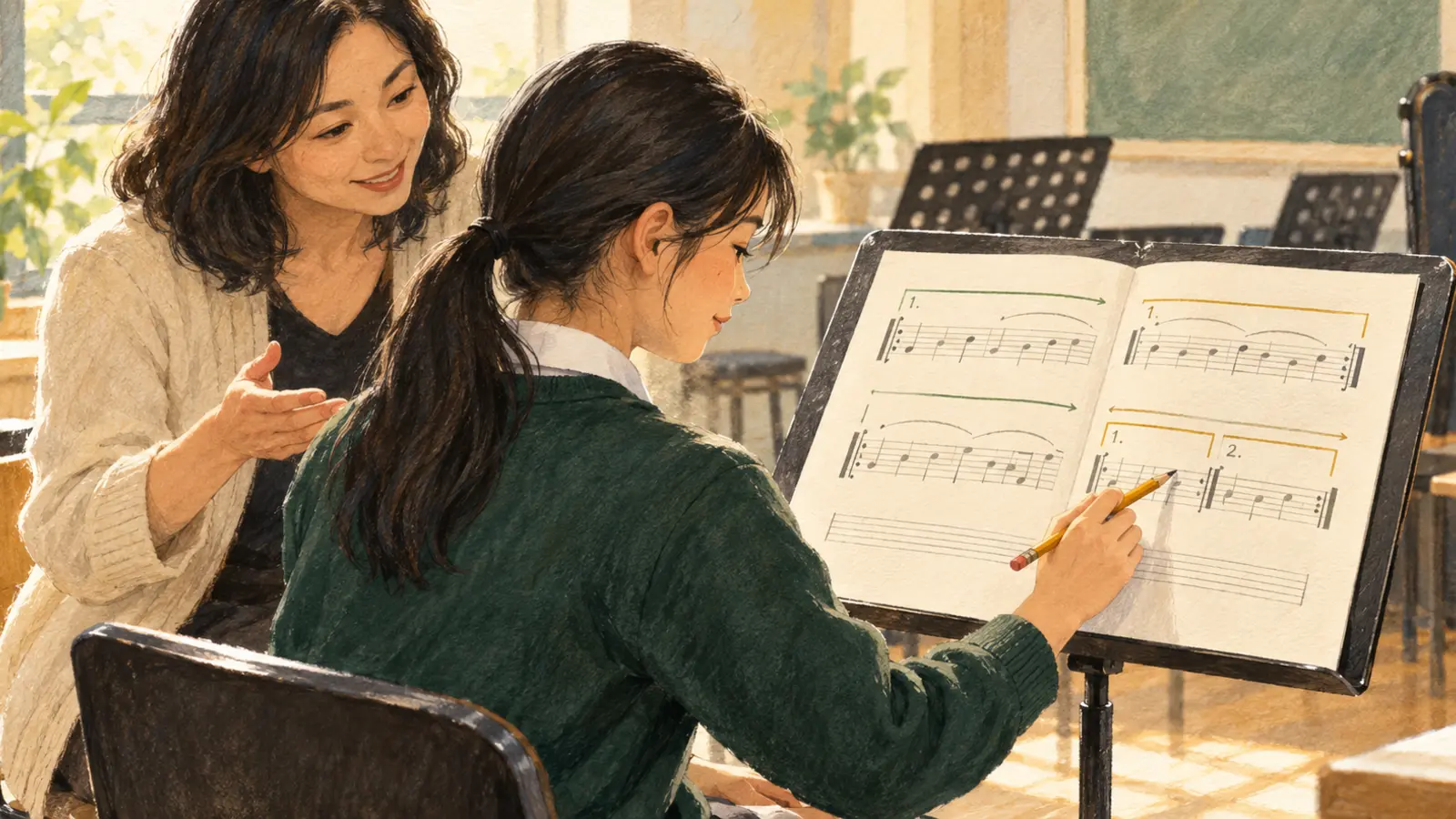
Did you know that performing a difficult piece of music is not the same as explaining what makes it expressive? A student might play every note accurately yet never consider why a phrase builds tension, how its instruments interact or which expressive choice connects with a listener.
Higher Music brings together listening, musical creation, performance and an additional opportunity to investigate a particular musical interest more deeply. It is therefore much more than an external instrumental grade or an extra recital.
For parents searching ‘PG1 Higher Music’, a vital distinction comes first. PG1 is the Secondary 1 posting group, while 2027 SEC Higher Music is G3 K351. The national subject is separate from both the lower-secondary common Music lessons and the examined G1 Music K128 syllabus.
Independent parent–student reader guide for Singapore, based on the 2027 SEAB SEC school-candidate syllabus and MOE’s announced 2028 post-secondary arrangements. Checked 24 October 2026. Always confirm the individual student’s actual school offering, examination year and course admission rules.
The 60-second answer
- PG1 is a posting group, not a separate Higher Music examination level.
- The 2027 national Higher Music school-candidate code is G3 K351; ordinary G3 Music is K350.
- All Higher Music candidates take the G3 Music core: Music Studies 40%, Creating 30% and Performing 30%.
- Higher Music additionally requires one elective: Research Essay, Higher Creating or Higher Performing.
- The core papers determine the SEC Music grade; the elective supports a separately assessed Higher Music Merit or Distinction award under actual SEAB rules.
- Paper 12 Research Essay is 1,500–2,000 words; the other electives require additional original creative coursework or an 8–12-minute performance and viva voce.
- School eligibility, appropriate repertoire, authenticity, workload and future admission prerequisites must all be checked rather than assumed from a PG1 label.
First, Posting Group 1 does not mean every subject remains at G1
Posting Group 1 (PG1) is part of how a pupil enters Secondary 1. General 1, General 2 and General 3 (G1, G2 and G3) describe the actual levels of academic subjects under Full Subject-Based Banding. Some eligible pupils take subjects at more demanding levels, but a posting group is not by itself a national examination code or a promise that every upper-secondary elective will be available.
From the first Singapore-Cambridge Secondary Education Certificate (SEC) examination in 2027, the result records the actual examined subjects and their subject levels. A pupil who joins a mixed form class for common Art, Music or PE does not therefore receive a G3 SEC result in an advanced elective. School availability, combinations, eligibility and the student’s preparation all matter.
This series explains a named G3 subject for a family searching from the PG1 starting point. It is not suggesting an official G1 paper exists where SEAB has not listed one. The family should verify the correct examination year and actual registered subject before ordering revision books or changing a long-term plan.
What Higher Music really helps a learner do
Music is a way of examining sound, time and communication. A listener who notices where the bass enters or how a melody changes can explain why a passage feels different without declaring that everybody must experience the same emotion.
Higher Music invites learners to go beyond recalling familiar pieces. The syllabus involves Western Classical Music, Jazz, Popular Music and Asian Music traditions, supported by listening, analysis and musical evidence. A student can consider both how sound works and why it was created in its context.
Creating music is another kind of inquiry. An initial phrase may have a promising shape but not work with the intended accompaniment. A learner can test a simpler harmony or change the instrumental balance, then explain why the revision communicates more clearly.
Performing requires preparation and interpretation, not only mechanical accuracy. Timing, phrasing, tone, ensemble listening and the relationship between musical intention and what an audience actually hears can all matter.
The additional elective allows a student to specialise. Someone drawn to music research may investigate a focused historical or cultural musical question; another student may wish to develop original composition; a performer may choose a longer recital and an oral discussion.
This is valuable only when the student can sustain the coursework and the subject is actually offered. Higher Music is not a sensible choice merely because it sounds prestigious or because the learner already holds a private practical-music certificate.
Eight core skills behind Higher Music
- Listen actively to rhythm, texture, instrumentation, musical structure and how these affect communication.
- Analyse unfamiliar excerpts with audible evidence, avoiding unsupported guesses about a style or period.
- Compare musical traditions respectfully using context and identifiable sound features.
- Create original musical ideas and explain the relationships among melody, harmony, rhythm and timbre.
- Perform with musical intention, appropriate technique and reliable rehearsal habits.
- Investigate a focused research question and distinguish credible musical evidence from personal taste.
- Choose a Higher Music elective consistent with strengths, interest and sustainable preparation.
- Document authentic work and reflect on why a revised creation, performance or interpretation is stronger.
The official 2027 SEC G3 Higher Music K351 assessment
The official 2027 Singapore-Cambridge SEC G3 Higher Music syllabus is K351, with the previous O-Level reference code 6086. Every candidate completes three core papers: Paper 1 Music Studies lasts 1 hour 30 minutes and carries 75 raw marks and 40% of the SEC Music grade; Paper 2 Creating is 50 marks and 30%; and Paper 3 Performing is 50 marks and 30%.
The Creating component assesses original composition and reflection, while Performing includes recital and reflection. School guidance controls file requirements, approved repertoire, authenticity and preparation procedures. External private music qualifications do not replace these national school assessments.
In addition, the candidate chooses one Higher Music elective. Paper 12 Research Essay requires a 1,500–2,000-word individual essay worth 50 marks, supported by appropriate evidence and sources.
Paper 22 Higher Creating comprises an additional 40-mark creative coursework element plus programme notes worth 10 marks. This rewards meaningful original development and explanation, not simply making a longer or louder piece.
Paper 32 Higher Performing comprises a 40-mark recital of 8–12 minutes and a 10-mark viva voce lasting 3–5 minutes, so a candidate must also be able to discuss choices and demonstrate musical understanding.
The three core papers establish the SEC Music grade; the elective is considered with the core outcome when awarding separate Higher Music Merit or Distinction under specified conditions. A family should not make up a 25/25/25/25 weighting or assume that entering the elective automatically gives a higher grade.
K351 differs from 2027 G1 Music K128 and ordinary G3 Music K350. A student must first confirm which syllabus the school actually offers and registers. There is no separate G1 Higher Music syllabus merely because the student’s posting group is PG1.
Did you know? A practical worked example that reveals understanding
Imagine an original listening example: a short fictional piece begins with a simple melody played on a keyboard, repeats it with a softer lower-register accompaniment, then shifts the rhythm while keeping the notes recognisable. The excerpt is invented for learning, not taken from an actual K351 specimen paper.
First ask the listener what remains recognisable. It may be the melody’s contour or a repeated rhythmic cell. This prevents the child from treating every change as a completely new idea.
Next identify what changed: volume, register, accompaniment, note duration, harmony or tempo. A stronger response names an audible feature before describing its possible effect on an audience.
Now try creating an eight-bar original phrase and one variation. Record both versions within an appropriate school-approved practice context, and ask which communicates the intended direction more clearly.
If the learner is interested in the Research Essay elective, turn the exercise into a focused inquiry: how can one recognisable rhythmic idea be transformed in different styles without losing its identity? The question is small enough to support comparison and genuine evidence.
If the learner prefers Higher Performing, play the original phrase with two different expressive intentions and explain the actual changes in touch, pace or dynamics. The evidence lies in what was heard, not how difficult the notes looked.
Finally note one limitation: a single listener’s interpretation is not a universal law about music. A thoughtful student can make a defensible musical decision and still recognise different responses.
Six common learning gaps and targeted repairs
- Calling an excerpt ‘jazz’ from one instrument alone. Repair: identify audible patterns, structure and musical context before categorising.
- Adding more instrumental layers without clarifying the intention. Repair: identify the central idea and remove a competing part.
- Performing a difficult piece while neglecting interpretation. Repair: choose one expressive decision and listen to its effect.
- Choosing an elective because friends chose it. Repair: compare the actual research, creative or recital workload and the learner’s interests.
- Submitting attractive coursework without an authentic development trail. Repair: preserve original drafts, practice evidence and the student’s own reflections.
- Confusing K351 with the ordinary G1 K128 Music exam or assuming PG1 itself provides access. Repair: verify the school offering and correct G3 examination registration.
A learning routine that builds independence
Listen to a short unfamiliar musical excerpt and name one concrete feature before expressing any preference.
Compare two versions of a phrase, describing how a changed musical element affects its structure or character.
Make a small original creative or performance choice and record why it was made, not only whether it sounded ‘good’.
Ask a second listener for feedback and identify one revision the learner can justify with evidence.
After a few days, apply the same idea to a different excerpt or technique without the original example. That shows understanding rather than recognition by repetition.
From Secondary 1 to Secondary 4
- Secondary 1: engage with shared Music lessons, practise keeping pulse, attentive listening, basic creation and inclusive ensemble habits.
- Secondary 2: explore musical styles, independent explanations and sustainable practice before considering more demanding specialisation.
- Secondary 3: check the actual availability and requirements for G3 Higher Music and select a suitable elective under school guidance.
- Secondary 4: complete the published year’s core and elective requirements authentically, then assess future study using the full SEC academic profile.
Education pathway: ITE, Polytechnic, JC and University
Did you know a long-term university ambition and direct admission to a particular diploma immediately after SEC are different questions? A real route can have several stages, each governed by its own recognised academic results and course prerequisites.
From the 2028 intake, MOE’s Post-Secondary Admissions Exercise (PSE) will cover the main results-based entry routes to eligible ITE, polytechnic and JC/MI programmes. Consolidating the application exercise does not merge all their admission requirements.
1. ITE Higher Nitec and technical or creative progression
ITE Higher Nitec: a student who meets a programme’s recognised SEC subject-level and grade requirements may apply for eligible programmes. Skills developed through a demanding elective can support interests and good study habits, but cannot substitute for missing course prerequisites. Eligible Higher Nitec graduates may later investigate further qualifications under published progression conditions.
2. Polytechnic diploma: direct or later eligibility
Polytechnic: direct diploma admission depends on the destination’s required complete SEC aggregate, subject levels, grades and sometimes additional selection. From 2028, a qualifying G2 subject may fill the specified fifth-subject place under the direct diploma framework; this is not permission to use an arbitrary G1 hobby or a single elective to bypass all other rules. An alternative for some applicants is a recognised Higher Nitec progression route.
3. Junior College and Millennia Institute
JC or MI: the announced 2028 JC L1R4 approach requires a qualifying profile of G3 results, while Millennia Institute also has its own current requirements. The initial PG1 label is not an irreversible barrier, but it cannot replace missing G3 examination subjects or results. A special project, recital or sporting ability by itself does not count as an invented extra aggregate grade.
4. University as a later qualification checkpoint
University: appropriate pre-university study or a qualifying diploma may lead to a later application, subject to institutional prerequisites, competition and any interviews, auditions or portfolios. The elective can help a learner discover a field, but no single secondary-school syllabus can promise university admission.
A realistic one-week practice plan
- Monday: listen to an unfamiliar extract and identify one rhythmic and one textural feature.
- Tuesday: write two short sentences connecting sound evidence to a possible musical effect.
- Wednesday: create a small original musical phrase and one purposeful variation.
- Thursday: practise a short performance segment and assess accuracy separately from expression.
- Friday: compare the three electives for their actual research, composition or performing demands.
- Weekend: complete a fresh mini-task and explain an improvement without a model answer.
Four parent–student conversations worth having
- Ask the school: is this elective offered to this cohort, at which level, and what combination, selection, timetable and assessment requirements apply? Never infer availability from the national syllabus directory.
- Ask the learner: can they show a recent independently produced task and explain their first uncertain decision, rather than merely tell a parent that the subject is interesting?
- Ask the teacher: which specific gap should be repaired next—understanding a concept, justifying an answer, interpreting evidence, managing practical work or sustaining a safe workload?
- Ask any future receiving institution: what complete qualifying SEC subject-level results, grades and additional evidence are actually required for this specific course and intake?
What to track in a small evidence notebook
Use a four-column mini-log: task, first uncertain step, student-made correction and date for an independent retest with changed material. It is a short record of reasoning rather than a second pile of homework.
For supervised coursework, add the school’s approved checkpoints and authenticity requirements, but leave the assessed design, practice, project, reflection and final files to the student. Parental support should not become uncredited production of assessed work.
At the end of a month, compare a current unseen task with an older one. Can the student now make, explain and verify a decision without copying their first model? If so, the learner has made a useful step independent of any eventual institution or career title.
Frequently asked questions
Is there a 2027 G1 Higher Music paper for PG1 students?
No. Higher Music is G3 K351. PG1 is the student’s original Secondary 1 posting group.
How is the core SEC Music grade determined?
For 2027 K351, Music Studies contributes 40%, Creating 30% and Performing 30%.
Does every Higher Music candidate complete all three electives?
No. Every candidate completes one chosen elective: Research Essay, Higher Creating or Higher Performing.
How long is the Research Essay?
The 2027 Paper 12 requires 1,500–2,000 words and is worth 50 marks.
How long is the Higher Performing recital?
Paper 32 requires an 8–12-minute recital plus a 3–5-minute viva voce, with separate marks.
Will entering Higher Music automatically give a Merit or Distinction?
No. Awards depend on the actual core result, elective performance and SEAB’s published requirements.
Can a PG1 learner eventually pursue music-related university study?
Potentially, through qualifying educational routes and meeting programme-specific academic and, where applicable, audition or portfolio criteria.
Where to verify the syllabus and education pathway
The 2027 school-candidate SEC G3 directory lists Higher Music with subject code K351. The official SEAB syllabus PDF specifies the assessment structure, permitted materials, supervised requirements and other rules. Use the document corresponding to the child’s examination year, not an older GCE O-Level paper simply because the subject name looks familiar.
The Full Subject-Based Banding school arrangements govern any eligibility for a more demanding subject and the school’s offering. The current PSE, ITE, polytechnic, JC/MI and university requirements govern the next admissions decision. This guide is for education and planning, not a guarantee of future qualification.
SEAB — 2027 G3 Higher Music K351 subject list
SEAB — official 2027 G3 Higher Music (K351) full syllabus (PDF)
SEAB — 2027 G1 subject list to distinguish subject levels
SEAB — 2027 G2 subject list to distinguish subject levels
SEAB — Singapore-Cambridge SEC overview
MOE — Full Subject-Based Banding subject flexibility
MOE — 2026 post-secondary admissions announcements
MOE — Post-Secondary Admissions Exercise from 2028
ITE — eligibility and Higher Nitec progression
Continue reading on eduKateSG
What is PG1? Posting Groups compared with G1/G2/G3 subjects
2027 MOE/SEAB subject-level syllabus directory
Education pathways: ITE, Polytechnic, JC/MI and University
Learn more about the official 2027 Higher Music syllabus
More specific Higher Music learning guidance
Compare another subject in the PG1 pathway series
Secondary 1 Mathematics Tutor Clementi | Small Groups Tutorials — the immutable foundation guide
Common Music versus Higher Music
2027 SEC G1 Music K128 compared with K351
One good question to ask tonight
Ask your child: ‘Which musical element actually changed your interpretation, and how would you explain that change to someone hearing it for the first time?’ Look for one observation and a clear explanation of what it means. That evidence is often more useful than an impressive project title or a label about academic potential.