
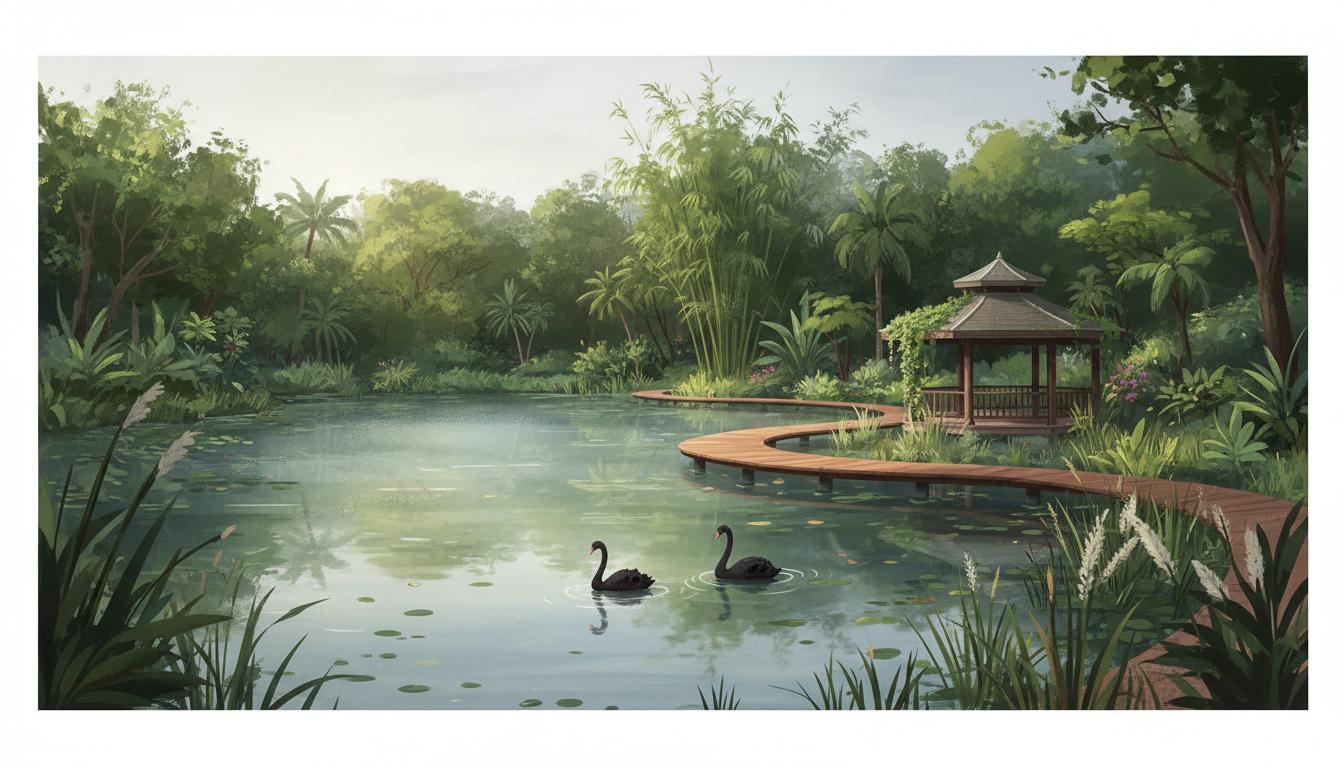
Botanic Gardens MRT Station (CC19/DT9) is the most convenient rail arrival for the Bukit Timah Gate of Singapore Botanic Gardens. It serves the Circle and Downtown Lines, so it suits visitors looking for an easy garden walk, Eco Lake, the Centre for Ethnobotany, the Seed Bank, the Evolution Garden and Jacob Ballas Children’s Garden. You can enjoy the main outdoor garden paths without buying a ticket. The National Orchid Garden is a separate, ticketed destination farther through the grounds.
Choose Exit A for the Bukit Timah Gate. The official Gardens visitor guide lists the main grounds as open 5am to midnight daily, while some facilities have their own shorter hours. Jacob Ballas Children’s Garden is generally open 8am–7pm with last entry at 6.30pm and closes on Mondays except designated public holidays. The Tree House play structure inside Jacob Ballas is currently closed because of termite damage, with a replacement expected around the end of 2027; the rest of the children’s garden has other attractions.
At a glance, this Botanic Gardens MRT visitor guide helps you select the right exit, avoid walking to the wrong end of a large UNESCO-listed landscape, budget for optional tickets and make a comfortable route for children or older companions. Information reviewed 1 November 2026. Always follow the park’s updated closures, signage and weather advice.
- Station: CC19 (Circle Line) / DT9 (Downtown Line), interchange, Exit A for Bukit Timah Gate
- Free outdoor choice: Eco Lake and nearby public gardens, with suitable public paths
- Learning attractions near this entrance: Centre for Ethnobotany, Seed Bank and Evolution Garden
- Family attraction: Jacob Ballas Children’s Garden, approximately 10 minutes’ walk from Exit A according to NParks
- Garden hours: grounds 5am–midnight; individual indoor exhibits and nature trails have shorter windows
- Important closure: Jacob Ballas Tree House closed; Public Reference Library closed for digitisation through 2027

Which entrance does Botanic Gardens MRT actually serve?
The Bukit Timah Gate is the nearest entrance from the station. This is not the Tanglin Gate, which is more conveniently approached from Napier MRT on the Thomson–East Coast Line. The different entrances matter because Singapore Botanic Gardens covers a large landscape with attractions at different distances, and the names on a general tourism map may conceal that walk.
From the station, use Exit A and read the garden’s on-site map rather than assuming an aerial photo shows the shortest permitted footpath. The station serves both the Circle and Downtown Lines; if you arrive by a different line, the appropriate transfer may make one direction easier. Check current rail service rather than repeating old first- or last-train times.
Visitors often meet friends by saying simply ‘at the Botanic Gardens’. Agree on a precise public point at the Bukit Timah Gate, or a named building near the station, and avoid blocking the station entrance. A group arriving from Napier may be at the opposite end and require a substantial internal walk before meeting.
The simplest arrival rule is to start near the gate and select one main zone. A visit built around Eco Lake and the Seed Bank does not need a detour to Swan Lake at the southern end. There is no award for covering the entire site in one afternoon.
What to see first: seven practical choices
Eco Lake: a relaxed walking and wildlife-viewing environment near the Bukit Timah end, suitable for a free outdoor break when paths are available.
Centre for Ethnobotany: a small educational destination where plants meet human culture, trade, tradition, food and daily life. It has a shorter indoor operating schedule than the grounds.
Seed Bank: a meaningful stop for understanding plant conservation and how seeds are collected, stored and studied for biodiversity protection.
Evolution Garden: a landscape designed to tell the history of plant life across geological time. It rewards observation more than racing between photo points.
Jacob Ballas Children’s Garden: a child-oriented area where visitors must observe age, accompanying-adult and opening-hour rules. A specific Tree House is closed for safety.
Foliage and Fragrant Gardens: smaller botanical interests that can make a short nature walk more purposeful.
Cluny Court and Adam Road Food Centre: nearby choices for food and errands outside the Gardens, with very different dining styles and individual business hours.
Stop 1: Eco Lake—begin with looking, not rushing
Eco Lake gives visitors a natural setting for slowing down before exploring specialised plant collections. Its paths and water views are particularly useful for people who want a short encounter with greenery rather than an intensive guided tour. The appeal is the relationship between living plants, water, movement and the surrounding urban environment.
A good first visit takes five quiet minutes at a safe viewing position. Notice the different plant forms and any birds or insects you can see without going closer. Some days you may observe swans; other days you may see little wildlife. A lake is not a staged performance, and a specific animal sighting should never be promised by a travel guide.
Children can choose something they can describe accurately, such as a bird’s movement or a plant’s leaf shape. Afterwards, ask which part of their explanation is visible evidence and which part is a guess. This turns an ordinary walk into a small science lesson without turning the afternoon into a worksheet.
Keep away from water edges, follow railings and posted rules, and do not feed animals. Never cross planted areas for a closer photograph. A dramatic picture gained by disturbing the habitat is less useful than a respectful observation from the public path.
Stop 2: Centre for Ethnobotany—how plants become part of human life
The Centre for Ethnobotany is a short educational destination in the Gardens, and the operator identifies Bukit Timah Gate as the nearest entrance. Its exhibitions connect plants with culture, food, medicine, material traditions and human communities. That makes it especially valuable to families who want an indoor learning moment between outdoor walks.
According to the Gardens’ June 2026 visitor information, the Centre generally opens 9am–6pm daily except the last Wednesday of the month. It is housed in a two-storey building adapted from a previous use, and its display themes may change. Do not assume an exhibition photograph from an old review is a permanent installation.
Rather than attempting to read every label, select one relationship. A spice may have travelled through trade, a leaf may have been used for weaving, or a tree may have supported a traditional material practice. Ask what people knew about the plant and what evidence the display provides.
For students, the most useful idea is that botany is not only a collection of plant names. Human history, agriculture, medicine and design all depend on how people learn to use and conserve living things. The centre helps visitors connect that idea with real exhibits.
A gallery has a different timetable from a public garden. If you arrive early in the morning, use the outdoor paths first and only visit the Centre after its doors open. If you arrive close to closing, make it the main stop instead of leaving it as the last optional item.
Stop 3: the Seed Bank—why seeds matter beyond a pretty flower
The Singapore Botanic Gardens Seed Bank was established in 2019 to support long-term conservation of plant species in Singapore and the broader region. The official operator says the facility stores seeds from more than three hundred species and uses exhibitions to explain why seed storage is important. It is not a retail seed shop or an invitation to access operational storage rooms.
The Seed Bank Interpretive Gallery generally opens 9am–6pm daily, with Bukit Timah Gate the nearest garden entrance. Visitors can learn about stages of collection, storage and the difficulties posed by tropical seeds that may not survive conventional drying and freezing. The display connects biology with an important conservation problem.
A simple question is why scientists would collect a seed rather than rely on mature plants remaining in one forest. The answer involves risk, reproduction, genetic diversity and the possibility of recovery after habitat loss. Young visitors may find the idea easier to grasp by comparing different seed shapes and dispersal methods.
Outside, the Seed Dispersal Garden illustrates how plants use wind, water, animals or mechanical force to spread. Look at the structures without plucking seeds or testing them on the spot. A living collection is part of conservation and education; removing a specimen for entertainment damages the experience for others.
Make this a focused stop for a family with curious school-age children. It can comfortably replace a distant attraction in a short itinerary, because understanding one idea well is a better outcome than trying to see everything on the map.
Stop 4: Evolution Garden—make geological time visible
Evolution Garden is designed to communicate changes in plant life through a landscape. Its routes invite a visitor to think beyond the lifespan of a human, a building or even a nation. What we know about plants today sits within an extraordinary history of changing environments and living forms.
An effective visit follows the theme rather than collecting only photographs. Read a panel and relate it to the planting or form shown nearby. Ask how scientists can know something about a period that predates recorded human history. The difference between a fossil, an inference and a modern reconstruction matters.
Young students often imagine evolution as a ladder with one correct destination. A well-designed time-themed garden can help correct that idea: changes occur through branching histories and different environments. You do not have to deliver a full biology lesson to make the walk valuable; one careful explanation is enough.
This is a garden path, not a closed classroom. Expect heat, humidity and the needs of other visitors. Keep the group on permitted paths, do not use stones or plants as props, and give others room to read interpretive signs.
If the route is too long for a companion, stop after the part that has been most interesting and return. A landscape intended to explain billions of years need not be walked at great speed.
Stop 5: Jacob Ballas Children’s Garden—one of the best family reasons to use this station
Jacob Ballas Children’s Garden is a child-centred destination at the Bukit Timah end, and NParks gives a roughly ten-minute walk from Botanic Gardens MRT Exit A. It is designed as a place where children explore plants, habitats and nature through age-appropriate activity. Adults accompanying children should follow admission and supervision rules.
The published opening is 8am–7pm, last entry 6.30pm. The Children’s Garden closes on Mondays except when the day is a designated public holiday. The operator states that children up to fourteen are the intended users and that all children must be accompanied by an adult. It is not intended as an adults-only tourist attraction.
A critical current detail is that the Tree House play feature is closed because of termite damage. The Gardens is developing a replacement, targeted around the end of 2027. Other parts of the Children’s Garden remain available under the general facility notices; do not present the closed Tree House as an open attraction in a 2026 itinerary.
Water play may be suspended in poor weather, and individual activities can have their own access rules. Check the official Children’s Garden page and on-site signs before promising a particular play experience. A short family visit should not hinge entirely on a single feature that may be unavailable.
Parents can use the visit to connect play and learning without pressure. Ask children what plants need, where water flows or what changes when an area has more shade. Let them enjoy the environment without requiring a written answer after every stop.
Foliage, Fragrant and other small themed gardens: why a shorter route can work
A nearby themed garden may be a better destination than a distant headline attraction. The Foliage Garden demonstrates differences in leaf shape, texture and colour. The Fragrant Garden draws attention to scent and the connections between plants and sensory experience. Choose a route that fits current paths and opening hours.
Visitors sometimes look only for flowers and miss leaves, bark, stems and the habits of plants. Spend a little time comparing two species that grow near one another. What makes them visibly different? What adaptation could explain a leaf surface or plant shape? Not every answer is obvious, and uncertainty can be a good start to learning.
Smell plants from permitted distances where appropriate, but do not pluck or crush leaves. Some plants are protected or may irritate sensitive skin. A garden is not an invitation to test unknown botanical material by touching or tasting it.
These small observations are ideal for a family who wants fresh air and a modest walking commitment. A theme supplies purpose without making the outing long or expensive.
Cluny Court: the station-side food and shopping alternative
Cluny Court, near the Botanic Gardens MRT entrance and the Bukit Timah Road corridor, offers cafés, independent shops and other services. It can make a useful meeting point or rest after walking in the Gardens. The attraction is convenience and a distinct small-scale shopping environment, not a guaranteed collection of particular tenants from an old blog post.
Food options and trading hours vary by business. A visitor who specifically wants a bakery or restaurant should check the current unit and menu, especially if arriving early. The general existence of a shopping centre does not mean every café is open at 7am when the Gardens are already accessible.
For families, a café break can be a useful compromise between outdoor activity and a child’s need for food or rest. A short meal also gives an opportunity to discuss what people saw, but it does not need to turn into a formal lesson.
If the chosen business is closed, look for another confirmed option or finish the trip. A good nature visit does not fail because a single dessert or brunch outlet is unavailable.
Adam Road Food Centre: another option, not inside the Gardens
Adam Road Food Centre lies on the other side of the Bukit Timah Road and Dunearn Road transport corridor and is a familiar local meal destination. It is a separate hawker centre, not a restaurant inside the Botanic Gardens. If you intend to go, plan the safe crossing and the approach from the MRT rather than assuming it is at the same gate as Eco Lake.
The food centre is associated with local dishes such as nasi lemak, but exact stalls, queues and dishes vary. Choose according to the operating business and your group’s needs, not because a generic article declares one stall permanently the best. Hawker opening hours are often different from those of the centre as a whole.
Return trays and crockery as directed, pay attention to queue movement, and have an alternative payment method. A short meal with friends can be enough to make a station-side outing; there is no requirement to enter the Gardens afterwards if the time is already spent.
Visitors with strollers or wheelchairs should choose an appropriate accessible crossing and approach. The short distance on a map is less important than using a lawful and comfortable pedestrian route.
Napier MRT is not this station: plan the southern garden separately
The Gardens’ southern attractions include Swan Lake, the Bandstand and the SBG Heritage Museum. Those can be reached through the grounds, but Napier MRT on the Thomson–East Coast Line is the more natural arrival for Tanglin Gate. The Gardens themselves list both train stations as gateways at different ends.
A visitor who enters through Botanic Gardens MRT and tries to see every southern feature may spend much of the day simply moving through the site. That is fine for a deliberate long walk but unnecessary for someone whose main interests are Eco Lake and Jacob Ballas Children’s Garden.
For Swan Lake or the Heritage Museum as the primary destination, consult the separate Napier MRT visitor guide. It explains the Tanglin-side experience without turning this article into a near-duplicate of another station guide.
A complete Gardens walk can use different arrival and departure stations, but check the total time, daylight, fitness and transport connections before choosing a one-way route.
A one-hour plan: Eco Lake and a gentle return
If you have roughly one hour, follow Exit A to Bukit Timah Gate and choose a manageable public path towards Eco Lake or a nearby garden area. Allow time to look rather than only walk. Set a turnaround point early enough that your return to the station remains comfortable.
The most common error is to count the first approach but not the final walk back. Another is to add a shop stop without including the time spent ordering and eating. One calm garden visit can be far more enjoyable than a rushed walk, snack and gallery queue.
This route is suitable as a first introduction for someone unfamiliar with the Gardens. The next visit can focus on a gallery or a longer plant-history route.
Two-hour plan: a living museum of plants
Combine Eco Lake with one educational attraction near Bukit Timah Gate, such as the Centre for Ethnobotany or Seed Bank. If the exhibition you want is closed, choose the Evolution Garden or another publicly accessible outdoor area instead. The intention is to learn one theme deeply rather than accumulate several unfinished stops.
Allow time to read the displays, help children ask questions and rest. If your group values food more than museum interpretation, substitute a confirmed-open café or hawker centre rather than trying to fit everything in.
Two hours is a guide to scope, not a precise travel-time promise. Different walking speeds, detours, heat and queues can change the plan.
Half-day with children: Jacob Ballas as the anchor
Start in the cooler part of the day, follow the route to Jacob Ballas Children’s Garden and allow children sufficient time for an appropriate play area. Remember the Monday closure and the temporarily closed Tree House. The focus should be the experience still available, not a promise to use every piece of equipment.
Afterwards, choose a short garden stroll or food stop depending on the family’s energy. Do not add a long hike towards the southern end after children are already tired. A half-day can be rewarding without entering the National Orchid Garden.
Bring drinking water, suitable footwear and the items needed for a safe family outing. Follow weather-related waterplay closures and do not enter fenced or maintenance areas for a photograph.
A longer independent learning route for older students
An older student may enjoy combining the Seed Bank, Centre for Ethnobotany and Evolution Garden. These places tell different parts of a coherent story: how plants evolved, how people use them, and how scientists conserve diversity. Organise the route around those questions rather than visiting randomly.
Begin by writing one question in a notebook, such as ‘What makes plant diversity valuable to human society?’ At each stop, record one example and whether the evidence comes from an exhibit, an observed plant or an explanation from a source. The result is a more thoughtful field exercise than a scrapbook of unrelated photographs.
Do not attempt to enter laboratories or research storage spaces. The interpretive visitor areas exist for public learning; operational scientific facilities may be restricted. Respect that distinction.
When are the Gardens open, and what actually closes earlier?
The main grounds are listed as open 5am–midnight. That does not mean every gallery, children’s facility or forest trail can be entered throughout that period. The Centre for Ethnobotany and Seed Bank generally operate 9am–6pm; Jacob Ballas follows its own 8am–7pm schedule and Monday rule.
The Rain Forest and Learning Forest sections have 7am–7pm restrictions and may close during inclement weather. A late evening walk should remain in the parts of the Grounds that are officially open and adequately lit, rather than entering a forest path because the main gate is open.
Current announcements identify the closed Tree House and the temporary Public Reference Library closure through 2027. A library closure does not close all gallery or outdoor attractions, and a specific play-feature closure does not make the entire Children’s Garden unavailable.
A sensible visitor checks the particular feature before departure, not only a site-wide opening-hours headline.
A current 2026 notice: public library, Tree House and special works
The Gardens’ October 2026 notices say the Public Reference Library is temporarily closed while collections are digitised, with closure extending through 2027. This affects people intending to consult reference material, not everyone enjoying Eco Lake or an outdoor walk.
The same notices say the Jacob Ballas Tree House is closed due to termite damage and a replacement is planned around late 2027. Do not promise children access to that structure. The programme of special works can evolve, so check for any new announcements before a future visit.
Other specific maintenance dates affect attractions across the wider Gardens, including the National Orchid Garden. These details reinforce the need to choose an actual venue and check its current page rather than treating every attraction as permanently available.
Accessibility and walking comfort: the full route matters
The Gardens provide wheelchair-friendly routes and services, but the full experience begins at the station exit and includes paths, crossings, distance and venue entrances. A particular accessible attraction does not mean every garden shortcut is step-free.
For somebody using a wheelchair or stroller, identify the approach to the desired attraction and the best return. Ask Visitor Services about borrowing a wheelchair if needed, while remembering that any loan depends on availability and current rules. Do not rely solely on a general accessibility icon in a third-party map.
Older visitors may prefer a short Eco Lake route or a single museum stop rather than a full-site circuit. Make time for shade and seating and agree that a companion may turn back while others continue.
The objective is to choose a route that the whole group can enjoy comfortably, not to reach the largest possible number of named features.
Rain, thunderstorms, heat and haze
Tropical weather can change quickly. During thunderstorms, do not continue exposed outdoor walks or seek shelter under isolated trees. The Gardens may close forest sections or waterplay areas during inclement weather and carry out checks before reopening.
On hot days, carry water and reduce walking distance rather than simply increasing speed. An air-conditioned café can be a helpful break only if the business is genuinely open. In haze, follow the relevant official Singapore advisories and adjust outdoor activity for the group.
Do not treat a nature park as a place where everyone should ignore fatigue or physical limits. A shorter visit can still provide useful learning and a pleasant break.
Free entry, paid orchid tickets and other costs
General outdoor access to Singapore Botanic Gardens is free. The National Orchid Garden requires separate admission, and prices or concessions depend on the visitor’s eligibility. Food, retail and transport are other expenses.
If the orchid garden is the primary purpose, confirm its published opening hours—8.30am–7pm, with last ticket sale and entry at 6pm—and check the route from the entrance before deciding whether Botanic Gardens MRT or Napier better suits the wider itinerary.
Do not imply that the MRT fare covers an attraction ticket or that a café meal is included in a free public-park visit. It helps to separate compulsory transport costs, optional admission and individual food choices.
Common mistakes around Botanic Gardens MRT
Using the wrong station for the wrong end. Botanic Gardens MRT serves Bukit Timah Gate; Napier MRT is useful for Tanglin Gate.
Assuming the Gardens’ main hours apply to every facility. Children’s spaces, galleries and forest areas have different schedules.
Promising the Jacob Ballas Tree House in November 2026. It is closed for safety and replacement planning.
Confusing the Public Reference Library with the entire museum-and-garden system. Its digitisation closure is facility-specific.
Guaranteeing a rare wildlife sighting. Birds and other animals are not scheduled attractions.
Planning only the outward walk. Return distance, rest, food queues and weather all need consideration.
Frequently asked questions
Which lines serve Botanic Gardens MRT? Circle Line CC19 and Downtown Line DT9.
Which exit leads to the Gardens? Exit A leads to the Bukit Timah Gate.
Is entry to the main Gardens free? Yes, general outdoor grounds are free; special paid areas such as the National Orchid Garden are separate.
What are the main opening hours? The operator lists 5am–midnight for the grounds, but individual areas have distinct schedules.
Is Jacob Ballas Children’s Garden near this station? NParks gives an indicative 10-minute walk from Exit A.
Is the Tree House open? No, the current notice says it is closed because of termite damage, with replacement targeted around the end of 2027.
Where can children learn about plants without a playground? The Seed Bank, Centre for Ethnobotany and public themed gardens can be excellent observation sites.
Is the Public Reference Library currently open? No, the current notice describes a temporary digitisation closure extending through 2027.
Can I see Swan Lake from this entrance? It is farther through the Gardens; Napier MRT can be a more convenient arrival for the Tanglin-side landmarks.
Why this guide is different from a general Botanic Gardens article
The main reader problem is selecting the correct station, gate, time and manageable route. The broad Gardens are covered by many excellent resources; this article instead explains how a visitor arriving at CC19/DT9 can choose among nearby experiences and avoid unnecessary walking.
Specialist pages can provide more detail on individual plants, museums or public programmes. Here the objective is a reliable arrival plan, with honest boundaries between free outdoor spaces, galleries, closed facilities and paid experiences.
Official sources and related reading
- Singapore Botanic Gardens: official entrance, hours and facilities
- Singapore Botanic Gardens: current Tree House, library and other closure notices
- Jacob Ballas Children’s Garden: Exit A approach and visiting rules
- Centre for Ethnobotany: interpretation and opening hours
- Seed Bank: plant conservation and visitor gallery
- Singapore Botanic Gardens: official walking routes and time planning
- eduKateSG: Napier MRT guide for Tanglin-side attractions
- eduKateSG: Heritage Museum detailed companion
Independent editorial guide. Reviewed 1 November 2026 using the Gardens’ current notices and visitor information. Weather, access and gallery schedules may change.