
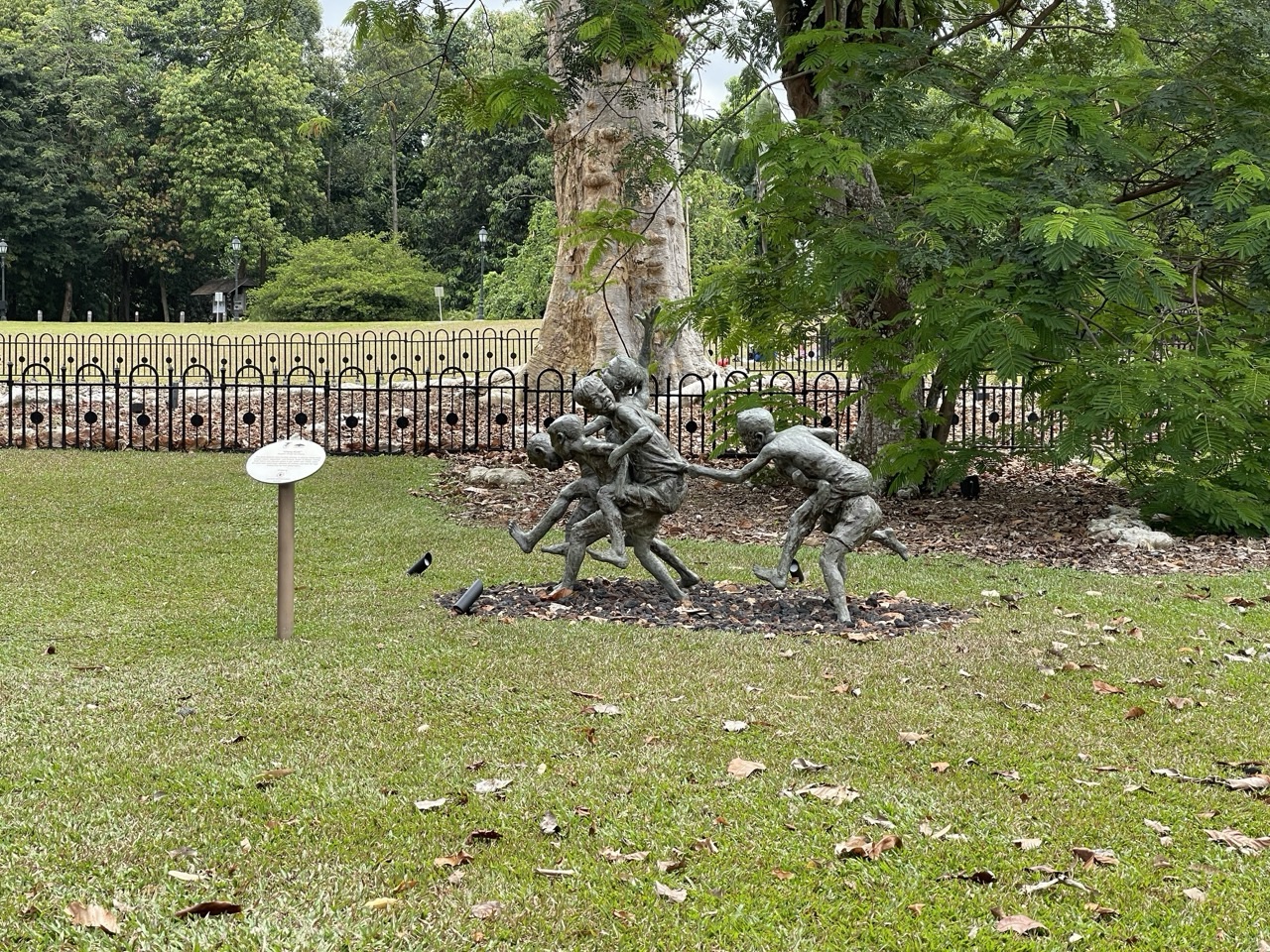
Where can you take a free sculpture walk in Bukit Timah? Begin at Singapore Botanic Gardens’ Bukit Timah Gate near Botanic Gardens MRT and use the Gardens’ official 2026 Sculpture Trail Map 2. The closest themed artworks include Ethnobotany Stone Murals by Yip Yew Chong and Hunter-Gatherer by Aileen Toh in the Ethnobotany Garden; Interactive Birds, Javan Cucumber Seed, Sea Pong-Pong Seeds and Saga Daun Tajam Seeds in the Seed Dispersal Garden; and Tandok-Tandok Seeds at the Seed Bank entrance. The general Gardens are free, but the National Orchid Garden is ticketed and Jacob Ballas Children’s Garden has child-focused entry restrictions.
If you search for Bukit Timah street art, public sculptures Singapore Botanic Gardens, outdoor art walks, Yip Yew Chong murals, Seed Bank sculptures, Botanic Gardens sculpture map, free art activities for families, Swan Lake statues or Instagram photo spots near Botanic Gardens MRT, the key is knowing that the sculptures are spread across several distinct Gardens zones. Do not expect to see the Swan Lake Flight of Swans in the same small Bukit Timah Core loop as the Seed Dispersal Garden: Swan Lake belongs to the Tanglin section of the park.
Best short route: focus on the Bukit Timah Core sculptures and treat nearby botanical displays as part of the experience. For families with children, the public sculpture Mystree at the Jacob Ballas Children’s Garden entrance makes a distinctive additional stop. The Native Wildlife sculptures lie inside that children’s garden: adults without accompanying children cannot assume independent entry. This guide uses NParks’ sculpture catalogue updated 16 June 2026 and visitor notices checked 22 October 2026.
Quick answer: which sculpture is where?
| Artwork | Official location | Artist or important detail |
| Ethnobotany Stone Murals | Ethnobotany Garden — Bukit Timah Core | Yip Yew Chong; four painted rock murals (2018) |
| Hunter-Gatherer | Ethnobotany Garden | Aileen Toh; figures carved from salvaged Shorea wood |
| Interactive Birds | Seed Dispersal Garden | Chua Boon Kee; brass birds and seed-bearing plants |
| Javan Cucumber Seed | Seed Dispersal Garden | Chua Boon Kee; wind-dispersed seed |
| Sea Pong-Pong Seeds | Seed Dispersal Garden | Chua Boon Kee; floating-seed adaptation |
| Saga Daun Tajam Seeds | Seed Dispersal Garden | Chua Boon Kee; self-dispersing seedpod |
| Tandok-Tandok Seeds | Outside Seed Bank entrance | Chua Boon Kee; brass seed sculpture |
| Mystree | Jacob Ballas Children’s Garden entrance | Zadok Ben-David; corten steel, 500+ human figures |
| Native Wildlife | Inside Jacob Ballas Children’s Garden | Animal-themed copper pieces; restricted adult access |
| Flight of Swans | Swan Lake — Tanglin section | Eng Siak Loy; separate longer walk |
Contents: free outdoor art without wrong turns
- Download the correct official trail map
- The Bukit Timah Core and its sculptures
- Ethnobotany murals and the meaning of plants
- Seed Dispersal Garden and the physics of seeds
- The Seed Bank and historic research building
- Mystree and access to Jacob Ballas
- How to extend the walk into Central and Tanglin
- Paid orchid-area sculptures
- Family art games, photography, accessibility and safety
- FAQs and official NParks sources
1. The Gardens are a public art gallery as well as a botanical garden
NParks describes Singapore Botanic Gardens as a living gallery for artworks by Singaporean and international artists. The pieces use metal, wood, stone, painted rock and other materials, often donated to mark an occasion or celebrate a relationship.
A sculpture visit is therefore not simply a hunt for famous statues. It is a way to see how visual art, scientific ideas, cultural history and landscapes support one another. Even a visitor who knows little about art can enjoy learning what a work depicts and why it is placed there.
2. The official sculpture guide has two maps
The Gardens’ Sculptures webpage offers two downloadable trail maps: one from Tanglin Gate and one from Bukit Timah Gate. The page groups artworks by Tanglin Entrance, Tyersall–Gallop Core, Central Core and Bukit Timah Core.
Use Map 2 for a visit that begins near Botanic Gardens MRT. Do not copy a full list of every park sculpture into a promised 30-minute local walking loop: the park is long, and the groups are not all beside each other.
3. Which MRT station is the most helpful?
Botanic Gardens MRT connects the Downtown Line and Circle Line and serves the Bukit Timah Gate. The nearby Bukit Timah Road and Cluny Park Road approaches are described on the official visitor page.
The nearest practical entry point depends on the first artwork you want, accessibility needs and the direction of travel. Begin with the map and allow time for unhurried paths rather than guessing from a single satellite screenshot.
4. The public Gardens have free general entry
The Singapore Botanic Gardens are generally open from 5am to midnight without a general admission fee. Individual venues such as the National Orchid Garden have a ticket or shorter hours, and the Seed Bank and Jacob Ballas garden maintain their own operating conditions.
A free sculpture walk can therefore be planned without paying for the orchid collection. If you choose to add orchid-area sculptures later, account for the separate ticket.
5. Find the Ethnobotany Garden
The Ethnobotany Garden in the Bukit Timah Core highlights how plants are used in medicine, food, construction and cultural practices across the region. The landscape is a fitting setting for artworks about human relationships with nature.
An ethnobotanical display is not permission to collect leaves or use an unidentified plant as medicine. The information is meant for appreciation and learning. Stay on designated paths and read labels where available.
6. Yip Yew Chong’s Ethnobotany Stone Murals
The official sculpture catalogue lists four painted rock murals by Singapore artist Yip Yew Chong, created on site in 2018. They illustrate different uses of plants in the daily lives of regional cultures.
The artist chose painted stone rather than a conventional indoor canvas. NParks notes that the murals are deliberately exposed to weathering and may eventually return to nature. That gives the work an unusual relationship with time.
7. What makes the rock murals different from a street wall?
Street murals are often painted on a building façade; these works use individual rocks within a planted setting. Their medium encourages viewers to notice the stone surface, the surrounding plants and the imagery together.
Look for the way the pictures communicate everyday practices, not simply the style of the painted figures. A useful question for children is: which human need does the depicted plant help meet?
8. The murals are not permanent in the usual sense
The Gardens’ catalogue explains that the paintings were made with weathering in mind. Their gradual fading is part of the agreed approach, rather than evidence that visitors are expected to repaint or maintain them themselves.
Document the works respectfully without touching or rubbing their surfaces. Your photograph records the mural’s present state; it does not grant permission to alter a publicly maintained piece.
9. Aileen Toh’s Hunter-Gatherer sculptures
The Hunter-Gatherer works in the Ethnobotany Garden are by Aileen Toh, using salvaged Shorea wood from the Gardens. The figures represent aspects of Orang Asli, the indigenous peoples of Peninsular Malaysia.
One figure holds a long stick; another is shown using a blowpipe. Their placement among culturally meaningful plants links the sculpture to knowledge of landscapes, materials and human survival.
10. A culturally respectful reading
These figures invite discussion about indigenous knowledge and historical relationships with plants, but two sculptures cannot convey the full diversity of Orang Asli peoples, languages or present-day lives.
Use the artwork to ask questions rather than to make sweeping claims about a living community. A family visit can open the door to more careful learning about Southeast Asian history.
11. Why salvaged wood is significant
The wood used for Hunter-Gatherer came from salvaged material rather than a newly sourced decorative tree simply being selected for visual impact. Its material history is part of the meaning: a fallen or recovered tree becomes a different sort of public record.
Look for how the sculptor uses the natural grain and shape of the wood. Keep a respectful distance and avoid treating the figure as climbing equipment.
12. Continue to the Seed Dispersal Garden
The Seed Dispersal Garden near the Seed Bank uses plants and sculptures to explain how seeds move by animals, wind, water and the plant’s own mechanical actions. It is one of the most useful places in Bukit Timah for art that communicates science.
The brass sculptures by Chua Boon Kee translate tiny seeds and ecological processes into objects visitors can see at a larger scale. This is not a claim that real seeds are made of brass, but a way to make form and function memorable.
13. Interactive Birds: art that teaches animal dispersal
Interactive Birds is Chua Boon Kee’s brass composition depicting birds associated with particular seed-bearing plants. The official page identifies species including the Orange-bellied Flowerpecker, Red-crowned Barbet and Pink-necked Green Pigeon alongside the plant species they interact with.
Ask how a bird could move a seed from one place to another. Look at the actual neighbouring plants and labels rather than assuming every living bird seen in the area is the same species as the sculpture.
14. Animal dispersal is also called zoochory
Zoochory describes seed dispersal through animals. A seed may attach to an animal, be carried in fruit or travel after passing through an animal’s digestive system, depending on species and ecological interaction.
The sculpture makes the relationship easier to imagine, but the details should still follow botanical evidence. Not every bird eating fruit disperses seeds successfully; some seeds may be destroyed.
15. Javan Cucumber Seed: a wind-travel design
Chua Boon Kee’s brass Javan Cucumber Seed sculpture refers to Alsomitra macrocarpa, a tropical climbing plant whose thin, winged seeds can glide through air. NParks describes seeds about a millimetre thick and sufficiently light to travel long distances.
Compare the seed’s aerodynamic form with a familiar paper glider. You can discuss lift, falling and sideways movement without releasing objects into the Gardens or touching the displays.
16. Can a seed really fly?
The word ‘fly’ here describes wind-assisted travel rather than powered flight like a bird. A light seed with a suitable shape can stay airborne longer and reach areas away from its parent plant.
An older learner might ask why an extended wing shape changes air resistance. The artwork helps bridge geometry and biology, but it should not be treated as a scale engineering diagram.
17. Sea Pong-Pong Seeds: travelling by water
The Sea Pong-Pong Seeds sculpture shows an adaptation to water dispersal. NParks describes a fibrous fruit structure and protective seed coat that help the seed remain buoyant and tolerate time in water.
Unlike the Javan Cucumber example, the key here is not gliding through air. Compare the two and ask what happens when plants grow near coasts and waterways.
18. Water dispersal is also called hydrochory
Hydrochory means dispersal by water. The fruit or seed may have buoyant tissue, a protective exterior or other traits that help it float and remain viable.
A sculpture can direct attention to these adaptations without requiring a child to place real seeds in public ponds. Do not remove plant material or release objects into the Gardens to demonstrate the mechanism.
19. Saga Daun Tajam Seeds: self-dispersal
The Saga Daun Tajam seed sculptures depict long seedpods that twist and split to release red and black seeds as the pod matures. NParks describes the process as an example of autochory, or self-dispersal.
Notice the form of the pod and its potential to store tension as it dries. Not every seed needs an animal or a stream to move away from its parent plant.
20. Why ‘exploding seeds’ is a helpful but imperfect phrase
Mechanical dispersal can involve a pod opening or releasing tension. Calling it an explosion may capture children’s attention, but it should not imply every pod behaves violently or travels the same distance.
Ask learners to describe what the plant structure actually does. Specificity is more educational than a dramatic label that replaces observation.
21. Tandok-Tandok Seeds stand outside the Seed Bank
Another Chua Boon Kee brass work, Tandok-Tandok Seeds, is located at the entrance to the Seed Bank. NParks identifies the plant as Strophanthus caudatus, a native climber with distinctive star-shaped flowers.
The sculpture’s brown brass patina contrasts with the light-coloured conserved building, creating a useful opportunity to look at material, light and architecture together.
22. The Seed Bank is a real conservation facility
The Singapore Botanic Gardens Seed Bank was established in 2019 and occupies a conserved former Raffles College building. It houses seed collections and research while offering a public interpretive gallery and the outdoor Seed Dispersal Garden.
The art outside becomes more meaningful when you understand what seed banking involves: collecting, studying and preserving genetic material to support conservation.
23. The Seed Bank’s current visitor hours
The official Seed Bank page updated 16 October 2026 lists 9am–6pm daily, with Bukit Timah Gate as the nearest entrance. This is a shorter opening window than the full Singapore Botanic Gardens grounds.
If you plan to go inside the interpretive gallery after an outdoor sculpture walk, arrive while the building is operating and check any current notices.
24. Why not every tropical seed can be kept frozen
The Seed Bank’s visitor information explains that many tropical native seeds do not tolerate the drying and freezing conditions traditionally used for long-term conventional storage. Researchers therefore investigate alternative conservation methods.
That is a sophisticated idea presented through a very approachable place: not every plant has the same biology, so conservation techniques cannot be universal. The sculptures outside can spark interest before visitors read the scientific exhibits inside.
25. From art to science in the interpretive gallery
The Seed Bank interpretive gallery describes seed storage stages, with panels and windows into research spaces. A child might begin by comparing two brass seeds outdoors and then asking what scientists need to do to preserve a real seed.
Do not confuse viewing a laboratory through a window with public access to its working areas. Stay in visitor spaces and respect restricted research facilities.
26. Mystree at Jacob Ballas Children’s Garden entrance
Mystree, created by Zadok Ben-David, is a corten-steel work near the entrance of Jacob Ballas Children’s Garden. NParks describes a tree-like structure made from more than 500 small human figures and notes that it was installed for the Garden’s 2007 opening.
Look from a distance and then more closely at how many small figures combine into a larger tree form. The work suggests that humans are connected to plant life and the natural world.
27. Why Mystree has a rusty-red colour
Corten steel develops a weathered surface when exposed to the environment. In Mystree, that colour is part of the material’s visual character, rather than something that necessarily needs to be painted over with a fresh coat of bright paint.
Ask children to notice how material and setting change their perception. Touching the artwork without permission is not required to understand its surface.
28. Jacob Ballas has special entry restrictions
Jacob Ballas Children’s Garden is free, but NParks describes it as a child-focused space for children up to 14. Adults ordinarily enter only when accompanying a child. Adults without children are asked to consult the service desk, and access is normally permitted only with NParks staff.
A solo adult doing an art trail should therefore not assume they can enter to see sculptures inside the Children’s Garden. Mystree at the entrance and public artworks elsewhere remain better choices for a solo visit.
29. Native Wildlife sculptures are inside the children’s garden
The Native Wildlife collection by Eng Siak Loy and Weng Ziyan includes tactile copper sculptures depicting a Common Kingfisher, Common Flameback and Common Rose butterfly in themed garden zones. These pieces are designed for children’s nature learning.
Because they lie inside Jacob Ballas Children’s Garden, their viewing is subject to that garden’s entry rules. A sculpture catalogue listing does not override restricted admission.
30. Jacob Ballas opening days and a 2026 closure
The Children’s Garden opens 8am–7pm, with last entry 6.30pm, and is closed Mondays except designated public holidays. The 2026 visitor notice says its Tree House is closed following termite damage, with replacement expected around the end of 2027.
The Tree House closure is not the same as closure of the entire Children’s Garden, but it does change what families can do during a visit. Check NParks’ current notices before promising a treehouse outing.
31. A free 60–90 minute Bukit Timah Core walk
A focused option is to look for the Ethnobotany artworks, continue to the Seed Dispersal Garden, and see the Tandok-Tandok sculpture near the Seed Bank. Add the Seed Bank gallery if it is open and the group wants more context.
The estimated duration depends on actual path choices, reading time and visitor mobility. Use the official Bukit Timah trail map for orientation rather than treating the route as a race-certified length.
32. What if the visitor wants Swan Lake?
Flight of Swans by Eng Siak Loy is at Swan Lake in the Tanglin section of the Singapore Botanic Gardens. The bronze work depicts swans appearing to rise from the water. It is not within the Bukit Timah Core sculpture cluster.
To see it, plan a longer Gardens walk or start at the Tanglin end. Do not invent a five-minute transfer between the Seed Bank and Swan Lake simply because both share the same park name.
33. Girl on a Bicycle and Girl on a Swing
These two bronze sculptures by Sydney Harpley are in the Bandstand Hill area, within the wider Gardens. They were gifted by David Marshall in the 1980s and depict the movement and joy of childhood.
They make good subjects for an extended art-and-park visit from another entrance or after a longer stroll, but they should not be presented as sitting immediately beside Bukit Timah Gate.
34. The Bookreader offers a quieter art subject
The Bookreader by Jonathan Mhondorohuma sits near the Library of Botany and Horticulture in a quieter part of the Gardens. The life-sized springstone figure depicts a woman absorbed in a book.
This contrasts with dynamic sculptures such as Flight of Swans and the childhood figures. Compare how pose, body weight and surrounding landscape influence the mood of an artwork.
35. Contemporary sculpture at Gallop
The Tyersall–Gallop Core includes works such as Biji Sayang by Kumari Nahappan and Contract by Antony Gormley near the Botanical Art Gallery. These belong to another section of the Gardens and make an interesting separate gallery walk.
Do not place them on the short Bukit Timah Core route. A longer itinerary may combine them, but it needs realistic transport, daylight and time for crossing the grounds.
36. Sculpture inside National Orchid Garden requires admission
NParks’ collection also lists the Cranes, Fan Palm Fountain, Little Girl with Shell and Sundials within the National Orchid Garden area. That garden requires admission under its own ticket policy.
Do not advertise these works as part of the free public-grounds itinerary. If you buy an Orchid Garden ticket, they can provide a worthwhile additional theme; if not, there are plenty of free sculptures in other zones.
37. How to photograph a sculpture without disturbing nature
Work from public paths, avoid stepping into beds for the perfect angle and choose light that reveals form. A wider frame can show why the artwork sits within the garden; a closer legal viewpoint may emphasise texture and composition.
Do not touch fragile painted surfaces or place equipment against a sculpture. Follow any rules for organised commercial shoots, tripods and group filming.
38. What to sketch with children
A child can draw the silhouette of Mystree, count a few visible small figures, compare the winged Javan Cucumber seed with the floating Sea Pong-Pong shape or write a two-line description of a mural.
Make the activity optional and age-appropriate. A few minutes of close observation can be more satisfying than a worksheet that requires the child to find every named sculpture.
39. A beginner’s art vocabulary for this walk
Try these terms: material (what it is made of), form (its shape), scale (its size), setting (where it sits), subject (what it represents), and interpretation (what meaning a viewer proposes).
Ask learners to distinguish an objective observation, such as ‘the sculpture is made of brass’, from a personal reaction, such as ‘it feels playful’. Both have value, but they are different kinds of statement.
40. Accessible visits need route-specific decisions
The Gardens have multiple entrances and an accessible visitor programme, but the official term ‘wheelchair accessible’ for one attraction does not mean every path and sculpture has identical slopes or surfaces. Request an appropriate route from Visitor Services where needed.
Build in breaks and avoid assuming the full Tanglin-to-Bukit-Timah sequence suits someone with limited walking endurance. A short outdoor art circuit may be more rewarding.
41. Rain, heat and the sculpture trail
Most public sculptures are outdoors. In heavy rain or lightning, use substantial shelter and follow park notices. The Gardens says some nature attractions can close during inclement weather; do not assume every outdoor area remains accessible after a storm.
Morning light can be pleasant, but choose the time based on weather and companion needs, not a rigid photography formula. Carry water and wear stable shoes.
42. Why reading the artist and donor matters
The Gardens catalogue names artists, materials, installation years and many donors. Those details help explain why different works are scattered across the park: some celebrate cultural ties, some express family life and others communicate science.
When a visitor asks why a bronze sculpture is beside a lake or a seed outside a research building, the placement often begins to answer the question. Public art can make a familiar path feel different without requiring an expensive ticket.
43. A family conversation after the walk
Ask everyone to name an artwork they remember and explain what attracted their attention. A child may choose the floating seed, another the birds, and an adult a mural with historical context. There is no need for everyone to agree.
The useful continuation is to check the official description and see whether it changes the interpretation. Good art viewing balances personal responses with accurate facts about artist, subject and setting.
Frequently asked questions about Bukit Timah sculptures
Is there a free sculpture trail at Singapore Botanic Gardens?
Yes. The park publishes official sculpture maps and many works stand in its generally free public grounds. Some artworks lie inside separately ticketed or restricted areas.
Which map should I use from Botanic Gardens MRT?
The Gardens’ 2026 sculptures webpage offers Map 2 from Bukit Timah Gate, which suits a Bukit Timah Core outing.
Are the Ethnobotany murals near Bukit Timah Gate?
They are in the Ethnobotany Garden, part of the Bukit Timah Core. Use the official sculpture trail map for the exact path.
Who painted the Ethnobotany Stone Murals?
Singapore artist Yip Yew Chong painted four rock murals onsite in 2018, depicting regional uses of plants.
Are the murals meant to weather?
Yes. NParks says the use of painted rocks anticipates natural weathering and eventual fading. Do not touch or repaint the works.
Who made Hunter-Gatherer?
Aileen Toh created the two figures from salvaged Shorea wood, depicting indigenous plant-related traditions in Peninsular Malaysia.
What are the Seed Dispersal Garden sculptures?
They include Interactive Birds, Javan Cucumber Seed, Sea Pong-Pong Seeds and Saga Daun Tajam Seeds by Chua Boon Kee, plus Tandok-Tandok Seeds at the Seed Bank entrance.
What is the Javan Cucumber sculpture about?
It shows the unusual winged shape of a seed that disperses through air, illustrating wind dispersal.
Why are Sea Pong-Pong seeds special?
The sculpture and garden interpretation draw attention to floating, water-dispersed seeds that use fibrous structures and protective coatings.
What is the sculpture with several tiny human figures?
Mystree by Zadok Ben-David at Jacob Ballas Children’s Garden entrance comprises more than 500 small human figures arranged in a tree-like form.
Can adults enter Jacob Ballas Children’s Garden alone?
Not ordinarily. NParks says adults must normally accompany a child; solo adults should ask Visitor Services about restricted escorted access.
Are the Native Wildlife sculptures free to see?
They are in the free Children’s Garden, but entry rules apply. Solo adults cannot assume they may enter simply to look at them.
Is the Children’s Garden open on Monday?
It is normally closed Mondays except when a designated public holiday falls on Monday.
Is the Tree House open in October 2026?
No. NParks’ 2026 notice says it is closed for safety after termite damage, with a replacement expected around late 2027.
Can I see Flight of Swans on this short route?
Not on a compact Bukit Timah Core loop. Flight of Swans is at Swan Lake in the Tanglin area; plan a longer walk or start from the Tanglin side.
Who made Flight of Swans?
Eng Siak Loy created the bronze work, installed in 2006 at Swan Lake.
Where are Girl on a Bicycle and Girl on a Swing?
Sydney Harpley’s two works are in the Bandstand Hill area of the broader Gardens, not beside the Bukit Timah Gate.
Where is The Bookreader?
It stands near the Library of Botany and Horticulture in another Gardens zone, not inside the Seed Bank.
Does the National Orchid Garden contain sculptures?
Yes, including the Cranes and Little Girl with Shell, but Orchid Garden admission is separately ticketed.
Can I visit the Seed Bank free?
The Seed Bank’s public interpretive area and outdoor garden are part of the Gardens visitor offerings; the Seed Bank opens daily 9am–6pm under current notices.
Is the Seed Bank itself a historic building?
Yes. The official description says it occupies a conserved two-storey building formerly linked to Raffles College, established in 1928.
How long does a sculpture trail take?
It depends on which artworks you select, path conditions and visitor pace. Plan a focused Bukit Timah Core visit rather than treating all artworks across the Gardens as one short route.
Can I bring a bicycle inside the Gardens?
No. NParks says cycling is not permitted inside Singapore Botanic Gardens; bicycles should be left at designated parking areas outside.
May I climb or touch outdoor art?
Do not climb, rub or handle general sculptures unless clearly permitted. Some child-focused pieces are described as tactile, but entry and supervision rules remain applicable.
Where are the Botanical Art Gallery sculptures?
The Gallop area includes Biji Sayang and Antony Gormley’s Contract. It is another section, suitable for a separate or longer art walk.
Is the sculpture route good for a school activity?
Yes, for observation and discussion, but organised school trips may require advance permissions, appropriate supervision and adherence to restricted-area rules.
Are the sculptures all from Singaporean artists?
No. The Gardens collection includes Singaporean and international artists, with varied donors, media and themes.
Is there a sculpture guide online?
Yes. NParks’ Sculptures page includes maps and detailed descriptions, artist names, dates and materials.
What happens if it thunderstorms?
Leave exposed outdoor areas, follow official Gardens notices and seek safe substantial shelter rather than continuing a sculpture hunt.
Can I use a drone for photography?
Do not assume drone use or commercial filming is allowed. Check relevant permits and Gardens-specific restrictions before any aerial or organised shoot.
Related Bukit Timah reading
- Museums, galleries and free educational visits
- National Orchid Garden ticket prices and displays
- Photography spots, quarries and scenic walks
- Child-friendly gardens and outdoor activities
- Free attractions and a one-day itinerary
- Accessible walks and senior-friendly outings
Official sculpture information, restrictions and visitor sources
Updated 22 October 2026 using NParks’ sculpture catalogue revised June 2026, October 2026 Seed Bank visitor details and September 2026 Jacob Ballas access rules. Use the live official trail map for exact turns and current notices for temporary changes.
- Singapore Botanic Gardens — official 2026 sculpture catalogue and Map 1 / Map 2
- Singapore Botanic Gardens — Seed Bank galleries, seed dispersal and October 2026 hours
- Singapore Botanic Gardens — ethnobotany exhibits and visitor information
- Singapore Botanic Gardens — Jacob Ballas access, supervision rules and temporary closure
- Singapore Botanic Gardens — opening hours, free general admission, entrances and biking rules
- Singapore Botanic Gardens — October 2026 maintenance and visitor notices
- Singapore Botanic Gardens — suggested walking plans
- National Orchid Garden — separate ticketed access and sculptures
- Meteorological Service Singapore — current weather and lightning information