
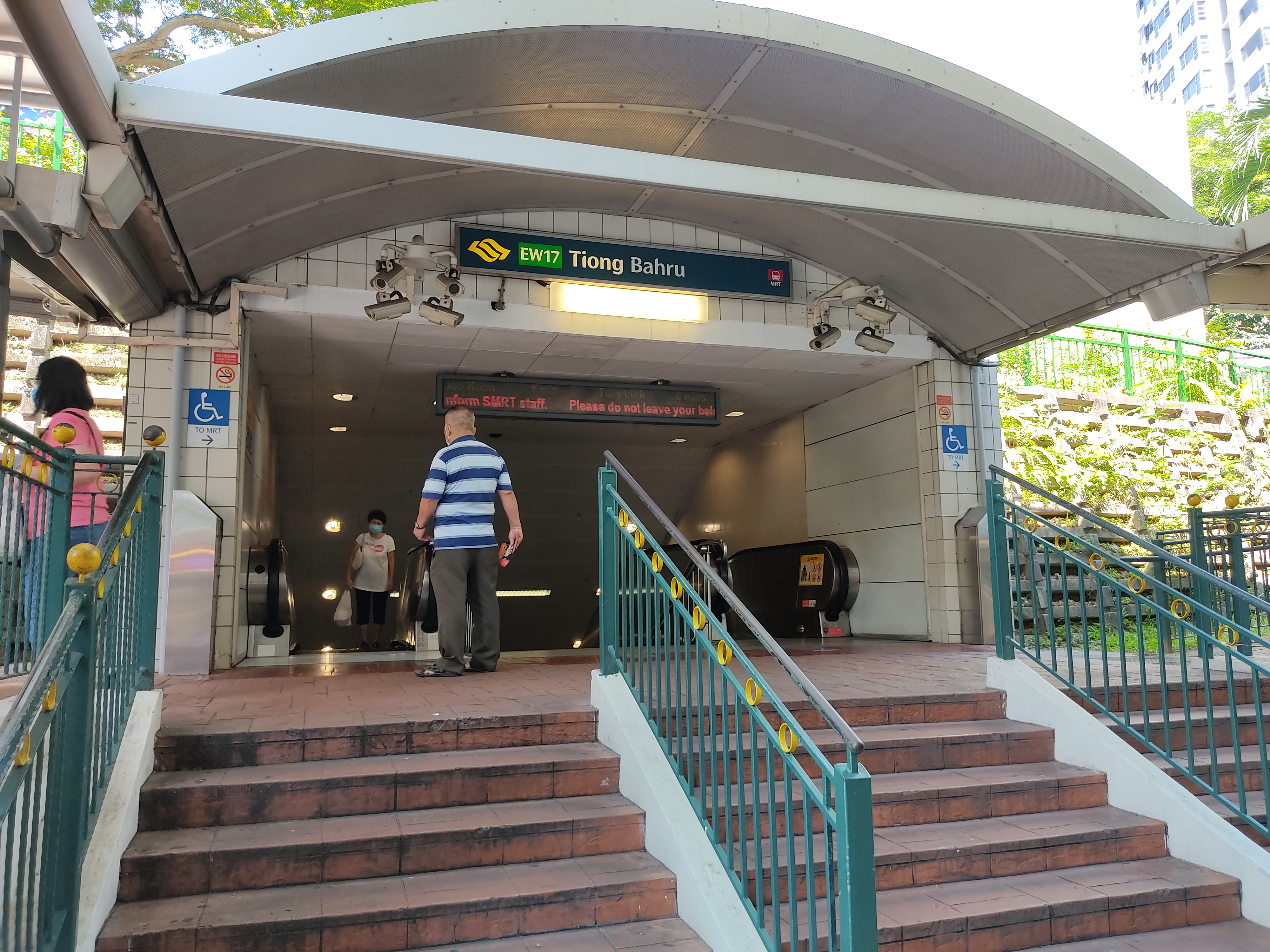
Tiong Bahru MRT Station (EW17) on Singapore’s East–West Line is a convenient starting point for two different outings: an easy mall-and-park visit around Tiong Bahru Plaza and Tiong Bahru Park, or a slower heritage-and-food walk towards Tiong Bahru Market, Seng Poh Road and the estate’s distinctive Streamline Moderne flats. Use Exit B to enter Tiong Bahru Plaza directly. For Tiong Bahru Park, NParks gives an indicative five-minute walk from the station. The famous old-estate streets and market require a separately planned walk rather than appearing immediately at the train gates.
The most important late-2026 visitor update is that Tiong Bahru Market is scheduled to close for cleaning on Monday, 16 November 2026, according to the National Environment Agency’s current hawker-centre schedule. Do not travel on that date expecting the wet market or cooked-food stalls to operate normally. The old housing estate and public streets remain separate from the market, and Tiong Bahru Plaza follows its own retail hours, usually 10am–10pm. The market stands at 30 Seng Poh Road, Singapore 168898 and is the beginning of the official Tiong Bahru Heritage Trail.
This guide helps you decide between shopping, a family playground, a hawker meal and architectural heritage. The market route is not identical to the park route; a child who wants the park’s tilting-train playground may have a very different ideal afternoon from an adult seeking independent cafés and pre-war flats. Reviewed on 1 November 2026, with opening and closure information from the operators themselves.
- Station: Tiong Bahru EW17 on the East–West Line; not an interchange
- Exit B: directly connected to Tiong Bahru Plaza, 302 Tiong Bahru Road
- Public park: Tiong Bahru Park, 3.3 hectares, open 24 hours, around five minutes from station
- Family highlight: the park’s tilting-train playground, sand play, dog run and therapeutic garden
- Heritage and food: Tiong Bahru Market at 30 Seng Poh Road and the official 10-point trail
- Critical date: Tiong Bahru Market closed for scheduled cleaning on 16 November 2026
- Heritage theme: 1930s Singapore Improvement Trust flats with Streamline Moderne / Art Deco forms
- Keep separate: Delta Swimming Complex at 900 Tiong Bahru Road, normally closed Wednesday, requires its own approach


What Tiong Bahru MRT is actually best for
Tiong Bahru is not only a fashionable café district, nor only a place to buy groceries. Its attractions are distributed across a working town: an underground railway station and shopping mall, a large accessible park, a busy wet market, older low-rise public housing and religious and community spaces.
The most efficient visit begins with an honest decision. Families wanting outdoor play should choose Tiong Bahru Park as the main destination. Shoppers and diners with little time may be happiest with Tiong Bahru Plaza. Visitors interested in conservation architecture should plan the longer walk to the older estate rather than assume it will fit into a quick stop immediately outside Exit B.
One trip can combine two of these interests, but a rushed attempt to visit all of them tends to miss what makes each one worthwhile. A market is best when you have time to choose food; a park is best when children can play; and an architectural trail is best when you actually stop to look at buildings.
The rail station and Exit B: one clear arrival decision
Tiong Bahru is EW17 on the East–West Line, between Outram Park and Redhill. It does not provide a direct interchange with a second MRT line. Travellers arriving from another line should plan their transfer at an appropriate station before reaching EW17.
Tiong Bahru Plaza’s operator explicitly directs visitors to Exit B. The plaza has a direct station connection, making it a sensible first destination for an easy meal or shopping outing. An older photograph of Exit A does not override the current mall directions.
Do not treat a station exit as an exact destination pin for the historic market. The older Tiong Bahru streets lie farther into the estate, and the actual route includes crossings and changes of direction. Use the full address of Tiong Bahru Market if it is the reason for coming.
A good meeting instruction names a specific exit or named mall entrance. ‘Meet in Tiong Bahru’ can send one person to the station, one to a café and another to the market. It is easier to plan the walk together after everyone arrives at the same place.
Stop 1: Tiong Bahru Plaza—shopping connected to the station
Tiong Bahru Plaza is at 302 Tiong Bahru Road, Singapore 168732. Frasers Property describes it as a retail mall directly linked to Tiong Bahru MRT, serving residents, workers and students from surrounding neighbourhoods.
The operator lists the mall as generally open 10am–10pm daily, with a Level 2 customer-service counter. Individual retailers and food businesses may keep different hours, so confirm an actual restaurant or service before travelling specifically for it.
The plaza can be a useful base before or after walking in the old estate. You can meet friends, eat, buy essentials or take a rest in the air conditioning. It does not have to be an attraction that consumes the entire day.
For a family with young children, the best approach is to choose a meal and one other activity rather than wander through every floor. A small amount of shopping plus time in the public park can be more enjoyable than an afternoon of repeated stops at shops.
Do not confuse the shopping plaza with the heritage market. A mall food outlet and a hawker stall at Seng Poh Road have different settings, prices and opening patterns.
What can you do at the mall without shopping?
A visitor can observe a busy town-centre building, use public retail areas and meet people without buying a paid tourist attraction ticket. The connection to the train is itself an example of how Singapore integrates daily commercial life with public transport.
Children can compare a modern mall with the older shophouses and low-rise flats that they may see later. What does each building need in order for people to move through it comfortably? How does the arrangement of entrances affect daily life?
A mall visit is still subject to its rules. Do not obstruct escalators or film shop staff without consent. Public retail access does not automatically extend to private offices and service rooms.
A meaningful day out need not be expensive. The main cost comes from the food, shopping or entertainment you personally choose.
Stop 2: Tiong Bahru Park—greenery very near the station
Tiong Bahru Park lies along Tiong Bahru Road and Lower Delta Road. NParks lists it at 3.3 hectares, open 24 hours, wheelchair-accessible and elderly-friendly. It gives an approximate five-minute walk from Tiong Bahru MRT for access.
This is a practical park for a short outdoor break because it is considerably closer to the station than the more extensive old-estate heritage loop. A visitor can enter, enjoy a path or public bench and return without a full morning of walking.
The park is not a nature reserve with a guaranteed wildlife tour. It is designed around community recreation, play and planted spaces. Look at how families, joggers and dog owners share the landscape, and choose a route suited to your group.
Because the park is open around the clock, its most comfortable visiting times still depend on weather and lighting. A daytime family visit is not the same as a late-night walk, and some facilities may be unavailable during maintenance.
Stop 3: the famous tilting-train playground
The tilting-train structure is the centrepiece of Tiong Bahru Park’s family playground. NParks describes a life-sized tilted train that children can climb through before sliding out, supported by sand-play and swing features.
This is one of the more distinctive public playground concepts in Singapore because it uses a familiar transport object in an imaginative way. The inclined carriages make the environment look playful while offering climbing and movement challenges.
Parents should still check age suitability, supervise children and follow the on-site signs. The attraction is not a train ride driven by an operator; it is fixed playground equipment, so climbing, sliding and turn-taking matter.
Do not promise that every feature will be operational at a given hour. Outdoor playgrounds can close during lightning, extreme weather or maintenance. An honest plan includes the possibility of playing elsewhere in the park or returning another day.
A family can enjoy the playground without buying a theme-park ticket. Bring drinking water and allow children to rest before travelling home.
Why the train playground is an educational opportunity
A child who rides the MRT to Tiong Bahru and then sees a tilted train-shaped playground can compare a real transport system with a play structure. What makes the train recognisable? Which elements are designed for safety rather than transport?
The activity supports observation, spatial understanding and movement. An older child can consider how designers turn familiar objects into interactive experiences without needing them to perform their original functions.
There is no need to turn the visit into an exam. One casual question is enough, followed by time for play. Play has its own value and should not always be interrupted by formal instruction.
Keep the space shared and inclusive. Children move at different speeds and have different confidence levels; adults should not pressure a child to climb a feature they find frightening.
The therapeutic garden, dog run and allotment garden
NParks lists a therapeutic garden within Tiong Bahru Park designed around plants and gardening-related experiences. The aim is a calmer setting that can support general enjoyment, including users who need a gentler pace than the main playground.
The park also has a dog run and community allotment plots. These are different facilities with their own purposes. A dog run is a managed area for dog activity, while allotment plots are leased to individual gardeners and are not available for the public to harvest.
Do not enter another person’s plot or remove herbs and flowers. A garden can be enjoyed visually without handling plants. When taking photographs, respect any users who do not wish to be included.
For older relatives, a calm garden and shaded public path may be a better focus than the playground. For a family bringing a dog, check the dog-run rules and control the pet when moving through shared areas.
Stop 4: Tiong Bahru Market—the food landmark of the old estate
Tiong Bahru Market & Food Centre is at 30 Seng Poh Road, Singapore 168898. The market and hawker centre is the first point on the National Heritage Board’s Tiong Bahru Heritage Trail and has been an important meeting and shopping destination for residents for generations.
The building is not merely a list of stalls. It combines a wet-market role with cooked-food and community use. People come to buy everyday ingredients as well as meals, so visitors should not treat the entire place as a theme-park food court.
Pick a stall based on what is genuinely available, your dietary needs and your willingness to wait. A famous dish mentioned in an old article may no longer be served, or the vendor may have a different weekly closing day. A working market has no single universal opening schedule for every stall.
At a crowded hawker centre, return trays as directed and keep pathways clear. Food safety and cleanliness rules serve regular customers and visitors alike. Ask before taking close photographs of stallholders or their work.
Give yourself enough time to eat without rushing toward the next heritage site. A relaxed market meal can be the most memorable part of the entire visit.
Important: the 16 November 2026 market cleaning date
NEA’s current public hawker-centre schedule lists Tiong Bahru Market for cleaning on 16 November 2026. This is a full-day scheduled closure of the relevant market facilities, not a statement that the entire Tiong Bahru estate is closed.
If a particular market dish is your reason for travelling, choose another date or confirm an updated notice. The scheduled market closure means it would be misleading to promise a normal hawker lunch that day.
Tiong Bahru Plaza, Tiong Bahru Park and public streets are separately managed. They can remain possible parts of a day out when the market is under cleaning, subject to their own operating conditions.
Stallholders may also make individual decisions about when to reopen after maintenance. Do not promise that the exact food stall you want will serve at the first possible minute the next morning.
Why Tiong Bahru is historically different
The National Heritage Board describes Tiong Bahru as one of Singapore’s earliest planned public housing neighbourhoods, developed by the colonial-era Singapore Improvement Trust in the 1930s. Its earliest flats addressed overcrowding and reflected a new approach to housing design.
Much of the older estate was once swampy land associated with graves and earlier settlement. Over time it became a distinctive low-rise residential area, then a conserved neighbourhood known for architecture, everyday businesses and cafés.
This history is more complex than a simple claim that Tiong Bahru is ‘old and hip’. People continued living in the neighbourhood while businesses changed around them. Heritage is not just a backdrop for visitors; it is the setting of everyday homes.
The official heritage route begins at the market and continues towards residential blocks, temples, open spaces and historic sites. A first-time visitor can choose only a few stops instead of attempting the entire route.
Stop 5: the Streamline Moderne housing blocks
Tiong Bahru’s pre-war flats are associated with Streamline Moderne, a late Art Deco style inspired by modern transport, movement and function. NHB describes curved corners, horizontal lines, porthole-style windows, flat roofs, cantilevered shades and unadorned surfaces.
Walk through a permitted public street and look for one architectural feature at a time. Does a corner curve rather than meet at a sharp angle? Are the windows arranged in long bands? Does a staircase produce a shape reminiscent of a ship or aircraft?
These comparisons make the heritage more accessible to readers without specialist architectural training. A child who has seen trains or aircraft may notice the connection between movement-inspired design and old housing.
Do not assume every block is pre-war or built in the same style. NHB distinguishes pre-war Streamline Moderne designs from postwar buildings using International Style principles, with some different construction dates and details.
Twenty of the pre-war blocks were conserved in 2003 under the Urban Redevelopment Authority’s protection framework. Conservation means the area retains important features, but the buildings are still homes and workplaces rather than unrestricted museum interiors.
A respectful architectural photography walk
A building can be famous without being public property. Residents may be going to work, caring for children or using their homes privately. Take exterior photographs from public paths and do not block doors, corridors or windows.
Look for architectural forms rather than trying to photograph strangers. Curved façades, window bands, staircases and the relationship between greenery and buildings can be interesting subjects.
A commercial photography session may require permission. A guide should never encourage a visitor to enter residential stairwells or other private areas without consent.
Keep the route short enough that you can stop and observe. A photographic walk becomes less useful when it requires constant movement and leaves no room to understand what was photographed.
Stop 6: the horseshoe-shaped blocks
The National Heritage Board’s Tiong Bahru Heritage Trail includes the distinctive horseshoe-shaped blocks around Moh Guan Terrace and Guan Chuan Street, built in the late 1930s and early 1940s.
The shape is interesting because it demonstrates how planners and architects used curved forms within a housing estate. It also gives a visible example of a distinctive building plan that differs from the straight rows familiar in many modern estates.
A family can observe how the buildings meet the street, where spaces are sheltered and how people move around the curves. Do not infer the size or history of every interior apartment simply from its exterior.
This site is better approached during a deliberate heritage walk than squeezed into a short mall outing. Save the exact heritage route on the official Roots trail before departing.
Stop 7: the Monkey God Temple and religious heritage
The official trail includes Tiong Bahru Qi Tian Gong, often called the Monkey God Temple. NHB traces its origins to 1920 in a small earlier setting before its development within the estate.
This is a living religious place with worshippers, not a tourist attraction that guarantees open access to every room. Follow the temple’s own visiting guidance, dress appropriately and refrain from interrupting prayer.
Children can learn that neighbourhood identity includes places of faith as well as food and buildings. A historic temple can remain important to a community even as the commercial district around it changes.
An exterior view and a short respectful discussion may be enough if visiting arrangements are restricted. Do not turn a cultural practice into an amusement or photograph people at prayer without permission.
Stop 8: Seng Poh Garden and the Dancing Girl Sculpture
Seng Poh Garden and its Dancing Girl sculpture are part of the official Tiong Bahru Heritage Trail. The site provides a way to think about small neighbourhood spaces rather than only grand tourist landmarks.
Early housing estates needed places for residents to gather and rest. Gardens and sculptures could give a residential neighbourhood identity and comfort, even when there was no major public attraction.
A visitor can take a few minutes to look at the sculpture and surrounding landscape. Ask how public art changes a place and why a small green area might matter to people living close together.
Do not climb the sculpture, damage plantings or block pedestrian paths for photographs. The site is shared residential space.
The former Bird Corner and other trail markers
The former Bird Corner near the junction of Seng Poh Road and Tiong Bahru Road is another point on NHB’s heritage trail. It recalls earlier social gatherings connected with bird keeping and community activities.
The word ‘former’ matters. A guide should not promise that a historic bird corner still hosts the same activity every day. Historical interpretation can explain a past practice even when the present use of the location has changed.
Read the on-site trail marker if available. Then look at how the surrounding roads, businesses and buildings function today. History becomes meaningful when you compare the documented past with what you can actually see.
The full route also includes stories of philanthropic figures and graves farther from the station. Choose those only if you have adequate time and a confirmed pedestrian route.
The station mural as a quick local-history introduction
Tiong Bahru MRT has featured public art illustrating nearby neighbourhood landmarks, part of an SMRT heritage-themed effort unveiled in 2023. The imagery references architectural and cultural features associated with the estate.
This is useful because a visitor can begin learning before reaching the street. Read the imagery without blocking passenger movement, then see whether you encounter any of the related landmarks during your walk.
A mural is interpretive art, not a complete or exact topographical map. It can inspire curiosity but should not replace the official trail directions or current station exit signs.
A short student exercise is to select one depicted landmark, research its documented history and compare that account with the real place.
Stop 9: independent cafés and small businesses
Tiong Bahru has become known for cafés, bakeries, bookshops and small independent businesses alongside ordinary neighbourhood shops. Their appeal can lie in the contrast between contemporary retail and the older architecture.
Do not assume a shop listed in a travel article from 2022 is still operating in the same unit. Independent businesses can change hands or hours, and a place may be closed on the day you visit.
A good café visit begins with verifying the address, menu and opening hours. There is no need to chase a long list of famous pastries or queue for multiple desserts to enjoy the neighbourhood.
Respect residential access near shopfronts. A narrow five-foot way often serves people walking to their homes and businesses, so avoid treating it as an exclusive outdoor photoshoot location.
Tiong Bahru Park versus the old housing estate
These are both worthwhile but different experiences. The park is relatively close to EW17 and suited to families who want short outdoor activity. The older estate and market are better for visitors prepared to walk farther and observe architecture or food culture.
Do not assume a child who wants the tilting-train playground will enjoy a detailed history trail, or that an art enthusiast wants to spend the whole afternoon at a sand playground.
Choose one main focus and make the other optional. A half-day could include both, but doing so requires extra time for walking, food and rest.
This distinction helps avoid SEO-style destination lists that look comprehensive while giving the reader no realistic way to enjoy them.
A one-hour outing: choose the mall or the park
For the simplest visit, leave EW17 through Exit B and choose a meal or a short browse in Tiong Bahru Plaza. Alternatively, follow the current public route to Tiong Bahru Park, enjoy the playground or green space, and return.
An hour is not enough for a thorough heritage trail, long meal and playground session. Keep the visit deliberately narrow.
During rain, the mall may be the sensible alternative. A free park is not a reason to keep playing in a thunderstorm.
A two-hour food-and-heritage plan
Choose the market at 30 Seng Poh Road as the main food destination, checking the 16 November closure and the actual stall hours. Enjoy a meal, then choose a short section of the official heritage trail.
A practical choice is to look at one curved block or architectural detail and one heritage marker. That is enough to understand why the estate is different without needing to complete all ten official points.
If queues take longer than expected, shorten the heritage section. A visitor gains little by rushing past the buildings simply to tick off a list.
A half-day Tiong Bahru with children
Begin at Tiong Bahru Park in a cooler part of the day, letting children spend time at the tilting-train playground. Follow the park’s rules and allow breaks for water and rest.
After the main play activity, choose a meal at a suitable open venue. If everyone has enough energy, you can take a short public-street look at the older estate, but do not force a full architecture trail on an exhausted child.
The best experience is flexible. A family that enjoys only the playground and lunch has still had a successful outing.
A longer independent architecture walk
An adult or older student with a few hours can follow a larger portion of the official NHB trail, reading the market, conserved flats, temple and public sculpture as parts of one housing estate’s story.
Begin at a confirmed starting point and finish near a useful transport option. Some trail markers lie farther apart than the small map makes them appear, and a full route may be uncomfortable in hot weather.
Record one observed feature at each stop, not a long transcription of every sign. A strong field note explains what a place is, why it matters and what evidence supports that explanation.
Do not enter restricted residential property or a private religious interior to find a landmark mentioned in the trail booklet.
Another optional sport stop: Delta Swimming Complex
Delta Swimming Complex is at 900 Tiong Bahru Road, Singapore 158790 in the broader Tiong Bahru/Redhill region. SportSG lists it as normally closed on Wednesdays, with its own pool and admission rules.
This is a separate sports activity, not a free pool attached to Tiong Bahru Plaza. If swimming is your purpose, choose the actual facility and plan the approach and time for changing clothes.
Do not confuse the operating day with the pool schedules at Bedok, Yishun or other complexes. Different ActiveSG facilities use different maintenance days.
A swimming session can fill an afternoon; do not add the entire heritage trail simply because both destinations have Tiong Bahru in their general address.
Food and budgeting without invented prices
General mall access and public parks do not require admission tickets, while food, shopping, cinema tickets or organised programmes have their own charges. Tiong Bahru Market is a working food centre, not an all-you-can-eat attraction included in a train fare.
Plan a realistic budget for public transport and one meal, then add optional purchases if desired. A lower-cost outing can consist of a park walk and a modest hawker meal on a day the market is open.
Do not rely on an old menu photograph for a current price. Individual stallholders set prices and may change ingredients, sizes or offerings over time.
Accessibility, children and slower visitors
NParks lists Tiong Bahru Park as wheelchair-accessible and elderly-friendly, while Tiong Bahru Plaza offers a direct rail connection. Yet a complete visit includes the actual station lift, pavement, crossings, entrance and return.
An older visitor might prefer a short park loop or a seated mall meal rather than a long heritage circuit. A family with a stroller should check the most comfortable pedestrian connection to the market rather than assuming every historic five-foot way is unobstructed.
Plan rests and keep the pace comfortable. A heritage tour should not make residents or visitors feel pressured to climb difficult stairs simply because a photograph looks interesting.
When a route is crowded or inaccessible, take an official alternative or shorten the outing.
Weather, heat and safe park conduct
Singapore’s midday heat can make an exposed heritage walk tiring. Carry water, pause in shaded public areas and choose a smaller route when necessary.
During thunderstorms, stop playground use and avoid walking under isolated trees. A 24-hour park opening does not mean it is safe to play during lightning.
Respect wildlife and planted spaces. The park’s dog run has its own rules, and dogs should not be allowed to disturb other visitors on shared paths.
A rainy-day alternative is a confirmed-open mall activity, while the heritage walk can be enjoyed on another day.
Six mistakes to avoid at Tiong Bahru MRT
Assuming Exit A is the mall entrance. Tiong Bahru Plaza’s operator recommends Exit B.
Travelling for Tiong Bahru Market on 16 November 2026. NEA lists the date for cleaning.
Confusing Tiong Bahru Park with the old housing estate. They are different types of outing and require different walking plans.
Assuming every housing block is pre-war Art Deco. The heritage area includes buildings from different periods and styles.
Turning homes and places of worship into unrestricted photo sets. Remain on lawful public paths and respect privacy.
Assuming Delta Swimming Complex has the same maintenance day as another pool. Check SportSG’s Wednesday closure for this facility.
Frequently asked questions
Which line serves Tiong Bahru MRT? The East–West Line, station EW17.
Which exit serves Tiong Bahru Plaza? Exit B, according to the mall operator.
How far is Tiong Bahru Park? NParks gives about five minutes on foot, depending on individual pace.
Is the tilting-train playground free? It is part of a public park, subject to safety and current facility access.
When does Tiong Bahru Market close for cleaning? NEA lists Monday, 16 November 2026.
Where is the market? 30 Seng Poh Road, the first stop on the official heritage trail.
What architecture should I look for? Streamline Moderne pre-war flats with curved corners, horizontal lines and other functional design details.
Can I complete the ten-point heritage trail in an hour? A thoughtful complete visit needs more time; choose a few markers for a short outing.
Can I visit the Monkey God Temple? Follow its current public visiting and religious etiquette rules; it is an active place of worship.
What is best for children? Tiong Bahru Park’s tilting-train playground and a comfortable meal.
What is best for someone who likes architecture? The official Tiong Bahru Heritage Trail around the conserved low-rise estate.
The purpose of a reliable Tiong Bahru MRT guide
An article about the estate can describe many beautiful buildings and famous cafés. A station guide must do something more practical: tell visitors the right exit, how far the main interests extend, which facilities are free and what is closed on the intended date.
The dated 16 November market cleaning and the distinction between the park and the heritage estate make a difference to real readers. The best visit is the one that gives people what they came for without misleading them about distance or access.
Official sources and companion reading
- Tiong Bahru Plaza: Exit B, address, retail hours and facilities
- NEA: Tiong Bahru Market cleaning date
- NParks: park size, five-minute MRT walk and public amenities
- NParks: tilting-train playground
- National Heritage Board: official ten-point Tiong Bahru trail
- NHB: Streamline Moderne architecture and conservation
- NHB: origin and changing identity of the estate
- SportSG: Delta Swimming Complex opening and weekly closure
- eduKateSG: Maxwell MRT for a separate hawker-and-CBD outing
Independent visitor guide, reviewed 1 November 2026. Stall trading, construction, playground operation and road access can change. Verify a specific business or facility before a time-sensitive journey.