
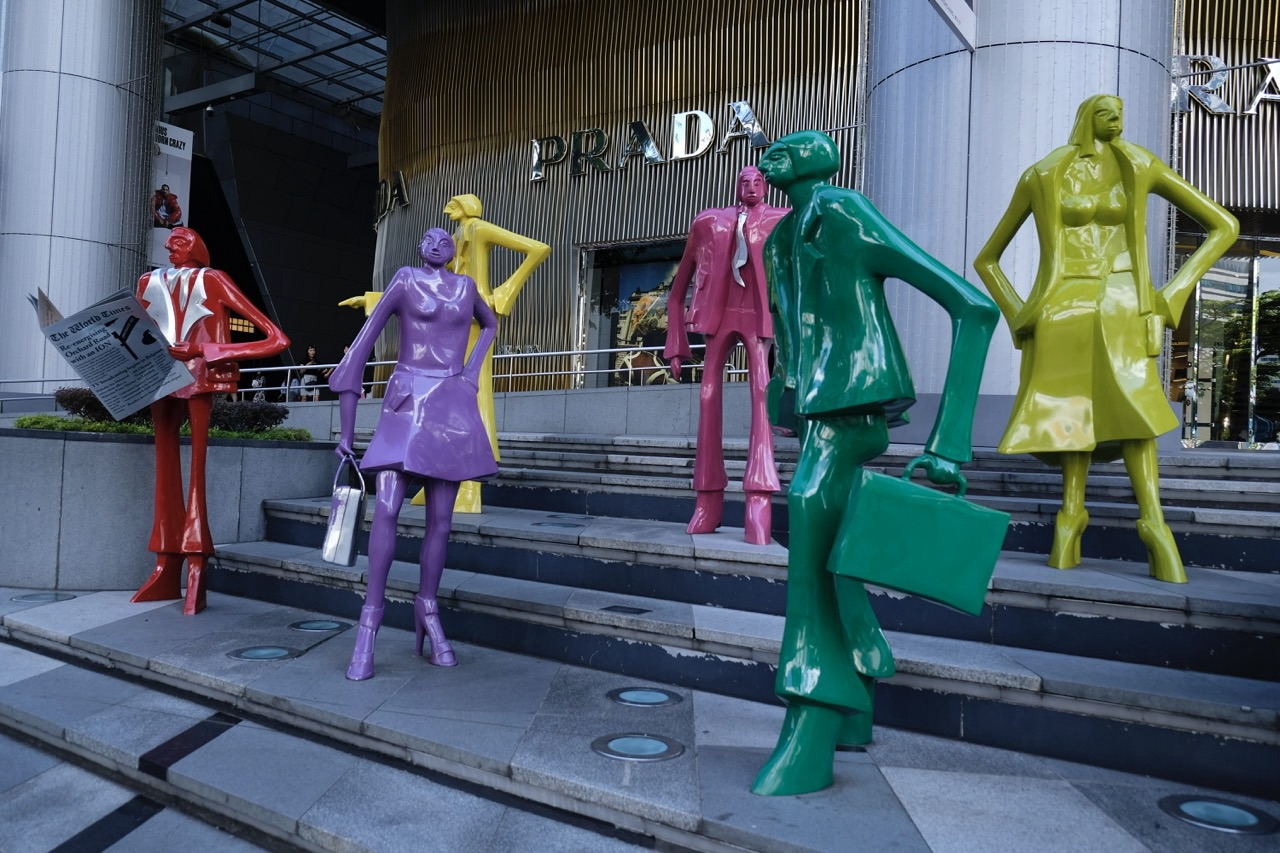
Orchard Road is an open-air gallery hiding in plain sight. Among the famous shopping malls you can discover colourful sculptures, monumental bronze work, reflective pieces near fountains, unusual architecture and installations that invite visitors to pause and look a little closer. Some artworks are permanent; others appear only for a season. Once you start noticing them, a shopping trip becomes a lovely art walk.
Here is the easiest place to begin: Orchard MRT (NS22/TE14). Look around ION Orchard for its public-facing art and distinctive architecture, then continue towards Ngee Ann City and Paragon for additional sculpture and public-space views. Scotts Square offers a short detour off Scotts Road, where our October 2026 photography also documents exterior artwork. Allow roughly one to two hours for a relaxed cluster of art stops and photographs, or longer if you want to explore an exhibition or have a meal.
There is plenty of genuine art history to appreciate. The National Arts Council documents Nutmeg and Mace at ION Orchard, a two-tonne bronze sculpture that links the area to its nutmeg-plantation past. It also documents Waterfall, a technological installation by the collective Troika inside ION. The colourful Urban People figures by Swiss artist Kurt Laurenz Metzler have long been associated with ION’s public frontage. Contemporary works exist alongside older shopping-centre artworks, but the specific piece visible in a photograph should not be assigned an artist or title unless that identification has been checked.
This guide uses actual photographs from eduKateSG’s October 2026 Orchard Road media library. The pictures show outdoor art at ION, the Ngee Ann City fountain and sculpture, artwork at Paragon and Scotts Square, and temporary character or festive displays. They are intentionally described by what the photograph demonstrates. A picture of a Doraemon character, for example, does not automatically make the installation part of the permanent public-art collection.
Orchard Road art walk: quick list of places
- ION Orchard, 2 Orchard Turn: outdoor sculpture, art integrated into the mall and ION Art Gallery on Level 4.
- Nutmeg and Mace: a documented permanent bronze sculpture at ION Orchard, relating to Orchard Road’s plantation history.
- Waterfall: a documented ION Orchard installation by Troika using animated flip-dot technology.
- Urban People: colourful sculptural figures historically associated with ION’s frontage.
- Ngee Ann City, 391 Orchard Road: fountain, outdoor sculpture and an important public-facing architectural space.
- Paragon, 290 Orchard Road: sculptural pieces and a changing mix of public-facing displays.
- Scotts Square, 6 Scotts Road: exterior art photographed in October 2026 and an alternative junction perspective.
- Wheelock Place and other façades: architectural forms that add interest between the art stops.
- ION Art Gallery: a venue for art exhibitions and related programming, with event-specific conditions.
- Optional extension: the National Arts Council also documents public art farther towards Dhoby Ghaut, but that is a distinct longer route.
Start with ION and one other stop if your group has limited time. Public art is best enjoyed when you can actually look at a piece rather than rushing between ten photo locations.

What makes public art different from ordinary decoration?
Public art generally refers to creative work conceived for the public sphere: sculpture, murals, installations, media works or other forms accessible to people outside a conventional museum setting. Singapore’s National Arts Council describes public art as something that can be permanent or temporary, creating encounters in places where people live, work and play.
The distinction matters when you are looking at Orchard Road. A sculpture commissioned to engage visitors may be an artwork. A seasonal Christmas tree may be an attractive event display, but it is not automatically part of a public-art collection. A character figure outside a mall may be promotional, cultural or artistic depending on its commissioning and context.
This does not mean one type of object is worth appreciating and another is not. Decorations can be delightful, and commercial displays can be visually inventive. The important point is to describe what a visitor actually sees and avoid inventing a formal status, artist or permanent location.
With that distinction in mind, you can enjoy a much richer walk. Instead of asking only, “Is this a famous artwork?”, try “What does this object do to the space, and why have people stopped to look?”
ION Orchard: art as part of the shopping experience
ION Orchard stands beside Orchard MRT and is known for its curved architecture, but the building’s art programme is another strong reason to visit. The official ION Art page describes a Level 4 gallery, permanent signature sculptural and media installations around the mall, and a changing programme of contemporary art exhibitions.
That means there are different ways to experience art in one destination. You can appreciate public-facing pieces outside, see works placed around the common areas or attend an exhibition when it suits your interests. Not every activity has the same admission or access arrangements, so check the particular event before making it the only reason for a trip.
For visitors who normally do not visit galleries, ION makes art feel approachable. You may notice an unusual object on the way to lunch, pause to inspect it, then continue shopping. The encounter can be brief and still meaningful.
Our October 2026 photo documents artwork outside ION. Its caption identifies the location without inventing the exact title. That is a useful habit whenever you are collecting images of installations that may change.
Nutmeg and Mace: Singapore’s orchard history in bronze
The National Arts Council documents Nutmeg and Mace as a permanent bronze sculpture at ION Orchard. The work interprets an opened nutmeg seed, showing the crimson mace that covers it. It is an unusually fitting subject for the street because Orchard Road’s name is linked to earlier orchards and nutmeg cultivation.
The sculpture weighs about two tonnes according to NAC’s description. But its significance is not simply size. The work connects a very modern retail district to a plant that played an important role in Singapore’s agricultural and trade history.
Imagine standing beside an artwork about a nutmeg seed while surrounded by glass malls, fashion boutiques, taxis and MRT entrances. The contrast is part of the pleasure. A visitor can look at the past and present at the same time without needing a formal history lesson.
If you want to photograph the named work specifically, locate it using the National Arts Council’s artwork page or current on-site signs. Do not assume that every public artwork shown in an ION exterior photograph is Nutmeg and Mace; the correct title must be matched to the object itself.
Why the nutmeg reference is worth knowing
National Heritage Board research records nutmeg plantations along Orchard Road in the nineteenth century. Their eventual decline and the change in land use helped shape the road’s later residential and commercial future.
A sculpture can communicate that story without an enormous historical plaque. The nutmeg seed becomes a symbol of an earlier landscape beneath today’s shopping district. Children may find the shape easier to remember than a collection of dates.
For an informal learning activity, ask what other objects could represent the history of a neighbourhood. A place once known for fishing might choose a boat or net; a place associated with trade might use a market or transport motif. Art becomes a way to tell local stories.
The most important thing is to appreciate the specific artistic decision. A nutmeg is not just a decorative fruit at this location. It is a deliberate connection between the name Orchard Road and the city’s history.
Waterfall at ION Orchard: an artwork made with technology
The National Arts Council also documents Waterfall, an installation at ION Orchard by the creative collective Troika. Its unusual visual effect is created using animated flip-dot elements attached to a tall atrium column, producing the impression of cascading water.
This is a lovely example of public art extending beyond traditional stone or bronze sculpture. Technology, movement, changing light and viewer position are essential to the experience. The appearance can vary as the elements move, so the artwork is not necessarily captured by one still photograph.
If you are visiting to see this particular installation, check its current location and any operational conditions with the venue. “Permanent” in a collection description refers to the commissioning or installation category; it does not guarantee that mechanical or electronic elements are running at every moment of every day.
For students, Waterfall creates a friendly question: how can a work suggest flowing water without using actual water? The answer involves visual perception, movement and clever technical design. It is a bridge between art, science and engineering.
Urban People: colourful figures and a busy city
The colourful Urban People sculptures by Kurt Laurenz Metzler have been associated with ION Orchard since its early years. Their bright colours and exaggerated human forms reflect urban movement, shopping and the lively social character of the area.
The figures can feel playful because they echo the people who walk past them. Shoppers, commuters and tourists become part of the scene, making the art seem connected to everyday activity rather than isolated from it.
If you are visiting with children, ask them to describe the poses or colours and compare them with the people moving through the public space. The conversation can lead to questions about why an artist might simplify or exaggerate the human body.
Do not assume that a photograph labelled only “art outside ION” necessarily shows Urban People. Use the artwork’s title, artist and plaque only after checking the actual figure in the image. Correct identification matters, particularly for readers planning to find a specific sculpture.

ION Art Gallery on Level 4: how to plan a visit
ION Art Gallery sits on Level 4 and is associated with contemporary art, design, multimedia and exhibitions. The official page lists general daily hours from 10am to 10pm, but an exhibition may have a different schedule or access conditions.
If a particular artist or event matters to you, check its current venue listing. A poster for an exhibition in an earlier month is not evidence that the event continues indefinitely. Likewise, the existence of a gallery does not mean every related workshop or event is automatically free.
First-time visitors can enjoy a gallery without knowing much about art history. Look at the work before reading its label. Notice materials, scale, mood, colour or movement, then compare your impression with the artist’s explanation.
If you bring young children, keep the visit short and follow the venue’s rules about touching works, food and photographs. Their interest may be strongest when they can ask a few questions and move on rather than standing in front of every piece.
Public art outside ION: finding a safe photographic angle
The ION exterior is an energetic place where major train connections, shopping entrances, public artworks and traffic meet. The setting is visually rich but also busy. Photograph from a safe pedestrian position, leaving doors and crossing routes clear.
For a named artwork, the most useful picture includes enough context to show its location. A close-up alone may highlight texture but leave readers unsure where the piece stands. Take a wide establishing photo and a detail frame if time permits.
Do not climb onto a sculpture, touch delicate areas or move barriers to improve a composition. Some artworks are meant to be experienced at close range, but any specific invitation to interact should come from the site or artist, not an assumption.
For an enjoyable art walk, there is no rush. Stand back, appreciate the work and let other visitors move naturally through the scene. Patience often creates a better photograph than repeated attempts to clear everyone out of the frame.
Ngee Ann City: fountain and sculpture in an urban space
Ngee Ann City’s frontage is a natural next stop. The large complex at 391 Orchard Road provides a broad public-facing area with a fountain and sculptural features, as documented in our October 2026 image collection.
The relationship between architecture and art is especially interesting here. A sculpture in a public plaza is seen against the scale of the building, the movement of shoppers and the changing reflections from surrounding surfaces. It creates an encounter even for people who came only to visit a bookstore or restaurant.
Older accounts identify artworks around this frontage, but a modern guide should not assume every component has remained unchanged or attribute a piece based solely on a distant photograph. Read any current label or consult an authoritative record when the precise title and artist matter.
The attraction for visitors is simple: stop long enough to notice the space. You can admire the fountain area, look at the sculpture from an appropriate position and continue towards Paragon with a new appreciation of what makes a shopping street lively.

Ngee Ann City’s artistic setting and historical depth
The public space at Ngee Ann City also has a longer historical context. National Heritage Board sources connect the site to Ngee Ann Kongsi and the former Teochew cemetery Tai Shan Ting. The modern commercial development opened in 1993.
Art in a commercial setting may not explicitly tell every part of that history, but it provides an opportunity to reflect on how cities change. A building can have a modern visual identity while occupying land with older community memories.
Ask what role a fountain or sculpture plays in such a large development. It may create a meeting point, invite people to pause or give the frontage a distinctive character that separates it from a plain row of shop entrances.
The space will not look identical every day. Events, temporary barriers or maintenance can change access and the appearance of water features. Use current conditions rather than relying on a single photograph taken in the past.
Paragon: sculptural work along the shopping belt
Across the Orchard Road shopping belt, Paragon is another useful stop for visitors who enjoy art. Our October 2026 Leica photographs document a public-facing art installation outside the mall. Older art-trail writing has also discussed sculptural works associated with this location.
Art around Paragon can be approached as a contrast to its luxury retail identity. A polished shopfront directs attention towards products, while a sculpture can invite you to think about form, balance, gesture or human relationships. Both operate within the same commercial environment, but they communicate differently.
If you encounter a sculpture with an official plaque, read it before describing the work by name. Installations may be rotated, moved or temporarily removed. Avoid treating a previous exhibition or outdoor sculpture as guaranteed for every future visit.
A wide photograph with part of the Paragon building is particularly useful because it anchors the work to its actual location. The image should help a reader recognise the site, not merely admire an abstract object without context.

Comparing the art at ION and Paragon
ION’s documented works include pieces inspired by nature and technology, while Paragon’s outdoor art offers another relationship between sculpture, retail architecture and the movement of people. The comparison is not about choosing a universal winner.
Instead, ask how the art interacts with its space. Does the work stand apart as an object? Is it integrated into a wall or column? Does it encourage people to gather? Is it easiest to appreciate from far away or from a closer permitted viewpoint?
These questions are helpful for visitors who do not consider themselves art experts. They direct attention to what the work does rather than requiring a memorised list of artists and dates.
There is also a practical photography lesson. A highly reflective sculpture may work better in softer light, while an architectural installation with strong colours may stand out against a busier background. Choose the composition that matches the actual artwork.
Scotts Square: public-facing art near Scotts Road
Scotts Square, at 6 Scotts Road, is a smaller retail destination near TANGS, Shaw House and Orchard MRT. Our October 2026 photo collection documents an art installation outside its retail frontage, along with pedestrians moving through the surrounding space.
The artwork adds a different point of interest to the junction. A short detour from the main Orchard Road alignment can offer a quieter composition than the busiest parts of ION’s exterior. You can photograph the piece together with the façade or focus on its texture and form.
The property is also a mixed-use development with residential components. Visitors should remain in areas open to public shopping or pedestrian access rather than using private residential routes to seek new photographic angles.
As with the other works in this guide, avoid inventing an artist attribution from an image that simply says “art installation”. If the artwork’s identity is not confirmed, an accurate place-and-subject caption is the best editorial choice.

Art changes how shoppers move through a public space
A sculpture can alter the rhythm of a shopping street. People who intended to walk straight past may stop, take a photograph, read a plaque or simply look at the work for a few seconds. A small pause can turn a functional journey into a personal experience.
Our Scotts Square photograph shows people moving past an installation. Their presence helps explain the role of art in a working urban environment: the art is encountered among errands, work, shopping and meetings, not in a silent gallery isolated from everyday life.
Think about how the experience differs for a commuter, a tourist, a child and an artist. One notices colour; another recognises a cultural reference; another uses the sculpture as a meeting landmark. Public art accommodates many ways of looking.
That is why a precise, respectful photograph showing the surrounding pedestrian space can be especially valuable. It documents how people encounter the work without requiring the photographer to intrude on anyone’s private moment.

A Doraemon character display: charming, but not automatically permanent art
The October 2026 eduKateSG media collection includes large Doraemon character figures displayed at Paragon. They make delightful subjects for families and people who enjoy the character, but a character installation should not automatically be presented as a permanent commissioned public sculpture.
A mall may install character figures for a special event, retail promotion, partnership or exhibition. The display can be meaningful or visually creative without being part of the same collection as a permanent bronze artwork.
If you are travelling to see that precise figure, confirm current availability with the venue first. Do not promise a child that an October photograph guarantees the same installation will be present during December or next year.
You can still enjoy such displays as part of an art-and-design walk. Ask what makes a familiar character recognisable and why it attracts people to photograph the area. The answer connects visual identity, storytelling and the public space around a mall.

Festive installations are not the same as the official art collection
Orchard Road is known for seasonal celebrations and Christmas lighting. Trees, arches, light displays and event sculptures may add colour to the shopping belt, but they often have defined installation periods.
Our media collection includes festive images at Paragon and ION Orchard. They document the specific appearance captured in October 2026, not a promise about the duration of a 2026–2027 event or the official programme.
When describing such material, separate what the photograph shows from what the organiser has confirmed. An individually decorated mall may run its own schedule; the Orchard Road Business Association’s district-wide Christmas programme is a different layer.
Visitors can enjoy both permanent art and temporary decorations, but accurate dates and labels help them make realistic plans. It is better to discover a pleasant surprise than arrive expecting an installation that has already been removed.

The difference between art, architecture and commercial design
The Orchard Road streetscape provides plenty of visual interest beyond sculptures. ION’s curved roof, Wheelock Place’s glass form, Wisma Atria’s steps and Tang Plaza’s distinctive roof are architectural features. Shop windows, signs and event displays are forms of commercial design.
These fields overlap but are not identical. A building may incorporate commissioned artworks; a retail display may use sculptural techniques; a temporary installation may be designed by an artist. The label depends on the actual work and its purpose, not simply whether a photograph looks artistic.
For visitors, the distinction is an invitation to notice more. Ask what you are looking at: an artwork, a building feature, a brand promotion or some combination. The question encourages careful observation without diminishing the pleasure of the scene.
You can create a photo collection with one example of each. Orchard Road provides enough variety that the activity is enjoyable even with a phone and no formal art training.
A brief stop at ION Art versus a longer art walk
If you have only thirty or forty-five minutes, make ION Orchard your central destination. Look at the building’s exterior, find a public-facing sculpture and check whether the gallery has a relevant current exhibition. A short visit can still be meaningful.
For a longer outing, continue towards Ngee Ann City and Paragon, with an optional Scotts Square detour. That gives you a comparison between art integrated into a modern mall, sculpture associated with a formal public frontage and artwork near retail façades.
Choose the route based on walking comfort and the weather. Several short stops can be more enjoyable than a long march, especially when visiting with children or older relatives.
The main purpose is to look thoughtfully, not to collect a fixed number of artwork names. If one installation holds your attention for fifteen minutes, that is a perfectly good use of the time.
Public art for children: a cheerful observation game
Children often respond naturally to large shapes, unexpected materials and bright colours. An Orchard Road art outing can build on that curiosity. Ask younger children to find one curve, one shiny surface, one human-shaped sculpture and one object that reminds them of something from nature.
For older children, ask why the artist might have chosen a particular material or location. How would a bronze nutmeg look different from a painted one? How can moving flip dots create the impression of flowing water? These questions connect artistic choices to history and technology.
Keep the exercise short and optional. A child who wants to sit down for a snack after a few installations has still had an enjoyable experience. Do not turn every artwork into a compulsory lesson.
If they want to photograph a piece, help them frame it without blocking anyone else. Encourage accurate captions such as “public artwork outside ION Orchard” when the exact title is not confirmed.
A little Science inside the art walk
Art and Science meet particularly clearly in works that use light, reflection and movement. Consider Troika’s Waterfall installation, which creates a perception of flowing water using moving mechanical elements rather than actual cascades.
Ask what happens to reflections when surfaces tilt. Why might a dark background make a bright moving object easier to see? How does the brain interpret repeated movement as a continuous flow? These questions lead into physics, perception and engineering.
Outdoor metal sculpture provides different observations. Light interacts with polished and matte surfaces differently. Shadows reveal depth and texture, while the appearance changes as you walk around the object.
No experiment should involve touching restricted artworks or climbing on installations. Observation alone provides plenty of useful material for an enjoyable conversation.
A little English and History on an art walk
Orchard Road provides a delightful place to practise precise description. Instead of writing, “The sculpture was beautiful,” ask a student to identify material, colour, position, scale and movement. Specific information helps a reader picture the artwork.
For History, Nutmeg and Mace creates a direct link to the road’s plantation-era origins. Ask why a modern mall might commission an object connected to an earlier landscape. The discussion can lead to collective memory, trade and the way the city chooses to represent its past.
You can also compare a neutral caption with a persuasive one. A neutral caption identifies what and where; a promotional caption may make claims about quality or popularity. Good travel information benefits from the first even when the writing is warm and engaging.
The goal is curiosity rather than examination. A few thoughtful questions can add meaning to a family outing without making it feel like homework.
Photographing sculpture: wide view, detail and human scale
A useful public-art photo series has at least two kinds of images. A wide establishing shot shows where the work stands in relation to the building or public space. A closer detail reveals its materials, pattern or texture.
A third photograph can show the scale of the artwork relative to people, while keeping any identifiable individuals from becoming intrusive portrait subjects. This can be particularly helpful for large works near busy shopping-centre entrances.
If an installation moves or changes appearance, consider taking two frames rather than relying on a single still. But do not use flashes, tripods or equipment that violates venue rules, and never obstruct a crossing for a dramatic shot.
Finally, write a truthful caption. A named work needs a checked identification; a temporary display benefits from a date. Good photography is informative as well as attractive.
When is the best time for public-art photographs?
Morning and late afternoon can provide softer natural light, although Singapore’s cloud cover and weather change quickly. An exterior sculpture may look dramatically different depending on whether the sun is behind you or reflected in the work’s surface.
Evening lighting can create attractive contrast at ION and other malls. Our October 2026 photo shows the building at night with seasonal illumination. Such a scene can be enjoyable even if you do not plan to photograph every festive installation.
Do not assume the same artwork will look exactly like its published image. Reflections, maintenance, temporary decorations and surrounding businesses may change. The challenge of a real urban photo walk is noticing what is available today.
Always prioritise safety. Keep clear of moving traffic and do not stand in the road to obtain a view. A thoughtfully framed picture from a lawful pedestrian position is enough.

A practical art walk from Orchard MRT
Start at Orchard MRT, follow signs into the ION area and spend time with the architecture and identified artworks. If the current ION Art programme interests you, explore it subject to its access rules.
Next, choose whether to detour towards Scotts Square for its photographed exterior artwork. The detour may involve a busy junction, so follow marked crossings or appropriate underground links. If the weather is unpleasant, leave this stop for another day.
Continue towards Ngee Ann City for its broad frontage, fountain and sculpture. Then explore the Paragon area from permitted pedestrian viewpoints. The sequence provides several different relationships between art and commercial architecture.
Finish wherever the day feels complete. You could continue towards Somerset, return to Orchard MRT or have lunch near your last destination. A good art walk remains flexible.
Public-art trails beyond the main Orchard shopping belt
Singapore’s National Arts Council provides resources on public artworks and self-guided trails beyond Orchard Road. Its collections include sculpture, murals and other works around the island. The National Heritage Board also offers a Public Art Walking Trail beginning near the Orchard Road and Prinsep Street junction in the Civic District.
That Civic District trail is not the same as the short ION-to-Paragon route described here. It continues towards museums and other central landmarks, so readers should use its published map if they want to follow it.
Separating those routes helps visitors plan realistically. Someone wanting Orchard MRT mall artworks may not want a long museum-district walk on the same afternoon. Someone interested in an extensive art day may enjoy both as separate outings.
The important thing is that public art is not confined to museums. Singapore offers creative work in a wide variety of everyday settings, and Orchard Road is a friendly place to begin exploring it.
Weather, accessibility and art-walk comfort
Outdoor art is exposed to Singapore’s heat and rain, so comfortable clothing, water and a flexible route matter. If a shower begins, move to an appropriate indoor place rather than rushing between installations on wet pavements.
Some public-facing artworks may be positioned near steps or areas with different levels. Choose an accessible route for wheelchairs and strollers and follow current venue signs. A work can often be appreciated from more than one viewpoint, and the closest position is not always necessary.
During haze episodes, consult official Singapore air-quality guidance and adapt outdoor time, particularly for vulnerable visitors. An art outing should never become an obligation that overrides comfort or health.
If an installation is unavailable or a route is blocked by an event, enjoy a nearby artwork or finish early. The city provides enough visual discoveries that a changed plan can still be a good day.
Frequently asked questions about Orchard Road public art
Where can I see public art on Orchard Road?
ION Orchard, Ngee Ann City, Paragon and the Scotts Square area offer documented art or sculptural installations. Some pieces are permanent and others change; check current venue information.
Is there an art gallery at ION Orchard?
Yes. ION Art Gallery is on Level 4, with exhibitions and art programmes. Check current schedules and any access conditions.
What is Nutmeg and Mace at ION Orchard?
It is a documented permanent bronze sculpture that interprets an opened nutmeg seed and connects the mall site to Orchard Road’s plantation history.
Who made the Waterfall artwork at ION?
The National Arts Council identifies the artist collective Troika. The work uses animated flip-dot elements to create a moving-water effect.
What are the colourful human figures outside ION Orchard?
Urban People is a sculptural group by Kurt Laurenz Metzler historically associated with ION’s frontage. Check the current location if visiting for that specific work.
Does Ngee Ann City have outdoor sculpture?
Our October 2026 photographs show a fountain and sculpture at the public-facing frontage. Specific features and operating conditions may change.
Can I see art outside Paragon?
Our October 2026 photos document an artwork outside Paragon. Confirm what is currently on display rather than assuming every earlier installation remains.
Is the Doraemon figure at Paragon permanent public art?
Do not assume so. The October 2026 photographs document a character display, whose event purpose and installation period should be checked with the venue.
Is public art free to see?
Many outdoor works can be viewed from permitted public pedestrian areas without paying. Gallery events, workshops and particular commercial experiences may have different conditions.
Can children enjoy Orchard Road’s art?
Absolutely. A short scavenger hunt involving colours, materials and shapes makes a cheerful activity, provided adults keep the route safe and manageable.
Can I take photographs of the artwork?
Often yes from permitted public locations, subject to property, exhibition and commercial-shoot rules. Keep paths clear and respect others’ privacy.
Do I need an art guide?
No. A self-guided walk works well. Official National Arts Council pages and current venue labels can provide artist and material information when you want more depth.
Which MRT station is best?
Orchard MRT is the practical starting point for the ION and Scotts Road area. Other stations suit separate longer art routes.
Are all these sculptures still there in 2026?
Some are documented as permanent works, while others are temporary displays. Confirm current availability of a specific installation before travelling especially to see it.
Discover a different Orchard Road
The nicest surprise of an Orchard Road art walk is discovering how much exists between the shops. A bronze nutmeg recalls the district’s agricultural past. A moving artwork shows technology becoming visual poetry. Outdoor sculptures invite people to pause while a busy city continues around them.
You do not need to be an art expert. Start with one artwork, look carefully and see what questions it raises. Then enjoy the next stop, perhaps with a coffee, a meal or a photograph of the street. Orchard Road becomes richer when you notice its creativity as well as its shops.
Official art sources and Orchard Road companions
- National Arts Council: public-art initiatives.
- National Arts Council: Nutmeg and Mace at ION.
- National Arts Council: Waterfall by Troika.
- ION Orchard: ION Art Gallery and programme.
- National Heritage Board: separate Civic District public-art trail.
- National Heritage Board: Orchard Heritage Trail.
- Best Orchard Road photography locations.
- Free things to do on Orchard Road.
- ION Orchard guide.
- Ngee Ann City guide.
- Paragon guide.
- Scotts Square guide.
- Orchard Road one-day itinerary.
- Orchard Road heritage trail.
Updated October 2026. Images are from eduKateSG’s Orchard Road media collection and show the locations or scenes named in their captions. Artworks’ titles, artists and permanence are described only where supported by relevant sources; temporary displays and current access may change.