
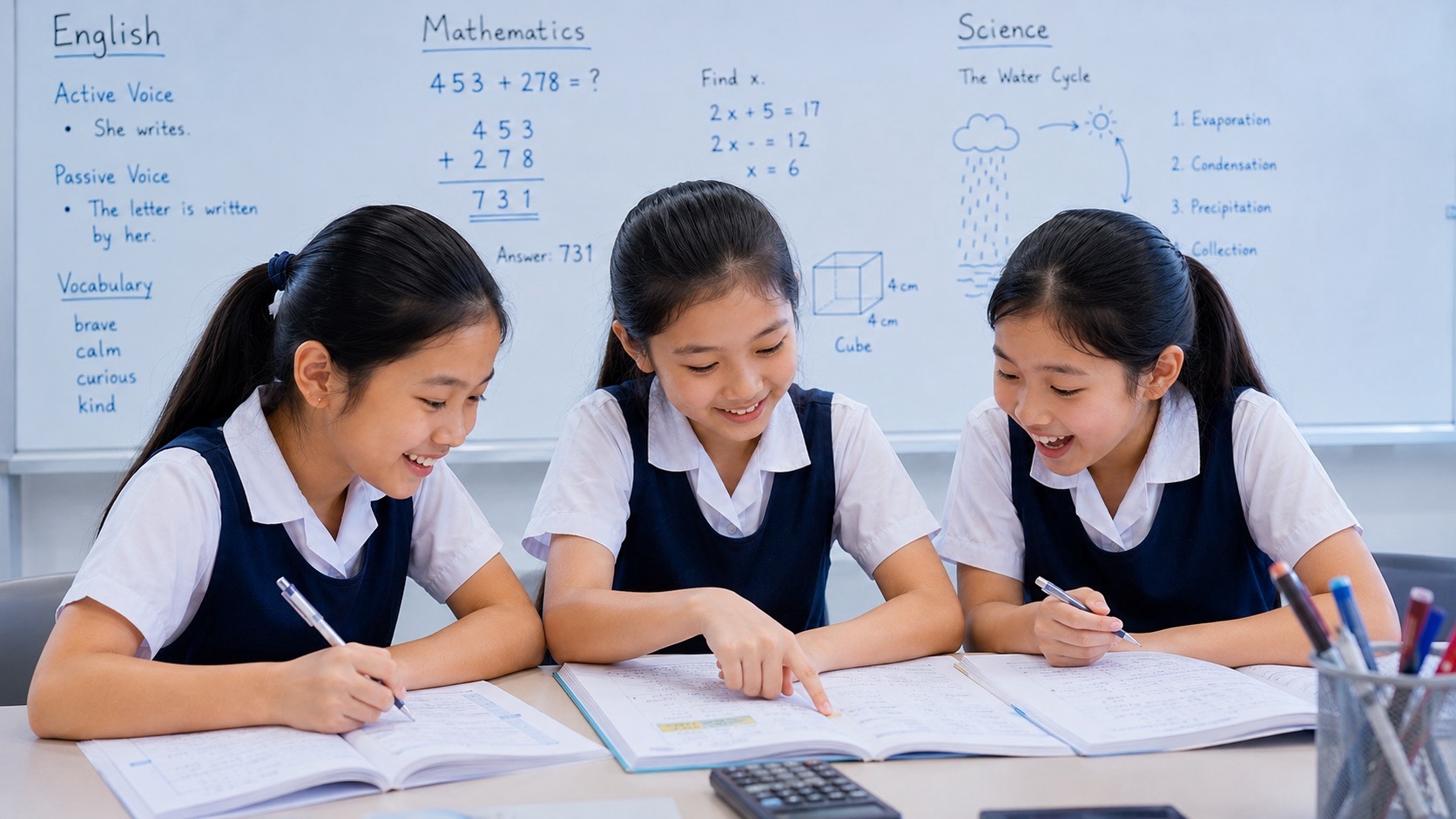
Primary 1 Mathematics tuition for Bendemeer families should do more than help a child finish worksheets. Parents searching for P1 Maths tuition in Bendemeer, Primary 1 Mathematics tuition near Bendemeer, small-group Mathematics tuition or MOE-aligned lower-primary support are usually looking for the same underlying result: a child who understands numbers, place value, addition and subtraction, early multiplication and division, shapes, measurement, money, time and word problems well enough to work with growing independence. Primary 1 is not mainly a race for speed. It is the year in which number sense, mathematical language, working habits and confidence begin to form one dependable system.
The current Singapore Primary Mathematics syllabus places mathematical problem solving at the centre of learning and develops Number and Algebra, Measurement and Geometry, and Statistics together with concepts, skills, processes, metacognition and attitudes. That matters for Primary 1 Mathematics tuition because arithmetic fluency cannot be separated from conceptual understanding. One child may know a number fact but misunderstand place value. Another may calculate correctly but fail a word problem because the language has not been translated into a mathematical relationship. Strong tuition identifies the weak layer and repairs that layer without rebuilding knowledge that is already secure.
This Bendemeer guide is a local discovery route into the wider eduKateSG Mathematics system. It is not a claim that eduKateSG operates a physical branch in Bendemeer. Families can use it to understand what effective P1 Mathematics support should diagnose, teach, practise and verify, then continue to the Mathematics Learning Hub and the broad Primary 1 Mathematics Tuition owner for the larger curriculum architecture. The local page stays focused on Bendemeer search intent while the broad owners retain the curriculum-wide job.
Primary 1 Mathematics Is a Foundation, Not a Warm-Up
Primary 1 can look easy to adults because the numbers are small. The cognitive work is still substantial. A young learner is coordinating spoken number words, written numerals, quantities, operation signs, diagrams, instructions and the conventions of a school worksheet. A single wrong answer can therefore come from several causes. The child may not understand the mathematical relationship, may know it but retrieve it slowly, may misread the instruction, may lose track while counting, or may not yet have an efficient way to record the thinking. Tuition becomes useful when it distinguishes those causes instead of treating every mistake as a request for more drilling.
Start with a Baseline, Not a Label
A practical P1 diagnostic baseline can be short. The tutor asks the learner to count a set, compare two quantities, read and build numbers, decompose a two-digit number into tens and ones, solve several addition and subtraction situations, interpret simple mathematical language and explain one or two choices. The purpose is not to grade the child. It is to locate the first point where understanding becomes unreliable. A learner who calculates accurately but cannot explain what the equation represents needs a different intervention from one who understands the relationship but loses accuracy because counting is effortful and attention is overloaded.
Number Sense Before Speed
Number sense is the ability to see numbers as quantities and relationships rather than as a memorised sequence of names. In Primary 1, this includes recognising small quantities, comparing sets, making a number in different ways, understanding one more and one less, seeing how ten can be composed and decomposed, and judging whether an answer is sensible. A child with developing number sense does not need to restart every calculation from one. The learner can use known relationships as bridges. This lowers cognitive load now and becomes increasingly valuable as numbers, operations and word problems become more demanding in later years.
Counting Is More Than Reciting
A learner can recite the number sequence and still have weak one-to-one correspondence. During diagnosis, the tutor watches whether each object is matched to one count, whether the final number spoken is understood as the total, and whether the learner can count a scattered arrangement without double-counting or omission. The repair can be concrete and brief: move objects as they are counted, organise an untidy set, predict before recounting, then record the numeral. The objective is not endless counting practice. It is a reliable link among quantity, spoken number and written symbol, which later supports addition, subtraction and estimation.
Subitising and Seeing Small Quantities
Young learners benefit from recognising small quantities without counting every item. Seeing three dots as three, or a structured six as two groups of three, begins to convert quantity into pattern. This is useful because arithmetic fluency grows from relationships rather than from repeated counting alone. A tutor can briefly show dot patterns, ten-frames or small arrangements and ask what the learner saw. Different explanations reveal different structures. One child may see five and one; another may see three and three. Both routes help the learner understand that a total can be composed in multiple ways.
Numbers to 100 and Place Value
Place value is one of the highest-leverage Primary 1 ideas because a two-digit numeral compresses a relationship between tens and ones into two symbols. If that relationship is fragile, later regrouping, mental calculation and written algorithms become harder. Effective P1 Mathematics tuition moves between bundles or place-value materials, drawings, expanded language and numerals. The learner should be able to say that 47 is four tens and seven ones, build it, compare it with 52, and predict what changes when one ten is added or removed. This makes the written number system meaningful rather than decorative.
Zero Deserves Explicit Attention
Zero looks simple but plays several important roles. It can represent no objects, preserve a place in a numeral, and participate in addition and subtraction relationships. A learner who understands 42 may still be unsettled by 40 because the ones place contains zero. Tuition should make that distinction visible. Forty is not four; it is four tens and no ones. Contrast questions using numbers such as 4, 40, 14 and 41 can reveal whether the learner is attending to place or merely recognising digits. That small diagnostic can prevent a much larger place-value problem later.
Comparing and Ordering Numbers
Comparison should be based on magnitude, not on whichever digit looks larger. Primary 1 learners can use concrete sets, number lines and place-value reasoning to explain why one number is greater or smaller. The tutor can ask the learner to order several values and justify the decision without recounting every unit. This habit supports estimation and checking later. It also gives the learner useful mathematical language: greater than, less than, equal to, before, after, between, closest and furthest. Language and number sense reinforce each other when the relationship is made explicit.
Number Bonds as Part-Whole Relationships
Number bonds are most useful when they are understood as relationships rather than as a diagram format. Eight can be made from five and three, six and two, seven and one, or eight and zero. The learner should be able to build, draw, say and write these combinations. This prepares several later skills at once: making ten, missing-number equations, mental addition, subtraction and model drawing. A tutor can ask for all the ways to make a small total and then turn those decompositions into related equations. The child begins to see a family of connected facts rather than isolated answers.
Addition Means More Than “Put Together”
Addition can describe joining two parts, increasing a quantity or composing a whole from known parts. A learner who experiences only one story pattern may know how to add but fail when the unknown moves to a different position. Good tuition connects an actual situation, a simple drawing, a number bond and an equation. The learner should be able to explain what each number represents. That understanding is more dependable than searching for a word such as altogether. Keywords can be useful clues, but the relationship among the quantities must determine the operation.
Subtraction Has Several Meanings
Subtraction can describe taking away, finding a difference or finding a missing part. These structures are related but do not look identical in language. If eight objects are present and three are removed, the story differs from comparing a set of eight with a set of three. A young learner may know the arithmetic fact while failing to recognise the comparison relationship. Tuition can place these situations side by side, ask the child to draw them and then connect each drawing to an equation. The objective is a flexible idea of subtraction rather than one memorised story pattern.
Addition and Subtraction as Inverses
The inverse relationship between addition and subtraction is an early source of efficiency and checking. If six and four make ten, then ten minus six is four and ten minus four is six. The learner does not need to memorise every fact as a separate item. A number bond can generate an entire fact family. Tuition should ask the learner to move in both directions: from parts to whole and from whole to missing part. This prepares missing-number questions and later algebraic thinking while also giving the child a natural way to verify an answer.
Making Ten as a Mental Strategy
Making ten is powerful because the base-ten system is organised around tens. To add eight and five, the learner can split five into two and three, combine eight with two to make ten, then add the remaining three. The strategy is not a magic shortcut; it is an application of number bonds and place value. A tutor should compare it with counting on and other valid methods so the learner sees why one route may be more efficient for a particular pair of numbers. Strategic choice is an early form of mathematical problem solving.
Arithmetic Fluency Without Turning Mathematics into a Race
Arithmetic fluency means that useful facts and methods become accurate, increasingly efficient and available without excessive effort. It does not require constant timed drills. For a Primary 1 learner, short retrieval practice is usually more productive than a long speed test. The tutor can mix known facts, derived facts, number bonds and mental strategies, then revisit them after a delay. Speed often improves as a consequence of stronger relationships and repeated retrieval. Pushing speed before meaning is secure can instead encourage guessing, anxiety and dependence on memorised sequences that do not transfer.
Early Multiplication as Equal Groups
Primary 1 multiplication begins with equal groups. The child should understand how many groups there are, how many objects are in each group and why repeated addition represents the same structure. Counters, drawings and arrays make this visible. The tutor can ask the learner to build three groups of four, describe the arrangement, connect it to four plus four plus four, and then record a multiplication statement when appropriate. Later fact learning becomes more durable when the symbols are attached to a clear structure instead of being introduced as another set of signs to memorise.
Early Division as Sharing and Grouping
Division begins with at least two related questions. If a total is shared equally among a known number of groups, the unknown is the size of each group. If the size of each group is known, the unknown is how many groups can be made. Children often confuse these because the same numbers may appear in both. Physical objects help initially. The tutor then moves to drawings and equations while asking what each number represents. Connecting both division structures to multiplication builds an inverse relationship rather than a collection of isolated procedures.
Mathematical Language Is Part of the Subject
Words such as more, fewer, equal, difference, before, after, longer, shorter, heavier and lighter carry mathematical relationships. They are not decoration around the arithmetic. A learner may fail a word problem while knowing the required calculation because the language has not been decoded. In small-group tuition, the tutor can ask the learner to restate a question in simpler language, identify the known quantities and say what is changing. This creates a bridge between English comprehension and mathematical representation without turning Mathematics tuition into a separate English lesson.
Word Problems Are Translation Tasks
A word problem asks the learner to translate from a situation into quantities and relationships, from those relationships into a mathematical operation, and from the result back into the context. A useful P1 routine is compact: What do I know? What am I finding? What is happening to the quantities? Can I draw or show it? Which operation fits? Does the answer make sense? The tutor should gradually shorten the prompts so the learner internalises the questions. This is more reliable than keyword hunting because it survives changes in wording.
Model Drawing Begins with Meaning
At Primary 1, model drawing can remain simple. A part-whole box, a comparison sketch or a short bar may be enough. The purpose is not to teach elaborate upper-primary heuristics prematurely. It is to provide a visual surface for a relationship that may be difficult to hold in language alone. Every part of the model should correspond to something in the question. If the child cannot explain what a bar, box or label represents, the drawing is not yet functioning as Mathematics. Good modelling makes the next decision clearer rather than merely making the page look complete.
Concrete, Pictorial and Symbolic Movement
Young learners benefit when the same mathematical relationship appears in concrete, pictorial and symbolic forms. The movement is not a rigid one-way staircase. A child may return to objects or a drawing when a symbolic equation becomes confusing, then move back to the symbols with a clearer mental model. The key is that the relationship remains invariant. Tuition should ask the learner to explain how the objects, picture and equation represent the same idea. Support is gradually withdrawn as the learner becomes able to work symbolically without losing meaning.
Money as Applied Number Sense
Money provides a familiar context for composing values, comparing quantities and using addition or subtraction. Recognising a coin is not enough. The child should understand that different combinations can have the same total value and that a larger coin physically does not necessarily mean greater value. Tuition can ask for two ways to make an amount, compare which collection is worth more or solve a small purchase situation. This naturally strengthens equivalence and number composition while giving the child a reason to care about exact amounts.
Time and Sequence
Time combines number, spatial representation and sequence language. A learner may recognise a number on a clock but still confuse before, after, earlier and later. Tuition can connect clock reading to ordinary routines: school starts, recess occurs later, an activity ends before dinner. Simple timelines help the learner see that time has an ordered structure. As the learner becomes comfortable, questions can vary which information is given and which is missing. Understanding the sequence is more useful than memorising isolated clock faces.
Measurement Starts with the Attribute
Before a child measures well, the learner needs to know what is being compared. Length, mass and capacity are different attributes. A tall container does not automatically hold more, and a physically large object is not always heavier. Primary 1 tuition can use direct comparison, estimation and ordinary objects to make the attribute explicit before formal procedures dominate. The learner should be able to say what is being measured and which comparison is sensible. This builds a conceptual foundation for later units rather than reducing measurement to number labels.
Shapes by Properties, Not Appearance
Geometry begins when a learner understands that a shape remains the same type even when it is rotated, resized or placed in an unfamiliar orientation. Instead of memorising one prototype, children should talk about sides, corners, straight edges, curved surfaces and spatial relationships. Examples and non-examples are useful. If every triangle shown points upward, the learner may accidentally conclude that orientation is part of the definition. Varied examples help the child focus on invariant properties, which is the beginning of genuine geometric classification.
Patterns and Early Generalisation
Patterns teach the learner to notice what repeats, what changes and what rule generates a sequence. This is early algebraic thinking. A tutor can use colours, shapes, actions and number sequences, but should ask the child to state the rule rather than merely continue the visible pattern. A learner who can create a new sequence that follows the same rule has moved beyond copying. The ability to describe a regularity in words becomes useful later when number patterns, relationships and generalisation become more formal.
Accuracy Is a System, Not a Personality Trait
When adults call a young learner careless, they often combine several different error mechanisms. One child miscopies a number. Another counts too quickly. Another skips the final sentence of a word problem. Another writes digits unclearly and then reads the wrong value back. Accuracy improves faster when the error is classified. The tutor can attach one preventive habit to each pattern: point while reading, estimate before calculating, align work, circle the target quantity, or perform an inverse check where suitable. Specific habits are teachable; the label “careless” is not.
Working Is Communication and External Memory
Primary 1 working should remain age-appropriate, but it should make enough reasoning visible that the learner and tutor can recover the path. A number bond, labelled drawing or simple equation gives the child somewhere to place the thinking. It also reveals whether a wrong answer came from the mathematical relationship or from the final calculation. Clear working supports independence because the learner can look back at the page rather than asking an adult to remember every step. It is the beginning of a habit that becomes increasingly important in multi-step Mathematics.
School Homework and Tuition Should Reinforce One Another
Tuition should support the school curriculum rather than create a disconnected second Mathematics programme. If school is teaching place value, the tutor can reinforce the underlying relationship, repair an older counting gap and add a small amount of transfer practice. When school moves to another topic, cumulative retrieval can keep the earlier idea active. This creates continuity without forcing the child to juggle contradictory terminology or unnecessary alternative algorithms. The MOE syllabus remains the reference frame; tuition can diagnose, sequence and deepen within it.
School Assessments as Evidence
Primary 1 assessments should be read diagnostically. A score reports how many marks were obtained, but it does not explain why marks were lost. A marked worksheet or school paper can be sorted into concept errors, arithmetic slips, reading errors, missing units, unclear working and questions left blank. The recurring category is often more informative than the total mark. Tuition can then target the highest-leverage cause and test whether the same error returns in a later assessment. This turns school evidence into a repair plan instead of an emotional verdict.
Diagnostic Gap Repair Should Be Narrow
If a learner confuses tens and ones, the tutor does not need to restart the entire number chapter. A narrow repair isolates the relationship, models it clearly, gives guided examples, tests an independent version and revisits it later. Secure knowledge is left intact. This protects the learner’s sense of competence and uses tuition time efficiently. Repair is not complete when the child agrees with the correction. It is complete when the relationship survives a changed question without the original example sitting beside it.
Alicia: Correct Answers, Slow Reconstruction
Alicia is a fictional eduKateSG learner who often reaches correct answers but recounts from one for almost every task. Her problem is not a lack of effort. She has not yet built enough reusable number relationships. In tuition, Alicia practises counting on, making ten, number bonds and related addition-subtraction facts. The tutor watches for a change in strategy rather than merely a faster worksheet time. Progress appears when Alicia spontaneously uses a known relationship, explains why it works and still retrieves it after several days rather than rebuilding every answer from the beginning.
Tricia: Strong Sums, Fragile Word Problems
Tricia is a fictional learner who calculates accurately when an equation is already written but guesses operations in story problems. She tends to notice one familiar word and start calculating immediately. Her repair routine requires her to state what is happening, identify the unknown and draw a simple relationship before writing an operation. The tutor then gives pairs of questions with similar vocabulary but different structures. Tricia learns that the mathematical relationship determines the operation. Over time, the drawing can become smaller because the reasoning has become more internalised.
Kai Kai: Prompt-Dependent Understanding
Kai Kai is a fictional learner who understands explanations but waits for adult confirmation before each step. In a classroom, this can look like weakness even when the Mathematics is within reach. His tuition goal is controlled independence. Kai Kai must attempt one useful first step before asking for help, then explain exactly where uncertainty begins. Prompts are gradually reduced. Progress is measured by the length of an independent work block, the specificity of his questions and whether he can notice and repair a small error without immediate rescue.
Why a Three-Student Group Can Work
A three-student Mathematics group can combine peer explanation with individual visibility. One learner may notice a number bond quickly, another may draw the relationship and a third may ask the question that exposes a hidden assumption. The tutor can use these differences productively while still requiring each child to solve a fresh item alone. Small group size matters only if individual thinking remains visible. Copying a peer’s method is not evidence of mastery, so every shared explanation should be followed by an independent transfer question.
A 1.5-Hour Primary 1 Lesson
A ninety-minute Primary 1 lesson should change cognitive mode several times while preserving a coherent mathematical thread. One useful structure is short retrieval, explicit teaching of one high-leverage relationship, guided practice, independent practice, correction, a brief oral or movement reset and cumulative review. The learner should not spend the entire session filling pages. The tutor needs opportunities to hear explanations, inspect representations and see what happens when support is removed. The final questions should look slightly different from the examples so transfer is tested before the child leaves.
Retrieval Practice for Young Learners
Retrieval practice means asking the brain to bring back something learned earlier instead of rereading it immediately. For Primary 1, this can be gentle: a few number bonds from last week, a place-value question from an older lesson or a quick explanation of an operation. The set should be short enough that it does not become a separate high-pressure test. Spaced retrieval helps knowledge remain available when school moves to a new topic. It also gives the tutor early warning when something that looked secure is beginning to fade.
Mixed Practice Builds Method Selection
Topical practice is useful when a method is first learned because repeated examples reduce unnecessary variation. Mixed practice serves a different purpose. It removes the topic label and asks the learner to decide what kind of Mathematics is needed. Even at Primary 1, a short mixed set of addition, subtraction, comparison, shapes and simple word problems can reveal whether the child is reading and selecting or merely continuing the pattern of the previous question. This is an early form of examination readiness because real assessments do not always announce the method.
Corrections Need a Fresh Question
When a learner gets a question wrong, showing the correct answer is only the first half of correction. The child should then solve a fresh question that uses the same underlying relationship but changes the numbers, wording or representation. This prevents recognition from being mistaken for learning. If the learner can explain the correction and apply it independently, the tutor has stronger evidence that the gap is closing. A delayed version in the following lesson provides even stronger evidence because the original explanation is no longer active in working memory.
The Difference Between Practice and Proof of Learning
Practice happens while a method is active in memory. Proof of learning comes later. A child may complete ten similar questions immediately after an explanation and still fail to retrieve the relationship two weeks later. Tuition should therefore include delayed checks. One or two older questions can be inserted into a new lesson without announcing the topic. If the learner retrieves the relationship, recognises it in a changed format and solves it independently, the knowledge is becoming durable. This distinction protects families from mistaking temporary familiarity for long-term progress.
Confidence Comes from Evidence of Control
Mathematical confidence should not depend on being told that every question is easy. A more durable form grows when the learner repeatedly experiences control: I can start this, I can draw it, I can check it, I can fix one mistake, I can ask a specific question. Tuition should therefore include small recoverable difficulties. The child experiences getting stuck without the lesson collapsing. Over time, unfamiliar-looking questions become less threatening because the learner has a sequence of actions available rather than relying on instant recognition.
Home Practice Should Be Short and Predictable
For most Primary 1 learners, short regular home practice is more useful than a long weekend worksheet battle. A brief session can include several number facts, one place-value question and one small story problem. Everyday Mathematics also helps: comparing prices, reading a clock, estimating quantities, sorting shapes or making an amount with coins. The adult should allow thinking time before supplying the next step. Immediate rescue can unintentionally teach the child to wait for help. The home routine should reinforce independence rather than create another performance environment.
When More Tuition Is Not the Answer
A child who is learning steadily, working independently and recovering well from ordinary mistakes may not need additional tuition hours. More practice is not automatically better. Fatigue can reduce attention and turn Mathematics into a continuous correction cycle. Tuition is most useful when it has a defined job: close a recurring gap, strengthen fluency, improve word-problem translation, develop working habits or support school assessment readiness. The objective should become smaller as the learner becomes more independent. Good tuition should eventually reduce the amount of external support the child needs.
What Parents Should Look For in Feedback
Useful feedback names mechanisms rather than broad labels. Instead of saying a child is weak in Mathematics, a tutor might say the learner understands two-digit place value but still counts all objects when adding ones, or can subtract accurately but misreads comparison language. Specific feedback makes the next action obvious. It also helps parents notice progress that may appear before a large change in marks, such as faster task entry, clearer working, better explanations, fewer prompts and successful retrieval of an older skill.
A Simple Parent Progress Dashboard
Parents do not need a complicated dashboard. Four observations provide useful evidence. Can the child explain a recently learned relationship? Can the child retrieve an older skill without a hint? Can the child start a familiar question independently? Can the child notice and correct at least some mistakes? These behaviours often improve before a major assessment jump. They also matter beyond one paper because they show that conceptual understanding, retrieval, independence and checking are moving together. The score remains useful, but it is only one output of the underlying learning system.
What a Strong Primary 1 Worksheet Should Reveal
A good worksheet is not valuable because it contains many questions. It is valuable because the sequence reveals something. A short set can move from a direct number fact to a missing-number equation, then to a simple word problem and finally to a changed representation. If the learner succeeds on the direct calculations but fails the representation changes, the issue may be transfer rather than arithmetic. Tuition materials should generate this kind of evidence. Volume without diagnostic purpose can make both tutor and learner busy while leaving the underlying mechanism unchanged.
Why Explanation Matters in Mathematics
Asking a young learner to explain does not mean demanding a long speech. A sentence such as “I made ten first,” “this is the whole,” or “there are three equal groups” can reveal whether the child is reasoning or copying. Explanation strengthens mathematical language and allows misconceptions to become visible before they become habitual. The learner does not need to narrate every routine calculation. Explanation is most valuable at high-leverage moments: when choosing a method, interpreting a diagram, comparing quantities or correcting an error.
Handling Repeated Errors Calmly
A repeated error should trigger a change in teaching evidence, not louder repetition of the same explanation. The tutor can change representation, reduce the numbers, contrast an example with a non-example or ask the learner to predict before calculating. If the error disappears under one representation and returns under another, the pattern itself reveals something useful. This keeps tuition analytical. It also prevents the child from interpreting difficulty as a fixed personal trait. Mathematics becomes a problem to investigate rather than a judgement about ability.
Problem Solving as a Habit of Entry
At Primary 1, problem-solving skill is largely the ability to enter a question sensibly. The learner identifies what is known, what is unknown and how the quantities relate. This can be practised with small questions long before sophisticated heuristics are needed. A child who learns to pause, represent the relationship and choose an operation is developing a habit that later supports multi-step primary problems and secondary Mathematics. The exact question changes, but the entry routine remains useful: understand first, represent second, calculate third, check last.
The Role of Estimation
Estimation at Primary 1 can be informal. Is the answer likely to be bigger or smaller? Is a group closer to ten or twenty? If we add something, should the result increase? If two numbers are almost the same, should their difference be large? These questions teach the learner to monitor direction and magnitude. Estimation becomes a protective layer against random calculation because the child has an expectation before the exact result appears. This is the beginning of checking by reasonableness, a habit that remains valuable in every later Mathematics examination.
Linking Mathematics to Everyday Decisions
Young children encounter Mathematics constantly: sharing snacks, comparing heights, counting change, reading a lift display, estimating how many objects fit into a box or deciding which container holds more. Tuition can use these situations to reinforce school concepts without pretending every lesson must become a game. The value lies in showing that number and measurement describe real relationships. This helps abstract symbols retain meaning. It also gives families simple opportunities to ask mathematical questions without adding another formal worksheet to the child’s day.
Avoiding Premature Upper-Primary Techniques
Parents sometimes worry that a Primary 1 child will fall behind unless advanced heuristics are introduced early. Acceleration can be useful for a learner who is genuinely ready, but it should not replace foundational depth. A child with strong number sense, flexible operations, clear mathematical language and independent working is better prepared for later model methods than a child who has memorised an upper-primary template without understanding the quantities. Future capacity grows from connected foundations. Early exposure is useful only when it adds depth rather than hides an unfinished first floor.
Preparing for Primary 2
Good Primary 2 preparation is mostly the successful completion of Primary 1. The learner should understand tens and ones, use addition and subtraction relationships flexibly, recognise equal groups, read simple word problems, use basic representations and begin familiar work independently. If these are stable, larger numbers and more formal multiplication, division and fractions have somewhere to attach. Families can continue through Primary 2 Mathematics Tuition | Bendemeer when the child is ready for the next stage rather than treating acceleration itself as the goal.
Bendemeer Search Intent and Educational Fit
A local search such as P1 Maths tuition Bendemeer or Primary 1 Mathematics tuition near Bendemeer usually expresses a practical need for convenience, but the educational decision should still be based on fit. Ask whether the tutor can identify the child’s first mathematical weak link, explain how it will be repaired, show how school material is integrated and describe how independence will be measured. Location can make attendance practical and regular. It cannot substitute for diagnostic quality, clear teaching or evidence that the learner is becoming less dependent on prompts.
MOE Syllabus Alignment
The official MOE Primary Mathematics syllabus remains the curriculum reference. The 2021 syllabus applies through Primary 6 from 2026. For Primary 1, whole numbers, addition and subtraction, multiplication and division, money, measurement, geometry and data-related foundations should be taught as connected mathematical ideas, not as a private parallel curriculum. Tuition can sequence, diagnose and deepen, but school Mathematics remains the common frame so that learning transfers back into class and assessment.
A Four-Week Repair Cycle
When a recurring gap is identified, a simple four-week cycle can make progress visible. In the first week, establish the baseline and teach the relationship explicitly. In the second, practise with varied examples while reducing prompts. In the third, mix the skill with other topics and include one delayed retrieval item. In the fourth, use a short independent check and compare the error pattern with the original baseline. The exact pacing varies by child, but the principle is stable: teach, vary, delay, retest. This is more informative than repeating one worksheet type until familiarity feels like mastery.
What Examination Confidence Looks Like at Primary 1
Primary 1 does not need heavy examination pressure, but the habits that later support examination confidence can begin gently. The learner reads the whole question, identifies what is being asked, chooses a representation, calculates, checks and moves on. When uncertain, the child has something to do besides freeze or guess. Confidence grows from repeated experience of these actions working. This is a healthier foundation than trying to make every school assessment feel easy. The learner discovers that difficulty can be entered and managed.
Sibling Routes in the Bendemeer Mathematics Cluster
The Bendemeer route is organised by stage so families do not have to navigate one oversized local page. Continue to Primary 2 Mathematics Tuition | Bendemeer, Primary 3 Mathematics Tuition | Bendemeer, or SEC Examination Mathematics Tuition | Bendemeer. The Mathematics Learning Hub remains the broad subject owner, while these local pages answer stage-specific Bendemeer discovery without creating a competing public root.
Primary 1 Mathematics Tuition | Bendemeer: Closing Principle
The strongest Primary 1 Mathematics tuition is not the programme that makes a child look most advanced for one month. It is the programme that leaves the learner with more dependable number sense, clearer place-value understanding, stronger arithmetic relationships, better word-problem entry, more meaningful model drawing, more accurate working and greater independence. Those gains make school assessments easier to interpret because a wrong answer becomes a specific repair target rather than evidence that Mathematics as a whole is failing.
For Bendemeer families, convenience may begin the search, but instructional fit should finish it. A young learner deserves teaching that sees the difference between a concept gap, a retrieval delay, a language problem and an avoidable slip. Diagnose precisely, teach the relationship clearly, practise with variation, revisit after a delay and gradually remove support. The first floor of Mathematics becomes strong when the learner can understand, retrieve, represent, calculate, explain, check and recover with steadily less adult help.