
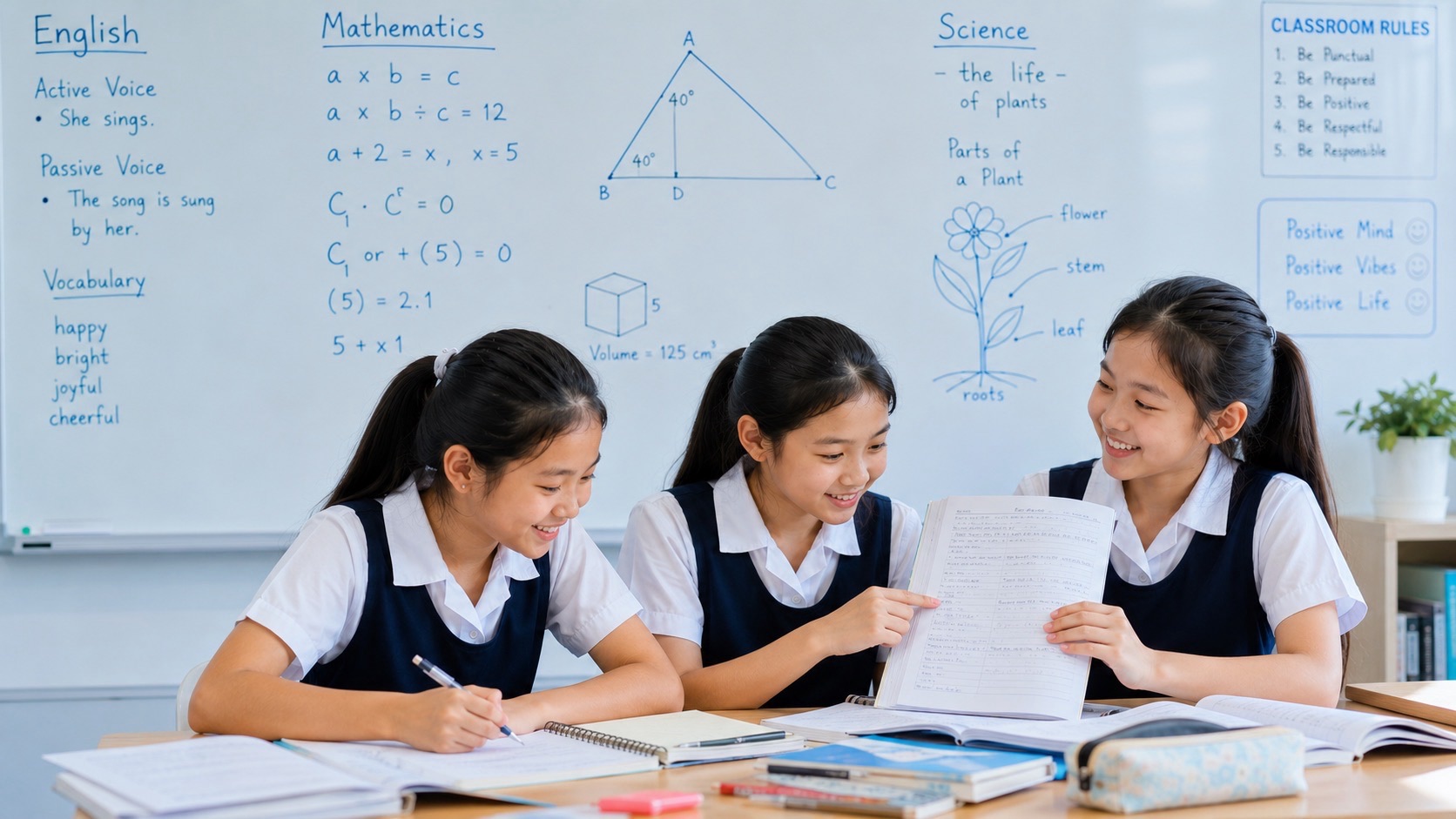
Primary 2 Mathematics tuition for Bendemeer families should strengthen the point where early number foundations begin to carry more mathematical weight. Parents searching for P2 Maths tuition in Bendemeer, Primary 2 Mathematics tuition near Bendemeer, small-group Maths support or MOE-aligned Mathematics tuition are usually looking for help with numbers to 1000, addition and subtraction, multiplication and division, fractions, money, time, measurement, picture graphs, arithmetic fluency and word problems. The important question is not whether the child can finish a topical worksheet. It is whether the learner understands the relationships well enough to recognise and use them when numbers, wording and representation change.
The Singapore Primary Mathematics syllabus places mathematical problem solving at the centre of learning, so Primary 2 should develop conceptual understanding, skills, processes, metacognition and productive attitudes together. P2 is often the year when a learner who seemed comfortable in Primary 1 begins to reveal whether number facts are genuinely retrievable, whether place value is stable and whether word problems can be translated without adult prompting. Effective tuition therefore combines number sense, arithmetic fluency, model drawing, problem-solving, accuracy routines, diagnostic gap repair and school-assessment support rather than treating each chapter as a sealed packet.
This Bendemeer page is a local discovery route into the wider eduKateSG Mathematics system. It does not claim that eduKateSG operates a physical branch in Bendemeer. The broader Primary 2 Mathematics Tuition owner and the Mathematics Learning Hub retain the larger curriculum job. This local guide concentrates on what P2 support should diagnose, teach, practise and verify for Bendemeer families while keeping the subject-wide architecture clean.
Why Primary 2 Is a Consolidation-and-Expansion Year
Primary 2 is not simply Primary 1 with larger numbers. The learner must keep counting, place-value and operation ideas active while multiplication, division, fractions and longer problem situations become more explicit. More information has to be held in mind at once. A child who still reconstructs every small fact by counting may now spend so much attention on arithmetic that little remains for reading and planning. Tuition should therefore ask which earlier skills have become dependable tools and which still consume too much cognitive effort to support new learning efficiently.
A Primary 2 Diagnostic Baseline
A useful P2 baseline samples several systems instead of giving a long test. The tutor checks three-digit place value, mental addition and subtraction, written algorithms, multiplication and division meaning, basic facts, fraction foundations, money, time, measurement, graph reading and word-problem entry. The learner should explain at least a few choices. This helps separate concept gaps from retrieval delays, reading difficulty, notation errors and prompt dependence. The aim is to locate the first unreliable step because that is usually where the most efficient repair begins.
Numbers to 1000
Three-digit numbers require the learner to coordinate hundreds, tens and ones as nested place-value units. A child may read 406 correctly and still misunderstand what the zero is doing. P2 tuition should move among expanded form, place-value materials, number lines, verbal descriptions and numerals. The learner should be able to construct a number from clues, compare two values, order a set and predict what happens when 1, 10 or 100 is added or removed. This flexibility supports estimation, mental calculation and formal regrouping later in the same year.
Place Value Must Survive Regrouping
Regrouping is not a mysterious mark written above a column. It is an exchange within the base-ten system. Ten ones can be regrouped as one ten; ten tens can be regrouped as one hundred. When a learner understands this, the written addition and subtraction algorithms become compressed records of meaningful exchanges. When the concept is missing, the procedure may look correct until zeroes or several exchanges appear. Tuition should keep the place-value meaning visible long enough for the written method to become stable rather than teaching the algorithm as a sequence of unexplained marks.
Three-Digit Addition
Primary 2 addition requires accurate digit alignment, reliable basic facts and controlled regrouping. The tutor should observe where an error begins. Is the learner misaligning hundreds, tens and ones? Is a small fact slow? Is a carried ten forgotten? Or is the final result accepted without any estimate of size? One error category may need a place-value model, another a retrieval routine and another a checking habit. Treating all of them as carelessness throws away the information contained in the child’s working.
Three-Digit Subtraction
Subtraction often exposes fragile place value because renaming requires the learner to exchange a larger unit for ten smaller units while preserving total value. A child may subtract the smaller digit from the larger regardless of position, lose track after renaming or become confused when a zero appears. Tuition can temporarily place a concrete or drawn representation beside the written algorithm, then remove it as the learner can explain each exchange. Inverse addition and estimation provide independent ways to check the result.
Mental Calculation as Flexible Structure
Mental calculation should not become the written algorithm performed invisibly. Learners can decompose numbers, make a friendly ten or hundred, compensate, double, halve or use a known relationship. The tutor can present one calculation and compare several routes, asking which is efficient and why. This teaches the child that mathematical strategy depends on the numbers involved. Flexible mental calculation also improves estimation because the learner develops a stronger sense of how quantities change rather than treating every calculation as a mechanical sequence.
Multiplication Facts Need Meaning and Retrieval
Primary 2 multiplication should connect equal groups, arrays, repeated addition and increasingly fluent fact retrieval. A learner who can chant a table in sequence may still hesitate when a fact is asked out of order. Tuition should preserve the structure: three groups of four and four groups of three have the same product but describe different group arrangements. Once the child understands what the factors represent, spaced retrieval can make facts increasingly available. This frees attention for word problems and later formal multiplication rather than turning tables into isolated recitation exercises.
Division as Sharing, Grouping and an Inverse
Division becomes more reliable when equal sharing and grouping are contrasted. If twelve objects are shared among three children, the unknown is the size of each share. If twelve objects are arranged in groups of three, the unknown is the number of groups. The numbers may be identical while the question is different. A tutor can use arrays and multiplication fact families to connect both division structures to inverse reasoning. The learner should eventually be able to reconstruct a division fact from a known multiplication relationship rather than treating division as a separate system.
Arithmetic Fluency Creates Working-Memory Space
Fluency matters because working memory is limited. If a child needs a long internal process to calculate every small sum or multiplication fact, a two-step problem can become difficult even when each individual operation is understood. Short, spaced retrieval practice reduces this load. It should mix facts, inverse relationships and derived strategies rather than repeat one table for an entire page. The goal is dependable access, not speed for its own sake. Faster retrieval is valuable because it leaves more attention available for interpretation, representation and checking.
Fractions Begin with Equal Parts
A fraction describes a relationship between a whole and equal parts. Primary 2 learners often count shaded pieces without checking whether the whole has been partitioned equally. Tuition should make equality of parts explicit through folding, drawing, fraction strips and comparison. The denominator tells how many equal parts make the whole; the numerator tells how many of those parts are being considered. These roles should be understood in language before symbolic rules are emphasised. A child who understands the partition is less likely to treat a fraction as two unrelated whole numbers separated by a line.
Comparing Unit and Like Fractions
Whole-number intuition can mislead fraction comparison. A learner may assume that one-eighth is larger than one-fourth because eight is larger than four. Visual models help show that when the same whole is divided into more equal parts, each individual part is smaller. Number lines provide another useful representation because they place fractions on a continuous magnitude system. The tutor should ask the learner to explain the comparison so the reasoning becomes visible. Understanding magnitude is more durable than memorising a rule about denominators.
Adding and Subtracting Like Fractions
When fractions have the same denominator, the learner is combining or removing equal-sized parts. The denominator remains the size system; the numerator changes because the number of selected parts changes. This meaning should be clear before procedural shorthand becomes dominant. A tutor can use fraction strips or drawings, then move to symbols and ask the child to explain why the denominator does not change in a like-fraction addition. The explanation protects against later errors when unlike fractions enter the curriculum and the denominator can no longer be treated mechanically.
Money as Applied Place Value
Money strengthens number composition, decimal notation, addition and subtraction in a familiar context. A learner should be able to build the same amount in different ways, compare values, decide whether an amount is enough and calculate simple change. Tuition should connect dollars and cents to place-value meaning rather than treating the decimal point as decorative. Real or represented coins and notes can support understanding initially, but the learner should also work symbolically so the concept transfers to school questions without physical materials.
Time, Sequence and Duration
Time problems combine clock reading with order and interval reasoning. A child may read an isolated clock face correctly but become confused when asked what happens before, after or several minutes later. Timelines are useful because they make duration visible. The tutor can connect school routines and everyday schedules to written questions, then vary which quantity is unknown. The learner begins to see time as a relationship among events rather than as a collection of clock pictures. This prepares later elapsed-time and conversion work.
Length, Mass and Volume
Measurement requires the learner to identify the attribute, choose or interpret the unit and judge whether the magnitude is sensible. A large-looking object is not always heavier, and a tall container may not hold more. Estimation before exact work is useful because it creates an expectation. P2 tuition can connect classroom and household objects to written questions so measurement is not reduced to manipulating numbers with units attached afterward. The child should understand what the measurement says about the object or quantity in the real situation.
Picture Graphs and the Meaning of a Scale
Picture graphs ask a child to translate symbols into quantities. A common error is counting the pictures while ignoring that one picture may represent more than one item. A read-first routine helps: read the title, inspect the categories, check the key, convert symbols to values and only then answer the question. Creating a small graph from data can deepen understanding because the learner has to decide how the representation encodes quantity. Graph reading is therefore another translation skill, not merely a visual counting exercise.
Shapes and Spatial Properties
Primary 2 geometry should move beyond recognising a familiar-looking shape. Learners can compare two-dimensional figures by properties and identify common three-dimensional shapes by their faces, edges or surfaces. Orientation should vary so a rotated figure is not mistaken for a different shape. Tuition can ask the learner to sort examples, justify the classification and find a non-example that looks similar. This develops the habit of using mathematical properties rather than visual resemblance, a habit that becomes increasingly important in later geometry.
Word Problems Need Relationship Reading
Primary 2 word problems increasingly require the learner to identify relationships rather than rely on keywords. The child should identify the known quantities, the unknown and what is happening before choosing an operation. A useful teaching pair uses similar vocabulary with different mathematical structures. This shows why words such as more, left or shared cannot mechanically determine the operation. The learner should be able to restate the situation in ordinary language and represent the relationship with a diagram, number bond, bar or equation before calculating.
Model Drawing as a Problem-Solving Tool
Simple bar models and part-whole diagrams can reduce the language load of a problem. The drawing should be built from the relationship, not copied because a teacher expects bars on the page. Each segment needs a meaning, each label should correspond to information in the question and the unknown should be visible. Once the learner sees the structure, the operation often becomes easier to select. Model drawing is therefore a thinking surface. A model that cannot be explained by the learner is not yet functioning as a useful representation.
The First Two-Part and Two-Step Problems
Some P2 problems require an intermediate quantity before the final answer can be found. This creates a planning demand that is different from simply performing two calculations. The learner may solve the first part correctly but forget what the result represents. Tuition should require a short label or sentence for the intermediate value. Working backward from the final question can help identify what must be known first. Over time, this becomes a general strategy for longer dependency chains in upper-primary Mathematics.
Working Should Make Thinking Recoverable
Clear working is not about making every page look identical. It is about leaving enough structure that the learner and tutor can reconstruct the reasoning. One mathematical statement per step, sensible alignment and labels for intermediate quantities reduce avoidable errors. If a child returns to the page several minutes later and cannot tell what a number represents, the working has not yet done its job. P2 is a useful stage for establishing this habit before multi-step problems become denser and more difficult to hold entirely in memory.
Accuracy Routines Instead of “Be Careful”
Accuracy improves when the learner has a repeatable routine matched to the error. A place-value problem may require alignment checks. A word-problem error may require marking the target quantity. A measurement error may require writing units beside every value. A copying error may require pointing while transferring a number. The tutor should identify which routine addresses the actual mechanism. Generic reminders to be careful rarely change behaviour because they do not tell the learner what action to take differently the next time the same situation appears.
Checking with Inverse Relationships
Addition and subtraction, multiplication and division provide natural checking relationships. A child who subtracts can add the difference back; a child who divides can multiply to see whether the groups reconstruct the total. Not every P2 question needs a formal check, but teaching these relationships strengthens both conceptual understanding and accuracy. The learner begins to see Mathematics as a connected network in which one fact can verify another. This is more powerful than a final instruction to check the paper because the child has a specific checking method available.
Estimation Protects Against Impossible Answers
Before exact calculation, a learner can ask whether an answer should be near 100, 300 or 900; whether subtracting should make the result smaller; or whether a money total is enough for a purchase. These expectations catch many impossible answers quickly. Estimation also strengthens number magnitude, so it belongs with number sense rather than in a separate isolated lesson. P2 tuition can make estimation habitual by asking for a rough prediction before selected calculations and then comparing the exact answer with that prediction.
School Assessments as Diagnostic Data
A Primary 2 school assessment can be analysed more usefully than simply recording the mark. Lost marks can be grouped into concept gaps, slow retrieval, question-reading failures, calculation slips, missing units, disorganised working and unfinished questions. Two children with the same score may therefore need completely different tuition. A strong post-assessment lesson prioritises the most frequent or expensive error mechanism rather than reteaching every chapter that contained a wrong answer. Later work should be checked specifically for recurrence of that mechanism.
Diagnostic Gap Repair Should Be Narrow
If a learner confuses regrouping across zero, the intervention should focus on that exchange rather than restarting all addition and subtraction. The tutor clarifies the idea, works a small number of guided examples, gives an independent matched item and then a changed transfer item. A later lesson revisits the same mechanism without warning. This sequence distinguishes temporary understanding from durable repair. It also preserves the child’s secure knowledge and prevents remediation from becoming an unnecessarily large programme that creates fatigue without solving the actual bottleneck.
Alicia: Strong Topical Work, Weak Mixed Selection
Alicia is a fictional eduKateSG learner who performs well when an entire page uses the same operation but slows when addition, subtraction, multiplication and division are mixed. Her calculations are not the main weakness. Method selection is. In tuition, topic headings are gradually removed. Alicia states the relationship before she calculates and checks whether the answer moves in the expected direction. Progress appears when mixed sets no longer create a long pause at the start of every item and she can explain why one operation fits better than another.
Tricia: Fractions as Familiar Pictures
Tricia is a fictional learner who recognises halves and quarters in familiar diagrams but becomes uncertain when the whole is shaped differently. She has attached the fraction to a visual prototype rather than to equal partitioning. Her repair uses valid and invalid fraction models, different orientations and number lines. Tricia explains why the parts must be equal and what numerator and denominator represent. Transfer is tested with unfamiliar shapes that preserve the same fraction relationship, followed later by symbolic questions without the original diagram.
Kai Kai: Correct but Confirmation-Dependent
Kai Kai is a fictional learner who understands P2 content but seeks confirmation after every operation. His difficulty is not mathematical ignorance so much as task control. Tuition gives him a self-check routine and a rule: attempt the next sensible step before asking whether the previous one is correct. The tutor responds to specific questions but avoids confirming every line. Over time, Kai Kai learns to carry a short chain of reasoning independently, and his questions become about genuine uncertainty rather than a request for constant validation.
Why Three Students Can Be Productive
A three-student group makes it possible to compare methods without losing sight of individual errors. One learner may solve mentally, another may draw a model and another may use a written algorithm. Discussing the differences can deepen understanding, but every learner should then complete a fresh question alone. The tutor can vary prompts and difficulty while keeping the shared concept coherent. Small-group size is useful only when individual transfer remains non-negotiable and the tutor can still see who understands the relationship without borrowing a peer’s working.
A 1.5-Hour Primary 2 Lesson
A ninety-minute P2 lesson can begin with short spaced retrieval, move into a focused explanation, use guided examples to make the relationship visible and then shift to independent and mixed practice. Correction should include a fresh matched question. The final portion can revisit one older dependency and one transfer problem. This rhythm keeps current school work connected to prior learning and prevents the lesson from becoming a long sequence of similar worksheet items. It also gives the tutor several opportunities to observe what happens as prompts are removed.
Spaced Retrieval Protects Old Learning
School chapters move on, but assessments eventually mix them. A child who learns multiplication in one month still needs those facts available when fractions, measurement or word problems later require them. Short cumulative retrieval at the beginning of tuition keeps older knowledge accessible. The questions should be small enough not to crowd out current teaching but varied enough to reveal what is fading. A weak old skill can then be repaired before it becomes a hidden dependency failure inside a newer topic.
Mixed Practice Trains Recognition
Topical practice trains execution after the method has effectively been named. Mixed practice trains recognition before the method is known. Both are necessary. A learner who can complete twenty subtraction questions may still choose subtraction incorrectly in a word problem. Mixing operations, fractions, measurement and graph questions teaches the child to read the mathematical situation first. This is a direct bridge from lesson success to school-assessment performance because the assessment will not always tell the learner which chapter or method is being tested.
Corrections Need Transfer and Delay
After an error is explained, the tutor should give another question with the same mathematical structure but different surface details. If the child can solve only the original item after seeing the correction, the evidence is recognition, not transfer. A fresh question tests whether the underlying relationship has been learned. A delayed version in the following lesson is stronger again because the original explanation is no longer active. This repair-then-transfer cycle is more informative than simply marking the corrected answer as complete.
Homework Volume Is Not a Progress Measure
A thick stack of completed worksheets can coexist with fragile learning if the questions are highly repetitive and corrected immediately. Better evidence includes whether the learner retrieves an older skill after several days, explains a key relationship, begins work without a prompt and corrects a familiar error independently. Tuition homework should therefore be short enough to complete thoughtfully and targeted enough that each question has a reason for being there. The objective is not maximum paper consumption. It is durable, increasingly independent Mathematics.
Home Mathematics Around Bendemeer
Everyday routines can provide low-pressure mathematical practice. A child can estimate a total before counting coins, read time before leaving home, compare quantities while shopping, or describe equal groups when sharing items. These moments should not turn every family activity into a lesson. Their value is simply to show that the same number relationships used at school describe ordinary situations. The child’s explanation matters more than the complexity of the example. Short authentic applications can help symbolic school work feel less detached from the world.
Building Examination Confidence Before High-Stakes Exams Exist
Primary 2 does not need heavy examination pressure, but it is a good time to build behaviours that later support exam confidence: read the question fully, identify the target, choose a method, record working clearly, check a result and move on. Confidence grows when these behaviours become familiar. The learner discovers that an unfamiliar-looking item can be entered step by step rather than treated as a threat. This is a more durable foundation than trying to make every school assessment feel easy or predictable.
Parent Feedback Should Name the Next Action
Useful tutor feedback is specific enough to guide what happens next. “Weak in Maths” is not actionable. “Understands three-digit place value but still loses accuracy when regrouping across zero” identifies both what is secure and what needs work. Parents can then avoid unnecessary extra practice in areas that are already stable. This kind of communication also prevents the child from being defined by a broad weakness label. The next tuition cycle should have a visible target that can later be retested.
Preparing for Primary 3
The best preparation for Primary 3 is a connected P2 foundation. Place value should be stable, addition and subtraction algorithms accurate, multiplication and division facts increasingly retrievable, simple fractions meaningful and word problems entered through relationships rather than keywords. The learner should also be able to complete a short independent block without constant confirmation. Continue through Primary 3 Mathematics Tuition | Bendemeer when this foundation is ready, rather than using acceleration to hide unfinished P2 dependencies.
When a Child Is Ahead
A learner who is already secure in P2 Mathematics does not automatically need to race into upper-primary content. Productive extension can deepen flexibility: solve the same problem in two ways, create a question for a given diagram, explain why an incorrect method fails, find several combinations with the same total or generalise a number pattern. These tasks develop reasoning while preserving age-appropriate foundations. Acceleration is one option, but depth can produce stronger transfer and a more resilient mathematical system without prematurely increasing procedural load.
When a Child Is Behind
A learner with older gaps should not automatically receive an entire lower-level workbook. Diagnostic repair identifies the minimum prerequisite blocking current work. If multiplication facts are slow, practise the facts and their structures. If word problems fail because language is unclear, repair translation. If place value is unstable, return briefly to hundreds, tens and ones. The objective is to reconnect the learner to current school Mathematics efficiently. Broad remediation can consume time and confidence while leaving the highest-leverage bottleneck insufficiently addressed.
Bendemeer Search Intent and Educational Fit
Families searching for Primary 2 Mathematics tuition near Bendemeer are often balancing travel, schedule and teaching fit. Convenience matters because consistent attendance matters. The educational decision should still ask whether the tutor can diagnose first, preserve MOE alignment, distinguish concept from fluency, teach word-problem translation, use model drawing meaningfully and show how progress will be retested. A local label cannot compensate for a vague intervention. The child should become more capable of handling school Mathematics with less external support over time.
MOE Syllabus Alignment
The MOE Primary Mathematics syllabus remains the curriculum reference, and the 2021 syllabus applies through Primary 6 from 2026. Tuition should reinforce the intended mathematical ideas, processes and problem-solving goals rather than create a competing private curriculum. Good alignment does not mean copying school worksheets. It means ensuring that explanations, representations and practice strengthen the same underlying Mathematics the learner is expected to use in class and school assessments.
A Parent Progress Dashboard for Primary 2
Four questions provide a practical progress dashboard. Can the child retrieve core addition, subtraction, multiplication and division facts with less effort? Can the learner explain a place-value or fraction relationship? Can the child begin a word problem without being told the operation? Can the learner detect and correct at least some errors? These behaviours show that conceptual understanding, fluency, problem-solving and independence are moving together. They are often more informative than one unusually high or low worksheet score because they reveal the mechanisms underneath performance.
A Four-Week Diagnostic Repair Cycle
A recurring P2 weakness can be handled through a simple cycle. Week one identifies the mechanism and teaches it explicitly. Week two varies the numbers and representations while reducing prompts. Week three mixes the skill with other topics and adds delayed retrieval. Week four uses a short independent check and compares the error profile with the original baseline. The cycle can be shorter or longer depending on the child, but it preserves one principle: improvement should be demonstrated in changed conditions, not assumed because the learner can repeat the tutor’s example.
Sibling Routes in the Bendemeer Mathematics Cluster
This P2 page belongs to a stage-specific Bendemeer route. Families can move to Primary 1 Mathematics Tuition | Bendemeer, Primary 3 Mathematics Tuition | Bendemeer or SEC Examination Mathematics Tuition | Bendemeer. The Mathematics Learning Hub remains the broad subject owner while the local cluster handles the location-and-stage combination without creating a competing root.
Primary 2 Mathematics Tuition | Bendemeer: Closing Principle
Primary 2 is where early Mathematics begins to prove whether it is connected. Larger numbers, regrouping, multiplication, division, fractions, measurement, graphs and word problems all depend on earlier relationships becoming retrievable enough to support new decisions. Strong tuition does not simply add worksheet volume. It identifies the first unreliable link, teaches that relationship clearly, practises it with variation, integrates it back into mixed work and tests whether the repair survives later.
For Bendemeer families, the most useful P2 support should leave a child more independent than before: stronger number sense, more stable place value, better arithmetic fluency, clearer model drawing, more reliable word-problem entry, fewer recurring error categories and greater confidence in school assessments. The child should not merely know more answers. The learner should have a more dependable system for understanding, retrieving, representing, calculating, checking and recovering. That is the bridge to Primary 3.