
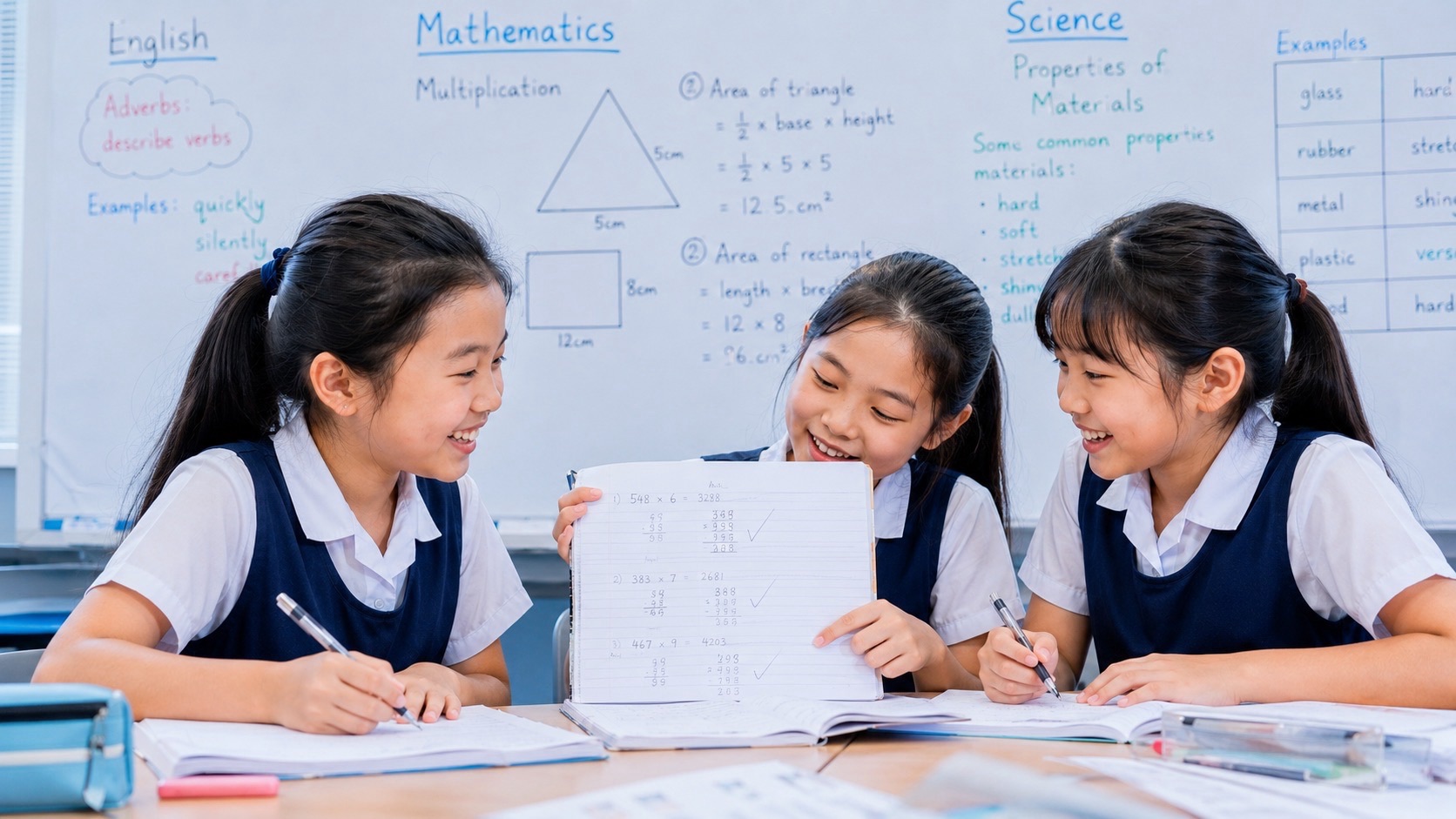
Primary 1 Mathematics tuition for Queenstown families should do more than help a child finish worksheets. At the beginning of formal primary Mathematics, the real task is to build a dependable system for number sense, place value, number bonds, addition and subtraction fluency, early multiplication and division ideas, model drawing, word problems, problem-solving, accuracy, conceptual understanding and diagnostic gap repair. Parents searching for P1 Maths tuition in Queenstown are often trying to answer a practical question: is the child simply adjusting to school, or is there a specific mathematical foundation that is already unstable? Good tuition makes that distinction visible early.
Singapore’s current MOE Primary Mathematics syllabus places mathematical problem solving at the centre of learning, with concepts, skills, processes, metacognition and attitudes working together. For a Primary 1 child, that means arithmetic speed is useful but cannot be the whole target. The learner needs to understand quantities, connect concrete objects to pictures and symbols, explain why a method works, choose a sensible representation and check whether an answer is reasonable. Fluency should reduce cognitive load, while conceptual understanding should provide a recovery route when memory is incomplete.
This Queenstown page is a local discovery route inside the existing eduKateSG Mathematics architecture, not a second national syllabus hub and not a claim that eduKateSG operates a physical branch in Queenstown. Families may search from Queenstown, Commonwealth, Queensway, Alexandra, Redhill, Dover or the wider city-fringe corridor, but the Mathematics remains the national curriculum. The broader Primary 1 Mathematics Tuition owner and the Mathematics Learning Hub remain the main curriculum routes; this page focuses on the P1 learner’s local discovery, diagnosis, repair and progression.
Why Primary 1 Mathematics Should Be Diagnosed Early
Primary 1 is forgiving in one sense and revealing in another. The numbers are still small enough for many children to obtain correct answers by counting every object or copying a familiar classroom method, so a weak strategy can remain hidden. Yet the year also reveals whether a child can connect quantity, language, representation and symbols. A learner who understands ten as a benchmark, can decompose numbers flexibly and can explain a simple comparison is building a system that later years can use. A learner who depends on one fixed worksheet layout may look secure until the surface form changes.
A useful tuition baseline therefore samples several kinds of evidence. Ask the child to compare quantities without counting one by one, explain the tens and ones in a two-digit number, solve a simple addition in more than one way, interpret a short word problem and check an answer using another relationship. The aim is not to create a mini-examination. It is to find the first point at which confidence, accuracy or understanding breaks. That first broken link is usually the most efficient place to teach.
Number Sense Comes Before Fast Calculation
Number sense is the child’s internal feel for quantity, order, size and relationship. At P1 it includes recognising small groups quickly, counting reliably, comparing sets, composing and decomposing numbers and using useful benchmarks such as five and ten. A child may know that 8 + 2 = 10 yet still lack strong number sense if the same relationship is not recognised on a ten-frame, a number line or inside a story. Tuition should therefore vary representation while preserving the underlying quantity.
Good number-sense questions often look simple. Which is closer to ten, seven or nine? If eight counters are rearranged, has the quantity changed? Can twelve be shown as ten and two, six and six, or seven and five? These questions reveal whether the learner sees structure or reconstructs every answer from scratch. When structure becomes visible, later arithmetic becomes faster for the right reason: the child is using relationships rather than rushing.
Subitising and Grouping Reduce Counting Load
Young learners often begin by counting every visible object. That is natural, but it should gradually become unnecessary for small structured groups. Subitising means recognising a small quantity without recounting each item. Ten-frames, dice patterns and grouped counters can help a child see five-and-two, four-and-four or ten-and-three as organised amounts. This frees working memory because the learner no longer has to rebuild every quantity from one.
The tutor should not simply demand that the child stop counting. Instead, make grouping obvious and ask what the learner notices. Show seven as five and two, then as four and three. Ask which arrangement is easier to recognise and why. Over time, the child learns that numbers can be seen as wholes made from useful parts. This is the conceptual beginning of mental arithmetic, number bonds and flexible calculation.
Number Bonds Build a Network, Not a List
Number bonds are often taught as pairs that make a whole, but their real value is relational. If a child knows that 7 and 3 make 10, the same relationship can support 10 – 7, 10 – 3, 17 + 3 and later regrouping. The goal is therefore not to memorise one diagram. The child should be able to move among objects, pictures, missing-number sentences and stories while preserving the same part-whole structure.
Practice should vary the unknown. Sometimes give the whole and ask for both parts. Sometimes give one part and the whole. Sometimes describe the relationship in words and ask the child to draw it. When a learner can reconstruct the bond rather than only recall a rehearsed picture, the knowledge becomes usable. That flexibility matters more than how quickly one worksheet page is completed.
Place Value: Tens and Ones Must Carry Meaning
Place value is one of the most important P1 foundations because almost every later written calculation depends on it. A two-digit number should mean something more than two symbols beside each other. Forty-three is four tens and three ones; it is also 40 + 3 and a point greater than 40 but less than 50. If the child understands only the spoken name, later regrouping can become a memorised procedure without meaning.
Use bundles, base-ten materials, drawings or simple place-value charts to make exchanges visible. Ten ones can be renamed as one ten without changing the total. A learner should be able to build a number, say it, write it, decompose it and compare it. If one of those forms breaks, the tutor has found a bridge that needs repair. Strong place value is less about a worksheet chapter and more about understanding how our number system is organised.
Zero Is a Place Holder with a Job
Children can become confused when zero appears inside a two-digit number because it seems to mean nothing while also changing the value of the other digit. Ten is not one; twenty is not two. Zero helps preserve the place structure. Even at P1, it is useful to discuss why 20 has two tens and no ones, and why writing 2 instead would describe a completely different quantity.
A simple diagnostic is to ask the learner to build 20, 23 and 30 with tens and ones, then explain what the zero is showing. If the child treats the zero as decorative, return to the quantity. The purpose is not to teach formal terminology too early; it is to make positional notation meaningful before larger numbers make the same weakness harder to see.
Addition Should Grow from Relationships
Primary 1 addition begins with combining quantities, but efficient addition grows from seeing relationships. A child who always counts all objects can still be accurate, yet that strategy becomes expensive as numbers grow. Counting on from the larger addend, making ten, using doubles and decomposing a number are all ways to preserve meaning while reducing effort.
For 8 + 5, one child may see 8 + 2 + 3 and another may know 8 + 4 = 12, then add one. The tutor should compare strategies rather than insist that one clever route fits every learner. What matters is that the child can explain why the total stays the same when numbers are reorganised. Explanation protects against empty trick-learning and gives the learner a method to reconstruct an answer when instant recall fails.
Subtraction Has More Than One Story
Subtraction can mean taking away, comparing two amounts or finding a missing part. These meanings should appear together because keyword rules are fragile. A child who thinks subtraction only means take away may struggle when a question asks how many more one person has than another. The arithmetic is simple; the relationship is what changed.
Use related stories with the same numbers. Twelve counters can lose five. Twelve and seven can be compared. Seven can be the known part of twelve with the other part missing. Ask the child what is known, what is unknown and what relationship connects them. When those questions become familiar, operation choice becomes an act of reasoning rather than a reaction to a single word.
Addition and Subtraction Should Check Each Other
Inverse relationships are an early form of mathematical checking. From 6 + 8 = 14, the learner can derive 14 – 6 = 8 and 14 – 8 = 6. This turns separate facts into a connected network and teaches the child that an answer can be verified from another direction. It is a powerful habit because later examination confidence depends partly on having ways to test one’s own work.
A tutor can deliberately ask how the answer could be proved without doing exactly the same calculation again. The child may use the inverse operation, a model or a story. This makes checking a mathematical action rather than a teacher instruction. Over time, self-checking should become more automatic, especially after an answer feels surprising or a question required several steps.
Arithmetic Fluency Is More Than Speed
Fluency combines accuracy, efficient strategy choice, flexible access and enough speed to protect working memory. A learner who answers rapidly but cannot explain or recover after one forgotten fact is less secure than the stopwatch suggests. Conversely, a child who is always accurate but reconstructs every basic fact from one may soon run out of cognitive capacity when word problems become denser.
Short retrieval practice works best when it is spaced and mixed. Revisit facts after a delay, change their order and occasionally ask how the child knew. The long-term target is that simple facts become easy to access while understanding remains available underneath. Speed should emerge from organised knowledge, not pressure.
Early Multiplication Starts with Equal Groups
Primary 1 does not need to become a multiplication-table race, but children can begin to recognise equal grouping. Three plates with two counters on each show a different structure from six counters scattered randomly. Repeated addition, arrays and equal groups prepare the idea that multiplication describes a relationship among number of groups, group size and total.
Ask the child to describe the same arrangement in several ways: three groups of two, two plus two plus two, six altogether. Then reverse the problem by giving the total and asking for equal groups. These experiences mean that when multiplication notation becomes more formal, the symbols have a conceptual history rather than appearing as an arbitrary new rule.
Early Division Needs Sharing and Grouping
Division also has two useful early meanings. Sharing asks how many each group receives when the number of groups is fixed. Grouping asks how many groups can be made when group size is fixed. Twelve counters shared among three children gives four each, while twelve counters arranged in groups of three gives four groups. The answer is numerically the same, but the unknown is different.
This distinction matters later in word problems. At P1, concrete materials make it visible without heavy terminology. Ask what is fixed, what must be found and what the answer represents. The child learns that operations describe relationships, not merely symbols on a page.
Mathematical Language Can Be a Hidden Bottleneck
Words such as more, fewer, altogether, difference, before, after, equal, longer, shorter, heavier and lighter carry mathematical meaning. A child can know the required calculation yet misunderstand the sentence. That is why a wrong word-problem answer should not automatically be labelled a weak-Maths problem. Sometimes the arithmetic is secure and the language bridge is the actual failure point.
Teach the child to restate the relationship in simpler language and identify each quantity. Avoid rigid keyword rules. Three more than and how many more both use the word more but place the unknown differently. Understanding the relationship is more durable than memorising a word-to-operation shortcut.
Word Problems Need a Stable Entry Routine
When a P1 learner freezes at a word problem, the first goal is not to supply the operation. Give the child a repeatable entry routine: read for the story, identify the known quantities, say what must be found, represent the relationship, choose a calculation and check the result against the story. A stable routine reduces the emotional cost of unfamiliar wording.
The tutor should vary surface details while keeping the same structure, then keep the surface familiar while changing the structure. This prevents the child from relying on one cue. Startability is an important measure of progress. A learner who can begin a new problem independently has gained more than one who can finish only after the tutor points to the method.
Model Drawing Should Clarify, Not Decorate
Simple bar models, boxes, number bonds, ten-frames and sketches can externalise relationships that are difficult to hold mentally. The representation should be economical. Every line or label should help answer a mathematical question. If the child copies a beautiful model after the teacher has already explained the solution, the picture may have little diagnostic value.
Build the representation from the language. Ask what each bar or box stands for and where the unknown belongs. Then ask whether another person could understand the relationship from the labels. If the child can explain the model, it is functioning as a reasoning tool. If not, simplify it and reconnect it to the story.
Knowing When Not to Draw a Model
A representation is a tool, not a compulsory ritual. Some P1 questions are clearer with a number bond; others need a quick bar or physical counters; some become obvious once number facts are fluent. The learner should gradually choose the simplest representation that preserves meaning. This is the beginning of strategic independence.
Over-scaffolding creates its own dependency. A child who believes every question requires a full bar model may spend more effort drawing than reasoning. The tutor should therefore fade tools as understanding strengthens while keeping them available for repair. Independence means the child can select, adapt and sometimes omit a representation.
Comparison Problems Need Direction
Comparison is a common early source of reversal errors. If Alicia has 9 stickers and Tricia has 4 fewer, the child must keep track of which quantity is larger and what the difference represents. A quick comparison bar or aligned set can make the direction visible. The arithmetic itself may be easy once the relationship is correctly represented.
Ask the learner to say the relationship in two ways: Alicia has five more than Tricia; Tricia has five fewer than Alicia. Being able to reverse the language without changing the mathematical relationship is strong evidence that the concept is understood. It also reduces dependence on keywords.
Measurement Builds Unit Sense
Length, mass and capacity introduce the idea that numbers describe attributes only when units and context are understood. A child should not merely read a ruler or identify a familiar measuring tool. The learner should estimate, measure, compare and decide whether the result is sensible. This begins the habit of reasonableness checking outside pure arithmetic.
Use ordinary objects. Which is longer before measuring? Which unit would be convenient? Why do we start from the same reference point? What changes if a different unit is used? These questions keep measurement conceptual and help the child see that a numerical answer without meaning can still be wrong.
Money Connects Number Value to Everyday Decisions
Money is useful because it makes number composition concrete. Two different collections of coins can have the same value, and more coins do not necessarily mean more money. This creates natural opportunities to discuss equivalence, number bonds, addition and subtraction without turning every real-life purchase into a formal lesson.
Ask the child to make the same amount in two ways, find how much more is needed to reach a target or compare two simple totals. The mathematical target remains the relationship. Context should make the numbers meaningful, not distract from the reasoning.
Time Requires Sequence as Well as Clock Reading
Children may learn to recognise a clock face before they understand sequence and duration. Time reasoning includes earlier and later, before and after, and the idea that events occupy intervals. Linking clock readings to familiar routines helps the child understand that the representation refers to the passage of time.
A useful task is to place simple events in order and explain which happens first. Another is to move forward or backward by a small interval on a timeline. The goal is to connect symbols, language and experience, just as place value connects written digits with quantity.
Shapes Should Be Classified by Properties
Geometry at P1 should move beyond recognising a familiar picture. A square remains a square when it is rotated; a triangle can look very different while still having three straight sides. Sorting and explaining are more revealing than naming alone because they force the learner to identify defining properties rather than rely on surface appearance.
Give the child shapes in unusual orientations and ask why each belongs to a group. Then ask whether two different sorting rules can both be valid. This develops precise mathematical language and the habit of looking beneath visual presentation, a habit that later supports more abstract reasoning.
Patterns Encourage Early Generalisation
Pattern work is useful when the child can state the rule rather than simply guess the next item. Repeating colour patterns, growing collections and simple number sequences all invite the learner to notice what stays the same and what changes. Describing the rule is the important step.
Ask the child to continue a pattern, explain it, then create a different pattern with the same rule. This separates the underlying relationship from one particular picture. That ability to preserve structure while changing surface form is an early form of generalisation.
Accuracy Needs Specific Error Labels
The word careless is too vague to repair. A wrong answer may come from misreading, operation choice, fact retrieval, copying, notation, units or failing to check. These errors require different responses. The tutor should identify the earliest point where valid reasoning became invalid and repair that point rather than simply marking the final answer wrong.
A small error vocabulary helps the child self-monitor. I read it wrongly suggests a different next step from I knew the method but copied 14 as 41. Over time, recurring patterns become visible. Accuracy improves when the learner can recognise and interrupt the error before a teacher does.
Diagnostic Gap Repair Should Follow the Failure
If a child cannot compare quantities reliably, more addition worksheets may be irrelevant. If the concept is secure with counters but breaks in symbols, the representational bridge needs work. If the learner explains the method clearly but retrieves basic facts too slowly, spaced fluency is the right intervention. Diagnosis prevents tuition from becoming undifferentiated practice.
After repair, use near transfer, then far transfer, then delayed recall. Change the numbers, context and layout. Return after several days. A correct answer immediately after correction proves only short-term success. Transfer shows whether the child can recognise the same mathematical structure independently.
Alicia: Accurate but Dependent on Counting
Alicia often obtains the correct answer, but she counts from one for almost every sum. Her marks therefore look stronger than her fluency. The tutor does not ban counting; instead, Alicia learns alternative structures such as counting on, making ten and using doubles. She names the strategy she used so that efficiency becomes visible rather than mysterious.
Over several lessons, the evidence to watch is not only speed. Does Alicia start from the larger addend? Can she see 9 + 6 as 10 + 5? Can she recover if one fact is forgotten? As her strategy network grows, arithmetic becomes quicker while remaining explainable.
Tricia: Arithmetic Is Strong but Word Problems Stall
Tricia answers direct addition and subtraction quickly but hesitates when the same arithmetic is embedded in language. More fact drilling would therefore miss the real problem. The tutor slows the entry stage and asks Tricia to identify the known quantities, unknown quantity and relationship before choosing an operation.
Mixed problem sets deliberately remove chapter cues. Tricia learns to sketch, compare and restate. Her progress is measured by whether she can begin unfamiliar questions without asking whether it is plus or minus. That independent start is a better sign of transfer than simply increasing the number of completed worksheets.
Kai Kai: Prompt-Dependence Looks Like Confidence
Kai Kai often appears successful because he answers after the tutor gives a small hint. The danger is that the hint has become part of his method. To build independence, the tutor replaces external prompts with an internal checklist: What do I know? What do I need? What relationship fits? What answer size is reasonable? How can I check?
Feedback is delayed gradually. Kai Kai completes one step, then one whole question, then a short set before review. When he makes an error, he first tries to classify and repair it. This is how examination confidence starts long before formal examinations: the learner develops a way to continue without immediate rescue.
What Three-Student Tuition Can Add
A three-student tutorial can preserve direct teacher visibility while allowing useful comparison of methods. One child may use a number bond, another a ten-frame, another a mental strategy. The tutor can ask the group which method is easiest to explain, most efficient or easiest to check. Seeing multiple valid routes develops flexibility.
The class remains useful only if the tutor observes each learner’s thinking. Identical wrong answers can have different causes. One child may misread the story while another forgets a fact. Small-group teaching becomes genuinely individualised when the evidence from each child changes the next task.
A 1.5-Hour P1 Lesson Needs Rhythm
A productive 1.5-hour lesson can begin with short retrieval, move into one concept or repair, then shift to guided practice, independent transfer and review. The sequence matters because children need both focused attention and variation. Long uninterrupted worksheet blocks can conceal when a learner has stopped reasoning and started imitating.
The final minutes should include one unfamiliar question, one explanation and one check. The tutor can record latency, prompting and error type rather than score alone. Across weeks, a useful trend is fewer prompts, faster retrieval, clearer working and better recovery after mistakes.
School Evidence at Primary 1
Primary 1 in Singapore is not organised around high-stakes weighted assessment, but there is still abundant evidence of learning. Classwork, teacher feedback, short checks, homework behaviour and oral explanation all show whether a child understands and can work independently. Tuition should use this evidence diagnostically instead of manufacturing unnecessary examination pressure.
A four-question probe can be more informative than forty repeated sums when each item tests a different relationship. One can test place value, one fact retrieval, one language interpretation and one checking habit. The point is to identify a teachable mechanism, repair it and see whether performance changes.
How to Read a Worksheet Without Overreading the Score
Two children can receive the same score for very different reasons. One may have a single fact slip and one copying error. Another may have guessed several answers correctly despite weak understanding. Looking only at the mark hides the teaching information contained in the child’s working, hesitation and explanation.
The tutor should note which questions were slow, which required prompts and which were correct for unstable reasons. Patterns across several pieces of work matter more than one isolated percentage. The aim is to see whether the same weak link is shrinking over time.
Home Practice Should Be Short and Purposeful
P1 home practice works best when it is low-friction. A few minutes of number bonds, a simple money conversation, reading the time before leaving home or explaining one word problem aloud can be enough. The goal is frequent contact with useful relationships, not exhaustion.
Parents can support thinking with neutral prompts: What do you know? What are you trying to find? Can you show it another way? Does that answer make sense? These questions help the child organise reasoning without supplying the operation. If the learner is truly stuck, returning to a concrete representation is often more useful than repeating the same verbal instruction.
Queenstown as a Local Discovery Context
Queenstown is a mature residential and school-travel corridor connected to Commonwealth, Queensway, Alexandra, Redhill, Dover and Buona Vista. Families may search by estate name, MRT route or nearby road, but those local terms are discovery signals rather than a different curriculum. The Mathematics is still the MOE Primary Mathematics system used nationally.
A local page should therefore answer the local search intent while sending curriculum questions back to the broad owners. That separation matters for readers and for search architecture. The Queenstown P1 page owns the combination of place and school stage; it does not try to replace the site’s general P1 Mathematics owner.
Preparing for Primary 2 Without Rushing Ahead
The strongest P1 preparation for P2 is not early exposure to every P2 chapter. It is dependable control of the foundations P2 will assume: quantity, tens and ones, number bonds, addition and subtraction relationships, early equal grouping, mathematical language, simple model use and checking. The learner should also be becoming less dependent on the tutor naming the method.
Transition checks should change the surface form. Reverse the unknown, remove a picture, add an irrelevant detail or ask for an explanation instead of an answer. If the child can reconstruct the relationship, the learning is ready to travel forward. If performance collapses, more transfer practice is needed before acceleration.
The Queenstown Mathematics Progression
Families who need the next stages can move to Primary 2 Mathematics Tuition | Queenstown and Primary 3 Mathematics Tuition | Queenstown. The existing local upper-primary route continues through Primary 4 Mathematics Tuition | Queenstown, Primary 5 Mathematics Tuition | Queenstown, Primary 6 Mathematics Tuition | Queenstown and PSLE Mathematics Tuition | Queenstown.
Older learners preparing for the national secondary certificate can use SEC Examination Mathematics Tuition | Queenstown. The Mathematics Learning Hub remains the broad map across levels. This local cluster extends that architecture rather than competing with it.
Metacognition: Teach the Child to Notice Their Own Thinking
At P1, metacognition can be very simple. The child does not need technical vocabulary; the useful habit is to notice what strategy was used and whether it worked. After a question, ask what the child did first, what helped, where the difficulty appeared and whether the same method would be chosen again. These questions turn invisible thinking into something the learner can improve.
A young child who can say that counting all was slow or making ten was easier is beginning to manage strategy choice. This matters because later Mathematics requires the learner to change method when the first attempt fails. Tuition should therefore make reflection short, concrete and connected to real work rather than adding another abstract lesson.
Reasonableness Should Become a Habit
Checking is stronger when it begins before the exact answer. If two groups are combined, the result should be larger than either group. If a small quantity is taken away, the answer should be smaller than the starting amount. These simple predictions let a P1 child detect answers that cannot be right even before an inverse operation is used.
The tutor can ask for an answer range instead of an exact estimate: should the result be less than ten, around ten or more than twenty? The language stays age-appropriate while the habit becomes powerful. Reasonableness protects against slips and teaches the learner that Mathematics includes judgement, not only calculation.
Writing Mathematics Clearly Helps Accuracy
Young learners sometimes know the Mathematics but lose track because numbers are crowded, symbols are reversed or working is scattered. Clear presentation should be taught as part of mathematical communication rather than as a cosmetic demand. One line should represent one relationship, labels should identify what a number means and enough space should be left to see the work.
Good layout reduces copying errors and makes checking easier. The tutor can model concise working, then ask the child to explain what each line records. As handwriting and notation become more stable, presentation can be simplified. The goal is not decorative work; it is a visible record that supports thinking and lets the learner find mistakes.
When a Child Says I Don’t Know
I don’t know can mean several things: the child did not understand the language, cannot remember a fact, cannot decide how to start, fears being wrong or has genuinely never met the idea. A useful tutor does not treat all five possibilities as the same. The next prompt should reveal which barrier is present rather than immediately providing the answer.
Ask the learner to point to the numbers, retell the story, show what is known with counters or choose between two representations. If one of these steps works, the tutor has narrowed the problem. Over time, the child also learns that being stuck is diagnosable. That reduces helplessness and makes persistence more practical.
Progress Should Be Measured by Transfer and Independence
A P1 learner may improve on familiar worksheets simply because the format has become predictable. Stronger evidence appears when the numbers, wording or representation change and the child can still identify the relationship. The tutor should therefore keep a small bank of transfer questions and revisit repaired ideas after a delay.
Independence is another important measure. Does the child begin without waiting for reassurance? Can a simple mistake be found and corrected? Can the learner explain why an answer makes sense? These behaviours often change before marks change dramatically, and they show that tuition is building control rather than dependence.
Conceptual Understanding Should Survive a Change of Representation
A P1 child may look secure with counters and become uncertain when the same relationship appears as a number sentence, or succeed on a worksheet and fail when the quantities are shown on a number line. That pattern tells the tutor the concept has not yet travelled across representations. Teaching should deliberately move concrete to pictorial to symbolic and sometimes back again, asking the child to explain what stayed the same.
This matters because school Mathematics constantly changes surface form. A number bond, bar, ten-frame and equation can all describe related ideas. The learner becomes more robust when the relationship is recognised before the preferred picture appears. Representation transfer is therefore a core part of conceptual understanding, not an optional enrichment activity.
A Good P1 Repair Plan Has an Exit Test
Every diagnostic repair should include a clear condition for moving on. If the target is place value, the child might need to build, read, decompose and compare two-digit numbers in several formats without prompting. If the target is word-problem entry, the child might need to identify knowns, unknown and relationship on three varied questions independently. An exit test prevents endless repetition.
The tutor can then reduce practice frequency while revisiting the skill later. If the learner still succeeds after spacing, the repair is likely durable. If performance falls apart, the concept returns to the active plan. This approach keeps tuition responsive and ensures that time is spent on the weaknesses that still matter.
Questions Parents Should Ask About P1 Mathematics Tuition
Ask how the tutor distinguishes a concept gap from a reading problem, retrieval weakness, notation problem or rushed execution error. Ask how number sense and place value are assessed, how arithmetic fluency is built without replacing understanding, how model drawing is introduced and how a repaired skill is retested after a delay.
Also ask what independence looks like. A child can appear strong when every question is heavily scaffolded. Better evidence is whether prompts reduce over time, whether the learner can explain a changed example, whether checking becomes self-initiated and whether an error can be recovered from without emotional collapse. Those behaviours are part of long-term examination confidence.
Official Curriculum Reference and Practical Endpoint
The official reference is the MOE Primary Mathematics Syllabus, updated October 2025. It places problem solving at the centre and describes learning through concepts, skills, processes, metacognition and attitudes. Tuition should reinforce that system rather than build a parallel collection of tricks.
For a Queenstown Primary 1 learner, the practical endpoint is simple to state and demanding to achieve: see the quantity, understand the relationship, choose a useful representation, calculate accurately, explain the choice and check the result. When those behaviours become increasingly independent, the child is not merely finishing P1 Mathematics. The child is building an operating system for the years ahead.