
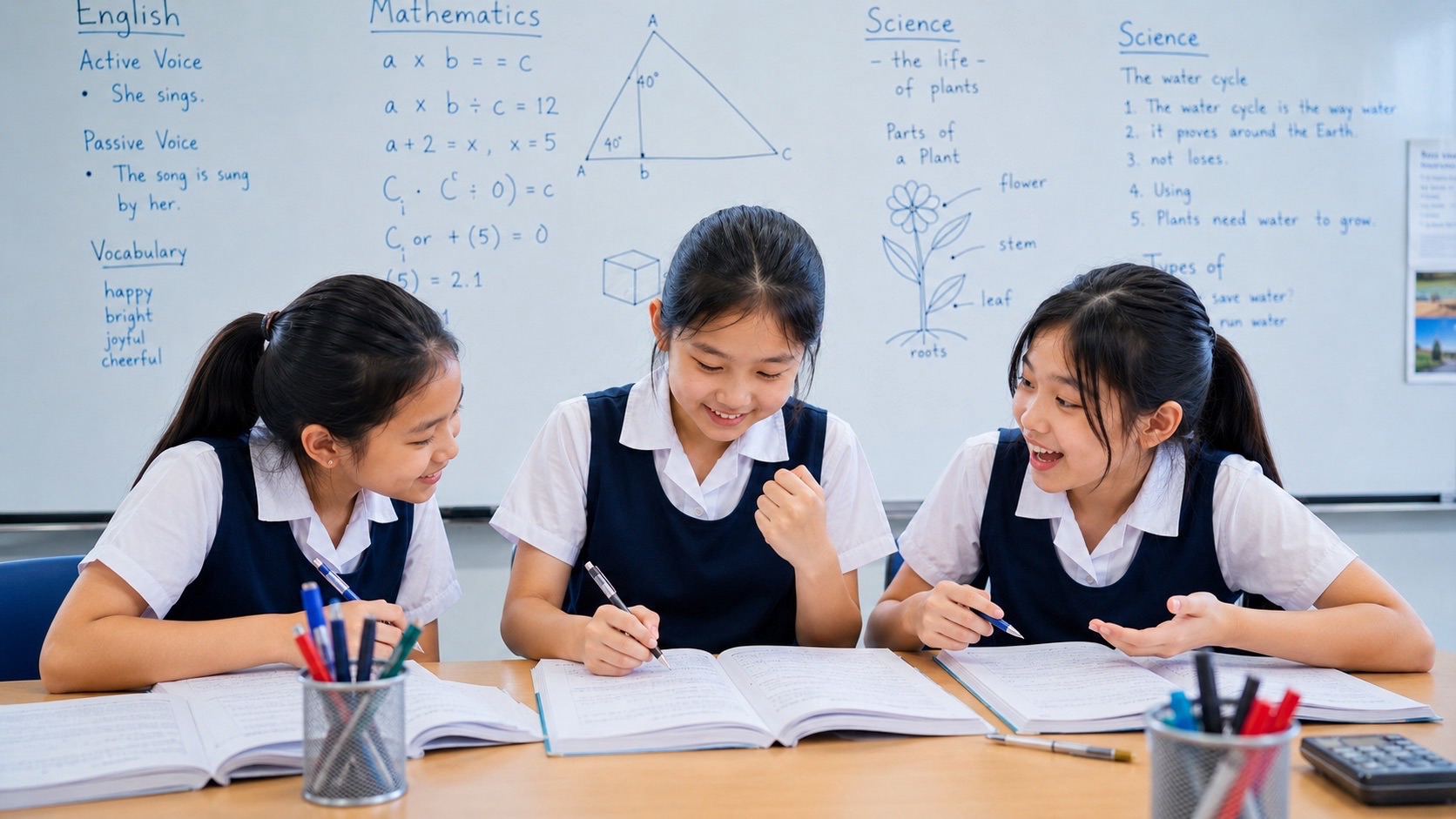
Primary 3 Mathematics Tuition | Queenstown is where the early-primary mathematical floor begins carrying a much heavier load. At eduKateSG, our small-group format keeps the class to a maximum of three students so the tutor can see where a learner’s reasoning first becomes unreliable and repair the actual dependency rather than simply assign more practice.
Primary 3 Mathematics in Queenstown is where the early-primary floor starts carrying noticeably more weight. Larger numbers, multiplication and division, fractions, measurement, geometry and multi-step problems begin interacting. A child can no longer rely on one recently demonstrated procedure. The learner must retrieve, select and combine.
This matters because Primary 3 is not just Primary 2 with larger numbers. The learner must retrieve earlier knowledge while handling new ideas, hold intermediate results in working memory, interpret less predictable wording and begin managing a test paper with more independence. The system becomes connected, which means one weak component can slow several topics at once.
Primary 3 Changes the Learning Load
By Primary 3, the child is expected to work with numbers to 10,000, strengthen multiplication and division, meet fractions more seriously, handle measurement and time with greater precision, distinguish area from perimeter, reason about geometry and read data. The current Singapore MOE Primary Mathematics syllabus frames these within the wider strands of Number and Algebra, Measurement and Geometry, and Statistics.
The important shift is not only content breadth. It is coordination. A learner may need to read carefully, choose an operation, retrieve a fact, keep an intermediate answer, convert a unit and then answer in a complete form. Each part may be individually simple while the combined task is difficult.
The Hidden Primary 3 Problem: Working Memory Gets Crowded
Working memory is the mental space used to hold information while doing something with it. Primary 3 begins to crowd that space. If multiplication facts are not available, the child spends attention reconstructing them. If written working is unclear, an intermediate value must be remembered mentally. If the question language is not fenced properly, irrelevant details compete with the mathematics.
Our response is not “try harder.” We reduce unnecessary mental load. Facts are retrieved more fluently. Diagrams externalise relationships. Written working stores intermediate results. Units are labelled. Problems are fenced. Checking routines catch predictable errors. This leaves more attention available for actual reasoning.
Why a 3-Pax Mathematics Tutorial Works Well for Queenstown Primary 3 Learners
Primary 3 learners are independent enough to compare methods and discuss reasoning, but misconceptions are still small enough to repair before they harden. A class of three gives us useful peer thinking without losing individual visibility.
The practical advantages
- Every student can explain a method and expose hidden assumptions.
- The tutor can identify whether a slow answer comes from weak facts, weak concepts, language or poor organisation.
- Mixed ability can be productive: one child repairs, one stabilises and one extends around the same core concept.
- Students see alternative methods and learn to compare efficiency rather than imitate one fixed route.
- Careless-looking errors can be classified before they become a permanent examination habit.
Queenstown families have access to many enrichment options, so we are careful not to confuse exposure with control. A child may have seen fractions or two-step problems early, but the useful question is whether the learner can explain the relationship, choose a representation and solve a changed version independently.
One Queenstown P3 learner may be fluent but careless, another may be careful but slow because multiplication facts are not yet automatic, and a third may understand concepts but struggle to organise written work. Those learners can sit in the same three-student lesson because the shared topic remains common while the intervention differs.
A Queenstown Primary 3 Mathematics Learning Map
For Queenstown parents, Primary 3 is an ideal year to convert early confidence into disciplined mathematical habits. We strengthen external working memory, error classification, retrieval after delay and interleaved method selection. These skills matter far more in upper primary than simply being a chapter ahead.
What We Teach in Primary 3 Mathematics
Numbers to 10,000
Larger numbers require secure place value, comparison, ordering and decomposition. We ask learners to move flexibly among standard form, expanded form and structured regrouping so the number system feels coherent rather than memorised digit by digit.
Addition and subtraction
The operations now interact with larger place values and more complicated word problems. Written methods should be accurate, but learners should also retain number sense so they can estimate whether an answer is plausible.
Multiplication facts
By Primary 3, multiplication facts need to become increasingly available. We build them through relationships—commutativity, doubles, known facts, arrays and fact families—so memory has structure.
Larger multiplication
When calculations extend beyond single facts, place value becomes central. We show how larger multiplication decomposes into familiar pieces instead of presenting a procedure as an unexplained sequence of marks.
Division and remainders
Division is connected to multiplication, grouping and sharing. Remainders are interpreted in context: sometimes they remain as a remainder, sometimes the situation requires another whole group, and sometimes the leftover itself matters.
Fractions
Fractions require children to reorganise whole-number intuition. A larger denominator does not automatically mean a larger fraction. The size of the whole matters. Equal parts matter. Numerator and denominator have different jobs. These concepts deserve visual and verbal grounding before symbolic fluency.
Measurement
Length, mass and volume are not just unit-conversion exercises. Learners must understand what quantity is being measured, choose or interpret units and decide whether an answer is reasonable.
Time
Clock reading, start time, end time and duration are related but distinct. We teach the child to identify the unknown before computing. Timelines can externalise the relationship when mental tracking becomes crowded.
Area and perimeter
Area measures the space inside a boundary; perimeter measures the boundary length. Because both may involve the same rectangle, children often mix them. We make the quantities physically and visually distinct before relying on formula-like routines.
Geometry
Geometry trains precise language, spatial reasoning and classification by properties. We encourage children to explain why a shape fits a category, not just recognise a familiar drawing.
Graphs and data
Reading data requires attention to labels, scale and comparison. We ask learners to distinguish information that is directly shown from conclusions that must be calculated or inferred.
Multiplication and Division Should Become One Relationship System
Multiplication and division are often taught in separate chapters, but the learner should eventually see them as one connected system. If 6 × 4 = 24, then 24 ÷ 6 = 4 and 24 ÷ 4 = 6. This relationship reduces memorisation load and improves problem recognition.
Fact families also provide a checking route. A child who multiplies can divide to verify, and a child who divides can multiply to confirm. The operations become tools that support one another.
Fractions: Whole-Number Intuition Must Be Reorganised
Whole numbers encourage the intuition that a larger numeral means more. Fractions complicate that. One eighth is smaller than one fourth even though eight is larger than four. The learner must understand that the denominator describes how many equal parts the whole has been divided into.
We use equal-sized wholes, fraction strips, diagrams and comparison language so the symbols remain attached to quantity. Once the structure is secure, symbolic comparison becomes much less arbitrary.
Equivalent Fractions: Different Symbols, Same Quantity
Equivalent fractions introduce a powerful mathematical idea: the representation can change while the quantity stays the same. Two fourths and one half look different symbolically but can represent the same amount. This is another invariant and an early preparation for more advanced algebraic thinking.
We want the learner to justify equivalence visually and numerically, not merely apply a multiplication rule to numerator and denominator.
Two-Step Word Problems: Find the Missing Middle
Many Primary 3 learners can perform both required operations but still fail a two-step problem because the intermediate quantity is invisible in the original wording. We teach them to name the missing middle. What must be known before the final question can be answered?
Once the intermediate quantity is identified, the problem becomes two connected one-step relationships instead of one overwhelming paragraph. Written working then stores the first result so working memory can move on.
Model Drawing as External Thinking
A good model is not decoration. It converts a verbal relationship into a visual structure that can be inspected. The child should know what each bar or segment stands for, why lengths are compared and which part is unknown.
We do not insist on a bar model when a simpler representation is clearer. The purpose of any model is to reduce ambiguity and support reasoning.
Problem Solving Without Keyword Dependence
By Primary 3, keyword shortcuts become increasingly dangerous. The same word can appear in several different structures. We teach learners to identify quantities, relationships and the unknown rather than hunt for one trigger word.
The Fencing Method helps by containing the relevant information: what is known, what is asked, what changes and what stays fixed. This also reduces errors caused by copying an irrelevant number into the calculation.
Written Working as External Memory
As questions become multi-step, written working stops being optional decoration. It becomes an external memory system. A clear line of working preserves intermediate values, units and method decisions so the child does not need to keep everything mentally active.
We therefore teach layout deliberately: one mathematical move per line when useful, labels where ambiguity exists, and enough structure that the learner can return to the work and understand it later.
Checking by a Different Route
Repeating the same calculation in the same way often reproduces the same mistake. We encourage a different checking route: estimate, use the inverse operation, compare with a model, substitute the answer back into the story or ask whether the magnitude makes sense.
Accuracy Is an Error-Control System
“Careless mistakes” are not one category. They include copying errors, operation-selection errors, place-value errors, unit errors, fact-retrieval errors, skipped steps and answer-statement errors. Once the type is named, a matching control can be trained.
Our First-Principles Teaching Method
1. Diagnose the first unreliable step
We locate where the solution first becomes unstable rather than focusing only on the final wrong answer.
2. Repair the smallest dependency
If multiplication facts are the problem, we repair facts. If fractions are visually understood but notation is weak, we repair notation. The smallest correct repair prevents unnecessary reteaching.
3. Use the Fencing Method
We identify the target, relevant quantities, relationships and expected result before calculation. This protects attention from irrelevant information.
4. Ask for explanation
Explanation exposes whether a correct answer came from understanding, guessing or imitation. The language need not be sophisticated, but the relationship should be coherent.
5. Retrieve after delay
A concept is revisited after time has passed so the child practises pulling it back without fresh demonstration.
6. Interleave
Different topics are mixed so method selection becomes part of the task. This is closer to real tests and real mathematical use.
7. Build age-appropriate time control
We do not turn P3 into a speed race, but children begin learning to notice when they are stuck too long, when an answer should be marked for return and when written organisation can save time.
Everyday Mathematics Examples for Queenstown
- Decompose a four-digit number in several ways and explain how regrouping changes the representation but not the value.
- Use fact families to move among multiplication and division instead of storing each equation separately.
- Represent equivalent fractions with diagrams before using notation.
- Calculate perimeter and area for the same rectangle and explain why the units differ.
- Write the result of the first step in a two-step problem as a named quantity before continuing.
What Happens During a 90-Minute Primary 3 Lesson
Cumulative retrieval
The lesson begins with previously learned facts and concepts so old knowledge stays available.
Current concept
New or current-school content is taught from the clearest dependency upward. We use diagrams, language and symbols as needed.
Guided application
Students solve representative questions with decreasing support while explaining key decisions.
Independent transfer
The child attempts a changed question without immediate rescue. This reveals whether the method has transferred.
Mixed practice
Different topics are combined to train recognition, retrieval and switching.
Correction
Errors are classified and corrected at the source, with an explicit check attached to recurring mistakes.
Continuation work
A small follow-up task keeps the lesson active between sessions without creating unnecessary worksheet volume.
Three Primary 3 Student Pathways
Repair
Repair may return to P1–P2 number sense, place value, addition, subtraction, multiplication facts, mathematical language or written organisation. We repair the dependency that is actually limiting P3 work.
Stabilise
The stabilisation pathway strengthens method choice, two-step structure, fractions, clear working, checking and cumulative retrieval.
Extend
Extension uses unfamiliar applications, multiple methods, richer fraction relationships, non-routine problems and explanation. Depth remains more valuable than rushing into later chapters without control.
Retrieval and Interleaving: A Chapter Is Not Learned When It Ends
Primary 3 is where chapter-by-chapter learning begins to fail if old knowledge is allowed to disappear. We deliberately bring earlier content back. The learner must retrieve multiplication during measurement, use place value during larger calculations and recall previous ideas during mixed problem solving.
How to Read a Primary 3 Test Paper
We teach children to scan instructions, notice units, distinguish direct questions from multi-step questions, show enough working and mark items that deserve a second look. Test control is not an exam trick; it is a way of allocating attention.
Teaching Ahead Towards Primary 4
We teach ahead when the P3 floor is secure. The purpose is to create headroom so school learning feels like a second encounter rather than an emergency first encounter. We do not trade away multiplication facts, fraction meaning or written control merely to claim syllabus acceleration.
What Progress Should Look Like
- Multiplication facts are increasingly retrievable without rebuilding each one.
- Division is connected to multiplication and interpreted correctly in context.
- Fractions are understood as quantities, not just numerator-and-denominator symbols.
- The child can identify and record the missing middle in two-step questions.
- Written working stores enough information to reduce mental overload.
- Old topics remain available during mixed practice.
- Errors are checked with specific routines rather than a vague instruction to be careful.
- The learner becomes more willing to attempt unfamiliar questions independently.
When Should a Queenstown Family Consider Primary 3 Mathematics Tuition?
Consider support when multiplication facts remain very effortful, division feels disconnected, fractions are confusing, two-step word problems collapse, written working is disorganised, test performance is much weaker than topical practice, or the child needs constant prompting to begin. Strong learners may also benefit when they need richer transfer rather than more routine repetition.
Planning Access from Queenstown to Sixth Avenue
Queenstown families have a practical west-side route to Sixth Avenue, but the schedule still needs to be sustainable. We prefer a child who arrives ready to think every week over one who is technically available but mentally depleted from a crowded afternoon.
Class Details
- Class size: up to 3 students.
- Lesson duration: 1.5 hours.
- Approach: diagnosis, first-principles concept repair, guided application, independent transfer, retrieval, interleaving and error control.
- Pacing: taught ahead of school when prerequisites are secure.
- Support: WhatsApp communication for parents and learning continuity.
- Long-term aim: build the capability for strong upper-primary and eventual PSLE Mathematics performance, including the possibility of AL1-level work, without promising grades.
- First step: a parent–student consultation rather than a generic trial lesson.
What Parents Can Bring to the Consultation
- Recent school worksheets or test papers showing actual working.
- Examples of two-step problems or fraction questions that caused difficulty.
- Teacher feedback about multiplication facts, problem solving, accuracy or independence.
- A short description of what happens when homework becomes difficult.
- Your practical weekly schedule so any tuition routine remains sustainable.
Frequently Asked Questions
Why is Primary 3 often harder than Primary 2?
The subject becomes denser. Children must retrieve more facts, coordinate more topics, handle fractions and multi-step problems, and keep more information active at once.
Should multiplication tables be fully memorised?
They should become increasingly fluent, but fluency should grow from meaning and relationships. A connected fact network is more durable than isolated chanting.
Why does my child do well in worksheets but poorly in tests?
Topical worksheets often reveal the method in advance. Tests mix topics and require retrieval, recognition, switching and time control. We train those separately.
Are bar models always required?
No. A representation is useful when it clarifies a relationship. We teach children to choose a helpful model rather than draw mechanically.
Should P3 students start P4 topics early?
Only after the P3 dependencies are stable. Headroom is useful; acceleration that hides weak facts or weak fractions is not.
How do you fix careless mistakes?
We classify the error type and attach a specific control: copy check, unit check, operation check, estimation, inverse check or layout improvement.
Do you give homework?
We use focused continuation and retrieval where it helps. We do not measure quality by the thickness of the worksheet stack.
Why travel from Queenstown for a three-student group?
Families should compare the practical travel cost with the value of close observation, specific diagnosis and individual pacing. The small-group format is most useful when those benefits match the child’s needs.
Can my child join midway through Primary 3?
Yes. We diagnose what is secure, what is unstable and what school is currently teaching, then build the sequence from the actual starting state.
Will tuition guarantee AL1 at PSLE?
No responsible tutor can guarantee a future grade. We can build the mathematical knowledge, reasoning, retrieval, error control and independence that make strong performance more achievable.
Helpful Reading for Queenstown Parents
- Mathematics Learning Hub | Primary, PSLE, Secondary, A-Math and JC Mathematics
- Singapore Mathematics Tuition by Area Index
- Primary 1 Mathematics Tuition | Queenstown
- Primary 2 Mathematics Tuition | Queenstown
- Primary 4 Mathematics Tuition | Queenstown
- Primary 5 Mathematics Tuition | Queenstown
- Primary 6 Mathematics Tuition | Queenstown
- How to be Good at Mathematics
- The Gold Standard of Mathematics
References
- Ministry of Education, Singapore — Primary Mathematics Syllabus
- Ministry of Education, Singapore — Education Conversations: assessment and learning direction
Primary 3 Mathematics Tuition for Queenstown Families
Primary 3 is where early Mathematics begins operating as a connected system. Multiplication supports division, number sense supports fractions, written working supports memory, and retrieval supports problem solving. When those connections strengthen, the learner becomes less dependent on hints and more capable of handling unfamiliar questions.
For Queenstown families considering eduKateSG, the goal is not merely to survive the Primary 3 jump. It is to use the year to build a stronger mathematical operating system before Primary 4 and the upper-primary PSLE runway.
Arrange a Parent–Student Consultation
A consultation lets us inspect the learner’s actual work, methods, errors and schedule before recommending a pathway. We prefer this to a generic trial because the useful first question is not whether the child can complete another lesson; it is where the mathematical system first becomes unreliable and what repair will create the most leverage.