
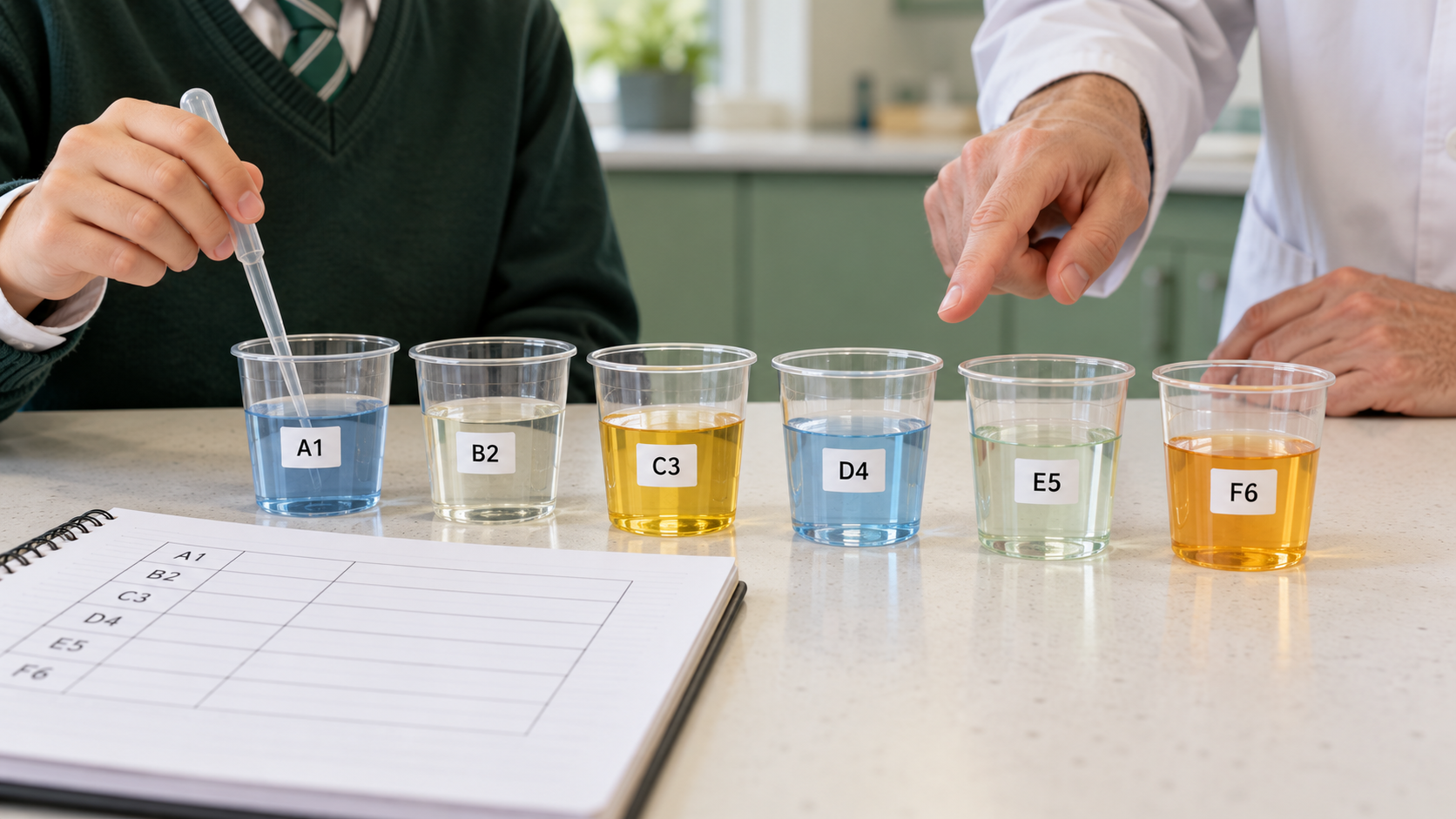
What is a fair test in Primary 4 Science? It is a comparison in which one intended factor changes while other relevant factors are kept the same, so the observed difference can be interpreted more confidently. A P4 student should recognise whether a comparison is fair, read observations with appropriate support, and explain what the data show. This guide uses shadows, temperature, plants and measuring cylinders to teach that reasoning.
The distinction between levels matters. In MOE’s Primary Science progression, pupils are expected by the end of P4 to recognise fair tests involving changed and unchanged variables. Designing a complete fair test independently is a later progression goal by P6. These P4 school-examination practice tasks emphasise identifying what changed, what stayed the same, what was recorded and what a result supports.
- Changed factor: what the investigation deliberately varies.
- Unchanged factors: important conditions kept comparable.
- Measured outcome: what the pupil observes or records.
- Evidence: numbers, drawings or notes collected from the investigation.
- Conclusion: what the evidence supports, without a claim stronger than the test.
- Worked practice: twelve comparison scenarios and sixteen short questions with solutions.
MOE Science enquiry skills at P4: the precise boundary
The official MOE Primary Science syllabus describes scientific enquiry through posing questions, investigating, analysing information, communicating evidence and using models. Its progression table distinguishes recognising a fair test at P4 from designing one at P6. It also expects P4 pupils to use senses and apparatus to collect data, investigate with guidance, record or compare observations with scaffolding, and perform simple analysis of information in representations such as charts and diagrams.
This is useful for parents choosing exercises. An age-appropriate P4 question might ask which of two setups is fair or what must be the same for a meaningful comparison. It might supply a partly completed table and ask for the trend. Requiring a ten-stage independent laboratory proposal with advanced vocabulary is not automatically a better assessment of P4 understanding.
The learning goal is not simply memorising the words ‘independent’, ‘dependent’ and ‘controlled’. It is seeing why a comparison fails when too many things change. The everyday explanation ‘I cannot tell whether it was the torch or the toy that caused the bigger shadow because both changed’ is the foundation of proper science.
Three things to identify in almost every investigation
1. The factor being changed
A question states: ‘A pupil moves a torch nearer a toy and compares shadow size.’ The intended changed factor is the distance between torch and toy. Not the torch colour, not the temperature of the room and not the size of the toy. If a student answers ‘the shadow’, the student has confused the outcome with the changed factor.
2. The relevant factors kept unchanged
For a shadow-size comparison, the pupil may keep the same toy, torch, screen, object-screen distance, lighting conditions and alignment. These controls reduce alternative explanations. They do not have to name every feature of the universe. The key is to identify conditions that could influence the result if altered.
3. The quantity being observed or measured
For the same investigation, the observed outcome is shadow size, for example shadow width in centimetres if width has been defined as the measurement. ‘Distance of torch from toy’ is what is changed; ‘shadow width’ is what is recorded. Children regularly swap these two because both appear as numbers in a table.
A compact template: change → keep → measure → conclude
Example question: Do closer torches create different-sized shadows? Change: distance from torch to toy. Keep the same: the toy, screen and toy-screen distance. Measure: the width of the shadow. Conclude: describe what the recorded widths show for the tested distances.
The template is for thinking, not a requirement to write four sentences on a one-mark question. Read the actual command word. If asked to ‘state one unchanged factor’, give one relevant control. If asked ‘why is this not a fair test?’, identify the extra changed factor and how it prevents a clear conclusion.
Experiment A — shadow size and a controlled change
Imagine a pupil has an LED torch, a cardboard figure and a sheet of white paper fixed to a screen. The figure is placed 20 cm from the screen. At three positions, the torch-to-figure distances are 10 cm, 20 cm and 30 cm. The pupil records shadow widths of 12 cm, 9 cm and 8 cm respectively. These are invented teaching data chosen to illustrate interpretation, not measurements that every torch will produce.
- 10 cm torch–figure distance → shadow width 12 cm.
- 20 cm torch–figure distance → shadow width 9 cm.
- 30 cm torch–figure distance → shadow width 8 cm.
- Changed factor: torch–figure distance.
- Recorded factor: shadow width.
- Unchanged example: figure–screen distance (20 cm).
What does the data show? In these three readings, the shadow became smaller as the torch moved farther from the figure. The values support that relationship within the tested setup. Do not claim that every light source, object and screen arrangement must give these exact widths.
Why does the setup matter? If the pupil also replaced the cardboard figure with a larger one at each trial, both figure size and distance would change. The data would no longer isolate the effect of distance. A fair-test question often hides precisely such a second change.
Experiment B — can a thermometer answer a heat question?
Imagine a closed classroom demonstration using two identical cups containing equal quantities of water at the same initial temperature. A teacher places them into environments with different temperatures while otherwise keeping relevant conditions the same. Temperature is recorded at equal time intervals. The pupil can investigate and describe the readings without handling boiling water or heated metal.
A fictional Cup A sequence is 22 °C at minute 0, 26 °C at minute 2, 29 °C at minute 4 and 31 °C at minute 6. Cup B is 22 °C, 23 °C, 24 °C and 25 °C at the same times. Observation: both increase, but A increases by more over six minutes. Possible explanation: if the setup says A is surrounded by a warmer environment, heat transfer from surroundings to water could produce the trend.
A thermometer measures temperature, not the total quantity of heat energy. The table alone does not prove every contributing cause. Pupils must use the stated experimental conditions and avoid claiming more than they can observe.
Experiment C — a misleading plant comparison
Plant A and Plant B are said to be similar at the start. Plant A has damaged roots and receives little water. Plant B has healthy roots and is watered adequately. At the end of a week, A wilts. Can the class conclude that the different root conditions alone caused the difference?
No. The amount of water also changed. To compare the effect of root condition, the plants should receive a comparable amount of water and other relevant growing conditions should be similar. Even a well-planned comparison gives evidence about the tested plants and conditions; it does not prove that every wilted plant has damaged roots.
This kind of question tests both the plant concept and the logic of a fair comparison. A child who can recite ‘roots absorb water’ but ignores the unequal watering may select an unjustified answer. Train the child to ask whether the experiment really tests what the question says it does.
Experiment D — measuring the volume of irregular solids
A measuring cylinder reads 42 mL before a suitable stone is fully submerged and 58 mL afterwards. The water volume displaced is 16 mL. The stone’s volume is therefore 16 cm³, assuming it is fully submerged and no water is lost. If the student writes 58 mL, they have copied a reading instead of calculating the change.
Now suppose a second stone is placed into a different cylinder with a different initial water amount. Can the pupil compare the stones by their final water levels alone? No. They must calculate the change in each cylinder. The starting levels may differ even when the stones have the same volume.
Reading tables: four steps before writing a conclusion
- Read the title and column headings. A column might give time, temperature, shadow width or water level. Do not silently substitute another quantity.
- Read units. 20 cm, 20 mL and 20 °C are different observations and require different interpretations.
- Describe the pattern using all readings. Look for increasing, decreasing, unchanged or irregular changes. Do not assume a trend after seeing just the first and last values.
- State only the conclusion supported. If data show a shadow became larger across tested distances, do not add ‘all shadows always behave this way’ unless a general principle and its conditions justify it.
Reading graphs without turning simple Science into advanced Mathematics
A bar chart may compare categories such as paper types or different objects. A line graph may show a measured change over time, such as temperature readings. At P4, the essential skill is recognising what the axes and markings represent and reading the values accurately. Graphical representation may be supplied with scaffolding rather than demanding a sophisticated graph-design exercise.
A useful routine is title → labels → units → points → pattern. For a temperature-time graph, first identify that the horizontal axis is time and the vertical axis is temperature. Then read two known values before predicting the direction. A sloping line does not automatically reveal the cause of change unless the experiment supplies the relevant context.
Twelve common fair-test scenarios and how to decide
1. Two shadows, two toys
Situation: A pupil changes both toy size and torch distance. Is the comparison fair for testing distance alone? Reasoned answer: No. Different toy sizes may influence shadow width; use the same toy.
2. One torch, fixed toy
Situation: The same toy stays fixed while the torch is placed at several measured distances. Is this a better comparison? Reasoned answer: Yes, if other relevant conditions such as screen position and alignment also remain comparable.
3. Same water, different cup
Situation: Equal amounts of water are placed in cups of different shapes to compare liquid shape. What is kept the same? Reasoned answer: The volume of water. The container shape is the change under investigation.
4. Different starting water levels
Situation: Two stones are submerged in cylinders with different initial readings. Can final readings alone compare volumes? Reasoned answer: No. Compare each stone’s water displacement.
5. Damaged roots, unequal watering
Situation: One plant has damaged roots but also receives less water. Can the wilting be blamed on roots alone? Reasoned answer: No. Two relevant conditions changed.
6. Leaf removal
Situation: Similar plants receive comparable light, water and soil conditions; leaves are removed from only one. What is changed? Reasoned answer: The leaf condition or amount of leaf area, depending on the description.
7. Lamp swap
Situation: A torch is replaced with a stronger lamp while its distance also changes. Can shadow size be attributed only to distance? Reasoned answer: Not reliably; the source changed as well.
8. Two thermometers
Situation: Two thermometers have different scales. What must a reader check? Reasoned answer: The scale interval and units before comparing readings.
9. Spoon materials
Situation: A teacher compares one metal spoon and one wooden spoon in a demonstration. What else should be considered? Reasoned answer: Relevant conditions such as spoon size, initial temperature, immersion depth and time may affect a fair comparison.
10. Graph without labels
Situation: A line rises but neither axis is named. Can a child confidently say what increased? Reasoned answer: No. The graph lacks information needed to identify the measured quantity.
11. One observation only
Situation: A pupil sees one wilted plant and claims all plants wilt only because their roots are damaged. Is the claim justified? Reasoned answer: No. The observation does not exclude other causes.
12. Repeated readings
Situation: A teacher repeats a temperature reading under the same defined conditions. What does repetition help with? Reasoned answer: It provides more evidence and may help detect inconsistent readings; it cannot fix a comparison where two intended factors changed.
Sixteen original exam-style short questions
- 1. A class tests whether changing the torch’s distance affects shadow width. Name the factor changed. Answer: Torch-to-object distance.
- 2. State one factor that can be kept unchanged in this shadow comparison. Answer: The same object, or the object-screen distance, or the same torch, as appropriate to the setup.
- 3. Which quantity should be measured to compare shadow sizes? Answer: A defined measure such as shadow width in centimetres.
- 4. Why is it unfair to use one small toy and one large toy while changing distance? Answer: The two factors both affect the possible outcome, so the effect of distance alone cannot be isolated.
- 5. A student records 15 cm, 12 cm and 10 cm for shadow width at successive torch positions. Describe the pattern. Answer: Shadow width decreased across the three measurements.
- 6. A temperature rises from 24 °C to 31 °C. State the observed change. Answer: It increased by 7 °C.
- 7. A table gives 20 °C, 24 °C, 27 °C and 29 °C at equal intervals. Did temperature increase by the same amount each time? Answer: No. The successive rises were 4 °C, 3 °C and 2 °C.
- 8. A child says ‘hotter water always contains more heat energy than cooler water’ based only on temperature. What is missing? Answer: Temperature alone does not establish a full comparison of energy quantities; amount of material and other factors matter.
- 9. Why should a comparison of water in two cups state the starting volume? Answer: Different water quantities could affect the observed result and make the comparison less informative.
- 10. One plant has damaged roots and receives less water; another has healthy roots and receives more. Which additional difference spoils the root-only comparison? Answer: The amount of water supplied.
- 11. What observation would a plant investigation record if studying growth? Answer: A defined measure such as height over time, with appropriate units.
- 12. Which plant part’s function may be reduced if many leaves are removed? Answer: The leaves’ food-making function.
- 13. A cylinder reads 50 mL before immersion and 63 mL after. Calculate the object’s volume. Answer: 13 mL, equivalent to 13 cm³.
- 14. Why is ‘final water level’ not always the same as ‘object volume’? Answer: The initial water level must be subtracted; the total includes water already in the cylinder.
- 15. A graph rises as time increases. Can you infer what is rising if the vertical axis is unlabelled? Answer: Not reliably. The measured quantity is unidentified.
- 16. A pupil reports a result opposite to the prediction. Should the result be erased? Answer: No. Record observations honestly, check the method and data, and explain the evidence without fabricating agreement.
Correcting three common mistakes that hide inside good-looking answers
Mistake 1: a control is named, but it is not relevant
A child investigating the effect of torch distance writes, ‘Keep the colour of the student’s socks the same.’ This is technically an unchanged feature but does not help make the shadow comparison fair. A better response names a factor that could influence the shadow, such as using the same toy or keeping the screen position unchanged.
Mistake 2: the conclusion repeats the last reading
‘Shadow width is 8 cm’ is an observation. ‘The shadow became narrower across the tested torch positions’ is a comparison. The examiner may ask for one or the other. A clear conclusion uses the pattern to address the investigable question without exceeding the data.
Mistake 3: the pupil uses a prediction as if it were measured
If a child predicts a shadow will get smaller but the table is not yet supplied, they cannot write ‘the experiment proved it got smaller’. A prediction is an expectation; a result is recorded evidence. Teach those categories separately. They are useful far beyond examinations when evaluating claims on social media or in advertising.
A seven-day mini-plan to master scientific investigation questions
- Day 1: identify what is changed and what is measured in five short scenarios.
- Day 2: highlight the additional changed factor in five unfair comparisons.
- Day 3: use a simple three-column table to read changes in shadow widths or temperature.
- Day 4: practise measurement differences using two water-displacement examples.
- Day 5: draw a simple bar or line display from a supplied, clearly labelled dataset with adult or teacher guidance.
- Day 6: write one observation and one supported conclusion from each of three given tables.
- Day 7: redo the original problems with changed numbers and objects. Make the child explain the fair-test rule without being prompted.
Home experiments should be low-risk and honest
For an at-home P4 Science investigation, a small LED torch, paper screen and cardboard shape allow meaningful shadow observations without hot liquids or electricity projects. Work on a flat surface, avoid pointing the light at eyes, and keep the set-up stable. A plant-observation diary can develop careful recording without pulling roots out or damaging living things.
Do not ask primary-school children to handle boiling water, heated metal, flame, laboratory chemicals or mains electrical circuits for revision. When a curriculum example refers to such conditions, a teacher-controlled demonstration, diagram or supplied dataset is enough to practise the reasoning.
Frequently asked questions
Must P4 pupils independently design full experiments?
The official MOE progression says pupils should recognise fair tests involving changed and unchanged variables by the end of P4; designing a fair test is a P6 progression outcome. Individual schools can introduce guided design tasks earlier, so follow what the teacher has taught and specified.
Will tables, graphs and experiments appear in every school’s exam?
The syllabus values enquiry and interpretation, but no universal P4 question distribution is published for every school. Practise these skills because they support scientific understanding, not because a specific number of questions is guaranteed.
What is the simplest way to tell a changed factor from an outcome?
Ask: ‘What did the pupil deliberately alter?’ Then ask: ‘What did the pupil observe or measure after that change?’ In the shadow experiment, torch distance is changed; shadow width is measured.
Should a child calculate an average for every experiment?
No. The question and learning objective determine which calculation is needed. At P4, read the supplied information and use basic arithmetic only where it adds to a correct answer. Do not impose advanced statistical treatment on every task.
Are these official exam questions for 2027?
No. The examples are original teaching materials. P4 is assessed within each school; there is no SEAB-set nationwide Primary 4 Science examination.
Read next: Science enquiry, answers and topics
- eduKate: scientific investigation across primary levels, variables and safety
- P4 Science MCQ strategies and 20 practice questions
- P4 open-ended answer techniques
- Heat and Light: interpreting shadows and thermometer readings
- MOE official Science syllabus and process-skills progression
- SEAB: national PSLE information
The larger lesson is useful outside school: if a claim says one change caused an outcome, ask what else changed. In Science tutorials, we help pupils build that habit by distinguishing observation from explanation and isolating the first reasoning error. See eduKateSG Primary Science support for the current programme route.
Editorial note (November 2026): All exercises and experimental values are fictional or original illustrations. They align with the MOE 2023 Primary Science framework. No experimental figure is claimed to be an official benchmark, and school instructions govern each P4 assessment.