
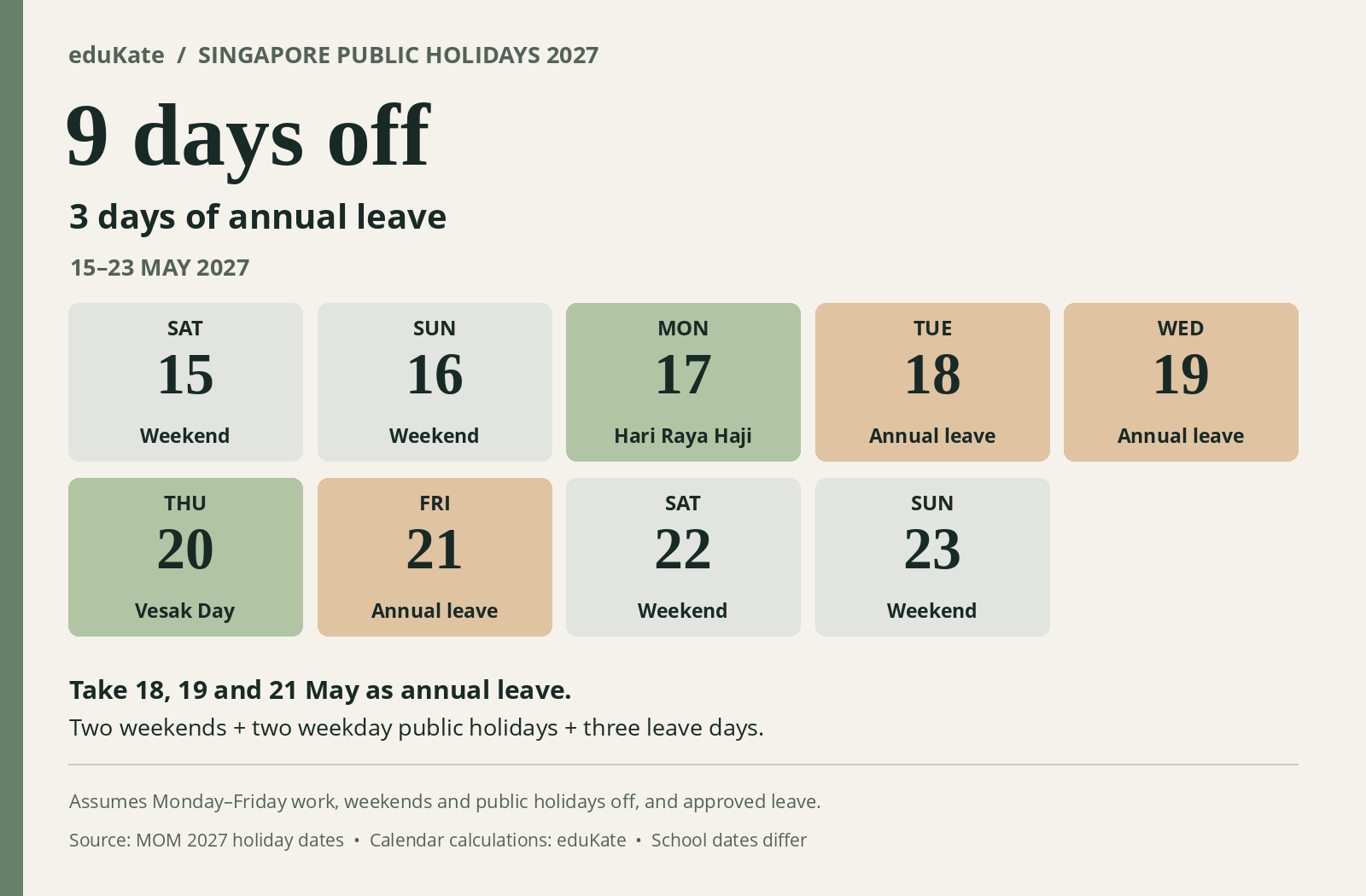
Take Tuesday 18, Wednesday 19 and Friday 21 May 2027 as annual leave to get nine consecutive days off, from Saturday 15 to Sunday 23 May. Hari Raya Haji falls on Monday 17 May and Vesak Day on Thursday 20 May. Together with the two weekends, those holidays turn three approved leave days into a complete Saturday-to-Sunday break for someone who normally works Monday to Friday.
This guide uses the Ministry of Manpower’s official 2027 public holiday dates and our own calendar calculations. It assumes weekends off, Sunday as the rest day and the listed public holidays observed. You can spend all nine days away, usually needing eight hotel nights, or travel for seven days and keep two days at home. Parents should check the school section first: the efficient May window falls within the MOE school term.
- Best leave-saving nine-day window under these assumptions: Saturday 15–Sunday 23 May 2027.
- Annual leave to request: Tuesday 18 May, Wednesday 19 May and Friday 21 May; three days per working adult.
- Exact calculation: four weekend days + two weekday public holidays + three annual leave days = nine different calendar days.
- Other useful windows: Chinese New Year, Hari Raya Puasa, Good Friday, National Day and Deepavali can support nine-day breaks using four leave days.
- School-friendly alternative: 13–21 March fits the published March vacation and requires five adult leave days under the same work pattern.
- Trip choices: nine days and eight nights away, or seven days and six nights away followed by two days at home.
Singapore planning guide · Dates and leave calculations checked 8 November 2026 · Leave counts assume Monday–Friday work, weekends and relevant public holidays off, Sunday as the rest day, and approved annual leave.
Plan your 9-day getaway
Start with the decision you need to make, then use the chapter links to continue.
Full contents · Complete Singapore 2027 public-holiday calendar
Contents
Chapters 1–4 · Dates, leave and school calendars
Chapters 5–9 · Nights, itinerary and destinations
Chapters 10–13 · Budget, travel, booking and questions
The May arrangement works because two public holidays sit inside the same working week. You bridge Tuesday, Wednesday and Friday with annual leave, while the weekends provide the four days around that week.
| Date in 2027 | Why you are off | Annual leave used |
|---|---|---|
| Saturday 15 May | Normal weekend non-working day | 0 days |
| Sunday 16 May | Normal weekend rest day | 0 days |
| Monday 17 May | Hari Raya Haji public holiday | 0 days |
| Tuesday 18 May | Approved annual leave | 1 day |
| Wednesday 19 May | Approved annual leave | 1 day |
| Thursday 20 May | Vesak Day public holiday | 0 days |
| Friday 21 May | Approved annual leave | 1 day |
| Saturday 22 May | Normal weekend non-working day | 0 days |
| Sunday 23 May | Normal weekend rest day | 0 days |
The result is 4 weekend days + 2 public holidays + 3 annual leave days = 9 consecutive days off. Each date appears once. You finish the preceding working week on Friday 14 May and resume your usual working pattern on Monday 24 May.
Why this window is unusually efficient
A normal Saturday-to-Sunday nine-day break contains five weekdays. Without a weekday public holiday, all five usually require annual leave. One weekday public holiday reduces that to four leave days. In this May week, two weekday holidays reduce it to three.
This is a calendar advantage under the stated assumptions, not a guarantee that every employee can take those dates. A different roster, required holiday work or an agreed substitute holiday changes the calculation. Confirm what is recorded in your own work calendar before buying travel.
Count the leave for each person
Three leave days applies separately to each working adult. Two adults with the same schedule each need approval for three days, making six employee-leave days across their workplaces. One person’s approval does not confirm the other person’s availability.
May offers the lowest annual leave count among the standard nine-day windows in this comparison. Other dates can work better for your household, the experience you want or the prices available when you book. All windows below run from Saturday to the following Sunday, inclusive.
| Nine-day window in 2027 | Relevant weekday holiday | Annual leave dates | Leave days |
|---|---|---|---|
| 6–14 February | Monday 8 February, Chinese New Year observed | 9, 10, 11 and 12 February | 4 |
| 6–14 March | Wednesday 10 March, Hari Raya Puasa | 8, 9, 11 and 12 March | 4 |
| 20–28 March | Friday 26 March, Good Friday | 22, 23, 24 and 25 March | 4 |
| 15–23 May | Monday 17 May and Thursday 20 May | 18, 19 and 21 May | 3 |
| 7–15 August | Monday 9 August, National Day | 10, 11, 12 and 13 August | 4 |
| 23–31 October | Thursday 28 October, Deepavali | 25, 26, 27 and 29 October | 4 |
| 13–21 March: school-vacation option | No weekday public holiday in this window | 15, 16, 17, 18 and 19 March | 5 |
| 29 May–6 June: school-vacation option | No weekday public holiday in this window | 31 May and 1, 2, 3 and 4 June | 5 |
These are our calculations from the MOM dates. The final two rows are included for families comparing adult leave efficiency with school availability; the school dates should also be checked against the child’s own notices.
Compare the complete trip
Keep two suitable windows while researching. For each, price the return journey, eight accommodation nights and the main costs you cannot avoid. Compare the same number of travellers, luggage needs and room arrangements. Otherwise a cheaper-looking option may simply include less.
Give each window a short explanation: “best use of leave”, “fits the children’s vacation” or “fits a family commitment”. This makes the choice easier when the lowest leave count and the best overall trip point to different dates.
Be careful with calendars from a different year. Vesak Day in 2027 is 20 May. It does not reduce the five ordinary working days inside the later 29 May–6 June window.
Chinese New Year shows why overlapping days need care. Saturday 6 and Sunday 7 February are already weekend days in this calculation. Monday 8 February provides the weekday holiday. You still need leave on 9–12 February for the nine-day break. Any separately agreed compensation for the Saturday holiday must be confirmed before you add it to the plan.
The simplest May request names Tuesday 18, Wednesday 19 and Friday 21 May. Monday and Thursday are already public holidays under the assumptions used here. If your leave system asks for individual dates, check that the deduction totals three days.
A message you can adapt
I would like to request annual leave on Tuesday 18, Wednesday 19 and Friday 21 May 2027. With the public holidays on Monday 17 and Thursday 20 May, I would be away through that working week and return on Monday 24 May. Please let me know the cover and handover arrangements needed before the leave is confirmed.
Adapt the wording to your actual workplace. The dates are a proposal until approved. If colleagues also want that week, discuss alternatives early enough for the team to make a workable arrangement.
Make the return date part of the plan
Record what needs completing before Friday 14 May, who will handle time-sensitive matters and what can wait until your return. Keep the handover proportional to the work. A short, clear note covering decisions and responsibilities is often more useful than an unsorted collection of messages.
Check whether the intended return journey lets you resume work on Monday 24 May. A service departing overseas on Sunday may arrive in Singapore on Monday. Read both dates before treating it as a nine-day trip.
Saturday compensation is a separate question
MOM’s guidance distinguishes a non-working day from a rest day. For employees covered by the Employment Act, a public holiday on a non-working day entitles them to another day off or salary in lieu; a holiday on a rest day makes the following working day a paid holiday.
Do not insert an extra Monday into your itinerary solely because another holiday falls on Saturday. Use a compensation day only when the employer has confirmed the actual arrangement. The May calculation above does not depend on a Saturday compensation day.
Recalculate if you work Saturdays
For an illustrative six-day working week, with Saturday as an ordinary working day and Sunday off, the same 15–23 May break has five working dates to cover: Saturday 15, Tuesday 18, Wednesday 19, Friday 21 and Saturday 22 May. The two public holidays remain free under that assumption, but the two Saturdays no longer provide free weekend days.
Check how your employer records leave for full or partial working days. The useful method is to mark each scheduled shift in the intended break, remove the holidays you actually observe, and identify the remaining work to cover. Use your real roster when it differs from the article’s main example.
The May shortcut is especially attractive for adults, but it overlaps the school term. The 2027 MOE dates published by Changkat Primary School place Term 2 from 22 March to 28 May, with the mid-year vacation beginning on Saturday 29 May.
Tuesday 18, Wednesday 19 and Friday 21 May therefore sit within the term. A parent’s approved annual leave does not turn those dates into school holidays. Plan around the child’s attendance requirements and commitments before making a family booking.
Two nine-day choices inside school vacations
For schools using the published dates, Saturday 13–Sunday 21 March fits the March vacation. A Monday-to-Friday worker needs annual leave on 15–19 March: five days. Saturday 29 May–Sunday 6 June sits within the mid-year vacation and needs leave on 31 May and 1–4 June, also five days.
These options use two more annual leave days than the May shortcut. That can be a worthwhile trade when the household needs the trip to fit the children’s school calendar. Compare them on that basis rather than treating the larger leave count as a planning failure.
School-only closures do not automatically cover the whole trip
Tuesday 9 February is a designated school day off in lieu, and Tuesday 10 August is the scheduled school holiday after National Day. Those closures help with specific dates. They do not make every weekday in the nine-day Chinese New Year or National Day windows a school holiday.
The MOE calendar is the starting point; the child’s own school and cohort notices complete the picture. Check assessments, camps, activities and any attendance requirements. Siblings at different institutions may have different free dates.
Build one household calendar
Give each traveller a row and each proposed travel date a column. Mark confirmed school closure, approved adult leave, ordinary work or school, and unresolved commitments. Settle the unresolved dates before a non-refundable purchase. This also helps you plan childcare if one adult returns to work before everyone else.
A conventional trip beginning on Saturday 15 May and ending on Sunday 23 May uses eight hotel nights: the nights of 15, 16, 17, 18, 19, 20, 21 and 22 May. Check out on Sunday 23 May. Count the nights on a calendar before comparing packages.
The two journey days still count
Arrival on Day 1 and departure on Day 9 leave seven middle days. Those are the days you can plan with the most confidence once you know the local travel arrangements. Treat the first and last days as partial destination days until the transport times are confirmed.
An overnight flight can change that pattern. You may arrive at the destination on Day 2, or arrive home on Day 10. An advertised nine-day package can also describe dates differently from your approved leave. Check the actual itinerary against the dates you must be free.
Confirm when the room is available
An early arrival does not necessarily give you early access to the room. A late departure does not automatically extend the checkout time. Ask about luggage storage, room access or an extra night if those arrangements materially affect the trip.
For two bases, the total still needs to equal eight nights. Four nights in the first base and four in the second is one straightforward split. Three plus five can work when one place has more of the experiences you want. Record the accommodation address for every night so that a transfer day does not create a gap or duplicate booking.
Agree what the seven middle days are for
List a few priorities before choosing every attraction: perhaps two cultural days, one outdoor day, time with relatives, a relaxed day and room to revisit somewhere. Leave space for the ordinary parts of travel, including meals, laundry and getting around. A longer break becomes easier to enjoy when it has a manageable rhythm.
This is an illustrative structure for 15–23 May, not a fixed tour or a claim about attraction availability. It can support one base or a single change of base. Check opening arrangements and transport details for the actual destination.
| Day and date | Suggested purpose | Keep the plan practical |
|---|---|---|
| Day 1: Saturday 15 May | Travel, settle in and explore close to the accommodation. | Make the first meal and the route back to your accommodation easy. |
| Day 2: Sunday 16 May | Enjoy the main reason you chose the destination. | Allow time around the experience instead of filling every hour. |
| Day 3: Monday 17 May | Explore a second interest or neighbourhood. | The Singapore public holiday does not determine local opening hours. |
| Day 4: Tuesday 18 May | Take a wider outing or a deeper visit. | Check the full outward and return journey before committing. |
| Day 5: Wednesday 19 May | Keep a slower day, or transfer once to a second base. | A transfer needs time for packing, checkout, travel and check-in. |
| Day 6: Thursday 20 May | Choose another main experience. | Check the operator’s actual calendar; Vesak Day in Singapore is separate. |
| Day 7: Friday 21 May | Follow a personal interest or revisit a favourite place. | Allow separate preferences if the group wants different activities. |
| Day 8: Saturday 22 May | Use a flexible final full day. | Leave enough time to prepare for the next day’s journey. |
| Day 9: Sunday 23 May | Return home. | Check the arrival date in Singapore and the onward journey home. |
Choose a few firm bookings
Identify the experiences that would make the trip worthwhile and check whether they need advance reservations. Place those into the calendar first. Fill the nearby time with shorter, easier activities. This helps the itinerary reflect what you care about, while keeping movement between places reasonable.
Keep at least one day adjustable
An adjustable day can absorb a postponed outing, accommodate someone who wants a slower pace or let you return to a place you enjoyed. Have an indoor or sheltered alternative where relevant. Check cancellation and change conditions before assuming a paid activity can move.
Use the middle for ordinary needs
On a nine-day trip, practical tasks such as laundry and replenishing essentials deserve a place in the plan. Ask what facilities the accommodation actually provides. A short pause halfway through can make the second part of the trip feel more comfortable.
If you change bases on Day 5, avoid making that day depend on a tightly timed main attraction at the destination. Settle the journey first and add an activity only when the available time is clear.
You do not need to travel for every day of the nine-day break. A seven-day trip from Saturday 15 to Friday 21 May can leave Saturday 22 and Sunday 23 May at home, while using the same three annual leave days.
| Part of the break | Dates | What to arrange |
|---|---|---|
| Seven days travelling | 15–21 May | For a conventional stay, six hotel nights: 15–20 May. |
| First home day | Saturday 22 May | Keep time for rest, laundry and anything that needs doing. |
| Second home day | Sunday 23 May | Prepare for the coming week without another major journey. |
| Return to the usual work pattern | Monday 24 May | Confirm the work handover and first-day priorities. |
Check that Friday really is the return-home day
This arrangement assumes you reach home on Friday 21 May. A flight that leaves the destination on Friday and arrives in Singapore on Saturday changes the amount of home time. Include the arrival date and the onward journey from the terminal in the calculation.
What you gain by returning earlier
Compared with eight hotel nights, the conventional seven-day trip uses six. You avoid the Friday and Saturday nights away and can compare the resulting accommodation and daily-cost difference using real quotations. The earlier return may also fit a family commitment or leave room to organise the week ahead.
Protect the home days according to their purpose. You might keep one for essentials and one largely open. If both fill with major commitments, that can still be a good decision, but it is a different kind of finish to the holiday.
Shorten the trip when the experience is complete
Start with the experiences that matter and the pace your group prefers. If those fit comfortably into seven days, an extra two hotel nights may add less value than time at home. If a ninth day enables an important visit or a slower route, the longer trip may be worth the extra cost. Decide from the itinerary and the budget together.
Nine days makes a second base possible, but it also makes a deeper stay in one place possible. Compare how each choice affects the actual days between arrival and departure.
| Arrangement | What it makes easier | What to check |
|---|---|---|
| Eight nights in one base | Settling into routines, flexible days and optional outings. | Whether repeated journeys to your chosen activities remain manageable. |
| Four nights plus four nights | A balanced visit to two areas with one accommodation change. | The complete transfer, luggage plan and room access at both ends. |
| Three nights plus five nights | A shorter first visit and more time in the main destination. | Whether the shorter stay still gives enough time after arrival. |
Ask what the move achieves
A second base should solve a practical problem or bring you closer to something important. It may allow time with relatives, provide a different setting or reduce repeated long journeys. Name that benefit before adding the move.
Write the transfer as a sequence: pack, check out, reach the departure point, travel, continue to the new accommodation, check in and unpack. Include any gap before room access. You can then compare the move fairly with an outing from the first base.
Choose accommodation for ordinary days
Imagine breakfast, a tired afternoon and a wet evening. Can you find suitable meals, return easily and spend comfortable time at the accommodation? Check the room arrangement, facilities and access you actually need. A convenient base improves several days of the trip, not just arrival.
Give the group room for different interests
For friends or a family spanning generations, a good base can support a shorter day for one person and a longer outing for another. Agree meeting points and communication arrangements. Ask each traveller about their needs and priorities rather than assuming that everyone wants the same schedule.
CHAPTER 9 OF 13
9. Taiwan as a nine-day example: one Taipei base or two compact bases
Taiwan provides a useful example of how to shape nine days around a manageable area. The Taiwan Tourism Administration introduces northern destinations including Taipei and New Taipei, as well as the central region containing Taichung. Start with the experiences you want, then compare one base with a single move.
Option A: stay in Taipei for eight nights
A Taipei base can support a mix of city exploration and selected outings. The official tourism site highlights places including the National Palace Museum and Taipei 101, along with neighbourhood and food experiences. Choose a few priorities from those resources and check their current visitor arrangements.
Use the seven middle days for different kinds of experience: a cultural visit, a neighbourhood day, an outing beyond the immediate city area, a personal interest and time to revisit somewhere. Check the actual journey from your accommodation before adding an outing. Keep some days adjustable instead of assuming that all seven need full-day bookings.
Option B: four nights in Taipei and four in Taichung
A four-plus-four split gives each base three complete days between arrival, transfer and departure. In the May example, you could spend the nights of 15–18 May in the first base, move on Wednesday 19 May, and spend 19–22 May in the second. The order should fit the transport you actually book.
The Taichung City Government’s tourism bureau provides visitor ideas and transport information for researching the second stay. Select the experiences that justify moving, then check the complete journey between accommodation addresses. Keep the transfer day reasonably open.
Choose the final base around the journey home
Before fixing the order, identify the departure point for your confirmed return journey to Singapore. Include the transfer from the final accommodation, luggage, check-in requirements and arrival-home time. An attractive second base may need a different order or night split if the return journey is awkward.
This outline does not assume a particular 2027 flight, rail service, fare or entry entitlement. Verify the current transport options and requirements for your actual travellers before treating either route as bookable.
Option C: six nights away and a weekend at home
If the experiences you want fit comfortably into seven travel days, choose six nights in one base and return home on Friday 21 May. Saturday and Sunday then remain free in Singapore. Compare that version with the eight-night trip using the complete cost and the amount of movement involved.
The useful question is what the extra two nights add. They might allow a meaningful second stay or an easier pace. If they simply create pressure to fill time, a shorter trip inside the nine-day break can suit the household better.
The calendar saves annual leave, but it does not set the price of the holiday. A nine-day trip usually needs more accommodation and daily spending than a shorter break. Build a complete budget and compare the value of the additional days.
An illustrative budget for two adults
Every figure below is an invented planning amount in Singapore dollars. This is not a quotation or a predicted price for any destination. Replace the figures with the actual costs for your party and add any required charges that are not included.
| Cost item | Illustrative calculation | Amount |
|---|---|---|
| Return transport | S$600 per adult × 2 | S$1,200 |
| Accommodation | S$150 per room-night × 8 | S$1,200 |
| Meals | S$80 per day for both adults × 9 | S$720 |
| Travel between bases | Example trip allowance | S$180 |
| Local transport | Example trip allowance | S$160 |
| Activities | Example trip allowance | S$240 |
| Insurance and connectivity | Example combined allowance | S$100 |
| Planned subtotal | Sum of the above | S$3,800 |
| Reserve | 10% of the subtotal | S$380 |
| Total amount set aside | Subtotal plus reserve | S$4,180 |
The illustrative total is S$2,090 per adult. The reserve need not be spent; choose an amount appropriate to your own bookings and circumstances. Compare a one-base trip by replacing the between-base allowance with its actual transport needs.
Compare nine days with seven days
Using the example room and meal amounts, removing two nights saves S$300 in accommodation and removing two days of meals saves S$160. That is S$460 before any change in transport, activities or other charges. Actual savings depend on the quoted prices and package conditions.
For a family, recalculate using the permitted room occupancy, actual bedding and the children’s ages. Confirm whether meals, baggage and activities are included. A two-adult budget cannot reliably be converted into a family price by multiplying its total.
Set the amount you are comfortable spending before selecting upgrades. Then choose which experiences deserve the largest share. A clear budget helps the extra days feel like an enjoyable choice.
Nine calendar days is a useful label, but it does not mean nine complete days at the destination. Make a second timeline beginning when you leave home and ending when you reach home again.
A precise illustrative time calculation
Suppose you leave home at 8 am on Saturday 15 May and return at 6 pm on Sunday 23 May. That is eight full days plus ten hours, or 202 hours away from home. It is less than nine full 24-hour days, which would be 216 hours.
If the two door-to-door journeys each take seven hours in this hypothetical example, they use 14 of those 202 hours. Eight nights of eight hours’ sleep would use another 64 hours. That leaves 124 hours before meals, local travel, rest and other everyday needs. These invented timings illustrate why the available experience is different from the headline day count.
Check every part of the journey
- Travel from home to the correct airport, ferry terminal or station.
- The operator’s required arrival and check-in time.
- The actual departure and arrival dates, shown in the relevant local times.
- Arrival procedures and baggage collection where applicable.
- The onward transfer and accommodation access.
- The equivalent steps on the return, including the final journey home.
Use the provider’s current instructions and realistic allowances for your group. A journey described by someone travelling alone with a small bag may not match a family managing several bags and different walking speeds.
Decide how the trip should end
Work backwards from Monday 24 May. If you need to begin early, compare an earlier Sunday return with the seven-day travel option. If you arrive home late, avoid pretending that the remaining hours are a full recovery day.
A longer holiday gives you more freedom to shape the return. Use that freedom deliberately when comparing fares and schedules, rather than selecting the latest possible service automatically.
A window using only three leave days is likely to attract the attention of other planners too. That is a reason to check availability, not evidence that any particular fare will rise or fall. The public holiday calendar alone cannot predict prices or how busy a destination will be.
Compare what the bookings include
For each viable window, record the total transport price, luggage, accommodation, taxes or fees shown in the quote, transfer costs and the conditions for changes. Compare the same room and traveller requirements. A headline discount becomes useful only when the complete booking fits the trip.
Consider the destination’s own calendar. Singapore’s public holiday dates do not determine overseas attraction opening hours, local school breaks or events. Check official destination and operator information for the dates you are considering.
A practical order for booking
- Confirm the free dates for every traveller, including school commitments.
- Compare the complete cost of two suitable windows.
- Obtain the required annual leave approvals.
- Check travel documents and the entry or transit requirements for each traveller.
- Match the transport dates with every accommodation night.
- Read cancellation, amendment and payment conditions before committing.
- Book the main activities that need reservations, then keep some time adjustable.
- Save a clear itinerary and the important booking references.
MFA’s general travel advice recommends checking passport validity, current visa and entry requirements, destination advice and suitable insurance, and sharing itinerary information with someone trusted. Apply those checks to the actual trip and each traveller’s circumstances.
Record the decision deadlines
If a booking is refundable or changeable, note the exact deadline and time zone. Read whether an amendment still requires a fare difference or other payment. Confirm availability before depending on early room access, a particular transfer or a special room arrangement.
Once the essentials fit, stop adding activities simply to fill all nine dates. A few well-chosen experiences, comfortable journeys and some open time can give the trip a clear purpose.
Before paying for the trip, put the key decisions on one page. Everyone travelling should be able to understand the dates, cost and basic route.
- Nine days off are confirmed for each traveller, with work and school checked separately.
- The exact annual leave dates are approved and correctly deducted.
- The arrival-home date fits the return to work or school.
- Every accommodation night is covered, with room arrangements confirmed.
- The full cost fits the budget, including unavoidable extras.
- The main activities fit the actual transport and opening arrangements.
- At least one part of the itinerary can adjust if needed.
- Booking conditions, documents and important contact details are accessible.
Which dates give nine days off with three leave days in 2027?
Saturday 15 to Sunday 23 May. Apply for Tuesday 18, Wednesday 19 and Friday 21 May, assuming a Monday-to-Friday working week, weekends off and the public holidays observed. Hari Raya Haji is Monday 17 May and Vesak Day is Thursday 20 May.
Why does this work when a normal nine-day trip needs five leave days?
The Saturday-to-Sunday span contains five weekdays. Two are public holidays, leaving three ordinary working days to cover with annual leave. The weekends contribute four separate days. No date is counted twice.
Can I get this nine-day break with only two annual leave days?
Not under the standard work pattern used here. Taking 18 and 19 May gives six consecutive days from 15–20 May. Friday 21 May remains a working day. You need that third leave day to connect to the weekend of 22–23 May, unless another confirmed work arrangement makes Friday free.
Is the May window suitable for school-age children?
Check the child’s own calendar. It falls within the published MOE Term 2 dates, so it does not automatically provide nine school-free days. Families can compare 13–21 March or a nine-day period inside the mid-year vacation, accepting the different adult leave requirement.
Do I need to stay overseas for eight nights?
No. Eight nights describes a conventional nine-day trip. You can travel 15–21 May for seven days and six nights, return home on Friday, and keep the weekend at home while preserving the nine-day break from work.
Is May guaranteed to be the cheapest nine-day holiday?
No. Its advantage here is the number of annual leave days needed. Prices depend on the actual destination, transport, accommodation and conditions available when you book. Compare complete quotations and choose the option that fits your household.
For the broader date overview, read eduKateSG’s Singapore Public Holidays 2027 calendar. The calculations in this guide were checked on 8 November 2026; confirm current travel arrangements when booking.
Official sources and checks
Public-holiday dates and employment guidance come from MOM. School dates should be checked against your own school’s notices. The leave combinations, sample itineraries and illustrative budgets are calculations and planning examples prepared for this guide.
- MOM: Public Holidays for 2027
- MOM: Public holidays, entitlement and pay
- MOE: School calendar
- Changkat Primary School: 2027 MOE terms and holidays
- Taiwan Tourism Administration: Official visitor information
- Taichung City Government Tourism and Travel Bureau
- MFA: General travel advice for Singaporeans
Continue planning your 2027 getaways
- Singapore public holidays 2027: the complete dates and family calendar
- Public Holidays 2027 | Planning the Perfect Getaways 3 Days
- Public Holidays 2027 | Planning the Perfect Getaways 4 Days
- Public Holidays 2027 | Planning the Perfect Getaways 5 Days
- Public Holidays 2027 | Planning the Perfect Getaways 6 Days
- Public Holidays 2027 | Planning the Perfect Getaways 7 Days
- Public Holidays 2027 | Planning the Perfect Getaways 8 Days
- Public Holidays 2027 | Planning the Perfect Getaways 10 Days
- Public Holidays 2027 | Planning the Perfect Getaways 11 Days
- Public Holidays 2027 | Planning the Perfect Getaways 12 Days
- Public Holidays 2027 | Planning the Perfect Getaways 13 Days
- Public Holidays 2027 | Planning the Perfect Getaways 14 Days
- Public Holidays 2027 | Planning the Perfect Getaways 15 Days
- Public Holidays 2027 | Planning the Perfect Getaways 16 Days
- Public Holidays 2027 | Planning the Perfect Getaways 17 Days
- Public Holidays 2027 | Planning the Perfect Getaways 18 Days