
How can Punggol parents manage homework and screen time after school without spending every evening arguing? Start by separating assigned schoolwork from recreational screen use, identify what genuinely must be completed that day, and build an after-school order the child can follow: arrive safely, eat or rest, finish one important task, check it, then leave room for movement, family and sleep. A realistic routine is more useful than a beautifully colour-coded timetable that nobody can sustain.
Digital homework through the Singapore Student Learning Space (SLS) or other school-approved platforms is not the same as an hour of online games. Singapore’s HealthHub guidance for children aged 7–12 recommends less than two hours of screen use daily apart from schoolwork, along with avoiding screens during meals and during the hour before bedtime. Older teenagers need age-appropriate conversations and limits; parents should not blindly apply one age band’s number to every secondary school student.
Here in Punggol, a child may return by LRT, walk through HDB precincts, attend a CCA or student care, or head home after a long school day. The real question is how to protect the learning that matters while keeping the student a functioning human being. That takes diagnosis, not more noise.
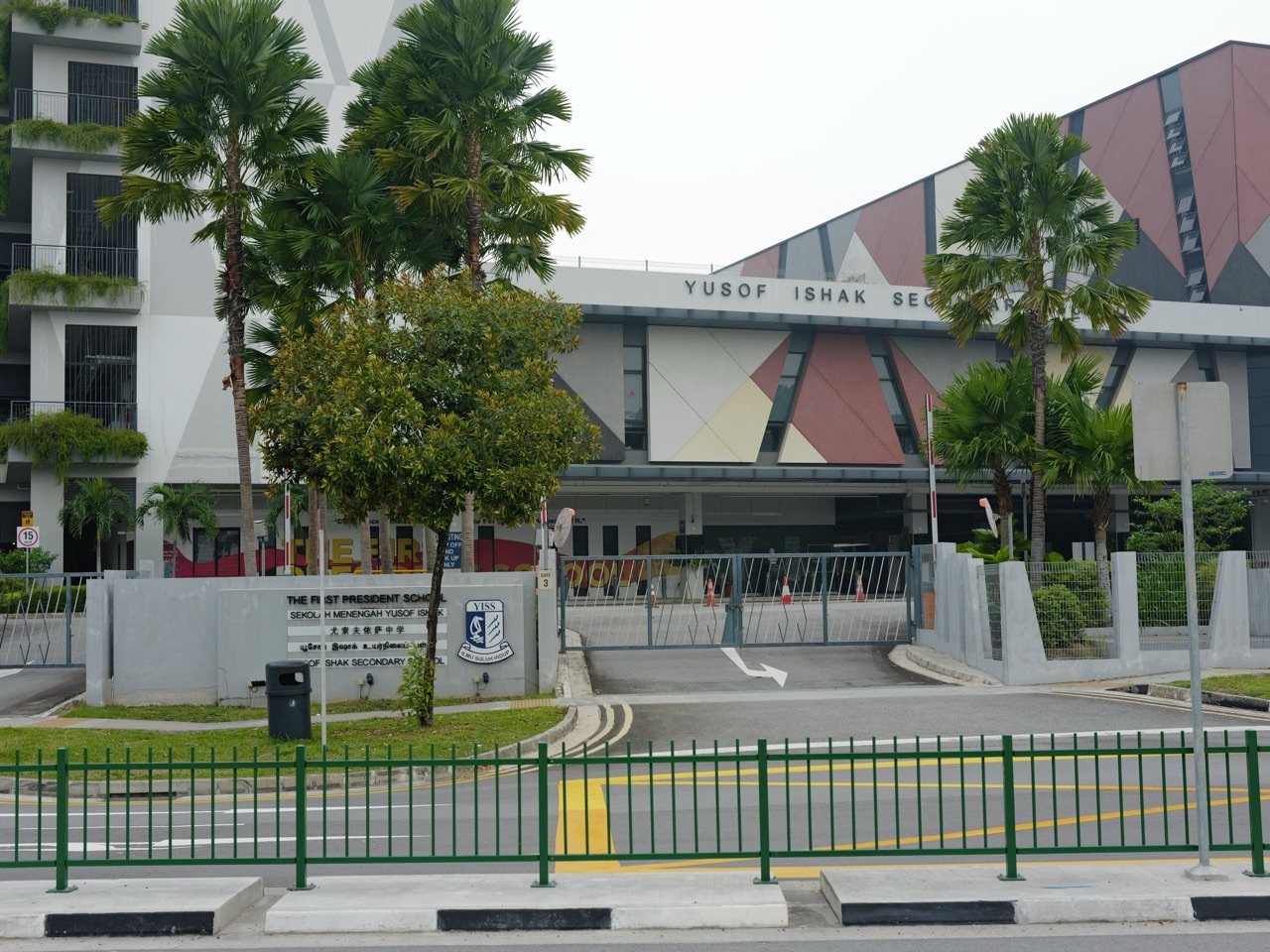
Local photograph: the main entrance to Yusof Ishak Secondary School in Punggol. The photograph shows the school exterior; it does not represent the school’s homework expectations, screen-use rules or timetable.
Choose your reading route
After-school order · Healthy screen use · Find the bottleneck
Article contents
Open sections 1–6
1. The afternoon starts before the homework reaches the table
2. What counts as homework, revision or extra tuition work?
3. Screen time is about purpose, boundaries and the child’s age
4. When the Student Learning Space helps—and when it does not
5. Make the Punggol neighbourhood part of a healthier evening
6. When homework takes the entire night, diagnose the hidden problem
Parents often measure an evening from the moment a workbook opens. But the child started much earlier: school assembly, lessons, recess, transitions, perhaps CCA, then travel. A student who arrives hungry and overstimulated may need a short reset before they can think clearly. That is not evidence of laziness.
Ask what happened between dismissal and arriving home. A student-care arrangement may provide supervised homework time; another child may complete work independently at home; a secondary student may need a break after late CCA dismissal. Treat these as different schedules rather than demanding one standard routine.
The goal is a predictable start. Put the school bag in its place, take care of meals and hygiene, check tomorrow’s timetable and decide the one task that cannot wait. Our Punggol school journey and after-school routine guide handles the travel half of that picture.
- Confirm the day’s actual dismissal and travel plan
- Leave a realistic interval for food and a short reset
- List school-assigned tasks separately from optional practice
- Choose the next task with the clearest deadline
- Reserve a definite time for winding down before bed
A school task has a purpose. It may check understanding, practise a method, prepare for a lesson or encourage independent reading. Revision is different: the student revisits material to make it easier to retrieve later. Tuition practice is different again: it should repair a diagnosed gap or develop a specific capability. Piling all three into one undifferentiated stack makes children feel that work never ends.
Ask the child to explain each item’s purpose. A Mathematics worksheet due tomorrow is a school obligation. Five extra pages chosen by a parent may be helpful, unnecessary or actively counterproductive depending on the child’s understanding and stamina. A learner who is repeatedly stuck may need an explanation before yet another question.
One helpful habit is to mark tasks ‘must submit’, ‘must understand’ and ‘can revisit’. This makes the workload intelligible. Parents should still follow school deadlines and provide needed support, but they can help the student see where real learning happens.
- Check the school task and due date before starting
- Distinguish assigned homework from voluntary revision
- Identify one topic that needs correction rather than more repetition
- Avoid quietly adding extra worksheets after the student completes the agreed plan
- Ask the teacher when tasks are consistently too difficult or unclear
Screens are tools, toys, social spaces and sometimes a source of difficulty. A blanket statement that ‘all screen time is bad’ misses the difference between learning a Science concept in SLS and scrolling for another hour after bedtime. The opposite mistake is treating every minute on a device as educational because a school account is logged in.
HealthHub’s Grow Well SG parent guidance recommends less than two hours of screen use for 7–12-year-olds apart from schoolwork. It also suggests agreed schedules, meals without screens, and avoiding screens in the hour before bedtime. That is national guidance for an age band, not a diagnosis of any individual child or a school-specific restriction.
For older students, discuss what they do online, what needs to be done offline, how they judge information and how they recover attention after entertainment. Set limits together and follow through consistently. A useful screen plan leaves space for reading, movement, hobbies, conversation and sleep—without turning every interaction into a battle.
- Differentiate school-required digital work from entertainment
- Set age-appropriate, explicit limits for recreational use
- Keep mealtimes and the pre-bed wind-down protected
- Ask what the student is actually doing online, not only how long
- Model the same attention and courtesy expected from children
SLS can provide a structured place for teacher-assigned activities, videos, readings or questions. But opening a lesson is not equivalent to learning it. Students still have to understand instructions, attempt tasks, notice feedback and ask questions when they are stuck. That principle does not change because the work is digital.
Parents can support digital independence with one simple sequence: locate the assigned work, check the due date, complete it without unrelated tabs, review feedback and close the task appropriately. If a platform or device fails, communicate through the school’s recommended support path rather than quietly guessing that the assignment is optional.
Our Punggol personal learning devices and digital homework guide deals more directly with device management and school digital work. Here we are answering a different question: how does that work fit into the hours after a real school day?
- Open the actual assignment, not just the platform homepage
- Read the instructions and deadline before clicking through
- Attempt rather than immediately searching for answers
- Check submission and feedback
- Seek help through the correct school channel when access or understanding fails
A sensible after-school routine does not need expensive enrichment at every turn. A family walk, a library visit, shared reading, a simple kitchen task or age-appropriate play can all provide something that another hour of scrolling does not. Activities near home are especially useful when school travel has already consumed a large part of the day.
Punggol Waterway Park and the One Punggol community environment offer ideas for families, but check current access, conditions and child supervision needs. The aim is not to turn every walk into a compulsory Science activity. Sometimes looking at the water, talking about the day and returning home satisfied is enough.
When a child does want a purposeful activity, the One Punggol Library guide and Waterway Park student-life guide offer ways to connect curiosity with the place where the child lives.
- Choose accessible, appropriate activities that do not add exhausting travel
- Leave room for unstructured play and conversation
- Use books and offline interests to supplement digital learning
- Check current operating conditions for any public facility
- Make recovery an ordinary part of the week, not something students must earn
A homework session can run long for several reasons, and the remedies are different. The student may not understand the concept, may work very slowly, may be distracted, may be perfectionistic, may be avoiding an intimidating task or may have more assignments than the available evening allows. Calling every case a ‘time-management problem’ hides what needs to change.
Ask the student to show where the work stopped. Could they begin the Mathematics question? Did they understand the Science vocabulary? Were they able to recall evidence for English comprehension? Did the problem occur before the first line, in the middle of the working, or while checking? A good response depends on the location of that break.
If schoolwork regularly feels unmanageable, speak with the teacher about what is being assigned and what support may help. Where focused tuition is appropriate, eduKate’s three-student small groups begin from the actual gap, not a promise to fill every hour. Good learning should compress the time it takes to understand, not permanently expand the workday.
Frequently asked questions
How much recreational screen time is advised for a Punggol Primary 3 child?
For children aged 7–12, Singapore HealthHub recommends less than two hours of screen use a day, excluding schoolwork. It also advises avoiding screens during meals and for one hour before bedtime.
Does homework on SLS count as recreational screen time?
School-related screen use is treated separately in the cited HealthHub 7–12 recommendation. It still needs appropriate breaks, attention and supervision, and schools determine the actual assigned tasks.
What if homework always takes my child three hours?
Check what was assigned and identify the bottleneck: missing understanding, slow working, distraction, unclear instructions or workload. Contact the teacher if it is persistent before responding with more practice.
Explore the Punggol learning series
Read Punggol digital homework, exam-week sleep and recovery, One Punggol Library, and student care and afternoons. Explore eduKate Punggol when there is a specific learning gap worth addressing.
Sources and accuracy notes
- HealthHub Grow Well SG: Nurturing Healthy Behaviours — MOH guidance for 7–12-year-old screen use and balanced daily routines.
- HealthHub Grow Well SG: Healthy Screen Habits — practical screen-free family activities and device-use planning.
- MOE Committee of Supply 2025 Announcements — Parenting for Wellness resources for families and digital-age parenting.
- Oasis Primary School Assessment Information — local example of assessment and ongoing classwork checks, not a prescribed homework duration.
Independent eduKateSG parent guide. This page is not issued by or affiliated with any named school. School policies and staff instructions take precedence over general advice; confirm them through official school channels. Photographs are exterior illustrations and do not show the activities or conditions described.